B6: Vertebral Column
 Call Kai
 Learn
Learn Practice Test
 Spaced Repetition
 Match
Match Flashcards
 Knowt Play
1/59

There's no tags or description
Looks like no tags are added yet.
Name | Mastery | Learn | Test | Matching | Spaced | Call with Kai | Chat |
|---|
No analytics yet
Send a link to your students to track their progress
60 Terms
vertebral column: definition and functions
DEFINITION: the
posterior portions of the trunk
FUNCTIONS:
Posture
Support of weight
Protection for the spinal cord and spinal nerves
Partial protection for thoracic and abdominal organs

What types of bones are in the vertebral column and how many in each?
There are three types of bones:
1. 24 moveable presacral vertebrae
7 cervical
12 thoracic
5 lumbar
2. Sacrum -
which is 5 fused vertebrae
3. Coccyx -
which is 4 fused vertebrae
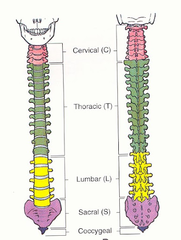
Intervertebral disc
fibrocartilaginous structures found between the bodies of adjacent vertebrae

Total number of bones (BEFORE fusion of the sacrum and coccyx) is
33
Total number of bones (AFTER fusion of the sacrum and coccyx) is
26...
24 pre-sacral vertebrae
1 sacrum
1coccyx
Fetal Curvature
In the fetus, the vertebral column exhibits one curvature, which is concave anteriorly.
This curvature is referred to as the
PRIMARY CURVATURE.
This curve is a result of differences in the height between the anterior and posterior aspects of the vertebral bodies.
(IMAGE ON THE RIGHT)

adult curvature
In the adult, the vertebral column exhibits 4 curvatures
Cervical (secondary)
Thoracic (primary)
Lumbar
(secondary)
Sacral (primary)

primary curvatures
concave anterior
The spinal curvatures present at birth; thoracic and sacral curvatures
Result of differences in the height between the anterior and posterior aspects of the vertebral bodies

secondary curvatures
concave posterior and due to differences in the heights between the anterior and posterior aspects of the intervertebral discs.
The cervical and lumbar exhibit a curve which is not primary, but rather have a curve which is classified as a secondary curvature

kyphosis
increased curvature of the thoracic region of the vertebral column, leading to a humpback posture; also called hunchback

lordosis
abnormal anterior (secondary) curvature of the lumbar spine (sway-back condition)

scoliosis
abnormal lateral curvature of the spine

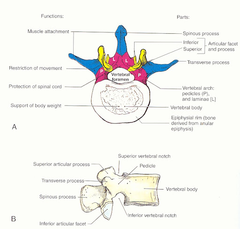
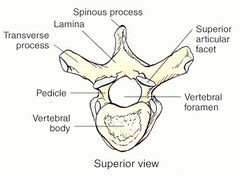
typical vertebrae: body
the large round mass of the vertebra. It forms the anterior aspect of the vertebra.

typical vertebrae: vertebral arch
posterior to the body lies an arch of bone which is formed by two pedicles and two laminae.

typical vertebrae: pedicle
a bridge of bone extending from the posterior aspect of the body
'LITTLE FEET'

typical vertebrae: lamina
a flat plate of bone extending from the pedicle. The two laminae fuse with each other in the median plane.
'THIN PLATE'

typical vertebrae: vertebral foramen
the hole in the center of the vertebra which houses the spinal cord.

boundaries of the vertebral foramen
anterior - body
posterior - laminae
lateral- pedicles
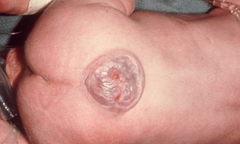
spina bifida cystica
Sometimes vertebral arch doesn't close and this happens - exposure of the nervous system tissue
How is this prevented? Folic acid taken before and during pregnancy
How many processes come off the vertebral arch?
7! (think of how many days there are in a week)
one spinous process (posteroinferior), two transverse processes (posterolateral), and four articular processes.
vertebral processes serve as attachment points for ligaments and back muscles.
typical vertebrae: spinous process
a single process the projects posteriorly from each vertebral arch at the junction of the two laminae.

typical vertebrae: transverse process
wo
processes that project laterally from the junction of a lamina and a pedicle

typical vertebrae: superior articular processes
two processes that project posterior to the transverse processes, which articulate with the superjacent vertebra.

typical vertebrae: inferior articular processes
two processes that project inferiorly, posterior to the transverse process, which articulate with the infrajacent vertebra

The inferior articular process of T3 would articles with _______
the superior articular process of T4
typical vertebrae: vertebral notches
notches on the superior and inferior surface of the pedicle.
When two vertebrae are articulated the notches form a foramen called the INTERVERTEBRAL FORAMEN. The intervertebral foramen transmits the SPINAL NERVE
Intervertebral foramen
Opening formed by the inferior and superior notches on the pedicles of adjacent vertebrae. Allows passage of spinal nerves and vessels.

Spinal Nerve
a nerve that emerges from the spinal cord and is located in the intervertebral foramen
Cervical vertebrae unique components
Has transverse foramen, bifid spinous process and bifid transverse processes

cervical vertebrae: transverse foramen
On the transverse process. The Vertebral artery passes through from C6-C1.

cervical vertebrae: bifid spinous process
divides into 2 smaller projections

cervical vertebrae: bifid transverse processes
divides into 2 projections:
anterior and posterior tubercles

cervical vertebrae bones and how many?
7
CV 1 - ATLAS
CV 2 - AXIS
CV 3 - CV 6
CV 7 - VERTEBRAL PROMINENS
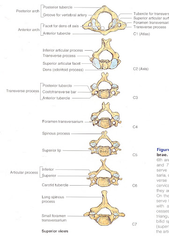
ATLAS a.k.a
C1
AXIS a.k.a
C2
VERTEBRA PROMINENS a.k.a
C7
cervical vertebrae: CV1 ATLAS
from Gk. Atlao = endure or sustain; to bear, carry
there is no body. It is replaced by the dens of CV2
there are no lamina or spinous process. They are replaced by an arch of bone, the POSTERIOR ARCH
the superior articular processes are concave for articulation with the occipital condyles

cervical vertebrae: CV2 AXIS
from L. Axis = an axle or pivot
a prominent superior projection, the DENS PROCESS (or odontoid process ), extends to the atlas

CV7 (Vertebra prominens)
has the longest, most prominent spinous process which does not bifurcate. It is important in counting vertebrae.
Transverse foramen is smaller relative to other cervical vertebrae.
b. Only the vertebralvein passes through, not the vertebral artery.

cervical vertebrae, vertebral artery and vein
notice how only the vertebral vein goes through c7 and that is why it has a smaller transverse foramen

thoracic vertebrae
there are TRANSVERSE COSTAL FACETS on the transverse processes for articulation with the ribs (12 thoracic vertebrae, 12 pairs of ribs)
there are no foramina in the transverse processes
thoracic vertebrae and rib contacts include:
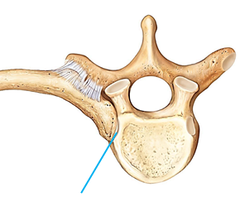
Costovertebral joint: head of rib
contacts the body of the vertebrae.
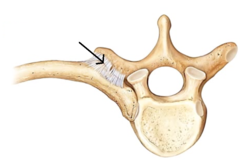
Costotransverse joint: tubercle of rib
contacts transverse process of vertebrae

costovertebral joint
head of rib articulates with demifacet on vertebral body
costotransverse joint
Tubercle of rib articulates with transverse process
lumbar vertebrae
there are no foramina in the transverse processes
there are no facets
on the transverse processes
largest size
the spinous processes are quadrangular

why is the lumbar vertebrae largest in size?
1. In general, the presacral vertebrae increase in size going superior to inferior.
2. The reason is that each successive vertebra must support all the structures superior to it.
3. After the weight has been transmitted to the pelvis and lower limbs in the lumbo - sacral region the vertebrae inferior to this region do not support the body weight.
4. The size of the sacrum and coccygeal vertebrae decreases going inferiorly.

The size of the sacrum and coccygeal vertebrae ___________ going inferiorly.
decreases
sacrum
5 fused vertebrae

sacrum superior articulation
the intervertebral disc inferior to LV5
sacrum lateral articulation
the ALA of the sacrum articulates with the ilium of the hip bone
ALA means wing .Auricular surface - a smooth surface on the lateral portion of the ala. it forms the sacro-iliac (SI) joint with the ilium

sacrum inferior articulation
the coccyx

the sacrum has two surfaces
pelvic and dorsal
pelvic surface of sacrum
concave anterior surface
PELVIC SACRAL
FORAMINA: four pairs of openings for
the ventral rami S1- S4
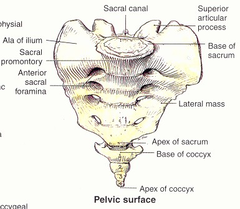
pelvic sacral foramina
four pairs of openings for
the ventral rami S1- S4
dorsal surface of sacrum
the posterior aspect of the bony sacrum
MEDIAN SACRAL CREST:
ridge representing the spinous processes of the superior 3 to SV.
DORSAL SACRAL
FORAMINA: four pairs of foramina for the dorsal rami S1 S4.
SACRAL HIATUS:an opening due to the absence of lamina on the 5th sacral segment

median sacral crest
ridge representing the spinous processes of the superior 3 to SV.

dorsal sacral foramina
four pairs of foramina for the dorsal rami S1 S4.

sacral hiatus
an opening due to the absence of lamina on the 5th sacral segment.

coccyx
4 fused vertebrae

auricular surface
region on the ilium for articulation with the sacrum
