week 9, Interpreting Data from Small Scale Experiments to National and International Studies
 Call Kai
 Learn
 Practice Test
 Spaced Repetition
 Match
 Flashcards
 Knowt Play
1/25

Earn XP
Description and Tags
Flashcards covering research measurement methodologies, measurement scales, reliability and validity, body composition techniques, physical activity guidelines, and national epidemiological databases.
26 Terms
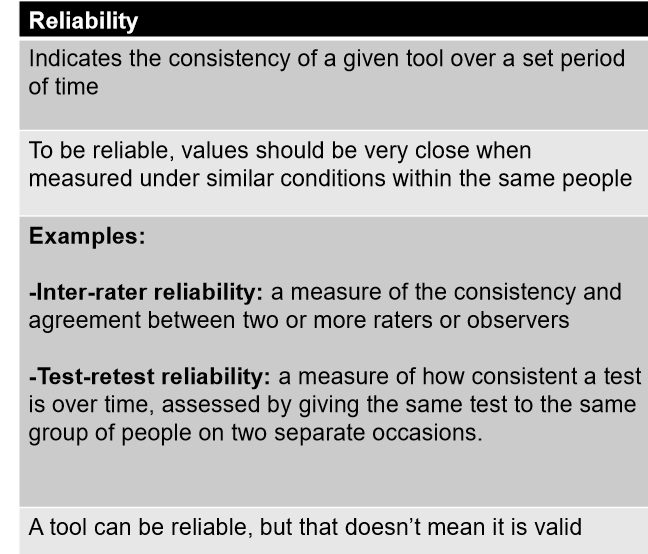
Reliability
The consistency of a given measurement tool over a set period of time, demonstrated when values are very close when measured under similar conditions within the same individuals.
Validity
The ability of a given measurement tool to measure what it is intended to measure, typically determined by comparing the tool against a 'gold standard' assessment.

Inter-rater reliability
A measure of consistency and agreement between two or more independent raters or observers evaluating the same phenomenon.
Test-retest reliability
A measure of how consistent a test is over time, assessed by administering the identical test to the same group of people on two separate occasions.
Content and construct validity
The extent to which a test covers the domain of content it is designed to cover and accurately assesses specific conceptual constructs that may not be directly observable or measurable.
Criterion validity
How well the results of a test compare to, correlate with, or predict the measurement of a recognized gold standard measure of a similar outcome.
hand grip test pros ad cons

Body Mass Index (BMI)
An anthropometric calculation defined as body mass in kilograms divided by height in meters squared ([Height (m)]2Weight (kg)), used widely to classify underweight, healthy weight, overweight, and obesity.
Asian heritage BMI cut-offs
Specific ethnic BMI cut-offs where overweight is classified as 23.0–27.49kg/m2 and obesity is classified as ≥27.5kg/m2, lower than standard European thresholds due to higher health risk at lower BMI levels.
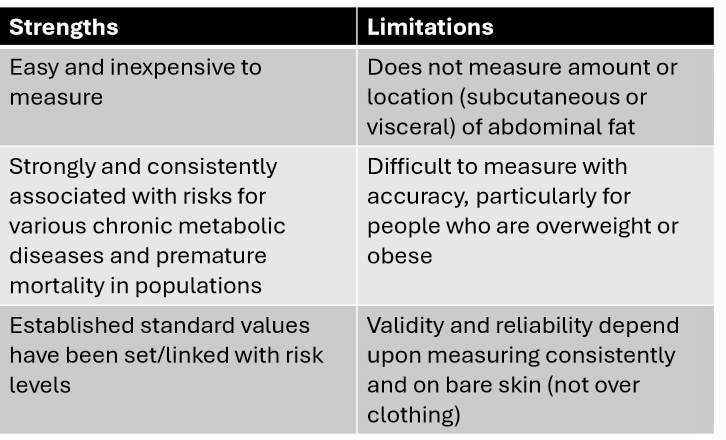
pros and cons of BMI

Waist circumference risk thresholds
Established clinical cut-off values indicating higher metabolic risk: ≥102cm (≥40in) in men and ≥88cm (≥35in) in women.
Waist to Hip Ratio (WHR) high risk thresholds
Established circumference ratio thresholds associated with high health risk: ≥1.0 for men and ≥0.86 for women.
pros and cons of waist and hip circumference measurement

Dual-energy X-ray absorptiometry (DEXA)
A machine-based body composition assessment based on the attenuation of X-rays through tissues of differing chemical composition and density, measuring areal bone mineral density (g/cm2), fat mass (g), and bone-free lean mass (g).

Air displacement plethysmography (ADP)
A machine-based densitometric method (e.g., Bod Pod) that determines body volume and body density by measuring changes in air volume within a sealed dual-chamber system containing the participant.

Bioelectrical Impedance Analysis (BIA)
A body composition measurement technique based on the principle that body fat is a relatively nonconductive electrical tissue compared to water and lean mass, assessing opposition to a weak electric current passed through electrodes.
Metabolic Equivalent of Task (MET)
A physiological measure expressing the energy cost of physical activity as a multiple of the resting metabolic rate; equivalent to 3.5mL O2kg−1min−1 or 1kcalkg−1hr−1.
Physical activity
Any bodily movement produced by skeletal muscles that results in energy expenditure; encompasses leisure-time, occupational, domestic, and commuting activities.
Exercise
A subcategory of physical activity that is planned, structured, repetitive, and purposeful, undertaken specifically to improve or maintain physical fitness, sports performance, or health.
Sedentary behaviour
Waking behaviors undertaken in a sitting or reclining posture characterized by low energy expenditure.
WHO Adult Aerobic Physical Activity Guidelines
Recommendation that adults aged 18–64 years perform at least 150–300 minutes of moderate-intensity aerobic activity, at least 75–150 minutes of vigorous-intensity aerobic activity, or an equivalent combination per week.

Short Physical Performance Battery (SPPB) and give pros and cons
A standardized clinical test evaluating lower-body physical function in older adults out of 12 total points, combining side-by-side/semi-tandem/tandem balance tests, a 3-meter gait speed test, and a five-repetition chair stand test.

UK Biobank
A large-scale national biomedical database and research resource containing in-depth genetic and health information from 500,000 UK participants, accessible to approved researchers worldwide.
Women's Health Initiative (WHI)
A major 30+ year US National Institutes of Health study initiated between 1993 and 1998 enrolling 161,808 postmenopausal women aged 50–79 years, featuring randomized controlled trials and an observational study.
Handgrip strength (as a vital sign)
A simple, non-invasive metric of upper-extremity muscle function and overall physical capability that serves as a central biomarker of frailty, sarcopenia, future morbidity, and all-cause mortality.
International Physical Activity Questionnaire (IPAQ)
A standardized self-report questionnaire assessing physical activity across walking, moderate, and vigorous intensity domains over the previous 7 days, quantified in MET-minutes/week.