Computer architecture
 Call Kai
 Learn
 Practice Test
 Spaced Repetition
 Match
 Flashcards
 Knowt Play
1/6

There's no tags or description
Looks like no tags are added yet.
7 Terms
Modified Harvard Architecture
Looks like Von Neumann to users
Either:
Same memory for data + instr but split cache
or data stored as instructions, loaded into data memory when program starts
MIPS
Millions of instructions per second. This is different from clock rate because instructions can be varying lengths and use multiple clock cycles.
MIPS is a way of measuring how much you can get out of a clock cycle e.g. how much donuts you get out of a dollar.
FLOPS
Floating point operations per second
Moore’s Law
Transistor density doubles every two years.
Outdated law - harder to make smaller transistors these days.
Dennard scaling
Smaller transistors use less power so we can have more of the smaller transistors and use roughly the same amount of power.
Outdated - hard to reduce voltage further, end to dennard scaling
Modern solutions
Can’t increase clock speed further due to end of moores law and dennard scaling, so instead:
Multi-core computers
Clustering - many computers connected by a high speed network (only improves efficiency if application can be decomposed to be ran in parallel)
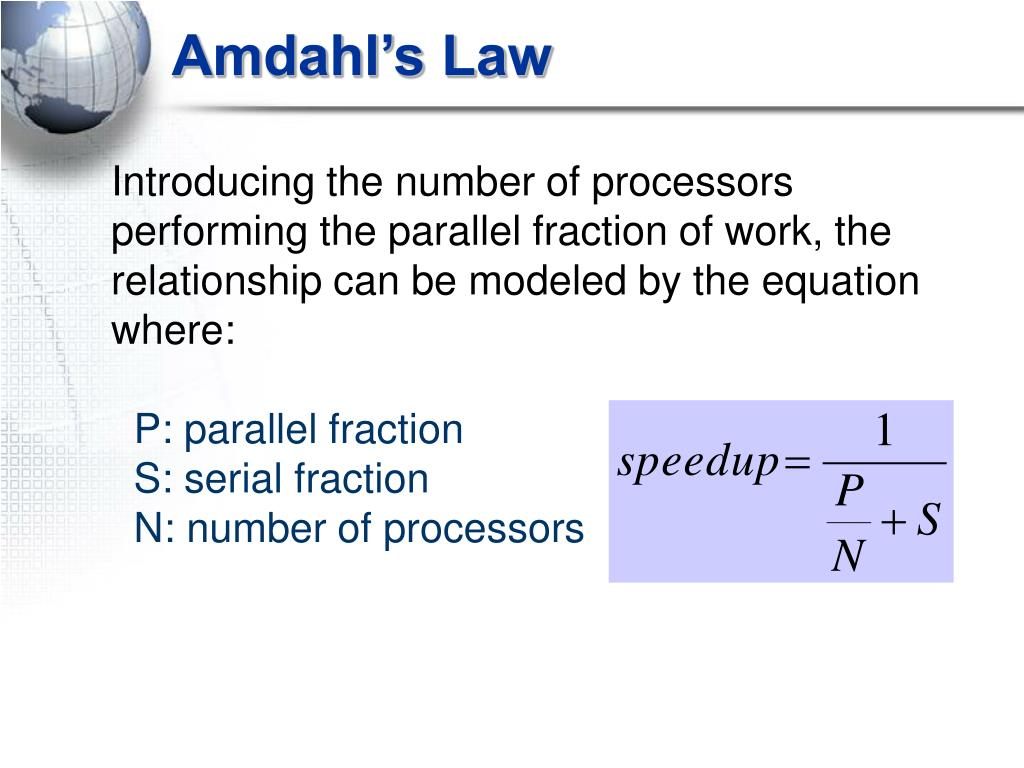
Amdahl’s Law
Formula that shows overall expected performance improvement by optimising a single part (e.g. parallelising a part)
S = 1 - P