Order Diptera wings
 Call Kai
 Learn
 Practice Test
 Spaced Repetition
 Match
 Flashcards
 Knowt Play
1/54

There's no tags or description
Looks like no tags are added yet.
55 Terms

Biting midge (Culicoides)
Black fly (Simulium)
Sand fly/Moth fly (Psychodidae)
SUBORDER: Nematocera
SUBORDER: Brachycera; FAMILY: Tabanidae
SUBORDER: Brachycera; FAMILY: […]
SUBORDER: Brachycera; FAMILY: Tabanidae
SUBORDER: [….]; FAMILY: Tabanidae
Horse fly (Tabanus)
Deer fly (Chrysops)
Cleg fly (Haematopota)
SUBORDER: Brachycera; FAMILY: Tabanidae
spcies
SUBORDER: Cyclorrhapha
FAMILY: Glossinidae
SUBORDER: […]
FAMILY: Glossinidae
SUBORDER: Cyclorrhapha
FAMILY: Glossinidae, Muscidae, Calliphoridae, Drosophilidae, Tephritidae, Syrphidae
SUBORDER: Cyclorrhapha
FAMILY: [..]
Tsetse fly (glossina)
Glossinidae animals?
Flies
Muscidae animals?
Blow flies
Calliphoridae animals?
Fruit fly
Drosophilidae animals?
True fruit flies
Tephritidae animals?
hoverflies or flower flies
Syrphidae animals?
Tsetse fly (glossina)
SUBORDER: Cyclorrhapha
FAMILY: Glossinidae
species
House fly (Musca)
Stable fly (Stomoxys)
Horn fly (Haematobia)
Lesser House Fly, Latrine Fly (Fannia)
Phaonia
SUBORDER: Cyclorrhapha
FAMILY: Muscidae
species
Fruit fly (Drosophila melanogaster)
SUBORDER: Cyclorrhapha
FAMILY: Drosophilidae
species
[Cyclorrhapha, Drosophilidae] Drosophila melanogaster
fruit fly
sci name
Bactrocera
SUBORDER: Cyclorrhapha
FAMILY: Tephritidae (True Fruit flies)
species
Allograpta
SUBORDER: Cyclorrhapha
FAMILY: Syrphidae (Hoverflies or flower flies)
species
Nematocera
Brachycera
Cyclorrapha
List all the suborders under order diptera
[Nematocera] Biting midge (Culicoides)
Small wing with light and dark spots; 2 radial cells
[Nematocera] Black fly (Simulium)
broad wing; thick front veins, the rest faint; no scales
[Nematocera] Sand fly/Moth fly (Psychodidae)
leaf-shaped, hairy; many straight parallel veins, almost no crossveins; held up in a V (sand fly) or roof-like (moth fly)
[brachycera, tabanidae] Horse fly (Tabanus)
veins R4 and R5 form a wide Y-fork around the wing tip; large discal cell. Chrysops has a dark crossband; Haematopota has mottled wings
[brachycera, tabanidae] Deer fly (Chrysops)
veins R4 and R5 form a wide Y-fork around the wing tip; dark crossband.
[brachycera, tabanidae] Cleg fly (Haematopota)
Veins R4 and R5 form a wide Y-fork around the wing tip; mottled wings.
[cyclorrhapha, glossinidae] Tsetse fly (Glossina)
"Hatchet" (cleaver) cell: the discal cell is shaped like an axe; at rest, the wings fold flat over each other like closed scissors.
[cyclorrhapha, muscidae] House fly (Musca)
vein M1+2 bends sharply forward toward R4+5, narrowing cell r5 at the tip
[cyclorrhapha, muscidae] Stable fly (Stomoxys)
vein M1+2 curves gently forward; cell r5 stays open
[cyclorrhapha, muscidae] Horn fly (Haematobia)
Vein M1+2 runs almost straight to the edge, curving only very slightly forward, and ends just behind the wing tip
[cyclorrhapha, muscidae] Lesser House Fly, Latrine Fly (Fannia)
vein M1+2 runs completely straight to the wing edge (no bend at all), so cell r5 stays wide open. Key clue at the back of the wing: the short anal vein (A1) and the next vein (A2) curve toward each other, so if you extended them they would meet before the wing edge.
[cyclorrhapha, Calliphoridae] Blue bottle fly (Calliphora)
M1+2 has a sharp bend, like Musca. The stem vein (the base of R) has bristles. Calypters are dark. Blue abdomen.
[cyclorrhapha, Calliphoridae] Green bottle fly (Lucilia)
— Same bent wing with a bristly stem vein. Calypters are pale. Metallic green body.
[cyclorrhapha, Calliphoridae] Black blow fly (Phormia)
— Same bent wing. Black-blue body with orange hairs
[cyclorrhapha, Drosophilidae] Fruit fly (Drosophila melanogaster)
— Tiny with red eyes. The costa is broken twice near the base. The veins are simple, with no bend.
[cyclorrhapha, Tephritidae] Bactrocera
— Patterned wing. The subcosta bends sharply forward and fades out. A cell near the base at the back has a long pointed lobe.
[cyclorrhapha, Syrphidae] Allograpta
— A spurious vein, a faint false vein through the middle of the wing. The veins form a false margin along the edge.
Body: yellow-and-black banded, like a wasp, but with only one pair of wings.
SUBORDER: Nematocera
Biting midge (Culicoides)
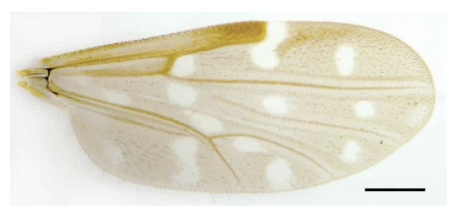
SUBORDER: Nematocera
Black fly (Simulium)

SUBORDER: Nematocera
Sand fly/Moth fly (Psychodidae)

[brachycera, tabanidae] Horse fly (Tabanus)
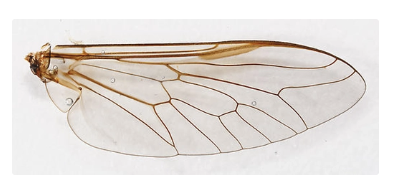
[brachycera, tabanidae] Deer fly (Chrysops)

[brachycera, tabanidae] Cleg fly (Haematopota)

[cyclorrhapha, glossinidae] Tsetse fly (Glossina)

[cyclorrhapha, muscidae] House fly (Musca)
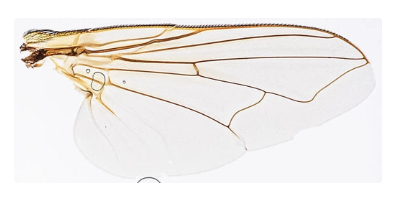
[cyclorrhapha, muscidae] Stable fly (Stomoxys)

[cyclorrhapha, muscidae] Horn fly (Haematobia)

[cyclorrhapha, muscidae] Lesser House Fly, Latrine Fly (Fannia)

[cyclorrhapha, muscidae] Phaonia

[cyclorrhapha, Calliphoridae] Blue bottle fly (Calliphora)

[cyclorrhapha, Calliphoridae] Green bottle fly (Lucilia)

[cyclorrhapha, Calliphoridae] Black blow fly (Phormia)

[cyclorrhapha, Drosophilidae] Fruit fly (Drosophila melanogaster)

[cyclorrhapha, Tephritidae] Bactrocera

[cyclorrhapha, Syrphidae] Allograpta
