chapter two - chemical context of life
 Call Kai
 Learn
 Practice Test
 Spaced Repetition
 Match
 Flashcards
 Knowt Play
1/47

Earn XP
48 Terms
matter
anything that takes up space and has mass, chemical elements in pure and compound form
matter example
air
element
substance that can not be broken down into other substances by chemical reactions
element example
sodium
compound
substance with two or more different elements in fixed ratio, combination of atoms
compound example
sodium chloride
what four elements make up 96% of all living matter?
cabron
hydrogen
nitrogen
oxygen
essential element
20 to 25% of the 92 natural elements that are needed by organisms to live a healthy life and reproduce and are similar among organism
trace element
element required by an organism in a fraction of qualities
neutron
relevant subatomic particle that has no electric charge, part of atom
proton
relevant subatomic particle that has a pos charge, part of atom
electron
relevant subatomic particle that has a neg charge, part of atom
atomic number
protons in an element’s nucleus
atomic mass
atom’s total mass that can be approximated by the mass number; protons, electrons and neutrons
isotope
2 atoms of an element that differ in number of neutrons
energy level, electron shell
electron’s state of potential energy
electron shell
energy level, electron’s state of potential energy
energy
capacity to cause change
what subatomic particle is directly involved in the chemical reactions between atoms?
electron
potential energy
energy that matter has bc of its location and structure
does a boy at the top or bottom of a slide have more potential energy? explain
the boy at the top of a slide because he has magnitude and will use energy to get down causing him to have less at the bottom
does an electron in the first or third energy shell have more potential energy? explain
third bc there is more distance from the nucleus allowing there to be more energy required to pull it to the positive nucleus
does water or glucose have more potential energy? explain
glucose because it has more energy in its more chemical bonds
what determines the chemical behavior of an atom?
valence electron
molecule
two or more of the same or different atoms or elements held together by covalent bonds
double covalent bond
sharing of two pairs of valence electrons
what type of bond is seen in O2.
double covalent bond
electronegativity
atom’s attraction for electrons
what happens in a polar covalent bond?
atom’s do not share electrons equally. one atom has more electronegativity. this causes a partial positive or negative charge for each atom or molecule
what happens in a nonpolar covalent bond?
atoms share electrons equally
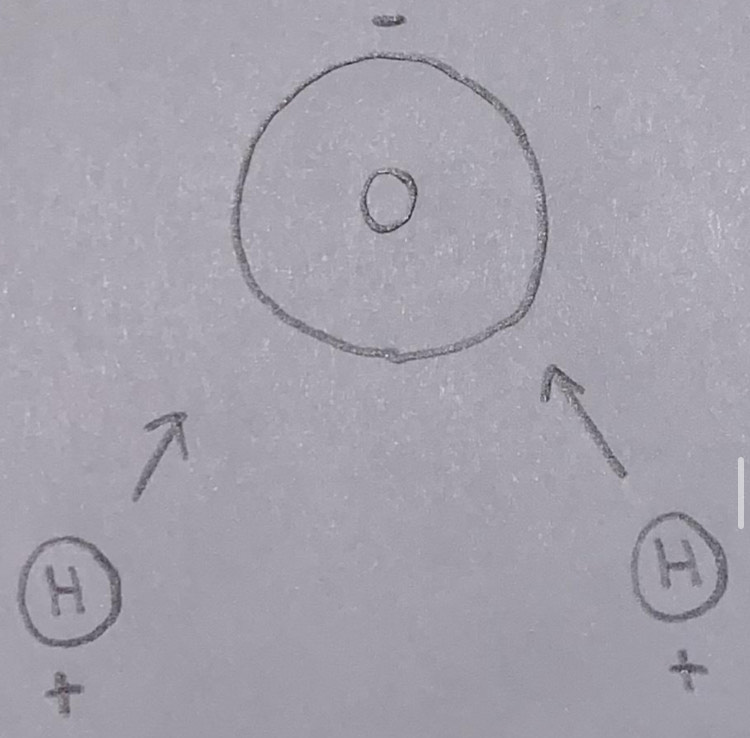
what element in water is the most electronegative?
O
what makes a molecule polar?
one element is more electronegative than the other making it so the electrons are not shared equally
polar molecule example
water
what happens with an ionic bond?
atom is stripping an electron from their bonding partner making the atoms ions
ion
charged atom or molecule
ionic bond
attraction between opposite ions that have or have not formed from a transfer of electrons between atoms, attraction between cation and anion
anion
negatively charged ion
anion example
chloride
cation
positively charged ion
hydrogen bond
weak chemical bond, hydrogen atom bonded to two electronegative atoms, dotted line
what do hydrogen bonds do?
reinforces the shape of large molecules and helps molecules adhere to each other
explain van der waals interaction
if electrons are distributed unequally in molecules or atoms they can result in hot spots of positive or negative charge. they are between molecules that are close together as a result of these charges. they are weak attractions
van der waal example
allows gecko to stick to things due to large amounts
what is the order of bonds in decreasing strength?
covalent
ionic
hydrogen
van der waals interaction
molecular shape importance example
opiates are drugs that relieve pain and alter mood by weakly bonding to specific receptor molecules on the surface of brain cells. endorphins are signaling molecules made by the pituitary gland that bind to the same receptors to relieve pain and produce endorphins during times of stress such as an intense exercise. they both have similar shapes which is why they have similar effects
photosynthesis chemical shorthand equation
6CO2 +6H2O →sunlight→C6H12O6 + 6O2
what happens with dynamic equilibrium?
reactions are still going on in both directions but with no effect on the concentration
does dynamic equilibrium imply equal concentrations of each reactant and product?
no