Ch 3: cost method
 Call Kai
 Learn
 Practice Test
 Spaced Repetition
 Match
 Flashcards
 Knowt Play
1/28

There's no tags or description
Looks like no tags are added yet.
29 Terms
Parent’s Ownership Accounting
The use of the Equity Method has been concentrated on as:
1. Consolidated Net Income will equal Parent Company’s pre-consolidation net income.
2. Consolidated Owner’s Equity will equal parent’s pre-consolidation owner’s equity.
Due to many of the complexities that we have already covered, you can see why many companies may opt to use the cost method for bookkeeping purposes. If the parent uses the cost method and converts to equity, there a lot of things that slip through the cracks so the accuracy of the consolidated financial statements might not be 100% reliable
Regardless of the bookkeeping approach chosen by the Parent, consolidated financial statements will look the same.
Post-Acquisition Consolidation Parent Uses the Cost Method
The consolidated financial statements will look the same, regardless of the pre-consolidation method of Equity Investment bookkeeping applied by the parent company. Its just about how we get there in the conversion
Because parent company’s pre-consolidation financial statements will be different under the cost method versus the equity method, the consolidation entries will (out of necessity) be slightly different. Not super different, only the ones that require you do go from cost to equity at the beginning of the year.
Cost Method for Equity Investment
Under the cost method, the Equity Investment balance always remains unchanged at its original acquisition-date amount.
Any dividends received by the parent are recorded as dividend income and thus included in Parent’s Retained Earnings

Its only when you do the conversion (does not the effect the actual accounts because its on the seperate workpapare)
equity inve - div - aap amort
Cost Method vs. Equity Method
Assumptions:
1.The parent purchases the subsidiary for $500,000 on January 1, 2022.
2.The subsidiary reports $100,000 of net income during 2022.
3.The subsidiary pays $20,000 of dividends to the parent during 2022.
4.The parent’s investment in the subsidiary includes AAP. During 2022, AAP amortization is $5,000.
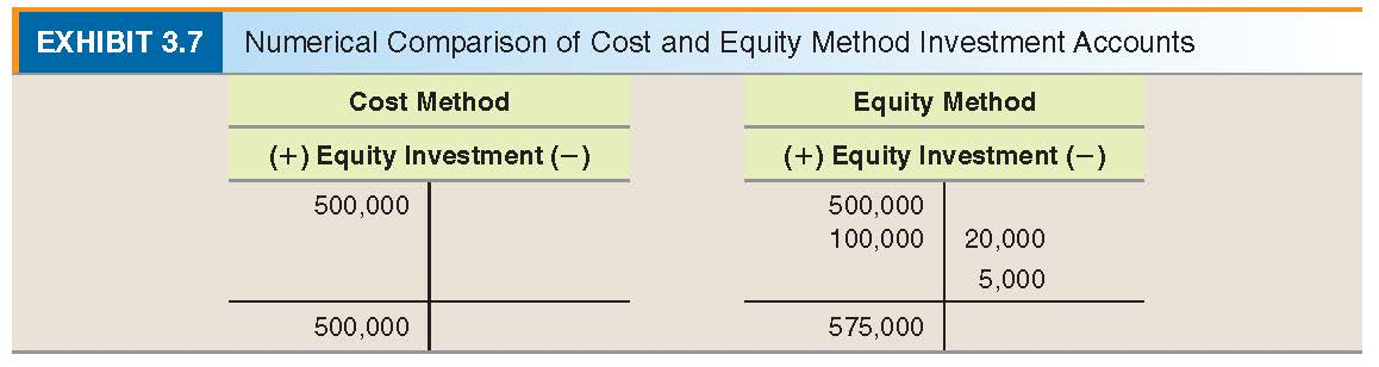
Cost Method vs Equity Method
Cost method: dividend income goes into retained earnings for the parent.
Under the equity method
The parent reports equity income of $100,000 - $5,000 (AAP adjustment) = $95,000
Under the cost method
The parent reports dividend income of $20,000
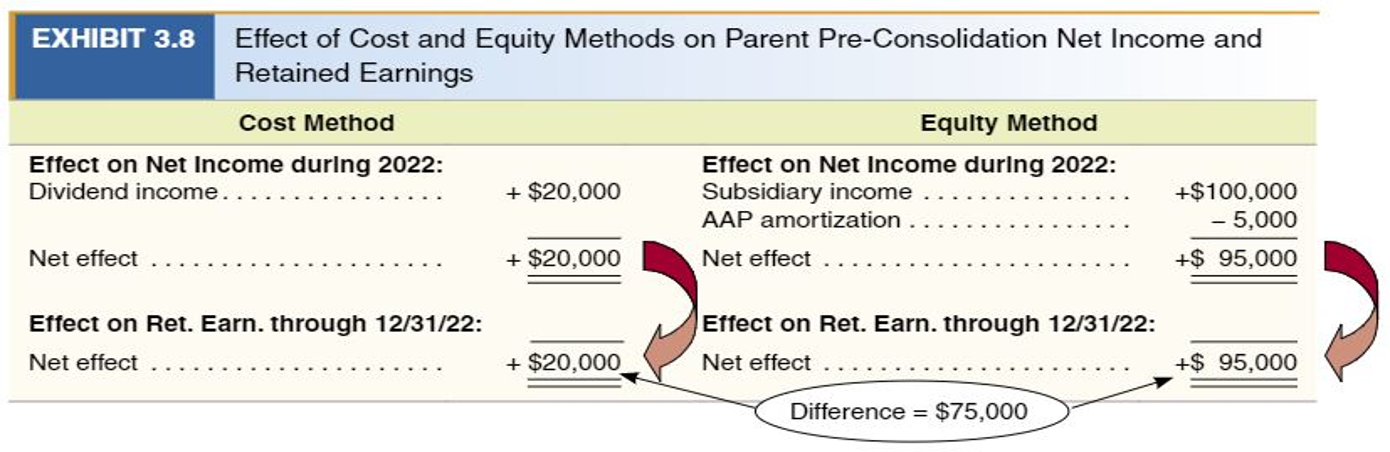
To convert from Cost to Equity:
Equity Investment $75,000
Retained Earnings (Parent) $75,000
To get rid of the income that hit retained earnings
Cost Method: Consolidation Process Subsequent to Acquisition

Entries [E], [A], [D], and [ I ] are identical to the equity method consolidation entries. This occurs because the consolidation entry [ADJ] causes the parent’s Equity Investment account and Retained Earnings account to equal their beginning of period balances as if the parent company always used the equity method.
[C] entry is changes made during the current year
The [ADJ] Entry
The [ADJ] entry: Will convert the Parent’s Equity Investment account and Retained Earnings to the Equity Method (assuming 100% ownership of subsidiary)
Retained Earnings of Subsidiary @ Beg. Of Year to be Consolidated
less Retained Earnings at Date of Acquisition
less AAP Amortization/Depreciation through Beg. Of Year to be Consolidated
This adjusts the Parent’s retained earnings to an as-if equity method or consolidated basis to provide consolidated financial statements. Adjustment is made only on the consolidated worksheet and not to the parent’s actual books. Only on workpaper. Never to the parents books
[Adj] Equity Investment(P) at Beg. Of Year
Retained Earnings(P) at Beg. Of Year
Accounting for Goodwill
ìGoodwill is an asset and must meet the conceptual definition of an asset in order to be recognized on the balance sheet.
1.Does the parent company control the Goodwill asset?
2.Will the Goodwill asset provide future benefits?
ìThe second question must be answered each year.
ìGoodwill must be tested annually for impairment and written down if impaired.
-The only way goodwill is changed is if it has impairement (test it annually)
Goodwill Amortization - Private Companies
The amortization of Goodwill depends on two factors:
1. Whether the acquiring company qualifies as a “private company” (i.e., entities that are not public business entities, not-for-profit entities, or employee benefit plans), and
2. Whether the acquiring (private) company elects to adopt the Goodwill amortization exception available to private companies.
Goodwill Amortization - Private Companiess
ìIf the acquiring company satisfies both of these conditions, then the acquiring company is required to amortize the Goodwill “on a straight-line basis over 10 years, or less than 10 years if the entity demonstrates that another useful life is more appropriate.” 10 Year write off of goodwill
ìHowever, if a private company attempts to transition to being a public business entity (e.g., by registering its common stock with the SEC and issuing the shares to investors via an Initial Public Offering), then the company will be required to retroactively restate its financial statements without the private-company exception included in the financial statements.
Goodwill - Public Companies
ì For public companies, Goodwill is not amortized like most identifiable intangible assets.
ìAlong with Goodwill, all indefinite-lived intangible assets must be evaluated, at least annually, for impairment.
ìFurther, companies must conduct this annual evaluation during the same time of year
Once you decide to test goodwill, it must be dont for the rest of the time
Impairment Journal Entry
ì “Impairment is the condition that exists when the carrying amount of a long-lived asset (asset group) exceeds its fair value.”
ìIf we test Goodwill for impairment and find it to be impaired, we must write it down with a journal entry similar to the following (assuming the parent uses the equity method):

The goodwill on the cosolidation workpaper has nothing to do with the goodwill on the standalone worksheets
Assigning Goodwill to Reporting Units
For the purpose of testing Goodwill for impairment, acquired assets and assumed liabilities must be assigned to individual reporting units as of the acquisition date if both
a.The asset will be employed in or the liability relates to the operations of a reporting unit, and
b.The asset or liability will be considered in determining the fair value of the reporting unit.
if you created goodwill, look at reporting unit as a whole to see if it has been impaired.Must have the tools to evaluate the reporting unit to see what its worth moving forward
After the identifiable assets and liabilities are assigned to the reporting unit, then the acquiring company must calculate the amount of Goodwill assigned to each reporting unit.
Goodwill Impairment Testing and Measurement
Companies are required to estimate the fair value of each of its reporting units in which Goodwill has been recorded.
The company compares the estimated fair value of each reporting unit to the recorded carrying value of each reporting unit (i.e., including goodwill).
What is the unit worth to me now?
If carrying value > fair value, then goodwill in the reporting unit is impaired.
If carrying value ≤ fair value, then goodwill in the reporting unit is not impaired.
Companies are required to test Goodwill for impairment every year.
Valuation processes is very costly and very time consuming
Goodwill Impairment Example
Assume:
The carrying value of the Equity Investment is $1,848,500.
The carrying value of Goodwill is $125,000.
The fair value of the reporting unit (the subsidiary) is $1,800,000.
The potential impairment is equal to the $48,500 difference between the fair value of the reporting unit and its carrying value.
The Goodwill balance is $125,000, so the impairment loss amount = $48,500
As a result of this computation, Goodwill must be written down with the following journal entry in the parent’s books:
Equity Income $48,500 (difference between the fv and carrying value)
Equity Investment $48,500
Causes goodwill to dropdown too so you have to write it down. You can never wirte goodwill back up
Bargain Purchase Accounting
A bargain acquisition is said to occur if the total fair value of the investee company is less than the acquisition-date amounts of the identifiable assets acquired and the liabilities assumed (i.e., the amount computed for Goodwill is negative). Create a gain that can only appear on parents books.
In that case, the investor recognizes the negative Goodwill as an ordinary gain in its income statement on the acquisition date.
Example of a Bargain Acquisition
Assume:
Purchase Price of Subsidiary is $200,000
Fair value of the sub’s net assets is $250,000
Bargain Purchase $ 50,000
Journal Entry at Acquisition on Parent’s Books
Equity Investment $250,000
Cash $200,000
Gain On Bargain Purchase 50,000
Gain will appear on Income Statement of Parent.
Consolidation Entries for Bargain Purchase
[E] Stockholder’s Equity (S) 100,000
Equity Investment 100,000
eliminates acquisition date Sub. Equity against investment account
[A] Net assets* 150,000
Equity Investment 150,000
eliminates remaining equity investment/ reclassifies AAP
* Broken into individual assets/liabilities
The net result is that the gain on the bargain acquisition is recognized in the consolidated income statement immediately upon acquisition.
Cost Method
Review of Post-Acquisition Consolidation
The consolidated financial statements will look the same, regardless of the pre-consolidation method of Equity Investment bookkeeping applied by the parent company.
Because parent company’s pre-consolidation financial statements will be different under the cost method versus the equity method, the consolidation entries will (out of necessity) be slightly different.
With respect to intercompany profits, the equity method accounting reflects the elimination in the pre-consolidation books, but cost method ignores the elimination in the pre-consolidation books.
Under the cost method, our [ADJ] entry will need to include adjustment for beginning-of-year pre-consolidation intercompany profits that were not removed.
Conversion from Cost to Equity with Intercompany Sale of Inventory
Original cost of Investment $550,000
Stockholder’s Equity of Sub at Acquisition Date $450,000
Increase in S retained earnings
Date of Acquisition to 12/31/21 $200,000
Original AAP Amount–(Building) $100,000
Book Value/Carrying Value of Building @ 1/1/22 $ 40,000
Annual amortization of AAP $20,000
Before considering intercompany sales of inventory, what would be the adjustment to the Equity Investment at 1/1/2022
Increase in Sub’s RE since acquisition to 12/31/21 $200,000
Less AAP amortization through 12/31/21 60,000
Net change in Equity Investment $140,000
Now let’s look at how this would be affected by the Intercompany sale of Inventory.
Deferred Intercompany Profit-Impact on
Cost Method on Sale Parent
Increase in Sub’s RE since acquisition to 12/31/21 $200,000
Less AAP amortization through 12/31/21 60,000
Net change in Equity Investment $140,000 Less Deferred Profit from 12/31/21 (12,000)
Cumulative understatement of Equity Investment
at 1/1/2022 $128,000
[ADJ] Equity Investment @ 1/1/22 128,000
Retained Earnings(P) @ 1/1/22 128,000

Sale of Non-Depreciable Asset by Parent under Cost Method
Parent sells a piece of land for $1,000 to the subsidiary; land cost $800. Parent reports a gain on its income statement.
Because the parent reports its equity investment using the cost method, parent will “correct” or i.e., defer the gain during the consolidation process.
In year of sale, the consolidation entry required is:
[I gain] DR Gain on sale 200
CR Land 200
This entry eliminates gain from consolidated income statement and thus retained earnings for consolidation purposes. Restates land to its original pre-sale amount for consolidation purposes.
Making it so that the land sale never occurs (because its going from one part of the company to another part of the same company (parent to sub)
Subsequent Years for Sale of Non-Depreciable Asset under Cost Method
Until the subsidiary sells the land to an unaffiliated party, the following entry is required each year during the consolidation process:
[ADJ] Retained Earnings (P) @ Beg. Of Year 200 Equity Investment@ Beg. Of Year 200 restates Equity from cost to “as if” equity method
Parent’s Retained Earnings are overstated at end of year asset is sold-corrects consolidate RE
[Igain] Equity Investment 200 Land 200 defers gain on sale and restate land account to pre-sale reported amount
Sale of Non-depreciable Asset to Unaffiliated Party-Cost Method
In the year of sale: the following entries are necessary: [ADJ] Retained Earnings (P) @ Beg. Of Year 200 Equity Investment @ Beg. Of Year 200 restates Equity Investment account to “as if” equity method
[Igain] DR Equity Investment 200
CR Gain on Sale of Land 200 confirms deferred gain in the year of sale to an unaffiliated company
Remember: These entries are only to provide consolidated financial statements that recognize the deferred gain in the year of sale to the unaffiliated party
Intercompany Sale of Depreciable Assets-
Cost Method
Remember the point of the consolidation process regarding depreciable assets is to make the consolidated statements appear as if the equipment-sale and purchase related transaction never occurred.
We will look at the example we used for equity and see the differences if Parent uses the cost method for its Equity Investment.
Parent sells equipment that cost $150 for cash of $135 on January 1, 2017. Useful life was 10 years with no salvage value. Parent’s records at date of sale had $60 of accumulated depreciation.
recognize gain through depreciation

Intercompany Sale of Depreciable Assets—Cost Method [ADJ]
Under the cost method, in periods after the year of the initial transaction, the beginning retained earnings of the parent company will still include the unconfirmed intercompany profits.
The amount of the [ADJ] adjustment will change during the depreciable life of the intercompany asset because:
The amount of the unconfirmed profit changes each year, and
The amount of the change in the subsidiary’s retained earnings changes each year.

The sellers gain to an outside party would appear in consolidated net income plus gain that remains that has not yet been recognized
[ADJ] Entry
Each year, beginning in 2018, the parent company will need to propose a “catch-up” [ADJ] consolidating entry to make the parent’s beginning of year investment and retained earnings accounts be on an “as if equity method” basis.
For example, during 2018’s consolidation procedures, the parent will propose the following [ADJ] entry to the beginning of year account balances:

Entries for 2018 Year After Sale-Cost Method
In addition, the parent will propose the following [E] and [I] consolidation entries in 2018:


Effect of [ADJ] Entry
The [ADJ] adjustment basically adjusted the parent’s pre-consolidation financial statements to an “as-if-equity-method” basis.
This means that the [I] entries, above, are identical to the [I] consolidating entries proposed in the equity method example illustrated in Exhibit 4.20 per your text.