CHEM 101 - Midterm Exam #2
 Call Kai
 Learn
 Practice Test
 Spaced Repetition
 Match
 Flashcards
 Knowt Play
1/253

There's no tags or description
Looks like no tags are added yet.
254 Terms
(Lesson 11: Electron Configurations of Ions; Sizes of Atoms and Ions) Formation of Ions
What do METALS typically form and how?
Metals typically form cations (Na → Na+) by losing electrons (radii in pm)
Metals are generally electropositive

(Lesson 11: Electron Configurations of Ions; Sizes of Atoms and Ions) Formation of Ions
What do NONMETALS typically form and how?
Nonmetals typically form anions by gaining electrons (F → F-)
Nonmetals are generally electronegative

(Lesson 11: Electron Configurations of Ions; Sizes of Atoms and Ions) Practice Questions


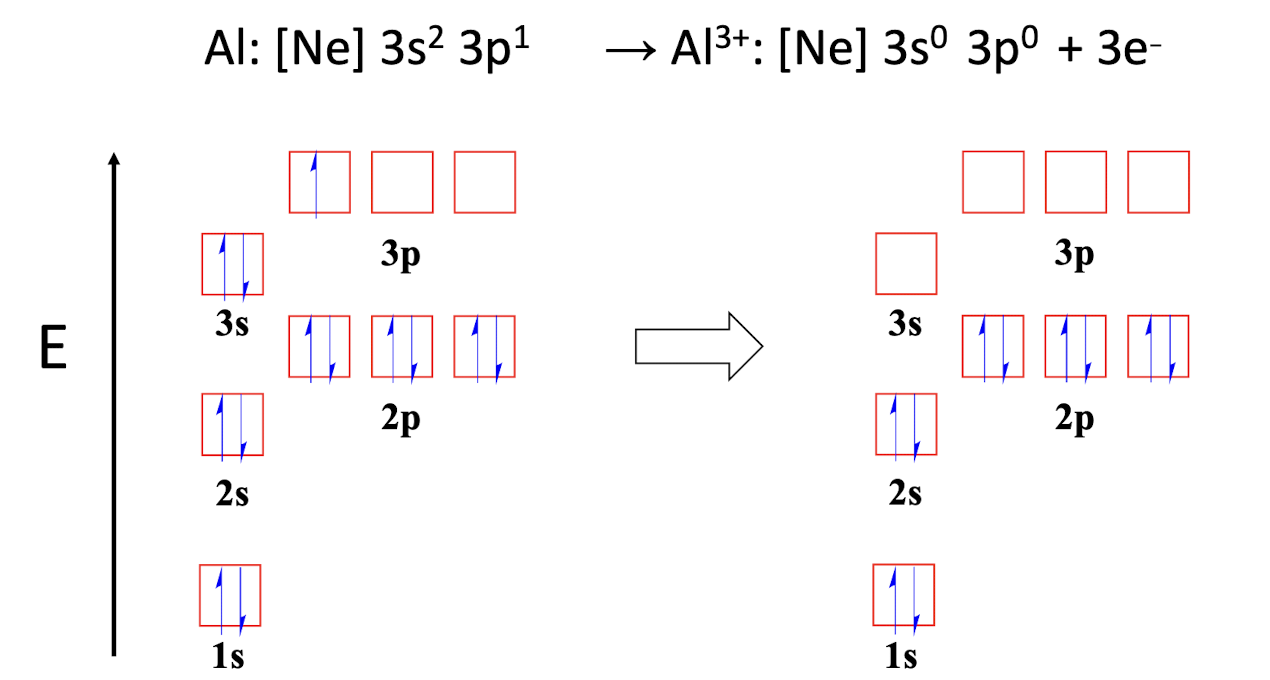
(Lesson 11: Electron Configurations of Ions; Sizes of Atoms and Ions) Stable Ion Configurations for Metals
How do you form CATIONS from elements?
To form cations from elements, remove 1 or more e- from subshell of highest n [or highest [(n + l)].
(Lesson 11: Electron Configurations of Ions; Sizes of Atoms and Ions) Practice Questions


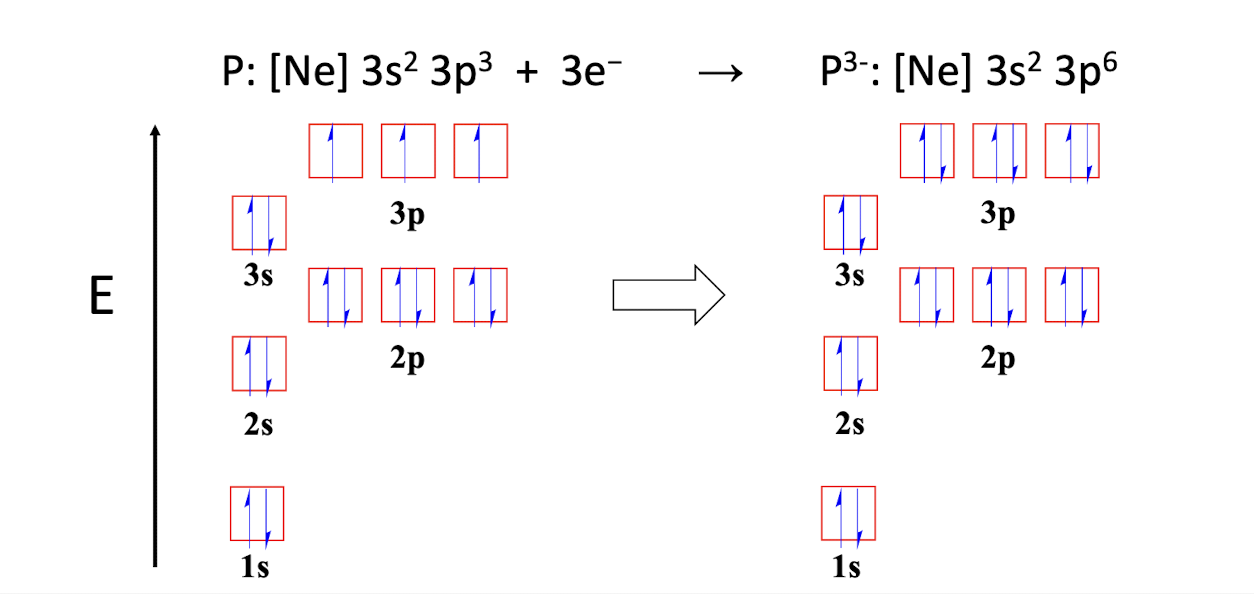
(Lesson 11: Electron Configurations of Ions; Sizes of Atoms and Ions) Stable Ion Configurations for Nonmetals
How do you form ANIONS from elements?
To form anions from elements, add 1 or more e- to subshell of highest n [or highest (n+l)].
(Lesson 11: Electron Configurations of Ions; Sizes of Atoms and Ions) Practice Questions


(Lesson 11: Electron Configurations of Ions; Sizes of Atoms and Ions) Stable Ion Configurations for Transition Metals
What do you do for transition metals?
For transition metals, remove n s electrons FIRST and then (n-1) d electrons.
This is because the s electrons are farther from the nucleus on average and easier to remove.

(Lesson 11: Electron Configurations of Ions; Sizes of Atoms and Ions) Stable Ion Configurations for Transition Metals
Why does iron lose the 4s electrons first?
Larger d for 4s electrons means less negative PE; less E needed to remove an electron
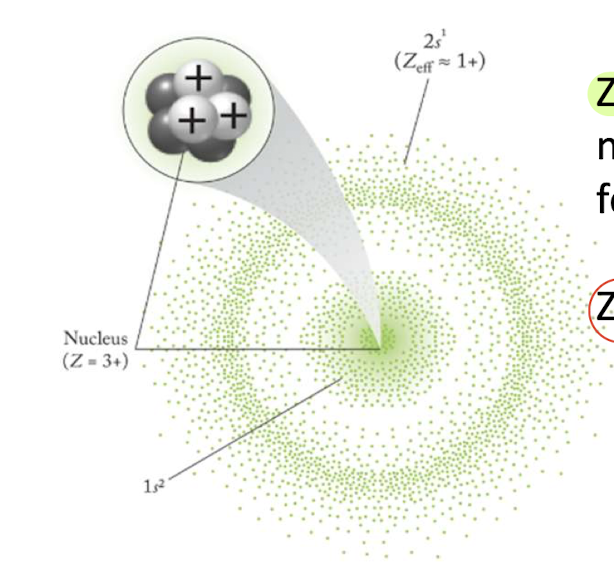
(Lesson 11: Electron Configurations of Ions; Sizes of Atoms and Ions) Effective Nuclear Charge, Zeff Shielding by Core Electrons
What is EFFECTIVE NUCLEAR CHARGE (Zeff)?
The magnitude of the nuclear charge that is actually felt by the valence electrons
Zeff = Z - shielding (~ Z - # core electrons)
assume valence electrons (highest n) don’t shield each other
(Lesson 11: Electron Configurations of Ions; Sizes of Atoms and Ions) Exam-Type Question


(Lesson 11: Electron Configurations of Ions; Sizes of Atoms and Ions) Reference: Definitions of Element Radius - Atomic, Metallic, Ionic
Draw ATOMIC RADIUS.

(Lesson 11: Electron Configurations of Ions; Sizes of Atoms and Ions) Reference: Definitions of Element Radius - Atomic, Metallic, Ionic
Draw METALLIC RADIUS.
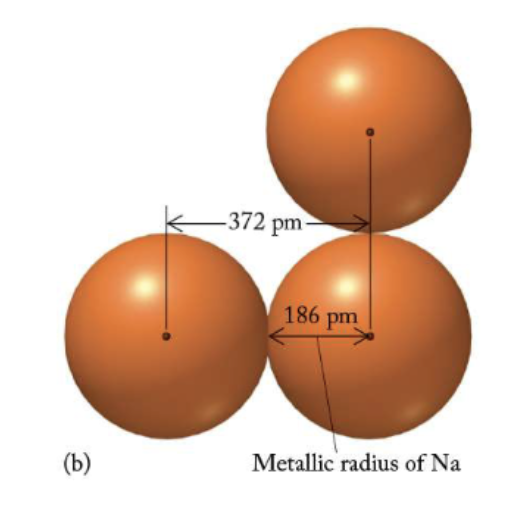
(Lesson 11: Electron Configurations of Ions; Sizes of Atoms and Ions) Reference: Definitions of Element Radius - Atomic, Metallic, Ionic
Draw IONIC RADIUS.

(Lesson 11: Electron Configurations of Ions; Sizes of Atoms and Ions) Knowledge Check
Is the following statement true or false? The radius of Ar is expected to be larger than that of Ne because Ar has more protons in its nucleus.
False! → The radius of Ar is larger than that of Ne because it has a larger valence shell of n = 3 compared to Ne’s valence shell of n = 2.
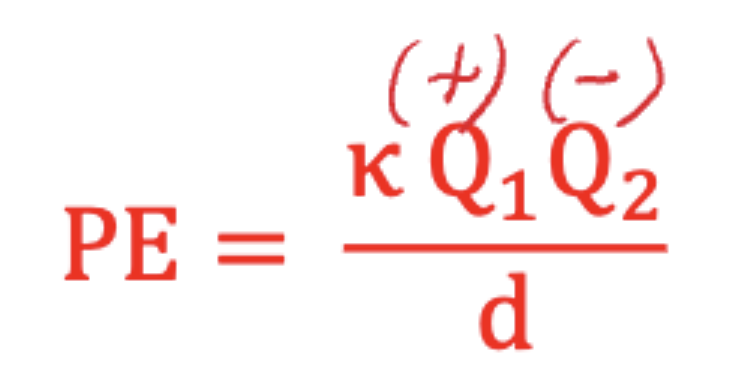
(Lesson 11: Electron Configurations of Ions; Sizes of Atoms and Ions) Electrostatic Potential Energy (Eel)
How do you explain an interaction between a valence electron and the nucleus?
For electrostatic potential energy, Q1 and Q2 are charged particles (often opposite in sign)
Q+ represents the effective nuclear charge (Zeff)
Q- represents the charge of an electorn (-1)

(Lesson 11: Electron Configurations of Ions; Sizes of Atoms and Ions) General Size Trends
What happens down a group?

valence n increases
average d from nucleus increases
electrons held less tightly
atom size increases
Zeff is essentially the same
(Lesson 11: Electron Configurations of Ions; Sizes of Atoms and Ions) General Size Trends
What happens across a row/period?
Zeff increases
atom size decreases
electrons held more tightly
same n / d from nucleus
(Lesson 11: Electron Configurations of Ions; Sizes of Atoms and Ions) Practice Questions


(Lesson 11: Electron Configurations of Ions; Sizes of Atoms and Ions) Practice Questions

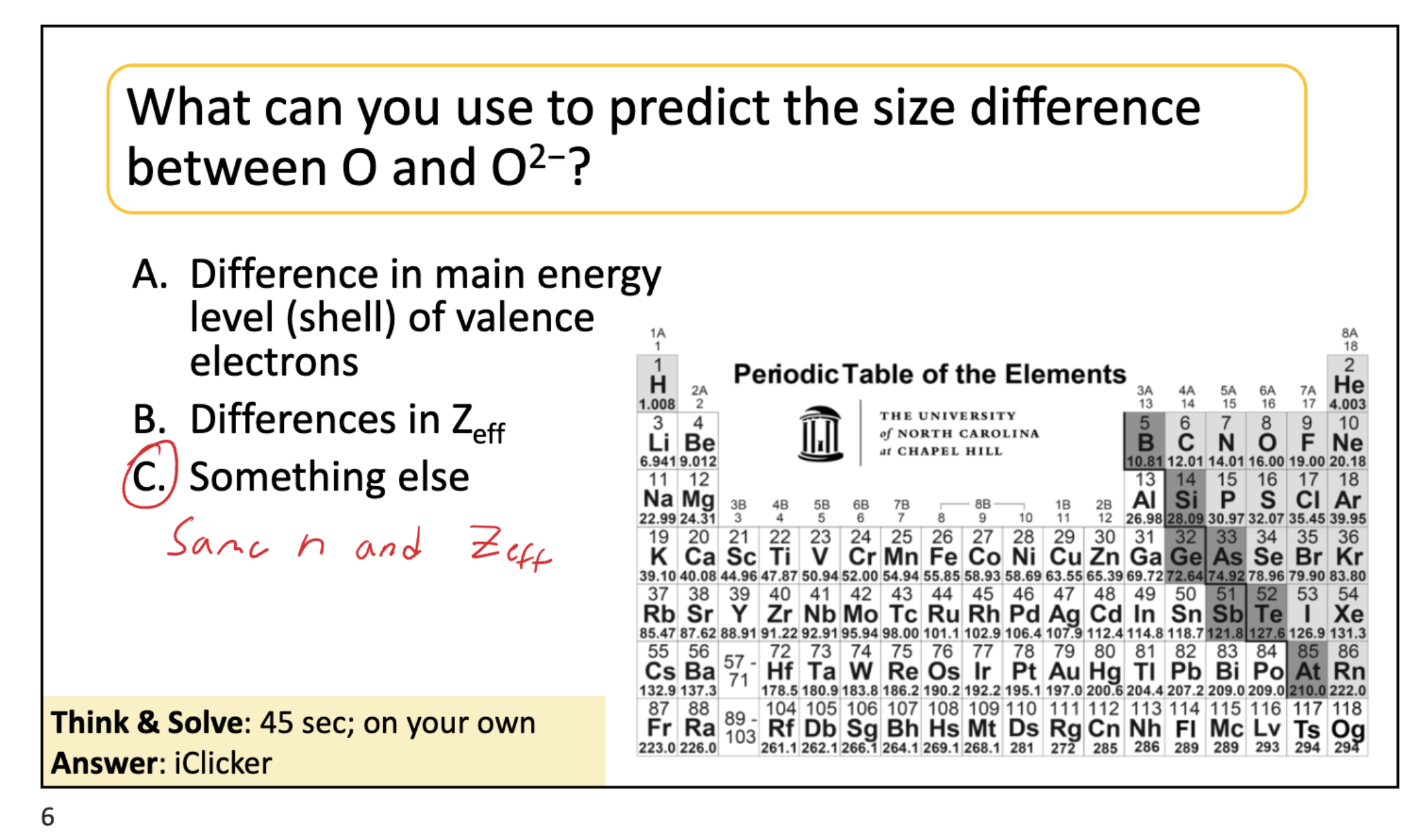
(Lesson 11: Electron Configurations of Ions; Sizes of Atoms and Ions) Ion Sizes: Forming a Cation
What happens to the ION SIZE when forming a CATION?

CATIONS are SMALLER than their parent atoms because the electron-electron repulsions have been reduced, and so size DECREASES.
Especially evident when all electrons from outer shell are lost (as distance between nucleus and electrons decreases, as n decreases).
Trends in cation sizes down a group are the same as atom sizes.
(Lesson 11: Electron Configurations of Ions; Sizes of Atoms and Ions) Ion Sizes: Forming an Anion
What happens to the ION SIZE when forming a ANION?

ANIONS are LARGER than their parent atoms because the electron-electron repulsions increase, and so size INCREASES (even though additional electrons do into same-size subshells).
Trends in anion sizes down a group are the same as atom sizes.
(Lesson 11: Electron Configurations of Ions; Sizes of Atoms and Ions) Practice Questions


As the number of protons increase, Zeff increases, and the radius becomes smaller, decreasing the size of the atom.
As the number of protons decrease, Zeff decreases, and the radius becomes larger, increasing the size of the atom.
(Lesson 11: Electron Configurations of Ions; Sizes of Atoms and Ions) Sizes of Ions: Isoelectronic Series
What does ISOELECTRONIC mean?
Two or more species have the same number of electorns.
(Lesson 11: Electron Configurations of Ions; Sizes of Atoms and Ions) Sizes of Ions: Isoelectronic Series
What happens to ION SIZE with an INCREASING Zeff? Why?
Ion size decreases with an increasing effective nuclear charge, Zeff, because electrons are held more tightly and closer to nucleus (and shielding is the same!)

(Lesson 11: Electron Configurations of Ions; Sizes of Atoms and Ions) Exam-Type Question


(Lesson 11: Electron Configurations of Ions; Sizes of Atoms and Ions) Exam-Type Question


(Lesson 12: Ionization Energies; Electron Affinities) Knowledge Check
Which equation correctly represents the second ionization of aluminum?
Al+ (g) → Al 2+ (g) + e-
(Lesson 12: Ionization Energies; Electron Affinities) Ionization Energy: Definitions
What is IONIZATION ENERGY?
The ionization energy is the amount of energy required to remove an electron from the ground state of a gaseous atom or ion.

(Lesson 12: Ionization Energies; Electron Affinities) Ionization Energy: Definitions
What is FIRST IONIZATION ENERGY (IE1)?
First ionization energy (IE1) is the energy required to remove the first electron from a neutral atom.
(Lesson 12: Ionization Energies; Electron Affinities) Trends in Ionization Energies
What happens to IE1 down a column?
As one goes down a column, less energy is required to remove the first electron, so IE1 decreases.

(Lesson 12: Ionization Energies; Electron Affinities) Trends in Ionization Energies
What happens to IE1 across a row?
Generally, as one goes across a row, it gets harder to remove an electron, so IE1 increases.
(Lesson 12: Ionization Energies; Electron Affinities) Practice Questions


(Lesson 12: Ionization Energies; Electron Affinities) (Exceptions to) Trends in First Ionization Energies
Explain the first exception.
The first occurs between Groups 2 & 13:
Electron removed from p-orbital rather than s-orbital
Outermost electron is in slightly higher energy orbital

(Lesson 12: Ionization Energies; Electron Affinities) Practice Questions


(Lesson 12: Ionization Energies; Electron Affinities) (Exceptions to) Trends in First Ionization Energies
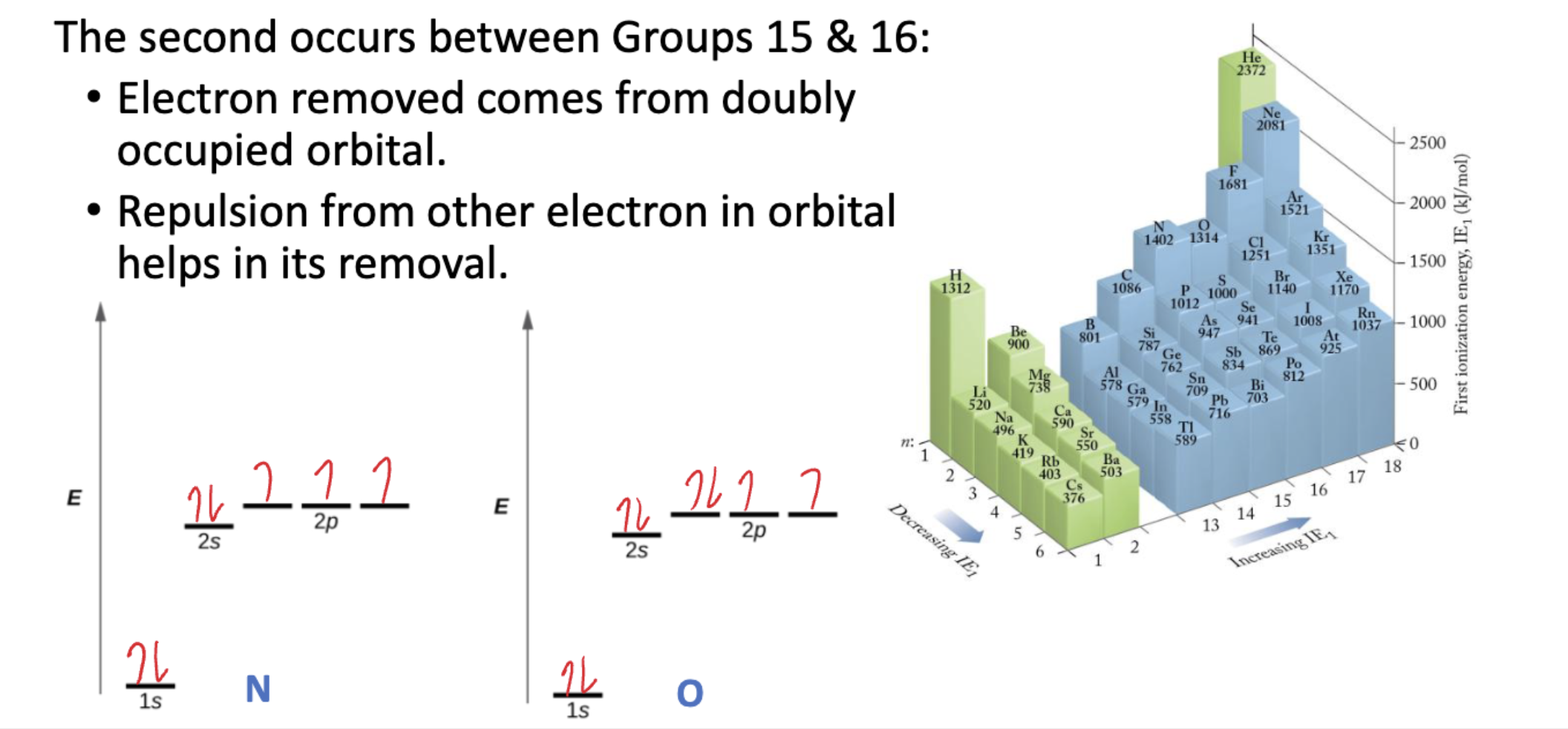
Explain the second exception.
The second occurs between Groups 15 & 16:
Electron removed comes from doubly occupied orbital.
Repulsion from other electron in orbital helps in its removal.
(Lesson 12: Ionization Energies; Electron Affinities) Ionization Energy: Successive Electrons
What happens with successive electrons?
More energy is required to remove each successive electron.
When all valence electrons have been removed, the ionization energy is much greater.

(Lesson 12: Ionization Energies; Electron Affinities) Exam Type Question


(Lesson 12: Ionization Energies; Electron Affinities) Electron Affinity: Definition
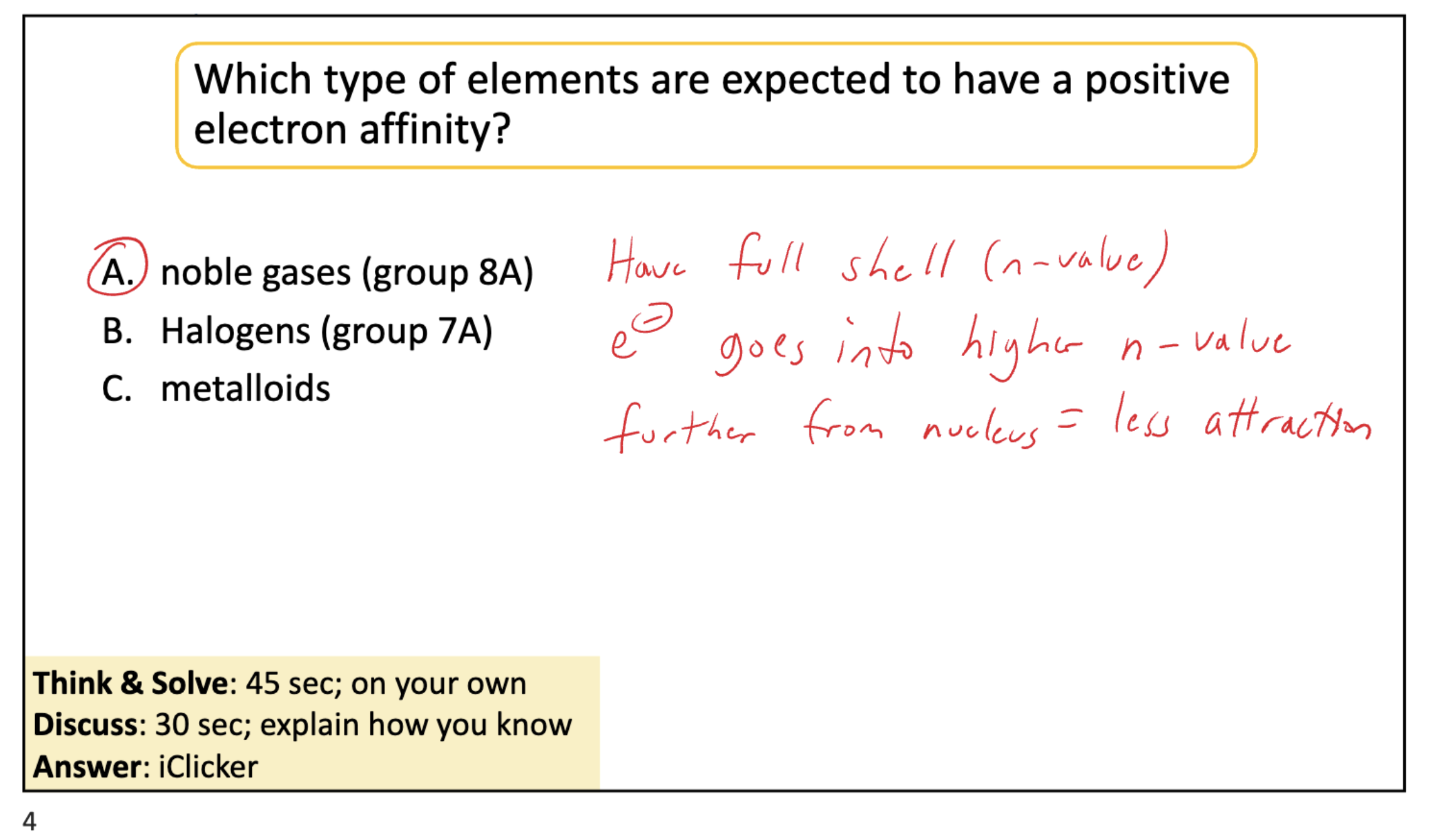
What is ELECTRON AFFINITY?
Electron Affinity is the amount of energy absorbed or released when adding an electron to the ground state of a gaseous atom or ion.

(Lesson 12: Ionization Energies; Electron Affinities) Practice Questions

(Lesson 12: Ionization Energies; Electron Affinities) Reference: Periodic Trends
Atomic Radius
(same period) Increasing Zeff _________ radius (stronger attraction between core and valence electrons)
(same group) Increasing n (principal quantum number) of valence shell _________ radius (electrons are farther away)
(same element) Increasing number of valence electrons __________ radius because of increased electron-electron repulsion (e.g., going from F to F-)
decreases
increases
increases
(Lesson 12: Ionization Energies; Electron Affinities) Reference: Periodic Trends
IE1
(same period) Increasing Zeff _________ IE1 (stronger attraction between core and valence electrons)
(same group) Increasing n of valence shell _________ IE1 (electrons are farther away)
(same element) Increasing number of valence electrons __________ IE (e.g., going from F to F-)
increases
decreases
decreases
(Lesson 12: Ionization Energies; Electron Affinities) Exam-Type Question


(Lesson 12: Ionization Energies; Electron Affinities) Reference: Naming Polyatomic Ions (Tables 4.5 and 4.6)
Carbonate
CO32-
(Lesson 12: Ionization Energies; Electron Affinities) Reference: Naming Polyatomic Ions (Tables 4.5 and 4.6)
Hydrogen Carbonate / Bicarbonate
HCO3-
(Lesson 12: Ionization Energies; Electron Affinities) Reference: Naming Polyatomic Ions (Tables 4.5 and 4.6)
Acetate
CH3COO-
(Lesson 12: Ionization Energies; Electron Affinities) Reference: Naming Polyatomic Ions (Tables 4.5 and 4.6)
Cyanide
CN-
(Lesson 12: Ionization Energies; Electron Affinities) Reference: Naming Polyatomic Ions (Tables 4.5 and 4.6)
Thiocyanate
SCN-
(Lesson 12: Ionization Energies; Electron Affinities) Reference: Naming Polyatomic Ions (Tables 4.5 and 4.6)
Hypochlorite
ClO-
(Lesson 12: Ionization Energies; Electron Affinities) Reference: Naming Polyatomic Ions (Tables 4.5 and 4.6)
Chlorite
ClO2-
(Lesson 12: Ionization Energies; Electron Affinities) Reference: Naming Polyatomic Ions (Tables 4.5 and 4.6)
Chlorate
ClO3-
(Lesson 12: Ionization Energies; Electron Affinities) Reference: Naming Polyatomic Ions (Tables 4.5 and 4.6)
Perchlorate
ClO4-
(Lesson 12: Ionization Energies; Electron Affinities) Reference: Naming Polyatomic Ions (Tables 4.5 and 4.6)
Chromate
CrO42-
(Lesson 12: Ionization Energies; Electron Affinities) Reference: Naming Polyatomic Ions (Tables 4.5 and 4.6)
Dichromate
Cr2O72-
(Lesson 12: Ionization Energies; Electron Affinities) Reference: Naming Polyatomic Ions (Tables 4.5 and 4.6)
Permanganate
MnO4-
(Lesson 12: Ionization Energies; Electron Affinities) Reference: Naming Polyatomic Ions (Tables 4.5 and 4.6)
Azide
N3-
(Lesson 12: Ionization Energies; Electron Affinities) Reference: Naming Polyatomic Ions (Tables 4.5 and 4.6)
Ammonium
NH4+
(Lesson 12: Ionization Energies; Electron Affinities) Reference: Naming Polyatomic Ions (Tables 4.5 and 4.6)
Nitrite
NO2-
(Lesson 12: Ionization Energies; Electron Affinities) Reference: Naming Polyatomic Ions (Tables 4.5 and 4.6)
Nitrate
NO3-
(Lesson 12: Ionization Energies; Electron Affinities) Reference: Naming Polyatomic Ions (Tables 4.5 and 4.6)
Hydroxide
OH-
(Lesson 12: Ionization Energies; Electron Affinities) Reference: Naming Polyatomic Ions (Tables 4.5 and 4.6)
Peroxide
O22-
(Lesson 12: Ionization Energies; Electron Affinities) Reference: Naming Polyatomic Ions (Tables 4.5 and 4.6)
Phosphate
PO43-
(Lesson 12: Ionization Energies; Electron Affinities) Reference: Naming Polyatomic Ions (Tables 4.5 and 4.6)
Hydrogen Phosphate
HPO42-
(Lesson 12: Ionization Energies; Electron Affinities) Reference: Naming Polyatomic Ions (Tables 4.5 and 4.6)
Dihydrogen Phosphate
H2PO4-
(Lesson 12: Ionization Energies; Electron Affinities) Reference: Naming Polyatomic Ions (Tables 4.5 and 4.6)
Disulfide
S22-
(Lesson 12: Ionization Energies; Electron Affinities) Reference: Naming Polyatomic Ions (Tables 4.5 and 4.6)
Sulfite
SO32-
(Lesson 12: Ionization Energies; Electron Affinities) Reference: Naming Polyatomic Ions (Tables 4.5 and 4.6)
Sulfate
SO42-
(Lesson 12: Ionization Energies; Electron Affinities) Reference: Naming Polyatomic Ions (Tables 4.5 and 4.6)
Hydrogen Sulfite / Bisulfite
HSO3-
(Lesson 12: Ionization Energies; Electron Affinities) Reference: Naming Polyatomic Ions (Tables 4.5 and 4.6)
Hydrogen Sulfate / Bisulfate
HSO4-
(Lesson 12: Ionization Energies; Electron Affinities) Reference: Naming Polyatomic Ions (Tables 4.5 and 4.6) → Oxoanions
Hypobromite
BrO-
(Lesson 12: Ionization Energies; Electron Affinities) Reference: Naming Polyatomic Ions (Tables 4.5 and 4.6) → Oxoanions
Bromite
BrO2-
(Lesson 12: Ionization Energies; Electron Affinities) Reference: Naming Polyatomic Ions (Tables 4.5 and 4.6) → Oxoanions
Bromate
BrO3-
(Lesson 12: Ionization Energies; Electron Affinities) Reference: Naming Polyatomic Ions (Tables 4.5 and 4.6) → Oxoanions
Perbromate
BrO4-
(Lesson 12: Ionization Energies; Electron Affinities) Reference: Naming Polyatomic Ions (Tables 4.5 and 4.6) → Oxoanions
Hypoiodite
IO-
(Lesson 12: Ionization Energies; Electron Affinities) Reference: Naming Polyatomic Ions (Tables 4.5 and 4.6) → Oxoanions
Iodite
IO2-
(Lesson 12: Ionization Energies; Electron Affinities) Reference: Naming Polyatomic Ions (Tables 4.5 and 4.6) → Oxoanions
Iodate
IO3-
(Lesson 12: Ionization Energies; Electron Affinities) Reference: Naming Polyatomic Ions (Tables 4.5 and 4.6) → Oxoanions
Periodate
IO4-
(Lesson 13: Chemical Bonds; Electronegativity and Bonding; Naming Compounds and Writing Formulas) Ionic Bond vs. Covalent Bond
What is an IONIC BOND?
electrostatic attraction between oppositely charged ions (no electron sharing)
elements are far apart on periodic table, usually between metal and nonmetal

(Lesson 13: Chemical Bonds; Electronegativity and Bonding; Naming Compounds and Writing Formulas) Ionic Bond vs. Covalent Bond
What is a COVALENT BOND?
electrons are shared in overlapping valence orbitals on neutral atoms
elements are close together on periodic table


(Lesson 13: Chemical Bonds; Electronegativity and Bonding; Naming Compounds and Writing Formulas) Practice Questions

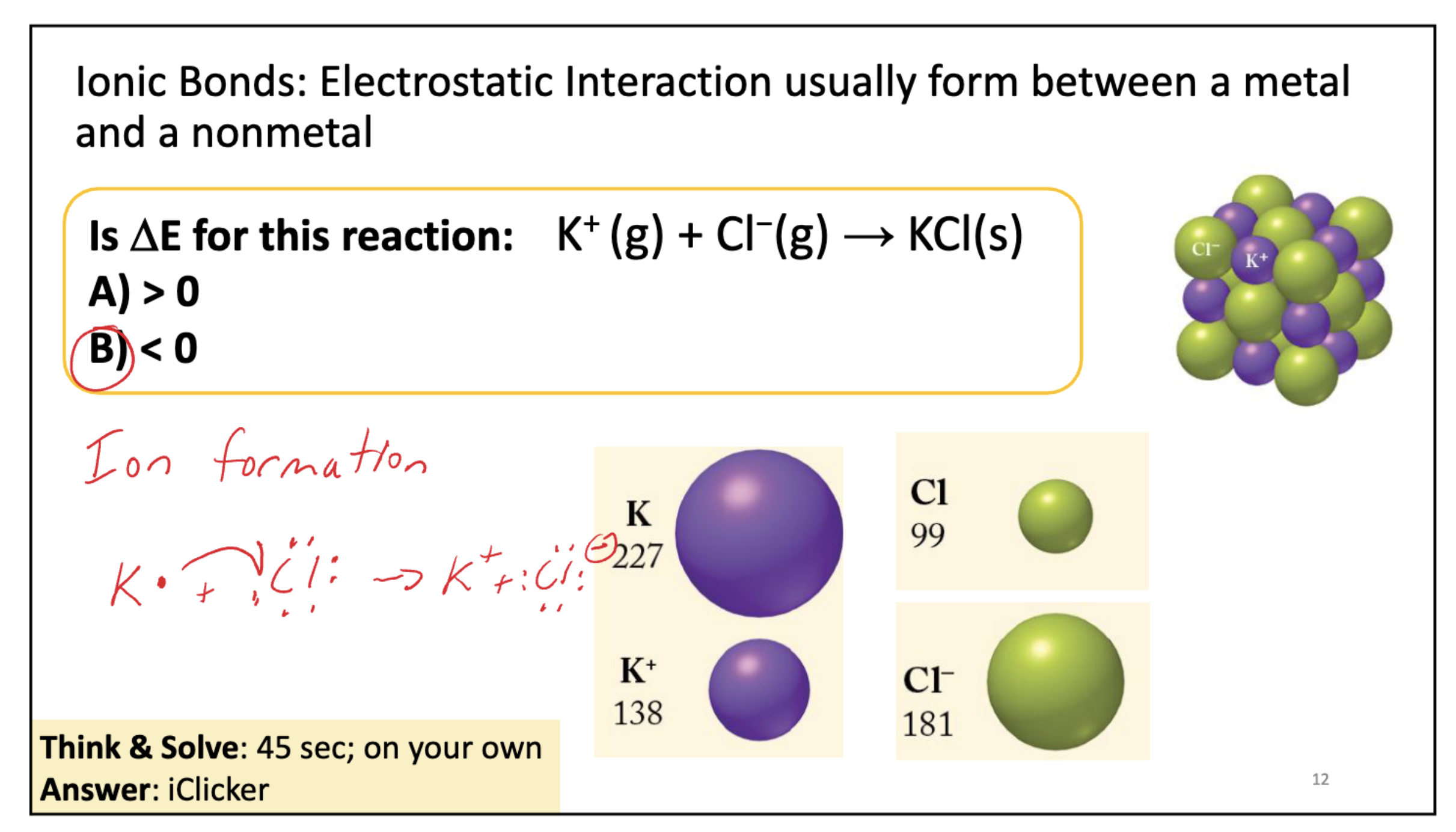
(Lesson 13: Chemical Bonds; Electronegativity and Bonding; Naming Compounds and Writing Formulas)
Does breaking bonds absorb energy or release energy?
absorbs energy
(Lesson 13: Chemical Bonds; Electronegativity and Bonding; Naming Compounds and Writing Formulas)
Does building bonds absorb energy or release energy?
release energy
Describe this graph.

When the ions are very far apart (right side of graph)…
very little electrostatic attraction
PE approaches 0
ions barely interact
When the ions move closer together (middle of graph)…
opposite charges attract
PE decreases (becomes more negative)
system becomes more stable
When the ions are too close together (left side of graph)…
the electron clouds overlap excessively
strong repulsion occurs
PE increases
system becomes less stable
(Lesson 13: Chemical Bonds; Electronegativity and Bonding; Naming Compounds and Writing Formulas) Ionic Bonds: Electrostatic Interaction
Ionization energy and electron affinity do not adequately describe why energy is released during ionic bond formation, so we need to quantify electrostatic interactions. What is LATTICE ENERGY?

The amount of energy released when gas-phase ions combine to form one mole of a crystalline solid.
(Lesson 13: Chemical Bonds; Electronegativity and Bonding; Naming Compounds and Writing Formulas) Practice Questions


(Lesson 13: Chemical Bonds; Electronegativity and Bonding; Naming Compounds and Writing Formulas) Reference: Lattice Energy
Lattice energy becomes ____ _______ (more energy is released) as the charge magnitude on the ions increases.
more negative

(Lesson 13: Chemical Bonds; Electronegativity and Bonding; Naming Compounds and Writing Formulas) Reference: Lattice Energy
Lattice energy becomes ____ ________ (less energy is released) as ion size increases, because the ions are further apart.
less negative
(Lesson 13: Chemical Bonds; Electronegativity and Bonding; Naming Compounds and Writing Formulas) Exam Type Question


(Lesson 13: Chemical Bonds; Electronegativity and Bonding; Naming Compounds and Writing Formulas) Electronegativity
What is ELECTRONEGATIVITY?
X, an atom’s tendency to attract electrons toward itself within a covalent bond
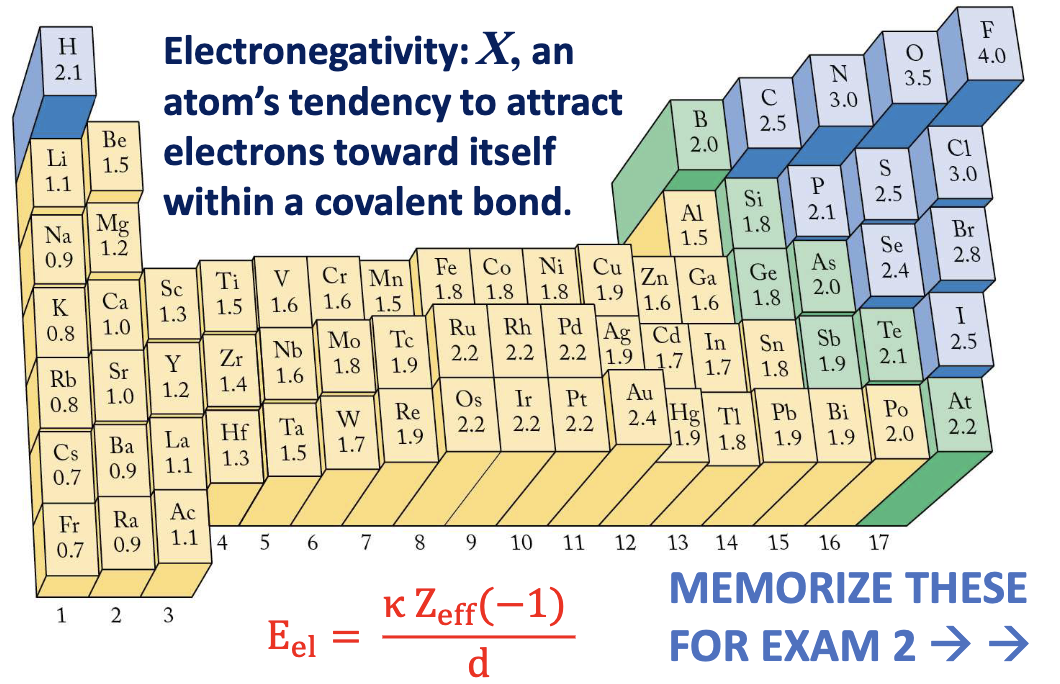
(Lesson 13: Chemical Bonds; Electronegativity and Bonding; Naming Compounds and Writing Formulas) Electronegativity
Fluorine (F)
4.0
(Lesson 13: Chemical Bonds; Electronegativity and Bonding; Naming Compounds and Writing Formulas) Electronegativity
Oxygen (O)
3.5
(Lesson 13: Chemical Bonds; Electronegativity and Bonding; Naming Compounds and Writing Formulas) Electronegativity
Nitrogen (N)
3.0
(Lesson 13: Chemical Bonds; Electronegativity and Bonding; Naming Compounds and Writing Formulas) Electronegativity
Chlorine (Cl)
3.0
(Lesson 13: Chemical Bonds; Electronegativity and Bonding; Naming Compounds and Writing Formulas) Electronegativity
Carbon (C)
2.5
(Lesson 13: Chemical Bonds; Electronegativity and Bonding; Naming Compounds and Writing Formulas) Electronegativity
Sulfur (S)
2.5
(Lesson 13: Chemical Bonds; Electronegativity and Bonding; Naming Compounds and Writing Formulas) Electronegativity
Iodine (I)
2.5
(Lesson 13: Chemical Bonds; Electronegativity and Bonding; Naming Compounds and Writing Formulas) Electronegativity
Hydrogen (H)
2.0
(Lesson 13: Chemical Bonds; Electronegativity and Bonding; Naming Compounds and Writing Formulas) Electronegativity
Phosphorus (P)
2.0
(Lesson 13: Chemical Bonds; Electronegativity and Bonding; Naming Compounds and Writing Formulas) Electronegativity
Bromine (Br)
2.8
(Lesson 13: Chemical Bonds; Electronegativity and Bonding; Naming Compounds and Writing Formulas) Electronegativity
Selenium (Se)
2.4