Binding equilibria
 Call Kai
 Learn
 Practice Test
 Spaced Repetition
 Match
 Flashcards
 Knowt Play
1/40

There's no tags or description
Looks like no tags are added yet.
41 Terms
what do enzymes ligand bind to?
substrates, cofactors
what do transporters ligand bind to
substrates, ions (ligands)
what do ion channels ligand bind to?
ligands, ions
what do receptors ligand bind to?
ligands, ions
what do proteins ligand bind to?
ligands, proteins, DNA, RNA, ions
what does DNA ligand bind to?
ligands, DNA, proteins
what does RNA ligand bind to?
ligands, proteins
what mediates control of affinity and specificity in ligand binding?
weak non-covalent interactions
what is the binding equilibrium reaction
P + L ←> PL
what is kinetics?
the rate at which something appears or disappears
what is affinity?
the strength of interaction
what does PL represent?
non-covalent protein-ligand complex
what is KA
association constant, as protein + ligand associate together
what is KD?
dissociation constant, inverse of association constant
what is KD in terms of P, L and PL?
[P][L]/[PL]
what is KD in terms of KA
1/KA
how can KD’s be determined, and determined experimentally?
using binding assays, binding isotherms
how to filter binding assay?
detect binding using a radio labelled ligand, mix with unlabelled ligand, add to sample + wait until it has reached equilibrium, separate PL from L using nitrocellulose filter to trap protein and PL, total bound is measured using a scintillation counter
what happens to ligands with low KD values?
ligands bind tightly
what happens to ligands with high KD values?
ligands bind weakly
define f
fraction bound = [PL] / [P] + [PL]
what does fraction of occupied ligand-binding sites depend on
[L] and binding affinity
what does it mean when f = 0
limit when no proteins are bound to ligand
what does it mean when f = 1
saturation limit when all proteins are bound to ligand
definition of binding isotherm/binding curve
plot of fractional occupancy (F) as function of ligand concentration at a constant temperature
rules of binding isotherm/binding curve
must be at constant temperature to be valid, shape of curve = rectangular hyperbola, deviation from hyperbolic shape is evidence of more complicated phenomena such as multiple binding sites with different affinities or allosteric regulation
what are the assumptions that are fundamental in law of mass action?
all receptors are equally accessible to ligands, all receptors are either free or bound to ligand (ignore any states of partial binding), neither ligand nor receptor are altered by binding, binding is reversible
what is the strength of non specific binding and what does it need to plateau?
weak, needs more ligand
what must be measured in all binding assays?
non-specific binding
what can non-specific binding involve
binding to other proteins or experimental materials
why can experimental materials such as plastic cause non-specific binding
can offer many binding sites
what does the corrected binding isotherm show?
saturation, it reaches maximum plateau
does non-specific binding reach a plateau
no
how is non-specific binding measured separately?
first fully saturate all protein binding sites using a high concentration of unlabelled ligand
what happens when all protein binding sites are occupied by unlabelled ligand?
radio labelled ligand only binds non-specifically
what concentration of unlabelled ligand is used as a rule of thumb?
100 x KD of unlabelled ligand
define fractional saturation (theta) for multiple binding sites
fraction bound / number of binding sites
define fractional saturation (theta) for individual binding site
[L] / KD + [L]
what is the overall fraction bound?
f = n[L] / KD + [L]
what is co-operativety in binding?
binding sites whee KD depends on presence of another site being occupied, can be positive (KD of a site gets tighter if another ligand is bound another site), can be negative (KD gets weaker if another site is occupied)
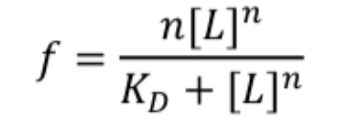
what does this represent in a reaction equation
P + nL ←> PLn