Neurons + Action Potentials - Anatomy Midterm 2
 Call Kai
 Learn
 Practice Test
 Spaced Repetition
 Match
 Flashcards
 Knowt Play
1/94

There's no tags or description
Looks like no tags are added yet.
95 Terms
What are the sensory functions of the nervous system
detection of sensations from within and outside the body (pain, temperature, pressure etc.)
What are the integrative functions of the nervous system
“decision making” primarily by CNS, analyze/interpret sensory stimuli and determine appropriate response
What are the motor functions of the nervous system
“action” stimulation of muscle contraction or gland secretion
The nervous system has which 2 major anatomical divisions
Central Nervous System (brain and spinal cord)
Peripheral Nervous System
What is the main role of the CNS
processes incoming sensory data (integration) and transmits motor commands
area for higher brain functions
What is the main role of the PNS
coordinates all communication between CNS and rest of body, connects CNS to muscles, glands and receptors
made up of all nervous tissue outside CNS
3 different subdivisions of the PNS
sensory (afferent): receptors
motor (efferent): effectors
enteric nervous system (ENS)
What do sensory (afferent) receptor neurons do? What are some examples of these
neurons from sensory receptors convey information to CNS (10 mil)
somatic receptors (muscles, bones, skin)
special senses (vision, taste, smell, hearing, balance)
visceral receptors (organs)
What are the 2 divisions within motor (efferent) effectors
(half a million of these combined)
somatic division
autonomic division
What does the somatic division of motor effectors do?
sends signals to skeletal muscle (voluntary)
What does the autonomic division of motor effectors do?
sends signals to smooth/ cardiac muscles and glands - vital role in homeostasis (involuntary)
What are the 2 subcomponents of the autonomic motor division
sympathetic division (fight or flight)
parasympathetic (rest and digest)
What does the enteric nervous system do in the PNS
involuntary sensory and motor neurons control the GI tract
neurons function independently of CNS
All communication between CNS and PNS is conducted through _____
action potentials
what is an action potential
a “wave” of electricity caused by the rapid movement of charged ions (Na+ and K+)
action potentials are created and conducted by _____
individual neurons (the functional unit of the nervous system)
communication is either on or off
differentiate between neurons and nerves
neuron: single cell that can grow long, be sensory or motor
nerves: collection of thousands of individual neurons that can contain both sensory and motor
What are the 3 basic shapes of neurons
multipolar, bipolar, unipolar
structure of a multipolar neuron, where are these found?
several dendrites and one axon
most common
all motor neurons are multipolar

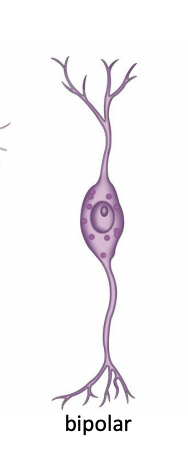
structure of a bipolar neuron, where are these found?
one main dendrite and one axon
found in retina, inner ear and olfactory
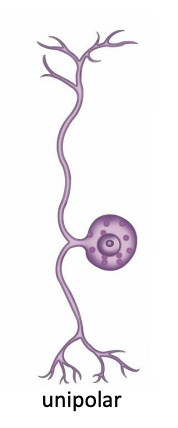
structure of a unipolar neuron and where are these found?
one process only
cell body off to side → create ganglion
always sensory neurons
What do dendrites do
Receive info from other neurons/cells,environment
Create graded potentials (small, short lived AP’s)
Graded potentials sent to cell body (soma) and added up at axon hillock
What does the cell body do?
Controls cells metabolic functions
contains nucleus and other organelles
What does an axon do?
Conducts action potentials away from cell body
long structures are either myelinated or unmyelinated
What do terminal end bulbs (axon terminals) do?
connect to muscle, glands or dendrites of other neurons
can be thousands of end bulbs per neuron
contain neurotransmitters
what does the axon hillock do?
gets graded potentials from dendrites and adds them up
if it receives enough positive signals it creates AP to travel axon
which structure has a specialized surface for contact with other neurons
dendrites
what is the typical structure of a dendrite
short, highly branches, unmyelinated
typical structure of an axon
long, thin, cylindrical cell that is myelinated or unmyelinated
arise from axon hillock, end in terminal bulbs
how many neuroglial cells do we have compared to neurons and why?
smaller than neurons but 10x more abundant (half the volume of CNS)
these cells can divide
List the 6 types of neuroglial cells and whether they’re in the CNS or PNS
CNS: astrocytes, oligodendrocytes, microglia, ependymal
PNS: schwann, satellite

Structure of an astrocyte
star-shaped, largest/most common, central body and “end feet”
What is the function of astrocytes “end feet” processes
anchoring neurons and blood vessels
regulate extracellular ion concentrations
assist with BBB formation
What is the structure of oligodendrocytes?
also have radiating processes- they wrap around axons to form sheath
White matter: neurons with myelin sheath
Grey matter: neurons without sheath
Main function of oligodendrocytes
protect neurons and speed up conduction rates
What is the function of microglia (the least numerous glial cell)
macrophages: immune defense
brain maintenance: removing damaged neurons and debris
Main functions of ependymal cells
form membrane lining cerebral cavities and spinal cord central canal
produce CSF (ciliated to circulate CSF)
What is white matter and grey matter within a schwann cell
white matter: myelinated axons
grey matter: unmyelinated axons
(same as oligodendrocytes)
Main functions of schwann cells (cells encircling PNS axons)
each cell produces part of myelin sheath
neural regeneration of PNS
shape of satellite cells
flat cells surrounding cell bodies of neurons in PNS
main functions of satellite cells
support PNS neurons within ganglia
link neurons to schwann cells
satellite cells may have a similar role to _____ but are poorly understood
astrocytes
How does grey matter differ in the brain vs in the spinal cord
spinal cord: forms H-shaped inner core surrounded by white matter
brain: a thin outer shell of grey matter covers the surface
explain electrophysiology of cells
distribution and movement of electrical charges (ions) across plasma membranes → the separation of ions creates a gradient between inside and outside of cell
the electrical gradient produced by ion movement provides _____
potential energy
what are the different types of channels that produce ion movement (electrophysiology)
leakage
voltage gated
ligand gated
mechanically gated
(therefore we have leakage or gated channels)
both leakage and gated channels use which type of transport?
passive transport (no added energy required)
ions move by diffusion down their concentration gradient
When do leakage channels open and close
they randomly alternate between open and closed positions (independent of stimulus)
When do gated channels open and close
In response to stimulus
voltage gated: open when change in voltage
ligand gated: response to particular chemical stimuli
mechanically gated: open with physical touch
What is membrane potential
a separation of charges across a plasma membrane (source of potential energy)
What is resting membrane potential
a neuron at rest → membrane potential of -70mV
inside of cell is negative relative to outside of cell
(polarized)
What factors contribute to the resting membrane potential
unequal ion distribution
leakage channels and inability of most anions to leave cell
sodium pump (active transport)
Why does the unequal distribution of ions occur
extracellular fluid is naturally rich in Na+ and Cl- (outside cell)
the cytosol (inside) is rich in K+ and anions (negative molecules)
How does passive diffusion occur (leakage channels)?
There are more K+ channels leaking positive ions out than Na+ channels bringing positive ions in (and negative particles can’t escape)
this helps to keep the inside of neuron more negative than outside
what happens to the cell when positive ions move in
membrane potential becomes LESS negative and is depolarizing
what happens to the cell when positive ions move out
membrane potential becomes MORE negative and is hyperpolarizing (or repolarizing)
membrane potential needs to reach at least _____ for an AP to generate
-55mV
What does an EPSP vs an IPSP (graded potentials) do to the membrane
EPSP: slightly depolarize membrane (more positive)
IPSP: slightly hyperpolarize membrane (more negative)
An EPSP results from…?
the opening of ligand-gated Na+ channels (Na+ ions come into cell, brings membrane potential closer to threshold)
An IPSP results from…?
The opening of ligand-gated Cl- or K+ channels (Some Cl- ions leak in or K+ ions leak out, making inside more negative)
Once the membrane potential threshold is reached, what happens
an action potential begins (once potential reaches -55mV at axon hillock)
What is the depolarization stage of an action potential
Ion channels open and Na+ rushes in
What is the repolarization stage of an action potential
K+ rushes out of cell
What principle does an AP use?
All or none principle: with stimulation, either happens one specific way or not at all (also travels over cell surface without dying out)
What is the absolute refractory period
the period where voltage gated sodium channels are open or inactive and no additional stimulus is able to produce an AP (no matter how strong)
What is the relative refractory period
the period where voltage gated sodium channels are back to resting state, some potassium channels may still be inactive and open
if a greater than normal stimulus occurs, membrane may depolarize again
The conduction speed of an AP is influenced by which 2 things
diameter of axon and presence/absence of myelin sheath
What is continuous propagation
An action potential travels along each section of an unmyelinated axon, beginning at the axon hillock
Why does an action potential travel in only one direction?
The refractory period prevents backward propagation.
How fast is continuous propagation?
Approx. 1 meter/ second
What is saltatory conduction?
Action potentials are regenerated at successive nodes of Ranvier.
(depolarization happens at the nodes)
Why is saltatory conduction faster than continuous propagation?
Myelin allows electrical current to spread rapidly between nodes without regenerating the action potential at every section.
What are the three different fibers classified by conduction speed and where are they found?
Type A: sensory axons from joints/muscles, motor axons to skeletal
Type B: sensory axons from organs
Type C: sensory axons that transmit pain, temperature and pressure
What are Type A fibers + their conduction speed
largest diameter axons, always myelinated
conduction speed: 120m/ second
What are Type B fibers + their conduction speed
intermediate diameter axons, sometimes myelinated
conduction speed: 15m/ second
What are Type C fibers + their conduction speed
smallest diameter axon, never myelinated
conduction speed: 0.5-2m / second
How do most neurons communicate with other cells (target cells)?
Chemical synapses + neuronal synpases (from one neuron to another)
In a neuronal synapse, which neuron is the presynaptic vs postsynaptic neuron
presynaptic: neuron sending the message
postsynaptic: neuron receiving message from its dendrite
A neuron can have up to _____ synapses with other neurons at the same time
10 000
the CNS contains billions of neurons organized into complex networks called ______
neural circuits
Simplest form of a neural circuit (least common)
a single presynaptic neuron stimulates a single postsynaptic neuron
more common and complex form of a neural circuit, otherwise known as divergence:
a single presynaptic neuron will synapse with multiple postsynaptic neurons
What is convergence?
multiple presynaptic neurons synapse with a single postsynaptic neuron
there are roughly ______ known neurotransmitters
100 (all have temporary effects)
Once released into a synapse, neurotransmitters are quickly removed by one of the three different ways, name the three possibilities:
deactivated by enzymes
pumped back into synaptic knob of presynaptic neuron
diffuse away
How do local anesthetics work to stop pain
prevent opening of voltage gated Na+ channels, nerve impulses cannot pass anesthetized region
AP never reaches brain therefore never “knows” there is pain
our nervous systems exhibit plasticity which is…
the ability to change/modify/grow based on an experience (eg. growing new dendrites)
though humans have limited ability to repair neurons
Plasticity in PNS vs CNS
PNS: damage to dendrites axons may be repaired if cell body intact
CNS: little/no repair possible even if cell body is intact (paralysis)
What is multiple sclerosis + symptoms
autoimmune disease where your own immune cells attack myelin sheaths → disrupting action potentials (commonly females)
vision problems, muscle weakness, tingling, numbness in limbs, fatigue (worsen with progression)
What is MS cause and cure
no single test for MS or known cause
thought to be genetic and environmental (Vit D)
no known cure but treatments to reduce severity
What is parkinson’s disease + symptoms
neurodegenerative disorder that affects dopamine producing cells in brain responsible for voluntary motor control
tremors, loss of balance, slowness in movement
Cause and cure of parkinson’s disease
no known case; genetics and environment (metals/pesticides)
no known cure but drugs and therapies reduce severity
What does the drug levodopa do
promotes dopamine release, can be used for people with parkinson’s disease
What is alzheimer’s disease + symptoms
neurodegenerative disease that progressively worsens with loss of neurons in the cerebral cortex
loss in memory, language, mood swings, bodily functions
Cause of alzheimers
unknown cause but recent hypothesis: buildup of amyloid plaques in brain
diagnosis only 100% definitive with autopsy