Chemistry | Paper One | Topic 1 & 2
 Call Kai
 Learn
 Practice Test
 Spaced Repetition
 Match
 Flashcards
 Knowt Play
1/58

Earn XP
Description and Tags
Topic 1: Atomic Structure and the Periodic Table | Topic 2: Bonding, Structure
59 Terms
What is meant by molecule?
2 or more atoms held together by chemical bonds
What is a catalyst?
A substance which changes the rate of reaction without being changed by the reaction itself
How did Mendeleev organise his periodic table?
Atomic mass
What is the modern periodic table organised by?
Atomic number

Who created the solid sphere atom model?
John Dalton

Who created the Plum pudding atom model?
JJ. Thompson
Who created the nuclear atom model & why?
Ernest Rutherford — nucleus with electrons orbiting around it (gold foil experiment)

Who created the planetary atom model & why?
Niels Bohr — electrons orbit in fixed orbits/shells (energy levels) at specific distances away from the nucleus
What are the 3 strong chemical bonds?
Ionic, covalent and metallic
How does an ionic bond form?
electrons from one/more atom(s) transfer to the other(s) filling the others outer shell and losing its excess
What type of diagram do you use for ionic bonding
Dot & Cross
What is the structure of an ionic lattice?
Highly organised, 3D grid, alternating positive and negative ions (to minimise attraction & repulsion), held together by electrostatic forces [ionic bonds]
— providing stability & high melting point.
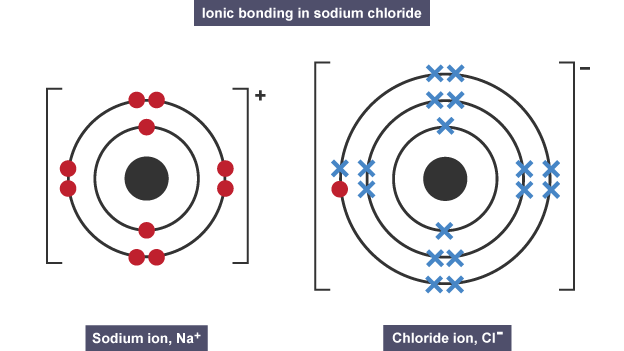
What are the limitations of a dot and cross diagram to show a giant ionic structure?
2D, Don’t show relative sizes, Ions are truly tightly packed

What are the limitations of a ball & stick diagram to show a giant ionic structure?
Don’t show relative size, Ions are truly tightly packed, Electrostatic attraction works in every direction
What does empirical formula mean in relation to ions
Finding the simplest ratio of atoms so the charge is 0 (e.g. Al3+ and O2- = Al2O3)
What determines melting & boiling point?
Strength of the bonds/forces

What are the limitations of the particle model for changing states?
Doesn’t show specific forces, Particles aren’t solid spheres, Doesn’t show relative size
What are the 4 state symbols + meaning?
(s) - solid ; (l) - liquid ; (g) - gas ; (aq) - aqueous
Do ionic compounds have high or low melting & boiling points?
High
When do ionic compounds conduct electricity
When molten / aqueous
Does diamond conduct electricity?
No
What is the definition of element?
Substance consisting of one type of atom
Roughly how many elements on periodic table?
100
What is the definition of compound?
Two or more different elements chemically bonded
What are the first three Alkali metals and what colours do they burn when they react with Oxygen?
Lithium - red/orange, Sodium - orange/yellow & Potassium - lilac
What are the first four Halogens?
Fluorine, Chlorine, Bromine & Iodine
What are the first three noble gasses?
Helium, Neon & Argon
What is the definition of a mixture?
Substance made of two or more elements/compounds - not chemically bonded
When do you use filtration?
Separating insoluble solid from liquid
When do you use Crystallisation/evaporation?
Separating soluble solid from liquid
When do you use simple distillation?
Separating liquid from solution
When do you use fractional distillation?
Separating two or more liquids with different boiling points
When do you use paper chromatography?
Separating different soluble substances (usually dyes / inks)
Who discovered the neutron?
James Chadwick
What is the radius of an atom?
0.1nm
What is the radius of a neutron?
0.000001nm (5 zeros)
What is an isotope?
Same number of protons different number of neutrons
What are the properties of metals? (2 physical ; 2 chemical)
Physical : Lustrous (shiny when cut) ; high mp & bp ; Good conductors ; Malleable ; Ductile ; High density ; Sonorous
Chemical : Form positive ions ; form metal oxides with oxygen ; (higher reactivity metals) form hydrogen + metal hydroxide with water
What are 2 physical and 1 chemical propertie(s) of non-metals?
Physical: dull ; Brittle ; Insulators ; Low melting & boiling points ; Low density ; Non-sonorous
Chemical: Form negative ions ; Covalent bonding
What happens when lithium reacts with oxygen, chlorine and water?
Lithium -
Oxygen: crimson flame ; white powder - lithium oxide
Chlorine: crimson flame ; white solid - lithium chloride
Water: Fizzes steadily & slowly ; water turns alkali - lithium hydroxide + hydrogen
What happens when sodium reacts with oxygen, chlorine and water?
Sodium -
Oxygen: yellow-orange flame ; white powder - sodium oxide
Chlorine: yellow-orange flame ; white solid - Sodium Chloride [table salt]
Water: Fizzes rapidly & quickly ; water turns alkali - Sodium Hydroxide + Hydrogen
What happens when potassium reacts with oxygen, chlorine and water?
Potassium - lilac flame [ALL]
Oxygen: white powder - potassium oxide
Chlorine: white solid - Potassium Chloride
Water: Most violent ; Hydrogen ignites instantly due to heat ; water turns alkali - Potassium Hydroxide + Hydrogen ; ends with small explosion
What is the method for Paper Chromatography? (6-7 steps)
Draw a baseline near the bottom of the filter paper using a pencil (since it is insoluble)
Add a spot of the ink to the baseline and place in a beaker of solvent
Make sure the ink is not touching the solvent (so it does not dissolve)
Place a lid on the beaker so the solvent does not evaporate
The solvent seeps up the paper, carrying the ink with it
When the solvent is near the top of the filter paper take the filter paper out and leave to dry
You will be left with a chromatogram
What is a polymer
Lots of small units linked together to form a long molecule
What is the bonding like in polymers? (compared to simple covalent + ionic / giant covalent)
Stong covalent bonds
Larger intermolecular forces than simple covalent (more energy needed to break them)
Weaker than ionic / giant covalent
What are 2 examples of giant covalent structures
Diamond
Graphite
Silicon dioxide
What is the name for different structural forms of the same element?
(e.g. Carbon’s _____ include diamond, graphite, fullerenes, etc…)
Allotropes
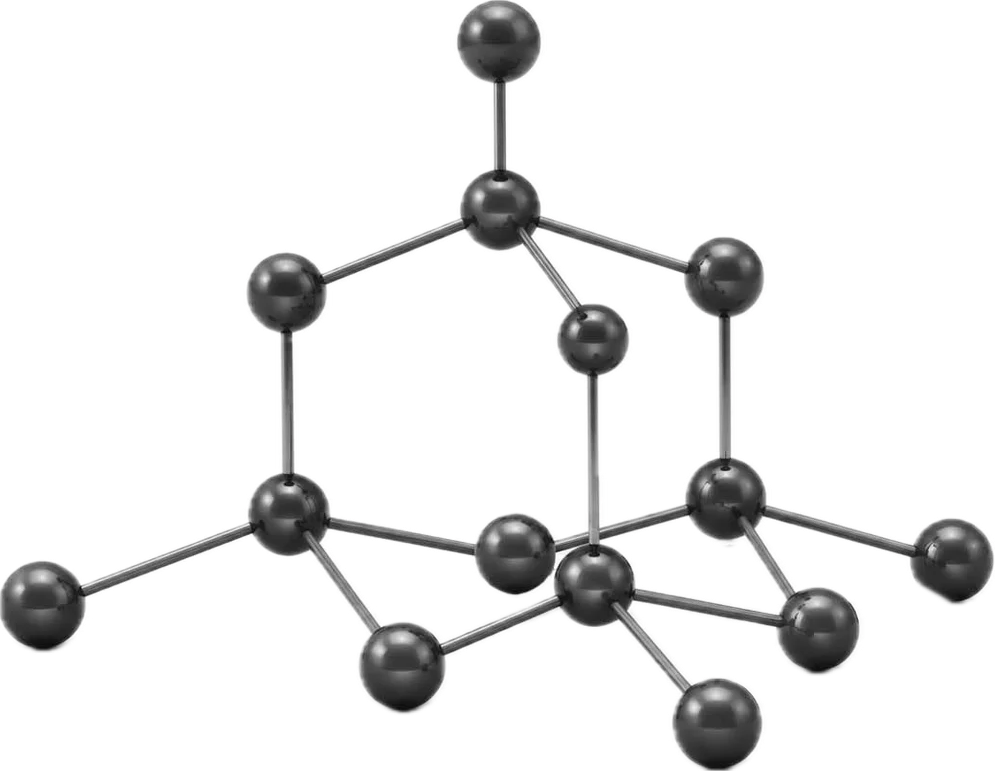
What are the properties and structure of diamond and why?
Giant covalent structure
Each carbon atom forms 4 covalent bonds — no delocalised electrons —> unconductive
Very high melting point
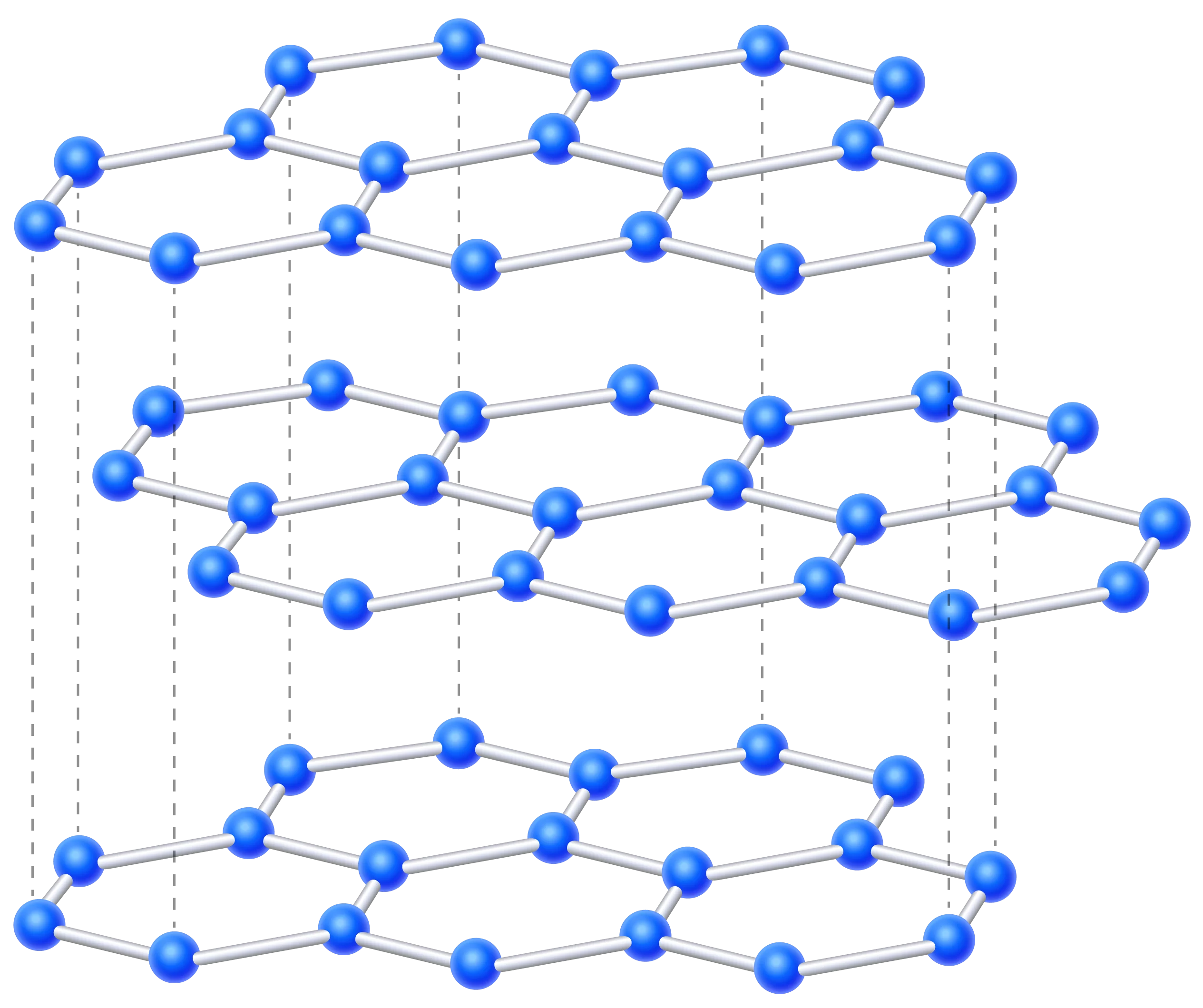
What are the properties and structure of graphite(/graphene) and why?
Giant covalent
Each carbon forms 3 covalent bonds — 1 delocalised electron —> thermal & electrical conductor
Hexagonal sheets — layers held together weakly —> soft & slippery
High melting point
Graphene is one layer (light & strong)
What are the properties and structure of fullerenes (+ nanotubes) and why?
Fullerenes:
Shaped like closed tubes / hollow balls (like the Buckminsterfullerene)
Mainly hexagonal (can also include pentagons / heptagons)
Huge surface area
Nanotubes:
Formed by fullerenes (tiny carbon cylinders)
High length:diameter ratio
Thermally & electrically conductive
High tensile strength
What are the uses of fullerenes (+ nanotubes)?
Can “cage” other molecules —> used to deliver drugs into the body
Huge surface area means they’re good catalysts
Lubricants
Nanotubes:
Electrically conductive —> used in electronics
Strengthen materials without adding much weight
What are the rough size ranges for Coarse-, Fine- and Nano- particles?
Coarse particles: 10,000nm —— 2,500nm
Fine particles: 2,500nm —— 100nm
Nanoparticles: 100nm —— 1nm
What are the uses of nanoparticles?
Catalysts: high SA:V ratio
Nanomedicine: Tiny particles absorbed more easily (deliver drugs)
Computing: Some conduct electricity (computor chips)
Antibacterials: Silver nanoparticles have antibacterial properties (surgical masks, wound dressings, deodorants)
Cosmetics: improve moisturisers
What is the relative atomic mass formula (Mr)?
rel
What is the relative atomic mass (Mr) of Magnesium Chloride?
Ar of Mg = 24
Ar of Cl = 35.5
Since halogens come in pairs the formula is MgCl2
Therefore,
24 + (2 × 35.5) = 95
So,
Mr of MgCl2 = 95
How do you calculate the percentage mass of an element in a compound?
Percentage mass of an element in a compound = [ (Ar x number of atoms of that element) ÷ Mr of the compound ] x 100
Ar = relative atomic mass
Mr = relative formula mass
A mixture contains 20% iron ions (by mass)
What mass of iron chloride (FeCl2) is needed to provide the iron ions in 50g of the mixture?
Ar of Fe = 56
Ar of Cl = 35.5
50g has 20% iron. 20% of 50 = 10g of iron (in mixture).
Percentage mass of an element in a compound = [ (Ar x number of atoms of that element) ÷ Mr of the compound ] x 100
(56 × 1) ÷ 56 + (2 × 35.5) = 0.4409…. x 100 = 44.09….%
If FeCl2 is 44.09….% Fe by mass, 100g FeCl2 has 44.09g Fe
So, for 1g Fe (100 ÷ 44.09….)g FeCl2
And, for 10g Fe [ 10 x (100 ÷ 44.09….) ] = 23g FeCl2 (2 s.f.)
What charge and symbol does sulfate have?
SO42-