Animal Bio Lab Final
 Call Kai
 Learn
 Practice Test
 Spaced Repetition
 Match
 Flashcards
 Knowt Play
1/84

There's no tags or description
Looks like no tags are added yet.
85 Terms
Protozoan
unicellular eukaryotes
animal-like (lack cell wall + are motile)
Phylum Amoebozoa (group of protozoans) movement
use pseudopodia (grab onto surface and pull themselves forward)
Phylum Amoebozoa (group of protozoans) reproduction
Mainly reproduce asexually through binary fission, but can also reproduce sexually using flagellated gametes
Phylum Amoebozoa (group of protozoans) feeding
Heterotrophic feeding via phagocytosis - surround food with pseudopods and bring the food to itself
Contractile vacuole
Collects and expels excess water entering via osmosis, preventing unicellular organisms from bursting in hypotonic environments and adjusting to salinity changes.
Phylum Amoebozoa (group of protozoans) examples
Amoeba proteus (free living)
Entamoeba histolytica (parasitic) —> causes dysentery
Arcella, diflugia, + actinosphaerium (shelled) —> shelled amoebas extend pseudopods through openings in their shell
Phylum Euglenozoa (group of protozoans) movement
use flagellum (corkscrew motion)
Phylum Euglenozoa (group of protozoans) reproduction
asexual reproduction via longitudinal binary fission
Phylum Euglenozoa (group of protozoans) feeding
Autotrophic, photosynthetic feeding - chloroplasts and paramylon to story energy, light sensitive eyespot to collect light
Phylum Euglenozoa (group of protozoans) example
Euglena
Phylum Viridiplantae (group of protozoans) movement
uses paired flagellum
Phylum Viridiplantae (group of protozoans) reproduction
seasonally switches between asexual + sexual reproduction
Phylum Viridiplantae (group of protozoans) feeding
autotrophic, photosynthetic feeding
Phylum Viridiplantae (group of protozoans) colonies
Division of labor between organisms within colony - beginning of cell differentiation + step towards multicellular life (somatic + sex cells)
Zooflagellates
Heterotrophic
Animal-like
Trypanosoma
Type of zooflagellate
Blood parasite that absorbs nutrients from surrounding blood
African sleeping sickness
Trichonymphia
Type of zooflagellate
Live symbiotically in termite gut —> produce cellulase used by termites
Phylum Apicomplexa (group of protozoans) movement
Generally lack cilia, flagella + other locomotive organelles
Phylum Apicomplexa (group of protozoans) reproduction
asexual or sexual
Phylum Apicomplexa (group of protozoans) feeding
osmotrophic = lack mouth —> all species are parasitic
Phylum Apicomplexa (group of protozoans) examples
Gregarina = parasite in roaches + mealworms
Multi-stage life cycle - trophozoites (feeding) + sporozoites (dispersal)
Plasmodium = 2 hosts (humans + female Anopheles mosquitoes)
Causes malaria
Phylum Ciliophora (group of protozoans) movement
move with cilia
Phylum Apicomplexa (group of protozoans) reproduction
Asexual = binary fission - separation of the body into 2 new bodies
Sexual = conjugation - one organism transfers genetic material to another through direct cell-to-cell contact
Phylum Apicomplexa (group of protozoans) feeding
Heterotrophic - consume bacterium through oral groove + mouth (use mouth cilia to direct prey into oral groove)
Phylum Apicomplexa (group of protozoans) examples
Paramecium
Macronucleus - regulates metabolism (ex. cellular functions, feeding + digestion)
Micronucleus - complex form of sexual reproduction
Vorticella
Stentor
Metazoans
Multicellular eukaryotes
Cellular differentiation
Heterotrophic
Blastula stage during development
Extracellular matrix
Phylum Porifera (group of metazoans) overview
Multicellular without tissues + organs
Choanocytes = flagellated cells used to move water for feeding + reproduction (synapomorphy)
Phylum Porifera (group of metazoans) body plans
Asconoid = no folding to body wall - hollow tube with osculum at the top
Syconoid = simple infolding of body wall —> increased SA:V ratio —> can be larger
Flagellated cells bring in water, filter it for food + oxygen, + guide it into the spongocoel to exit the body
Leucinoid = body folds that are folded —> series of chambers connected by canals
Chambers lined with choanocytes
Greatest SA:V ratio —> can grow to the the largest
Phylum Porifera (group of metazoans) reproduction
Sexual = monoecious (contain both egg + sperm), internal fertilization by taking sperm through Ostia —> create free-swimming parenchymella + amphiblastula larva
Amphiblastula larva = flagellated larvae found in radial canals + exit adult through osculum
Asexual = fragmentation, budding, gemmules (shelled clumps of undifferentiated cells to withstand harsh conditions)
Budding = genotype of parent copied to new offspring that grows on adult + eventually detaches + gets carried away
Phylum Porifera (group of metazoans) structure
Choanocytes = flagellated feeding cells that create currents of water + remove particles from water
Spicules = internal skeleton
Pinacocytes = epithelial cells (protection)
Porocytes = tubular cells that make up the pores of the sponge body
Phylum Porifera (group of metazoans) water pathway
Water —> dermal osmium —> incurrent canals (lined with pinacocytes) —> prosopyles —> radial canal (lined with choanocytes) —> apopylle (pore through which water is forced by the beating of choanocytes) —> spongocoel (lined with pinacocytes) —> osculum
Phylum Porifera (group of metazoans) classes
Hexactinellida = 6-rayed silicone spicules, syconoid/leuconoid
Calcarea = 1/3/4-rayed calcium carbonate spicules, asconoid/syconoid/leuconoid
Demospongiae = spicules made of silicon/spongin, leuconoid
Phylum Cnidaria (group of metazoans) overview
Tissue level organization
Diploblasts = 2 germ layers (endoderm/gastrodermis + ectoderm/epidermis)
Radial symmetry
Polymorphic = different forms across life cycle
Synapomorphies:
Cnidocytes/nematocysts = stinging cells/organelles on tentacles
Free-swimming planular larvae
Class hydrozoa: hydra feeding (phylum cnidaria)
Capture prey with nematocysts + ingest through hypostome - both extraceullar + intracellular digestion
Class hydrozoa: hydra reproduction (phylum cnidaria)
Polyps only (no medusa stage)
Can be monoecious or dioecious
Can reproduce asexually via budding
Class hydrozoa: obelia life cycle (phylum cnidaria)
Differentiated organisms within colony - specialized feeding and reproductive structures (Gonangium/gonozooid = reproductive, hydranth/gastrozooid= feeding)
Produce mobile offspring (Medusa) —> able to find more favorable conditions + have a greater opportunity for genetic mixing with conspecifics

Class hydrozoa: gonionemus overview (phylum cnidaria)
Reduced hydra stage
Contains velum for circulation + movement (jet propulsion + swimming)
Statocysts = specialized sensory structure for balance/direction
Class Scyphozoa structure (phylum cnidaria)

Gastric cavity = digestion, nutrient distribution, fluid support
Radial canal = extend from central stomach to 4 interconnected gastric pouches —> increase SA:V ratio + help with nutrient distribution
Circular canal = Nutrient distribution + waste removal
Rhophalium = sensory organ (senses light + gravity/balance)
Class Scyphozoa life cycle (phylum cnidaria)

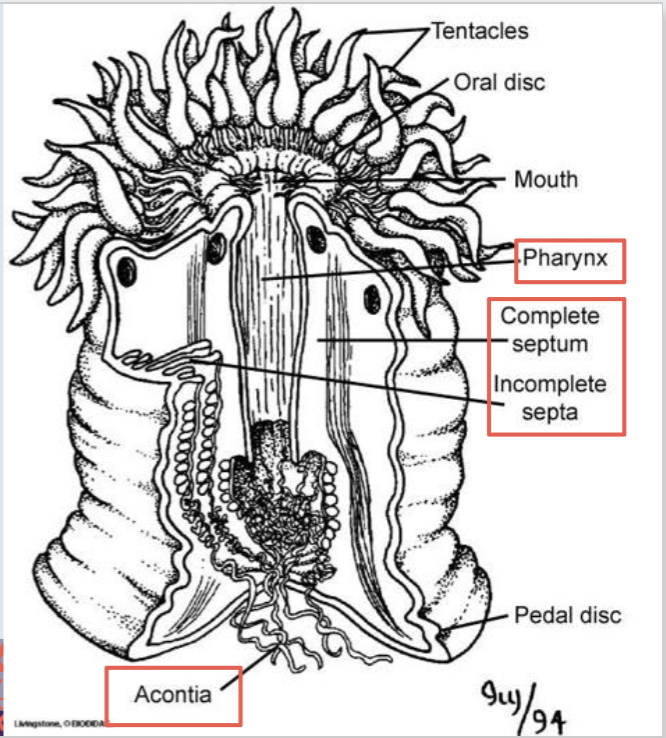
Class Anthozoa structure (phylum cnidaria)
Pharynx = 2 way passage for ingesting food + “throwing up” undigested waste
Complete septum = structural support + digestion
Incomplete septum = increase SA:V ratio —> increased nutrient absorption, gas exchange
Acontia = contain nematocysts for stinging (defense)
Phylum Ctenophora (group of metazoans) overview
Tissue level organization
diploblastic
possibly triploblastic with true muscles
Biradial symmetry
Synapomorphies:
Ctenes (comb rows): 8 rows of fused cilia used for movement
Colloblasts = adhesive cells on tentacles
Similarities between cnidaria and ctenophores
ctenophores closely resemble jellyfish due to convergent evolution!
Both cnidarians and ctenophores are diploblastic animals
Both cnidarians and ctenophores exhibit external fertilization
Protostomes
mouth forms first
Deuterostomes
anus forms first
Coelom
Fluid-filled body cavity between body wall + digestive tract —> provides hydrostatic skeleton + organ cushioning
Protostome classifications
Lophotrochozoans = grow by continuously adding mass, have either trochophore larval form or lophophore feeding structure
Ecdysozoans = grow by shedding outer cuticle/exoskeleton
Phylum Platyhelminthes overview
Bilateral symmetry
Cephalization = nervous system/sensory organs concentrated in anterior head
Triploblastic (endoderm, ectoderm, mesoderm)
Acoelomates
Lophotrochozoans
No true synapomorphy
Move using longitudinal + circular muscles
Mostly monoecious/reproduce asexually via fission
Phylum Platyhelminthes: Class Turbellaria
Free-living flatworm
Ciliated epidermis excretes mucus
Excretory system contains ciliated flame cells —> move/filter water
Monoecious + can reproduce via fission
Ex. Planaria
Planaria glides on mucus + uses longitudinal/circular muscles for movement
Ventral mouth extends from pharyngeal sheath —> pharynx sucks + ingests food —> food goes to anterior trunk of intestine —> passes down branch of posterior trunk of intestine
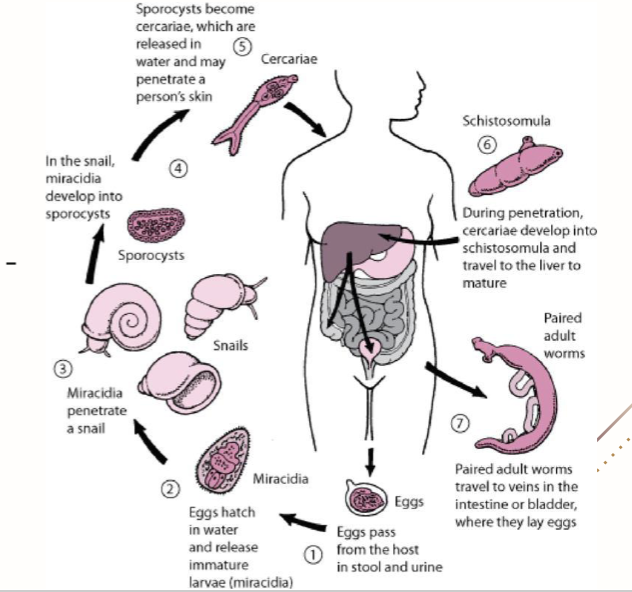
Phylum Platyhelminthes: Class Trematoda overview
Parasitic flukes with 2+ hosts
First = mollusk, second = vertebrate
Possess suckers to attach
Epidermis is syncytial tegument - unciliated
Mostly monoecious
Blood flukes (schistosoma) are dioecious
Phylum Platyhelminthes: Class Trematoda life cycle
Phylum Platyhelminthes: Class Cestoda overview
Parasitic tapeworms with 2+ hosts
Found in all vertebrate classes
Scolex with hooks/suckers to attach
Tegument = specialized epidermis for living in hostile environments
Lack a digestive system
Divided into proglottids with separate reproductive systems
Monoecious
Phylum Platyhelminthes: Class Cestoda life cycle

Phylum Nematoda overview
Bilateral symmetry with cephalization
Triploblastic
Pseudocoelomates
Ecdysozoans
Collagenous cuticle without cilia
Move with longitudinal muscles
Either monoecious or dioecious - dioecious can be sexually dimorphic (phenotypic difference between males + females —> males are larger than females)
Can be parasitic or free-living
Phylum Rotifera
Foot with pedal gland for clinging to objects (secretes cement)
Free-swimming
Phylum Gastrochica
Acoelomates
Glide using ventral cilia
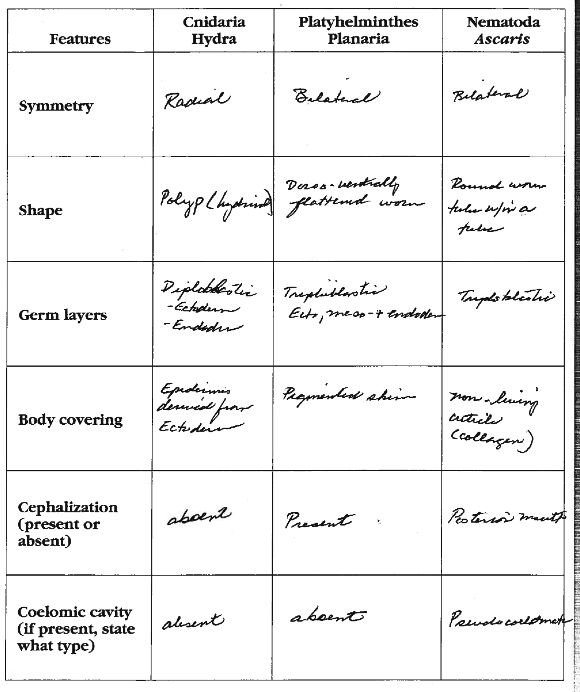
LAB THREE TABLE PART ONE

LAB THREE TABLE PART TWO
Lophophore
crown of ciliated tentacles for feeding + gas exchange
Trochophore
free-swimming larva with ciliated rings for movement/feeding + a full digestive system
Phylum Mollusca overview
Triploblastic protostomes
Lophotrochozoans - trochophore larva
True coelomates
Open circulatory system: blood flows through open sinuses, not vessels
Synapomorphies:
Mantle = fold in the body wall that covers the gills + secretes shell
Radula = ribbon of teeth for feeding
Muscular food for movement
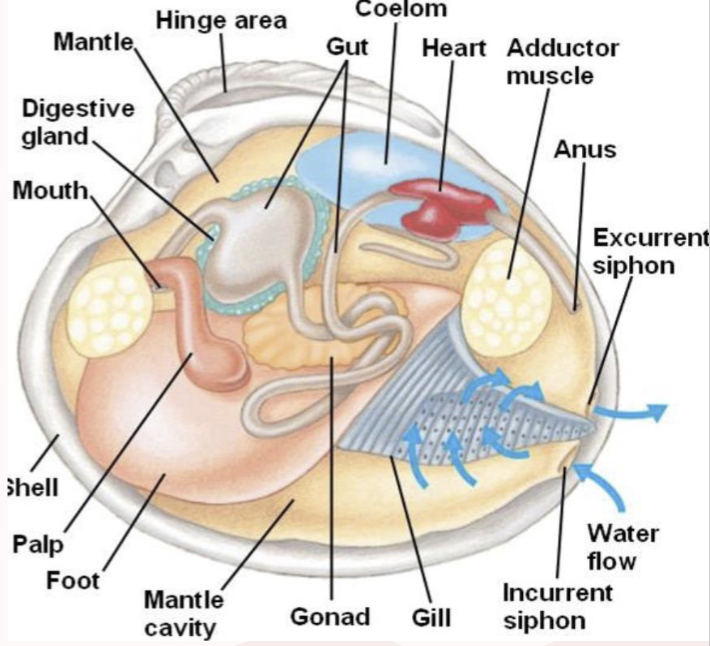
Phylum Mollusca: Class Bivalvia
Reduced cephalization
No radula - evolutionarily lost
Mantle has 2 lobes (one on either shell)
Move using hydrostatic skeleton in foot or jet propulsion from siphons
Mostly dioecious
Ex. clams, oysters, mussels
Phylum Mollusca: Class Gastropoda
Snails have asymmetrical body in shell
Well-developed head containing radula
Mantle may be modified into secondary gills/lung
Large flat foot to move
Dioecious/monoecious
ex. snails + slugs
Phylum Mollusca: Class Polyplacophora
Elongated, flattened body with reduced head
Covered in 8 body plates secreted by mantle
Flat foot for moving
Long, flat gills along side of body = ctenidia
Radula (feeding)
Usually dioecious
Chitons
Phylum Mollusca: Class Cephalopoda
Developed head with eyes + radula (inside beak)
Shells reduced in squids/cuttlefish, lost in octopuses
Internal shell in squids = pen
Foot modified into tentacles/arms
Use siphons for propulsion
Closed circulatory system with 3 hearts —> improved O2 exchange
Dioecious
ex. squids, octopi, cuttlefish, nautiluses
Phylum Annelida overview
Triploblastic protostomes
Lophochozoans - trochophore larva
True coelomates
Closed circulatory system without heart
Mouth-to-anus digestive tract
Move with hydrostatic pressure + muscular wall
Synapomorphy = segmentation of body
Metamerism = body divided into repeated units by septae
Phylum Annelida: Class Errantia
Polychaete worms = many-haired
Parapodia = fleshy outgrowths for movement/gas exchange
Setae = bristles on parapodia/segments —> anchoring/moving
Internally + externally segmented
Distinct head with eyes + mouth
Dioecious
Phylum Annelida: Class Sedentaria
Family Lumbricidae:
Few setae + no parapodia
Body segmented inside + out (coelom divided with septa)
Excratory system = metanephridia
Clitellum = specialized band of epidermis for reproduction (facilitates sperm transfer + is brood chamber for larvae)
Young are brooded - no larva
Monoecious
ex. earthworms
Family Hirundinidae
No setae or parapodia
33-34 segments (internal segments NOT divided with septae)
Coelom packed with connective tissue + muscle
Have clitellum
Monoecious
ex. leeches
Open vs. closed circulatory system
Open circulatory system = blood suffuses the body + may be directly open to the environment (blood not contained in arteries/veins)
Closed circulatory system = heart pumps blood into the vessels to reach tissues + organs
Phylogenetic pathway towards mollusks
Bilateral symmetry —> protostomes —> lophotrochozoa
Phylum Arthropoda overview
Triploblastic protostomes
Ecdysozoans - chitinous exoskeleton covered by waxy cuticle (epicuticle)
Coelomates
Hemocoel = reduced coelom filled with hemolymph (blood) for open circulatory system
Organ-system organization
Exhibit tagmatization = fusion of functional groups into segments
Synapomorphy = jointed appendages (often specialized)
Subphylum Chelicerata overview
Chelicerae = specialized appendages anterior to the mouth for feeding/prey capture
4 pairs of legs + pair of pedipalps
No attenae
Cephalothorax/prosoma = head + thorax fused into 1 segment
Abdomen usually unsegmented
Respiration with book gills (horseshoe crabs)/book lungs (arachnids)
Book gills = exposed to environment directly, book lungs = internal
Subphylum Chelicerata classes
Class Merostomata (horseshoe crabs)
Blood used for LAL test - tests for presence of toxins + bacterial infections in humans —> safety-check vaccines, implants, etc.
First set of operculum covers genital pores (reproduction), posterior plates cover 5 sets of book gills (respiration)
Class Pcynogonida (sea spiders)
Class Arachnida (spiders, scorpions, ticks)
Subphylum Crustacea overview
Largely aquatic + breath using gills
Gills have high SA:V ratio —> ideal for gas exchange
Carapace = protective cover/shell over head and/or thorax
Hardened with calcium salts
One pair of appendages per segment
Specialized appendages
Often biramous (two-branched)
2 pairs of atennae + maxilla (mouthparts)
Green gland = specialized gland in head for excretion/waste filtration
ex. crabs, crayfish, lobsters, etc.
Subphylum Myriapoda overview
Only two tagmata = head + segmented trunk
Uniramous (single-branched) appendages
Mandibular mouthparts
1 pair of antennae + 1-2 pairs of maxilla
Breath using a trachea
Subphylum Myriapoda classes
Class Chilopoda (centipedes):
1 pair of legs per segment
Flattened shape
Carnivorous + venomous
Class Diplopoda (millipedes):
2 pairs of legs per segment
Cylindrical shape
Eat detritus
Subphylum Hexpoda overview
3 tagmata = distinct head, thorax, + abdomen
2 pairs of wings on abdomen (except in flies)
3 pairs of jointed appendages
Some larval hexapods have gills that are not homologous to crustacean gills (convergent evolution)
Make up 80% of all animal life
Waxy cuticle + flight allowed for high diversification + success (waxy cuticle prevents water loss, flying helps evade predators + occupy new niches)
All true insects
Subphylum Hexapoda classes
Ephemeroptera = mayflies
Isoptera = termites
Homoptera = cicadas + hoppers
Lepidoptera = butterflies + moths
characterized by flattened hairlike scales covering body + wings
Odonata = dragonflies + damselflies
Dermaptera = earwigs
Coleoptera = beetles
characterized by forewings that are hardened into a wing-case that covers hindwings
Diptera = flies + mosquitoes
hindwing have evolved away from flight —> used as mechanosensory organs (halters) for advanced flight maneuvers
Orthoptera = grasshoppers, crickets, roaches, mantids
Hemiptera = true bugs
Neuroptera = lacewings
Hymenoptera = ants, wasps, bees
characterized by hindwing that are connected to forewings by a series of hooks
Crustacean swimming methods
Swimmerets
Tail flapping
Paddles
Daphnia use atennae for locomotion in quick bursts
Preventing hybridization with similar species
Lock + key = parts need to fit (mechanical)
Pheromones = detect conspecific mates (chemical)
Courtship displays (behavioral)
ANNELIDA VS. ARTHROPODA CHART
