M10 - Renal System
 Call Kai
 Learn
 Practice Test
 Spaced Repetition
 Match
 Flashcards
 Knowt Play
1/36

There's no tags or description
Looks like no tags are added yet.
37 Terms
ultrafiltration
filtration through a capillary wall which allows small molecules (water and small solutes) to pass but excludes larger molecules (proteins)
glomerular filtration rate (GFR)
volume of plasma filtered from the glomerular capillaries into the Bowman’s capsule per unit time
GFR = 180 L / day (~90 L per kidney)
99% is reabsorbed
~1.7-1.8 L of urine / day
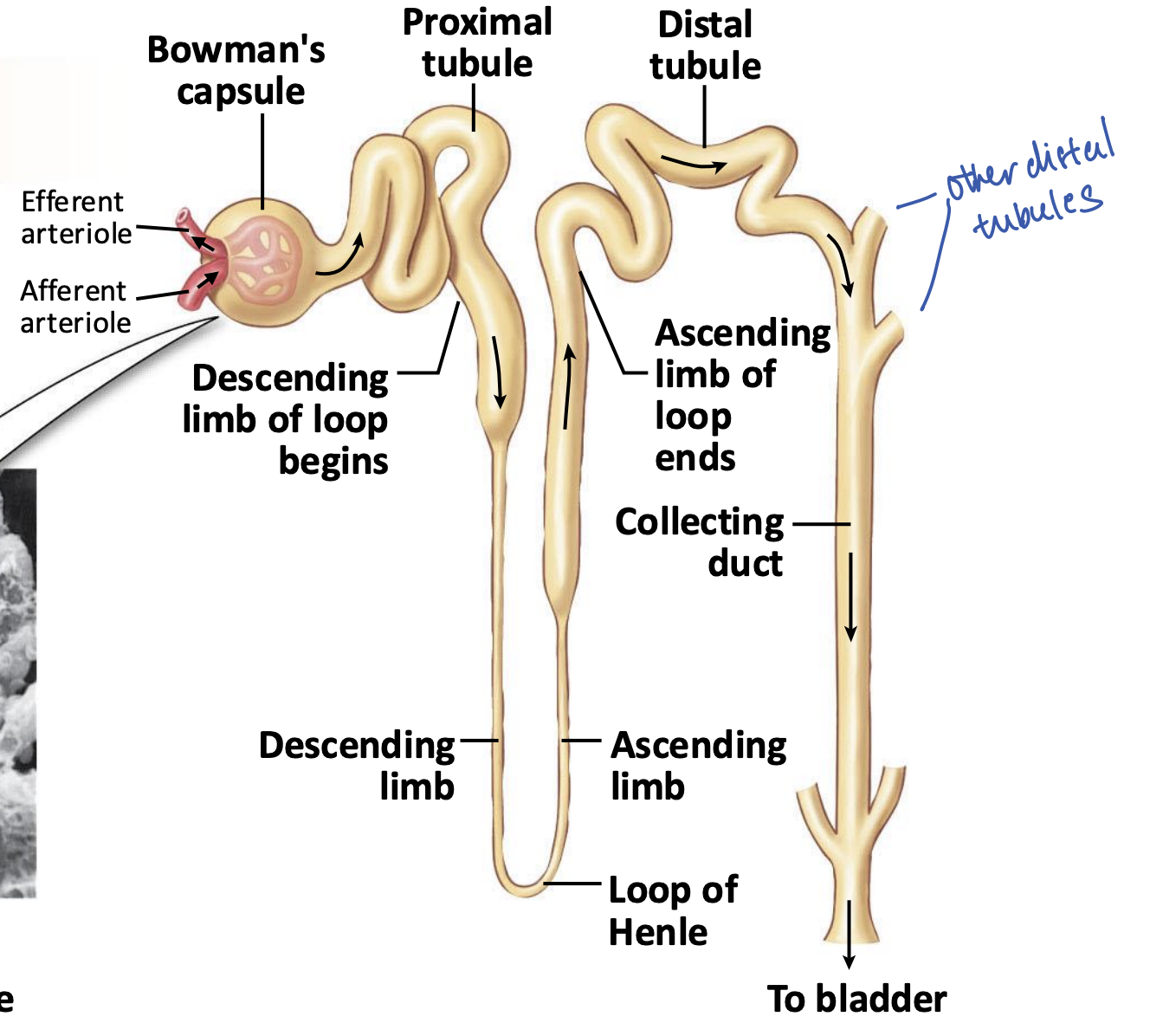
nephron
has two sets of arterioles (afferent and efferent)
has two sets of capillaries that form a portal system
glomerulus
Bowman’s capsule
proximal tubules
descending loop
Loop of Henle
ascending loop
distal tube
collecting duct
bladder
glomerulus
small ball of capillaries that is the site of blood filtration in the kidneys
enclosed by Bowman’s capsule
produces ultrafiltrate which is further modified down the nephron
contains 3-layer filtration barrier: glomerular capillary endothelium, basement membrane, and podocyte
fenestrations that allow filtration
glomerular filtration pressure
= PH (hydrostatic pressure/blood pressure) - π (colloid osmotic pressure due to proteins in plasma) - Pfluid (pressure of fluid in Bowman’s capsule)
= PH - π - Pfluid
autoregulation of GFR
maintains a steady rate of GFR despite large MAP changes between 80-180 mmHg
~180 L/day
myogenic response (intrinsic control of GFR)
↑ MAP = ↑ blood flow = ↑ stretch of afferent arterioles
leads to depolarization of Na+ channels and opening of Ca2+ channels
vasular muscles contract = vasoconstriction
↓ GFR
tubuloglomerular feedback (intrinsic control of GFR)
↑ GFR = ↑ blood flow
macula densa senses increased blood flow of distal tubules and release paracrine factors (ex. adenosine)
afferent arterioles constrict
PH (hydrostatic pressure) ↓
↓ GFR
granular cells
specialized smooth muscle cells in the wall of the afferent arteriole; play a big role in regulating blood flow to the glomerular capillaries
secrete renin, an enzyme involved in salt and water balance.
neural regulation of afferent arteriolar diameter (extrinsic control)
norepinephrine binds to alpha-adrenergic receptors in the afferent arterioles, leading to vasoconstriction (↓ GFR)
hormonal regulation of afferent arteriolar diameter (extrinsic control)
hormones like atrial natriuretic peptide (ANP) mediates vasodilation of the afferent arterioles

amount filtered - amount reabsorbed + amount secreted = amount of solute excretion
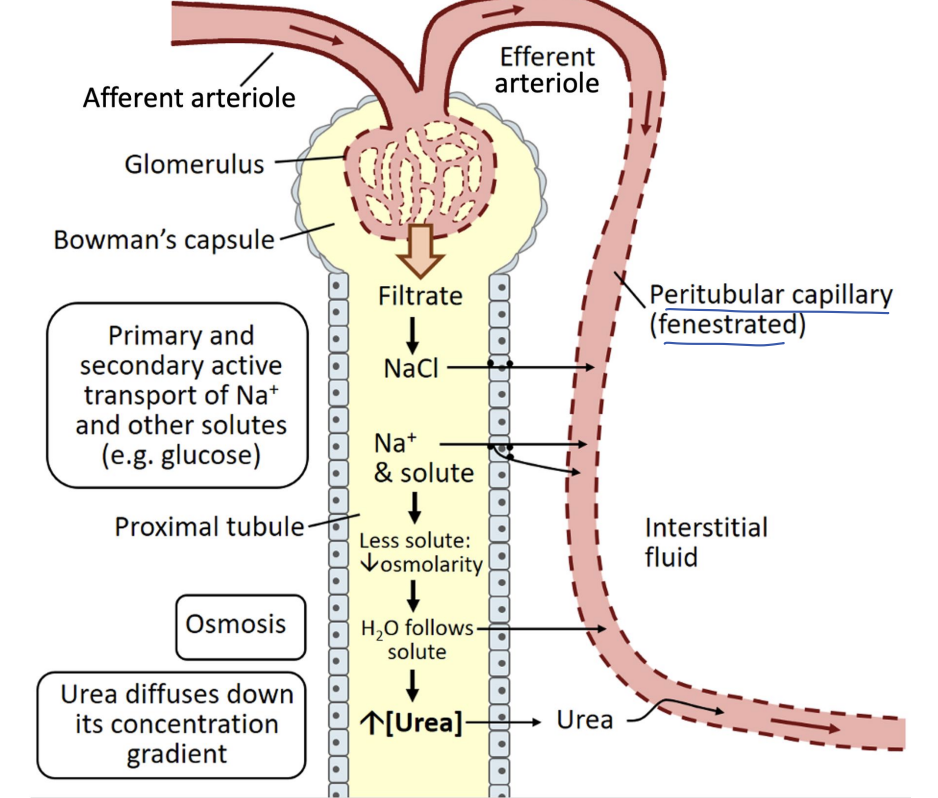
tubular reabsorption of water and solutes
Na+ is reabsorbed by active transport (primary)
Na+ is also actively pumped out to basolateral side by Na+/K+ ATPase pump (primary)
electrochemical gradient drives anion reabsorption (ex. Cl-, glucose) as they diffuse against its conc. gradient (secondary, Na+ dependent cotransport)
water moves by osmosis, following solute reabsorption
permeable solutes are reabsorbed by diffusion through transporter proteins or by paracellular pathways (ex. K+, Ca2+, and urea)
renal secretion
enhances excretion of kidney
active process (moves solutes against conc. gradient)
secretion of K+ and H+ for homeostatic regulation
renal excretion
excretion = filtration – reabsorption + secretion
mass/time (mg/min)
RENAL CLEARANCE = volume / time (mL/min)
renal clearance
non-invasive diagnostic procedure to measure GFR
defined as volume of plasma of a substance that has been completely cleared per unit time
clearance = rate (vol./time) = amount filtered
inulin
benchmark for GFR clearance b/c 100% of inulin is excreted and 0% is reabsorbed into the kidneys
glucose clearance
100% of glucose is REABSORBED and 0% is excreted
Cinulin > Cglucose
urea clearance
an example of net absorption because Rfiltration > Rexcretion
Cinulin > Curea > Cglucose
penicillin clearence
an example of net secretion because Rfiltration < Rexcretion
additional penicillin is being secreted by the proximal tubules of the kidneys
Cpenicillin > Cinulin = Ccreatine = GFR > Curea > Cglucose
Csubstance > Cinulin
secretion: Rfiltration < Rexcretion
Csubstance = Cinulin
NO secretion or reabsorption: Rfiltration = Rexcretion
Csubstance < Cinulin
reabsorption: Rfiltration > Rexcretion
glucose handling by the nephron
filtration does not saturate (through bulk flow and does not involve carrier proteins)
reabsorption is proportional to plasma concentration until transport maximum (Tm) is reached → Tm at max = SGLT proteins become saturated = 375 mg/min
excretion of glucose appears in urine when Tm is maxed and renal threshold is reached (saturated)

type 1 diabetes mellitus (T1DM)
autoimmune disease: destruction of beta cells of pancreas
insulin hyposecretion -→ leading to hyperglycemia and glycosuria (glucose in urine)
damage to blood vessels, eyes, kidneys, CNS due to higher osmotic pressure on vessels as glucose DOES NOT get reabsorbed
polyuria: excessive urine production leading to osmotic diuresis
type 2 diabetes mellitus (T2DM)
due to lifestyle factors (overweight/sedentary) and genetics
insulin resistance in muscles and adipose tissues
glucose tolerance test: cannot differente b/t problems with insulin secretion, synthesis, or end-organ responsivity
hyperglycemia

SGLT2
reabsorbs ~90% of glucose
exclusively for kidneys and has a low binding affinity
high glucose transport
canagliflozin
for type 2 diabetes
inhibits SGLT, preventing glucose reabsorption by the proximal tubule and increasing urine concentration of glucose
side effect: urinary tract infection

homeostatic regulation of blood pressure

what happens when decreased blood volume and GFR lead to H2O absorption and solute excretion?
Isosmotic fluid leaving the proximal tubule becomes progressively more concentrated in the descending limb (aquaporins are present).
Removal of solute in the thick ascending limb creates hypo-osmotic fluid (aquaporins are absent).
Permeability to water and solutes in the distal tubule and collecting duct is regulated by hormones (vasopressin and aldosterone).
Final urine osmolarity depends on reabsorption in the collecting duct.

H2O Movement Across Cell Membranes
Can only occur if epithelial cell membranes are permeable to H2O (i.e., if aquaporin channels are present).
H2O permeability is high in the proximal and distal tubules and is reabsorbed by osmosis in constant proportions following reabsorption of solutes (Na+).
H2O permeability is high in the descending loop of Henle and essentially zero in the ascending loop of Henle,
H2O permeability in the COLLECTING DUCT can be high or low and is regulated by vasopressin which controls the trafficking of aquaporin-2
vasopressin
antidiuretic hormone (ADH) stored in posterior pituitary gland and released into the bloodstream
peptide hormone (hydrophilic)
responses to increased plasma osmolarity and decreased blood pressure → collecting duct epithelium → insertion of water pores (AQP2 stored in vesicles) in apical membrane → increased water reabsorption to conserve water
makes collecting duct more permeable to water
diabetes insipidus (urine is bland and tasteless)
loss of ability to produce vasopressin = central diabetes insipidus
loss of vasopressin receptors = nephrogenic diabetes insipidus
results in H2O diuresis (25 L / day vs 1.8 L / day of urine)
NOT the same as osmotic diuresis which is excessive solute loss
renin-angiotensin-aldosterone system (RAAS)
renin: enzyme involved in water and salt balance, secreted by granular cells of juxtaglomerular nephron
ALSO catalyzes angiotensinogen (from liver) to angiotensin 1 which is further turned by ACE (angiotensin converting enzyme) to angiotensin II
angiotensin II: works together with vasopressin (from posterior pituitary in hypothalamus) and aldosterone (from adrenal cortex) to increase volume, increase pressure, and maintain osmolarity through Na+ reabsorption

hyperkalemia
elevated blood K+ , depolarizes cells, can lead to life-threatening cardiac arrhythmia
reabsorption not regulated by hormone
secretion is regulated by aldosterone
aldosterone
made by adrenal gland
increased K+ = high osmolarity → negative feedback to adrenal cortex secretes aldosterone which targets P cells in collecting duct to reabsorb Na+ and secrete K+
initiates transcription in the nucleus to make new protein channels and pumps and modulate existing ones

Atrial natriuretic peptides (ANPs)
due to increased blood vol + pressure → afferent arteriole stretch in heart
promotes salt and water excretion to lower blood vol. + pressure
