Ch 7:
 Call Kai
 Learn
Learn Practice Test
 Spaced Repetition
 Match
Match Flashcards
 Knowt Play
1/13

There's no tags or description
Looks like no tags are added yet.
Name | Mastery | Learn | Test | Matching | Spaced | Call with Kai | Chat |
|---|
No analytics yet
Send a link to your students to track their progress
14 Terms
What is the fundamental function of the plasma membrane?
It acts as a selective barrier (selective permeability) separating the cell's internal environment from its surroundings, regulating the movement of substances in and out of the cell.
Amphipathic?
They contain both hydrophilic ("water-loving") head regions and hydrophobic ("water-fearing") tail regions. (e.g phospholipids)
Describe the Fluid Mosaic Model.
The membrane is a fluid structure composed of a phospholipid bilayer with various proteins floating or embedded throughout it.

How do unsaturated vs. saturated fatty acid tails affect membrane fluidity?
Unsaturated tails: Kinks in the chains prevent tight packing, keeping the membrane more fluid at lower temperatures.
Saturated tails: Straight chains pack closely together, making the membrane more viscous/solid.

What is the role of cholesterol in animal cell membranes?
It acts as a temperature buffer:
At high temperatures, it restrains phospholipid movement to reduce fluidity.
At low temperatures, it prevents tight packing to keep the membrane fluid.

What is the main structural difference between integral and peripheral membrane proteins?
Integral proteins: (inside) Penetrate the hydrophobic core of the bilayer (transmembrane proteins span all the way through).
Peripheral proteins: Loosely bound to the outer or inner surface of the membrane.

What secondary protein structure typically forms the hydrophobic region of transmembrane proteins?
An -helix composed of nonpolar amino acids.
List the six major functions of membrane proteins.
Transport
Enzymatic activity
Signal transduction
Cell-cell recognition
Intercellular joining
Attachment to the cytoskeleton and Extracellular Matrix (ECM)
Name the three main types of intercellular junctions in animal cells.
Tight Junctions: Prevent fluid leakage between cells.
Desmosomes (Anchoring Junctions): Fasten cells together into strong sheets.
Gap Junctions: Provide cytoplasmic channels for communication between adjacent cells.
What is passive transport, and what drives it?
The movement of molecules across a membrane without any cellular energy (ATP) input, driven naturally by a concentration gradient.
What is osmosis?
The diffusion of free water across a selectively permeable membrane toward a region of higher solute concentration.
(movement of water from a place where it is watery to a place where it is concentrated (or salty/sugary) through a barrier)

How does a cell react when placed in hypertonic, hypotonic, and isotonic solutions?
Hypertonic: Is Higher solute outside → water leaves → cell shrivels.
Hypotonic: Is Lower solute outside → water enters → cell swells/lyses.
Isotonic: Equal solute concentration → no net water movement.

What is the difference between active transport and facilitated diffusion?
Facilitated Diffusion: passive transport, meaning the cell lets substances slide down a concentration gradient (from a crowded area to an empty area) through a helper channel or carrier (no energy req)
Active Transport: Uses transport proteins and energy (ATP) to move substances against their concentration gradient (from an empty area into an already packed room).
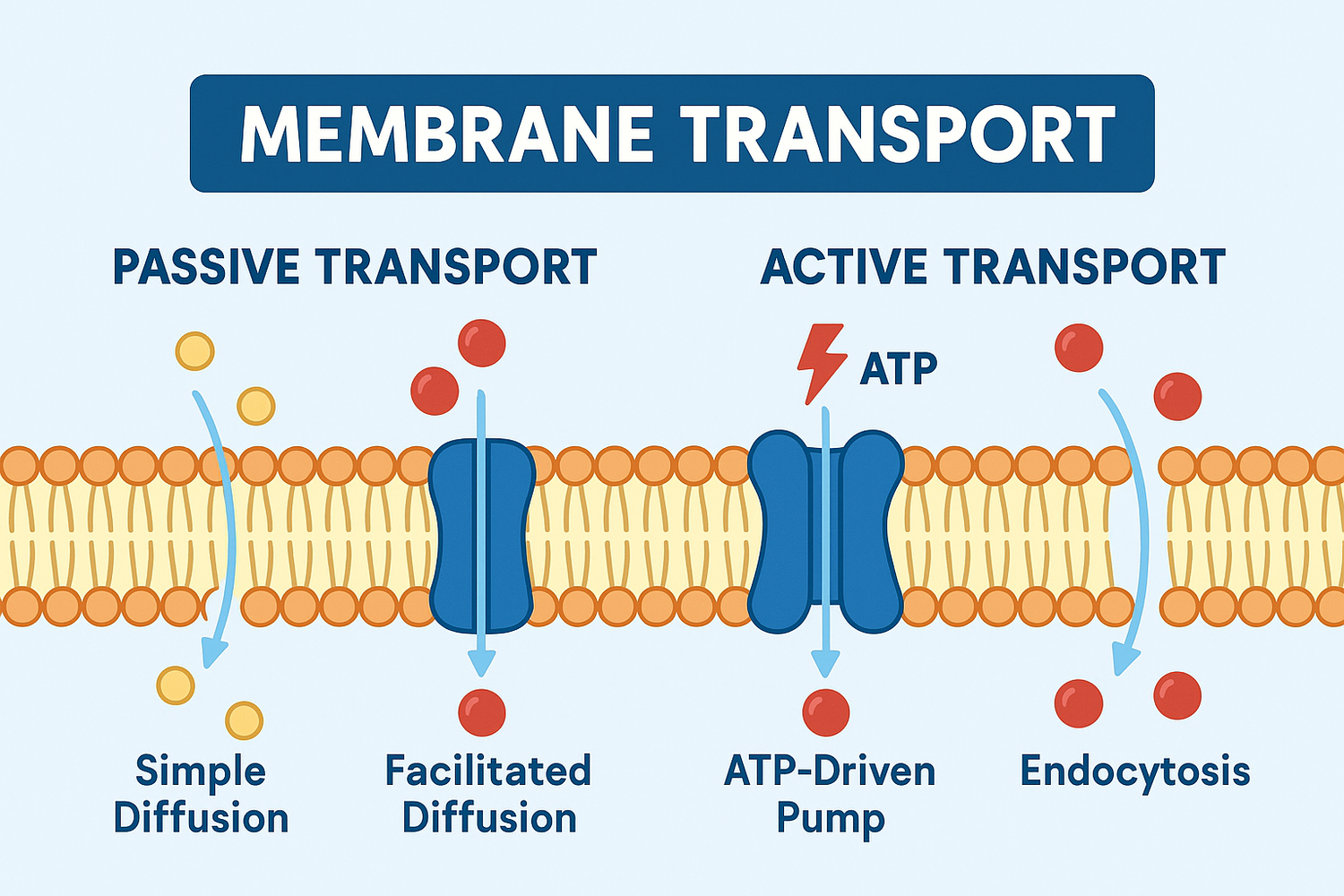
What is the difference between exocytosis and endocytosis?
Exocytosis: Transport vesicles fuse with the membrane to release materials out of the cell.
Endocytosis: The cell takes in materials by forming new vesicles from the plasma membrane.
