Tuberculosis and Leprosy
 Call Kai
 Learn
 Practice Test
 Spaced Repetition
 Match
 Flashcards
 Knowt Play
1/82

There's no tags or description
Looks like no tags are added yet.
83 Terms
What bacteria causes tuberculosis
Mycobacterium tuberculosis
What causes leprosy in Humans
Mycobacterium leprae
What does Mycobacterium bovis cause?
Tuberculosis in cows, rarely in humans.
caused by drinking unpasteurized milk
What two forms can infection by M. tuberculosis take?
Latent or active.
What is latent TB?
Person is infected with M. tuberculosis but the immune system is containing the bacteria.
They have no symptoms and are not contagious.
What is active TB?
The bacteria are replicating and causing disease.
The person has symptoms and, with pulmonary disease, can spread TB through the air.
What is the common abbreviation for Mycobacterium tuberculosis?
Mtb
What is Mtb and where does it live in the host?
It’s an intracellular pathogen that lives within macrophages.
What is unusual about the mycobacterial cell envelope? What does this cause?
It has a high concentration of mycolic acid, which makes it “waxy.”
makes it impermeable to stains and dyes
How do mycobacteria behave with a standard Gram stain? Why do we label it as ‘ gram positive acid fast stain’?
They don’t stain reliably because the dye can’t get through the envelope.
acid fast stain bac. is structurally gram + b/c of its thick peptidoglycan layer but stain poorly due to mycolic acid.
What causes “acid-fastness”?
The presence of mycolic acid in the cell envelope.
What are the steps of the acid-fast stain, in order?
Stain with carbol-fuchsin (red stain) with slow heating
Wash with ethanol and HCl
Counterstain with methylene blue
How do acid-fast and non-acid-fast organisms appear?
Acid-fast organisms appear red (has mycolic acid), and non-acid-fast organisms appear blue (no mycolic acid)
What is the unusual mycobacterial cell envelope associated with?
resistance to antibiotics
osmotic lysis
lethal oxidative stress.
What are the three stages of tuberculosis
Exposure
Latent Infection
Active Disease
How are infectious particles generated in TB? How is TB transmitted in the exposure stage?
Coughing or sneezing
By inhalation of aerosolized droplets from an infected host.
Why does droplet size matter for the droplet nuclei?
small droplets (~5 µm) can stay airborne for extended periods, so more people can be exposed over time and distance than with larger droplets.
What happens to the TB bacteria first in the second stage?
Lung macrophages phagocytose the TB cells.
What may infected macrophages go on to form in the second stage?
Granulomas
What is a TB granuloma?
A “tubercle,” a structure of immune cells that tries to destroy the invading pathogens. It is typically formed by macrophages.
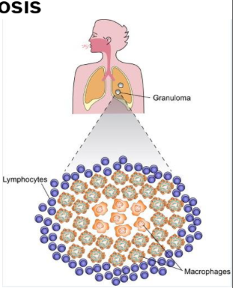
What cells are in a granuloma, according to the diagram?
Macrophages in the middle, surrounded by lymphocytes on the outside.

What does the granuloma represent?
A “balance” between the pathogen and the host, which is the latent infection.
Why is it called latent?
The person is infected, but the granuloma can’t kill the bacteria and the bacteria can’t escape. The infection is contained but not cleared.
In the latent stage, what does TB do to survive in macrophage?
It blocks acidification of the phagosome.
Inhibits fusion of lysosome to phagosome
What is an ESX system?
A protein secretion machine that Mtb uses to move proteins across its thick cell envelope and out into its surroundings, including the host cell.
What do ESX systems do?
They enable the transport of select bacterial molecules across the thick Mtb cell envelope.
Why does Mtb need specialized secretion systems?
Its cell envelope is very thick and waxy so most molecules can’t cross it on their own.
ESX systems act as channels through all these layers.
What other functions do ESX systems have?
can damage the phagosome membrane
can inhibit other immune responses
How do activated T cells help control TB in latent infection?
They secrete cytokines, specifically IFN-gamma, to activate macrophages.
if T cells can activate macrophages to kill TB, why isn’t the infection simply cleared?
Macrophages at the center of the granuloma remain harder for T cells to activate, so TB survives inside them.
What is caseous necrosis?
Chronic inflammation caused in the granuloma
Lesions in the lung that look like “soft cheese.”
In stage 3 TB, What provides the route of transmission in active disease?
The bacteria multiply and erode the granuloma into the airway.
What can cause the shift from latent to active disease?
Deterioration of host immunity, which can result in a life-threatening infection called active tuberculosis.
Is active TB transmissible?
Yes
. How do patients present in active disease?
They become symptomatic.
What happens to the caseous center in active disease?
It can liquefy, leading to cavitation
What is extrapulmonary tuberculosis?
TB infection outside the lungs.
Who is more likely to develop extrapulmonary TB?
Immunocompromised individuals (for example, HIV/AIDS patients) and young children.
What is Miliary tuberculosis
widespread dissemination of TB
almost always fatal
What type of immune response does the tuberculin test measure?
A T cell-mediated response.
When is a person considered infected based on the skin test?
If they convert from negative to positive on a TB skin test.
What could a TB positive result mean?
Latent or active TB, BCG vaccination, or previous infection.
What could a TB negative result mean?
The person is not infected, is immune compromised (for example, AIDS), or has not been infected long enough.
What usually follows a positive tuberculin test?
A careful history and a chest X-ray.
What is the typical X-ray finding in TB?
Upper lobe “shadowing,” which represents lesions.
calcified granulomas

What lab tests are done on sputum?
Staining for acid-fast bacilli and culturing.
What is the interferon-gamma response assay (IGRA)?
A specialized blood test used primarily to diagnose latent TB infection.
What happens if active TB is left untreated?
lethal
How long is the short treatment course for TB?
6 months of antibiotics
Why does TB treatment take so long?
Mtb’s slow growth means long treatments are needed.
Does TB treatment usually use one antibiotic or several?
Generally multiple types of antibiotics.
What does rifampin do?
It inhibits RNA polymerase.
What does isoniazid do?
It inhibits mycolic acid synthesis.
Why give two or more drugs to treat TB
To decrease the chance of antibiotic resistance developing to multiple antibiotics.
What is MDR-TB?
Multidrug-resistant TB.
Resistant to isoniazid and rifampin
What is XDR-TB?
Extensively-drug resistant TB.
resistant to the most effective second line drug for MDR-TB
What is being done to address drug-resistant TB?
New drugs are being developed, along with drug combinations and treatment regimens that take less time.
What kind of vaccine is BCG?
A living vaccine prepared from attenuated M. bovis.
Attenuated = weakened version of bacteria
What secretion system does BCG lack? why does it matter?
The ESX-1 secretion system.
makes BCG less virulent.
Why is BCG controversial?
Its efficacy is variable, about 80% or much less, against pulmonary TB.
Against which form of TB is BCG effective?
Miliary TB.
How does BCG affect the tuberculin skin test?
Vaccinated individuals can give a false positive.
What physical effect does vaccination often have?
It leaves large scars
Who is BCG recommended for?
Individuals at high risk of exposure.
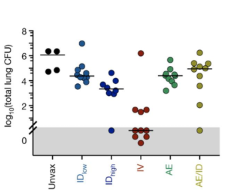
what does this graph explain
The method of administration of the vaccine changed how effective it was
IV was more effective than ID for primates
What causes leprosy?
Mycobacterium leprae.
aka Hansens Disease
What type of disease is leprosy, and how fast does it progress?
: It is a chronic disease with very slow progression, and an incubation period of about 5 years.
What can leprosy damage?
Skin, nerves, limbs, and eyes, and the damage can be permanent.
Where is leprosy common, and where is it rare?
It is very rare in high-income countries. It is mainly found in tropical developing countries.
What are the general features of M. leprae?
gram?
acid or non acid fast?
shape?
w/ or w/o mycolic acid
“Gram-positive,”
acid fast
rod shaped
with a waxy cell envelope (mycolic acid)
Can a Gram stain be used on M. leprae?
No, but it is classified as being like a Gram positive.
What does it mean that M. leprae cannot be cultivated in vitro?
It can’t be grown in the lab outside a living organism (for example, in a culture dish). It can grow in living animals such as armadillos.
Which cells does M. leprae infect? What does it damage?
Macrophages of the skin
Damages schwann cells surrounding nerves.
Which animal is a natural resevoir for Leprosy ) Hanses Disease
What does that make leprosy then?
The armadillo
Therefore, Leprosy can be a zoonotic disease
What is more infectious, TB or Leprosy?
Leprosy is much less infectious
What are the 2 major forms of leprosy? What is their severity?
Tuberculoid form = infected but mild
Lempromatous form = very severe form
What do the skin lesions in tuberculoid leprosy look like? What other symptoms?
Light colored lesions with “anesthetic” areas.
no sensation
Loss of hair
Pigmentation

What physical changes can lepromatous leprosy cause?
Loss of eyebrows, and thickening and enlarged nares, ears and cheeks.
What can happen when the lesions become secondarily infected?
Bone resorption, disfigurements and mutilation.

What is a macrophages response to Mycobacterium leprae
The bacteria is not affecting schwann cell directly but it reprograms the behaviour of macrophages which then affects the schwann cells
What is probably required for transmission of leprosy?
Close and direct contact for extended periods of time.
Do most exposed individuals develop leprosy?
No, most exposed individuals do not develop disease.
What likely plays an important role in protection from leprosy
Host genetics.