2.5 DNA and RNA
 Call Kai
 Learn
 Practice Test
 Spaced Repetition
 Match
 Flashcards
 Knowt Play
1/14

There's no tags or description
Looks like no tags are added yet.
15 Terms
What is DNA?
DNA is a double helix structure in which the strands are antiparallel, containing genetic information which codes for specific amino acids to make a specific protein.
it has two sugar-phosphate backbones attached to one another by complementary bases.
these bases pair in the centre of the molecule by means of hydrogen bonds.
Describe the structure of a DNA nucleotide, draw a diagram to show it’s structure as well
has a nitrogenous base one of: adenine, guanine, cytosine and thymine
has a deoxyribose sugar - with only a H at the C2 position
has a phosphate group

State and explain what a phosphodiester bond
a bond that joins the pentose sugar of one nulceotide to the phosphate group of another nucleotide to form polynucleotides
this occurs by a condensation reaction forming water
Describe how nucleotides join together to form DNA (2)
by a condensation reaction which forms phosphodiester bonds forming DNA polymerase
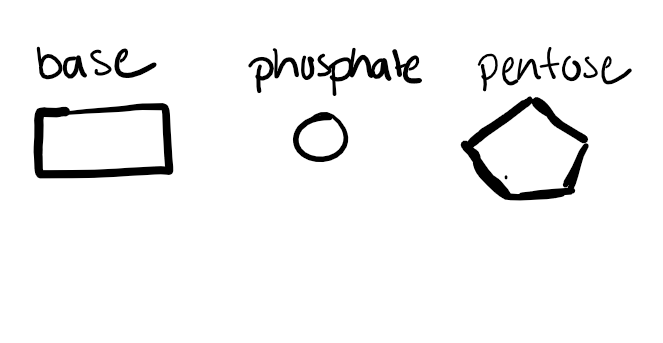
Draw a molecule of DNA that contains four nucleotides, using the shapes shown (2)
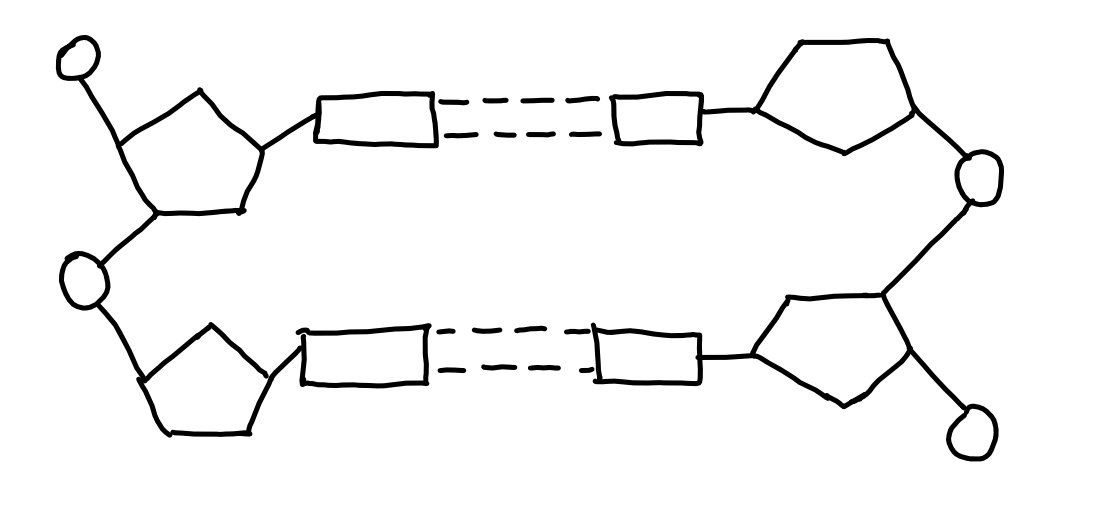
Describe how the two nucleotide chains in DNA are bonded together (4)
complementary base pairs: adenine and thymine, guanine and cytosine which are held together by weak hydrogen bonds
purines bond to pyrimidines
there are 2 hydrogen bonds between A & T whereas there are three hydrogen bonds between C and G
Describe the structure of RNA
a ribose sugar with a hydroxyl group -OH at the C2 position
a phosphate group
a nitrogenous base one of: adenine, guanine, cytosine and uracil
Describe how base pairing occurs in DNA and RNA
complementary base pairs: adenine and thymine, guanine and cytosine
these base pairs are held together by weak hydrogen bonds
Describe the differences between the structure of DNA and the structure of RNA. (3)
DNA is double stranded whereas RNA is single stranded
DNA contains deoxyribose whereas RNA contains ribose
DNA contains thymine whereas RNA contains uracil
DNA polynucleotide chains are much longer compared to RNA polynucleotide chains
Describe and explain how the properties of RNA and DNA enable them to carry out their function
RNA contains the hydroxyl group at the C2 position and so it is more suceptible to hydrolysis
this is why DNA is the storage molecule, contains the genetic code/genetic material and RNA is the transport molecule with a shorter molecular lifespan
State what purines and pyrimidines are and state the difference between purines and pyrimidines
the nitrogenous base molecules occur in two structural forms purine and pyrimidines
the bases adenine and guanine are purine - have a double ring structure and so are bigger
the basses cytosine, uracil and thmine - have a single structure so are smaller
State the role of messenger RNA (mRNA)
transfers the complementary DNA
out of the nucleus
for protein synthesis
Describe the structure and function of tRNA
a single nucleotide chain folded up into a clover shaped molecule
it is held in this shape by hydrogen bonds between base pairs A-U and C-G
at one end of the tRNA molecule there is a specific sequence of 3 bases called anticodon
at the other end is an amino acid binding site
tRNA carries amino acid to the ribosomes where they are used to make proteins
Describe how mononucleotides are bonded together in a DNA double helix structure
the nucleotides are joined together by a phosphodiester bond
forming water whereby the phosphate group of one nucleotide is bonded to the pentose sugar of another nucleotide
Define the term gene
a gene is a sequence of bases on a DNA molecule that codes for a sequence of amino acids in a polypeptide chain