PHRX 5040 Cardio Module - Exam #2 (Dr. Baker's Section)
 Call Kai
 Learn
 Practice Test
 Spaced Repetition
 Match
 Flashcards
 Knowt Play
1/60

There's no tags or description
Looks like no tags are added yet.
61 Terms
define hemostasis
the stoppage of blood loss from a damaged vessel
define thrombosis
- formation of a blood clot inside of a blood vessel
- which can slow or block normal blood flow
what are the 3 major components of hemostasis?
- platelets
- endothelial cells = lining the blood vessels
- coagulation factors
describe the end result of the activated coagulation system
formation of a complex of cross linked fibrin molecules and platelets to stop hemorrhage AFTER injury
overall, describe the process of thrombus formation
- wall defect/damage occurs
- platelets stick to the damaged areas and release other substances to recruit others to help
- downstream more substances are recruited to be activated
- degranulation eventually occurs and glycoproteins are unregulated to stick platelets together
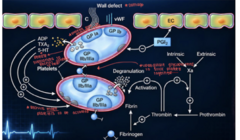
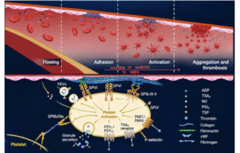
in general, describe the process of platelet activation and aggregation
in the order listed below, there is a progressive increase in platelets brought to that area:
- flowing
- adhesion
- activation
- aggregation and thrombosis
overall, describe what happens when tissue factor (TF) is released from damaged muscle cells
triggers the coagulation cascade
- TF is released and activates the extrinsic coagulation cascade
- downstream it form a fibrinogen mesh

describe the intrinsic coagulation pathway
contact activation via damaged surface leads to activation of the following in this order:
- 12
- 11
- 9
- 10
- 10a

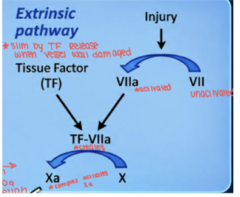
describe the extrinsic coagulation pathway
- stimulated by TF release when the vessel is damaged
- TF-VIIa stimulates the conversion of 10 to 10a
describe the prothrombinase complex activation
- overall, the formation of 10 to 10a in both the intrinsic and extrinsic pathways leads to the activation of the prothrombinase complex
- at this point, fibrin = Ia makes the fibrin mesh that plugs damaged areas wit platelets

what are the 2 most common types of venous thromboembolism (VTE)?
- deep vein thrombosis = DVT
- pulmonary embolism = PE
describe a DVT
- a thrombus is a clot that forms in a deep vein = most commonly in peripheries (legs)
- stasis of blood occurs = clotting
describe a PE
- an embolus = detached clot
- travels through the venous system to the lungs = blocks the lungs
- causes a pulmonary embolism
what 3 main categories of events increase risk of thrombus? (Virchow's triad)
- hypercoagulable state
- vascular wall injury
- circulatory stasis
what are 8 examples of hyper coagulable states?
- malignancy
- pregnancy or peri partum period
- estrogen therapy
- trauma or surgery of lower extremity
- IBS
- nephrotic syndrome
- sepsis
- thrombophilia
what are 6 examples of vascular wall injury?
- trauma or surgery
- venipuncture
- chemical irritation
- heart valve disease or replacement
- asthesclerosis
- indwelling catheters
what are 5 things that may contribute to circulatory stasis?
- a fib
- left ventricular dysfunction
- immobility or paralysis
- venous insufficiency or varicose veins
- venus obstruction from tumor, obesity or pregnancy
what are 3 drug types that are considered anticlotting drugs?
- anticoagulants
- thrombolytics
- anti platelet drugs
what are 3 drug types that facilitate clotting?
- replacement factors
- vitamin K
- antiplasmin drugs
what 3 drug classes are examples of indirect thrombin inhibitors?
- UFH
- LMWH
- pentasaccharides
how does the structure of UFH contribute to its activity?
- has the longest chain connected to the pentasaccharide sequence
- this chain allows it to bind to and inhibit BOTH factor Xa and thrombin IIa

how does the structure of LMWH contribute to its activity?
- shorter chain attached to pentasaccharide sequence
- has more activity against Xa and less, but some, activity against IIa because of this shorter chain

how doe the structure of pentasaccharides contribute to its activity?
- pentasaccharide sequence with NO chain
- it will bind to and inhibit factor Xa but has NO impact on thrombin IIa due to that lack of chain

describe the MOA of UFH
- heparin is an indirect thrombin inhibitor
- heparin binds to antithrombin III
- ATIII binds to and inhibits key clotting factors = specifically Xa and IIa
- this stops growth and propagation of a formed thrombus = important to note that it does not break down already formed clots, only prevents growth
describe the onset of UFH
- IV = immediate with bolus
- SC = 20-30 mins
describe the elimination of UFH
- both hepatic and renal elimination
- dose dependent
- need to monitor levels because PK is unpredictable
describe the MOA of LMWH
- indirect thrombin inhibitor
- binds to and activates ATIII
- ATII binds to and inactivates Xa and IIa = BUT it binds more to Xa then IIa
- stops growth and propagation of a formed thrombus
what is the main idea behind the use of LMWH for VTE?
- almost always given SC and its smaller side again makes its PK more predictable
- by selectively targeting Xa, LMWH effectively prevents new clot formation while maintaining anticoagulant efficacy with a lower bleed risk
describe the elimination of LMWH
- both enoxaparin and dalteparin are renally eliminated
- they require dose adjustments with renal damage
which drug is a pentasaccharide indirect thrombin inhibitor?
fondaparinux
describe the MOA of fondaparinux
- binds ATIII
- selectively inhibits factor Xa
- this means that there is minimal activity against IIa and no direct binding to thrombin
since fondaparinux has a selective mechanism for Xa, what does this imply?
- predictable anticoagulant effect
- once daily SC dosing
- no routine monitoring required = predictable, stable PK
- lower risk of HIT compared UFH/LMWH = does not really affect platelets
what clinical pearl is associated with fondaparinux
- offers a predictable targeted approach with lower risk of HIT
- not used 1st line, only really used if pt has platelet probs like HIT
what are the 2 IV direct thrombin inhibitors?
- agratroban
- bivalirudin
describe the MOA of direct thrombin inhibitors
- bind directly to thrombin = NO cofactor required for activity
- inhibit clot bound thrombin AND free circulating thrombin
which oral anticoagulants inhibit the initiation step of coagulation cascade?
warfarin
which oral anticoagulants inhibit the amplification step of coagulation cascade?
DOACs = inhibit factor Xa
which oral anticoagulants inhibit the propagation step of coagulation cascade?
dabigatran = inhibits IIa
describe the MOA of warfarin
- inhibits vitamin K epoxide reductase
- this prevents activation of vitamin K dependent clotting factors
- only affects FREE clotting factors = prevents formation of new thrombi but no effect on formed thrombi or circulating clotting factors
describe the warfarin SNOT factors
SNOT = 7, 9, 10, 2 in order of which they are inhibited by warfarin
- 7 = 4-6 hrs
9 = 21-30 hrs
- 10 = 27-48 hrs
- 2 = 42-72 hrs
also impacts protein C and S
describe the duration of warfarins effects
- duration = 2-5 days
- caused by the half life of clotting factors inhibited
describe the CYP metabolism of warfarin
warfarin is a racemic mixture = S warfarin more potent
- 2C9 = primary metabolism = S warfarin
- 3A4 = secondary metabolism = R warfarin
overall, describe the MOA of DOACs
they bind to clotting factors directly to inhibit them
what 3 drugs are direct factor Xa inhibitors?
- rivaroxaban
- apixaban
- endoxaban
which drug is a direct thrombin inhibitor?
- dabigatran
- binds to and inhibits IIa
compare the bioavailability of DOACs
- compared to factor Xas, dabigatran has a much lower bioavailibility
- requires special dosage form for better absorption
what is the dosing frequency of the following:
- dabigatran
- rivaroxaban
- apixaban
- dabigatran = once or twice daily
- rivaroxaban = once or twice daily
- apixaban = TWICE daily
which DOAC had the most renal elimination? what does this mean
- dabigatran
- not ideal for renal dysfunction, will require dose adjustments
which DOAC had the least renal elimination? what does this mean
- apixaban
- best option for pts with poor kidney function
what key DDIs are seen with factor Xa inhibitors
potent inducers and inhibitors of P-gp and CYP3A4
which medication is the ONLY oral direct thrombin inhibitor?
dabigatran
describe the metabolism of dabigatran
- P-gp substrate
- NO CYP interactions
describe the bioavailibility of dabigatran, what does this mean?
LOW bioavailibility = needs acidic enviorment for full absorption
- capsule creates an acidic enviorment in the gut
- tablets can NOT be crushed, chewed, broken or opened
- caution with long term PPI use = reduces absorption
describe the clearance of dabigatran
- renally eliminated
- avoid in severe hepatic and renal impairment
what is a unique ADE seen with dabigatran? why does this occur?
dyspepsia
- occurs because of the packaging delivery system
- should take with a full glass of water
what 3 drugs are considered thrombolytics?
- alteplase
- reteplase
- tenecteplase
what is the route of admin for all thrombolytic drugs?
IV
describe the half lives of all thrombolytic drugs, which is shortest acting?
- all short acting
- shortest acting = alteplase so it requires IV bolus and infusion
how is alteplase administered?
IV bolus + infusion
how is reteplase administered?
double IV bolus
how is tenecteplase administered?
single IV bolus