Body Fluids
 Call Kai
 Learn
 Practice Test
 Spaced Repetition
 Match
 Flashcards
 Knowt Play
1/53

There's no tags or description
Looks like no tags are added yet.
54 Terms
Cell viability relies on two interconnected conditions:
relative constancy of internal environment
continuous physical and chemical exchanges between internal fluid compartments and external environment
The most abundant chemical constituent of the human body, accounting for 45% to 75% of total body mass
H2O
Essential biological roles of body water:
serves as aqueous solvent in which all organic molecules are dissolved and metabolic reactions occur
regulates body core temperature via evaporative heat loss
lubricates joints, protects organs and moistens mucosal tissues
facilitates waste elimination via renal (kidney) excretion and hepatic (liver) processing
transports oxygen, nutrients, and electrolytes to peripheral tissues
What mainly drives individual variations in TBW?
Adipose tissue (10% H2O content)
How does H20 content as a proportion of lean body mass (i.e excluding adipose) compare between all individuals?
Consistently uniform; because lean tissue has relatively similar water content across individuals (70-80% H2O content)
The main determinant of TBW %
Variation in total adipose tissue proportion is the most important factor explaining why TBW varies across individuals
Why does more adipose tissue lower TBW%?
Adipose tissue is only ~ 10% water (much less than lean body mass)
What is the approximate water content of muscle
~ 75% water
True or False; water content varies significantly across tissues
True
What is the approximate water content of visceral organs?
70-80%
What is the approximate water content of bone?
~25% water
How does TBW change with sex after puberty?
Females has lower TBW % because estrogen promotes subcutaneous adipose deposition
How does TBW% differ before puberty?
Prior to puberty, male and female children display identical body water proportions
What is a typical adult female TBW?
~ 50% of body mass ; 35L for a 70-kg female
Why do newborns have high TBW?
Newborns possess minimal subcutaneous fat, resulting in a high TBW content of ~75%
Why does TBW% decrease with age?
Tissues become progressively drier due to age-related loss of muscle (replaced by drier connective tissue) and accumulation of adipose;
reducing TBW to ~45% in elderly females (~31.5 L for 70 kg)
Why can the same administered drug mass produce different concentrations?
Because water-soluble medications distribute throughout TBW, variations in TBW % alter the final circulating drug concentration when dosed purely by gross body weight
ex. different concentrations result between 70-kg patients from dosing the same amount because final concentration depends on TBW volume

What happens to final concentration if TBW doubles at the same dose?
Final concentration is halved
Components of daily water input:
oral fluids (~1.2L)
food intake (~1.1L)
oxidative/metabolic water; synthesized intracellularly as a byproduct of cellular aerobic respiration (~0.4L)
Components of daily water output
insensible (unconscious loss via evaporation)
sensible (conscious measurable excretions)
most are obligatory losses (~1.5L regardless of fluid intake) while only urine is categorized as facultative loss
Insensible losses:
lungs: humidified exhaled air (increase in cold or high altitude dry air) ~ 0.4L
skin: non-sweat passive evaporation ~ 0.5L
Sensible losses:
feces ~ 0.1L
urine (kidneys); minimum obligatory volume ~ 0.5L
How does sweat differ from other forms of daily water output?
Sweat is categorized as a sensible loss that is neither obligatory nor facultative (body cannot increase sweating to clear excess fluid intake)
Facultative loss:
Variable urine volume excreted by the kidneys to eliminate excess intake and maintain balance
What is the primary homeostatic organ for water balance?
Kidneys
What explains the higher water turnover rate in infants (~10%/ 24hrs) compared to adults (3-4%/24 hrs) ?
Infants have a high surface-area-to-volume ratio (SA:V), making them exceptionally vulnerable to dehydration
Distinguish insensible perspiration and sweating
Insensible perspiration is the continuous, obligatory loss of pure water through passive evaporation across the entire skin surface (occurs in absence of sweat glands), and it is influenced by ambient temperature and relative humidity.
Sweating, in contrast, is the active secretion of an electrolyte-containing fluid by sweat glands, primarily caused by high temperatures or physical activity.
Who formulated the concept of "milieu intérieur", stating that complex organisms carry an internal fluid environment ("milieu intérieur") that bathes individual cells
Claude Bernard
When does water Intoxication (Hyponatremia) occur and what are consequences?
When rapid excessive water intake exceeds kidney’s excretion rate, diluting extracellular Na+
Hyponatremia creates hypotonic ECF, driving water into body cells via osmosis; this causes cellular swelling and lysis which can lead to cerebral edema, hemorrhages, or death
What are the two major body water compartments?
ICF: aggregate of fluid enclosed by body cell membranes (2/3 TBW; 40% body mass)
ECF: all fluid situated outside cell membranes (1/3 TBW; 20% body mass)
What separates the two major body water compartments?
Total body water (60% of body mass) is divided into two primary fluid compartments (ICF and ECF) separated by cell plasma membranes
What separates the two major sub-compartments of ECF?
Capillary endothelial walls
Major ECF Subcompartments:
interstitial fluid (ISF): percolating between individual tissue cells ("milieu intérieur"); ¾ of ECF; 15% body mass
plasma: medium in which blood cells are suspended; ¼ of ECF; 5% body mass
Minor ECF Subcompartments (< 1-2% of ECF)
lymph: ISF collected by blind-ended terminal lymphatic tubules that drain back into chest veins
transcellular fluids: aggregate of specialized fluids secreted by endothelial cells lining body cavities (ex. cerebrospinal, synovial, pleural, pericardial and peritoneal fluids)
Why is transcellular fluid usually insignificant for systemic water balance?
It exchanges little water with the rest of the body on a systemic scale
Why can local changes in transcellular fluids cause severe pathology?
Transcellular fluid is small in total volume, but because it occupies specialized, confined spaces, abnormal accumulation can cause major local problems.
ex. glaucoma (excess transcellular fluid accumulates in the eye) and joint effusion (excess synovial fluid accumulates within a joint cavity)
Buffy coat:
The middle layer (<1% of column) of centrifuged blood fractions consisting of WBCs (leukocytes) and platelets
Hematocrit:
Percentage of total blood volume occupied by RBCs; normal reference value ~ 45%

If plasma volume (Vplasma) and hematocrit (Ht) are known, how can total blood volume be calculated?
Because plasma constitutes the remaining non-RBC fraction (1-Ht);

What is the ionic composition of the two major body fluids?
ECF: High in Na+ and Cl-; low in K+
ICF: High in K+ (and Mg2+); low in Na+ and Cl-
Physiological saline (0.9% NaCl):
serves as an isotonic replacement for lost ECF; prepared by dissolving 9g NaCl in 1L H2O (0.9g/100mL)
Ringer's & Locke-Ringer Solutions:
Complex physiological solutions concocted to match ECF ionic composition and maintain isolated cell viability
What are the steps involved in the indicator dilution method?
introduce known quantity (Q) of indicator into the vein
allow time for vascular circulation & distribution
retrieve a plasma sample and measure concentration (c)
calculate volume: V = Q/c

Why is the direct measurement of compartment volume method not practical clinically?
It involves complete evaporative desiccation (e.g., drying an organism in a desiccator); lethal and non-viable clinically.
Is the indicator dilution method a direct or indirect measurement of compartment volumes
Indirect; fluid volume is measured from indicator concentration rather than measured directly
Ideal indicator properties:
non-toxic and biologically inert (doesn’t react with, change or participate in metabolic processes of living organisms)
diffuses readily and distributes evenly throughout the target compartment
does not alter fluid distribution or osmolarity between compartments
easily measured in plasma (ex. radio labeled compounds or dyes)
For indicator dilution method, what are the indicator permeability requirements if target compartment is TBW?
Indicator must be able to permeate both capillary walls and cell membranes (ex. antipyrine)
For indicator dilution method, what are the indicator permeability requirements if target compartment is ECF?
Indicator must cross capillary walls but not cell membrane (eg. radiolabled inulin, sucrose, or mannitol)
For indicator dilution method, what are the indicator permeability requirements if target compartment is plasma volume?
Indicator must be limited to vascular space; cannot cross capillary walls (eg. Evans Blue dye)
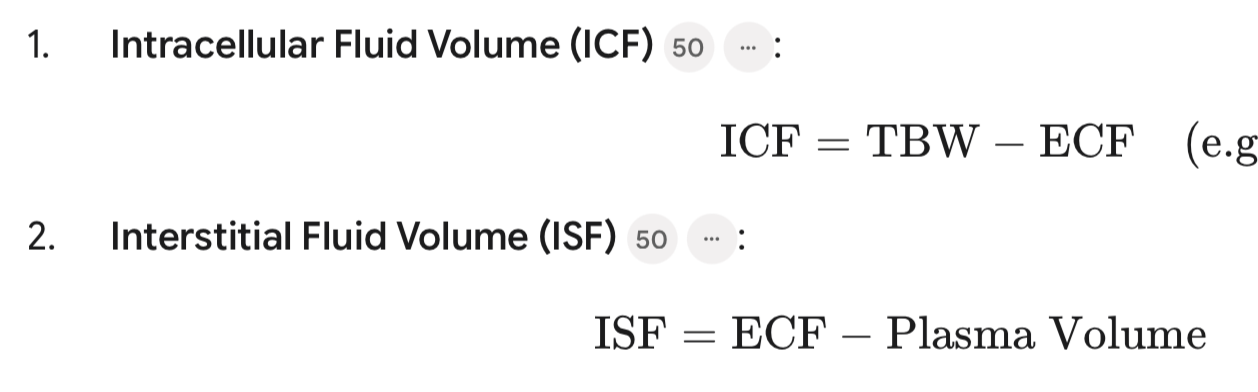
Why are ICF and ISF volumes calculated indirectly using two indicators?
Because no single indicator can selectively accumulate inside cells or exclusively interstitial space without equilibrating elsewhere
Mass/Volume Percent (g%):
Grams of solute per 100mL (1dL) of solution
(ex. 0.9g NaCl in 100mL H2O = 0.9% solution)
Molarity (M):
Moles of solute per 1L of solution (1M solution contains Avogadro’s number of molecules per litre)
Molality (m):
Moles of solute per 1kg of solvent
Equivalents (Eq)
Measure electric charge per unit volume
ex. Na+ (valency = 1) = 1Eq/mole, Ca2+ (valency = 2) = 2Eq/mole
