Lecture 7 - Corporate Finance and Capital Structure
 Call Kai
 Learn
 Practice Test
 Spaced Repetition
 Match
 Flashcards
 Knowt Play
1/52

There's no tags or description
Looks like no tags are added yet.
53 Terms
The main objective of a business is to maximise firm value, what are the three decisions about how to do this?
The investment decision
The cost of capital reflects the riskiness of investments and the financing mix used
The return reflects the size and timing of cash flows, and all side effects
The financing decision
The optimal mix of debt and equity that maximises the firm value
The right type of debt that matches the tenor of your assets
The payout decision
How much cash you can return depends on current and potential investment opportunities
How you choose to return cash depends on whether they prefer dividends or share repurchases
What are the classic objectives of stockholders, bondholders, financial markets and society?

What is the difference between the theoretical and practical relationship between stockholders and managers?
In theory: The stockholders have significant control over management
Expressing disapproval
Voting to keep managers in check
The board of directors check on management
In practice: Neither mechanism is as effective
What is the difference between the objectives of stockholders and bondholders in theory and practice?
In theory: No conflict of interest between stockholders and bondholders
In practice: Stockholders and bondholders have different objectives. Bondholders are most concerned about safety and ensuring that they get paid their claims. Stockholders are more likely to think about upside potential
What is the difference between the theoretical and practical relationship between firms and financial markets?
In theory: Financial markets are efficient. Managers convey information honestly and in a timely manner to financial markets, and financial markets make reasoned judgements on the effects of this information on “true value”. As a consequence:
A company that invests in good long-term projects will be rewarded
Short-term accounting gimmicks will not lead to increases in market value
Stock price performance is a good measure of company performance
In practice: There are some holes in the “efficient markets” assumption and information (especially negative) is sometimes suppressed or delayed by managers
What is the difference between the theoretical and practical relationship between firms and society?
In theory: All costs and benefits associated with a firm’s decisions can be traced back to the firm
In practice: Financial decisions can create social costs and benefits:
Social costs
Environmental costs (eg. pollution, health costs)
Quality of life costs (eg. traffic, housing, safety)
Social benefits
Creating employment in areas with high unemployment
Supporting development in inner cities
Creating access to goods in areas where such access does not exist
Corporate social responsibility (CSR)
Environmental, social and (corporate) governance (ESG)
What are the solutions when the objectives of corporate decisions go wrong?

What is capital structure and an un-levered and levered firm?
Capital structure is the proportion of the firm’s capital that is financed by debt or equity
An un-levered firm is only financed by equity (no leverage), a levered firm borrows and so is financed by both debt and equity
What does an illustrative balance sheet at market values look like for an un-levered firm compared to a levered firm?

What is M&M Proposition I?
M&M (1958) created a simplified model of the world, where there are no taxes and capital markets function well. They concluded that the value of a firm remains constant regardless of the debt level
M&M Proposition I (Without Taxes): V(L) = V(U)
The market value of the firm is independent of its capital structure
If two firms have the same cash flows, they must have the same value
If the value of two firms with the same cash flows is not equal, then we have the possibility of arbitrage which will make them equal


What is M&M Proposition II?
States that E + D = U = A. The total market value of the firm’s securities is equal to the market value of its assets, whether the firm is un-levered or levered
E = Market value of equity in a levered firm
D = Market value of debt in a levered firm
U = Market value of equity in an un-levered firm
A = Market value of the firm’s assets
The cost of capital of levered equity is equal to the cost of capital of un-levered equity plus a premium that is proportional to the market value debt-equity ratio
What is the formula for M&M Proposition II and how is it derived?


What is this graph showing?
A firm’s cost of equity capital is a positive linear function of the firm’s capital structure
The WACC doesn’t depend on the debt-equity ratio (Proposition I)
What are the implications of M&M II?
The cash flows from holding un-levered equity can be replicated using homemade leverage by holding a portfolio of the firm’s equity and debt
Homemade leverage is when investors use leverage in their own portfolios to adjust the leverage choice made by the firm


What other factors affect a firm’s capital structure?
Corporate and personal taxes
Transaction costs
Costs of financial distress
Principal-agency issues
Asymmetric information and signals
Describe the interest tax deduction
M&M relaxed assumption of no taxes: Interest payments are deductible for tax purposes while dividend payments are not
Corporations pay taxes on their profits after interest payments are deducted
Interest reduces the amount of corporate taxes
This creates an incentive to use debt
Show a bar chart of the cash flows of assets, an un-levered and a levered firm due to taxes

What is M&M Proposition I with Taxes and the formula for the tax shield?
The total value of the levered firm exceeds the value of the firm without leverage due to the PV of the tax savings from debt

Draw the graph showing firm value of the levered and un-levered firm under Proposition I with Taxes, and the formula for WACC

Give a summary of the M&M Propositions and how WACC is identified


What causes the cash flows to investors to be typically taxed twice?
Once at the corporate level and again when they receive their interest or dividend payment
For individuals:
Interest payments received from debt are taxed as income
Equity investors also must pay taxes on dividends and capital gains
Describe the tax effects on a firm financed with more debt, and one with more equity and what’s the net advantage?
A firm financed with debt will have more cash to return to investors, but the cash then received will be taxed at a higher rate
A firm financed with equity will have less cash to return to investors, but the cash then received will be taxed at a lower rate
Net advantage is still for firm to finance with debt, but tax advantage is reduced if we consider personal tax rates
Show the after-tax cash flows if the investor is paid interest, or paid a dividend/capital gain

Show the relative advantage of debt in terms of the tax benefit

What is an initial public offering (IPO)?
The process of selling stock to the public for the first time
Greater liquidity and better access to capital
The equity holders become more widely dispersed
The firm must satisfy all the requirements of public companies
After deciding to go public, managers of the company must work with an underwriter, who is an investment banking firm that manages a security issuance and designs its structure
What are some of the largest UK IPOs?
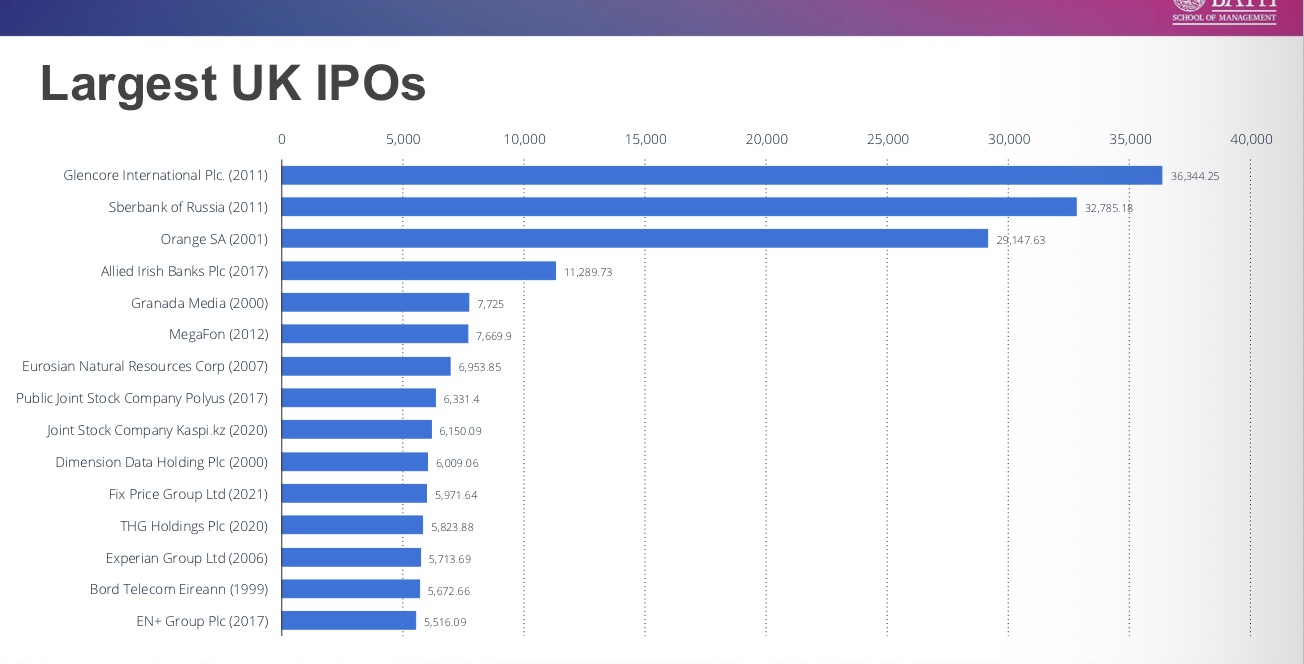
What are the 4 types of offerings?
Primary and secondary offerings
Best-efforts
Firm committment
Auction IPOs
Describe primary and secondary offerings, and best-efforts
Primary and secondary offerings
New shares available in a public offering that raise new capital
Shares sold by existing shareholders in an equity offering
Best-efforts
For smaller IPOs, a situation in which the underwriter doesn’t guarantee that the stock will be sold, but instead tries to sell the stock for the best possible price
Describe firm commitment and auction IPOs
Firm commitment
An agreement between an underwriter and an issuing firm in which the underwriter guarantees that it will sell all of the stock at the offer price
Auction IPOs
Rather than selling a price itself and allocating shares to buyers, the underwriter in an auction IPO takes bids from investors and then sets the price that clears the market

How does the action IPO set the price? (Hint: Work out accumulated number of shares bid)

What are the mechanics of an IPO?
Underwriters and the syndicate
SEC filings
Valuation
Pricing the deal and managing risk
Describe underwriters and the syndicate
Lead underwriter: The primary investment banking firm responsible for managing a security issuance
Syndicate: A group of underwriters who jointly underwrite and distribute a security issuance
Describe SEC filings
Registration statement
Preliminary prospectus (red herring)
Final prospectus
Describe valuation
There are two ways to value a company:
Compute the PV of estimated future cash flows
Estimate the value by examining comparables (recent IPOs)
Describe pricing the deal and managing risk
Spread: The fee a company pays to its underwriters that is a percentage of the issue price of a share of stock
Potentially the risk that the banking firm might have to sell the shares at less than the offer price and take a loss
What is financial distress and what does it mean for shareholders and cost of borrowing?
A firm experiences difficulties paying its debt
Bankruptcy is not costless
Legal and other admin, fees involved
Sale assets at less than value in use
Shareholders are likely to demand higher returns to compensate for the risk of financial distress caused by higher gearing
Cost of borrowing is also likely to increase as debt holders become concerned about default
What are the direct and indirect costs of financial distress?
Direct costs: Costs of the process itself, eg. legal, accounting, administrative
Indirect costs: Impact on operations, eg. customers, suppliers, managers, agency costs, ability to raise new funds or invest in positive NPV projects
What is the trade-off theory?
Whilst debt is tax deductible and may increase distributable cash flows (subject to personal taxes), financial distress costs require caution in the use of debt financing
This trade-off between tax and financial distress considerations is referred to as the trade-off theory of capital structure
What is the value of a levered firm with financial distress costs included, and what does this mean about the trade-off?
V(L) = V(U) + PV (tax shield) - PV (financial distress costs)
The gain from the tax shield on debt is offset by the financial distress costs. An optimal capital structure exists that balances the additional gain from leverage against the added financial distress costs
Draw a diagram showing the trade-off theory of firm value against debt-to-equity ratio

Draw another diagram showing the trade-off theory, but as cost of capital (WACC) against debt-to-equity ratio

Describe the pecking order theory and the assumptions of it
Financing comes from three sources, internal funds (retained earnings), debt and new equity
Companies prioritise their sources of financing, first preferring internal financing, then debt, then equity as a last resort
Assumptions of the theory:
Managers act in the interest of existing shareholders (they don’t sell undervalued securities)
Information asymmetry: Investors don’t know the true value of either the existing assts or the new opportunity, but managers do
A firm with assets-in-place has a growth opportunity requiring additional financing. Now the firm announces an issue of ordinary shares. What would new investors think about it?
Investors may view the share issue as good news if it signals a growth opportunity with a positive NPV. However, it may be bad news if managers believe the firm's existing assets are overvalued and are trying to issue overpriced shares
Investors may suspect that only overvalued firms issue new shares, since managers of undervalued firms would avoid doing so. This causes investors to mark down the share price. Evidence: Share prices fall by approximately 3% on average following a share issue
What are the implications of the pecking order theory?
The theory doesn’t produce an optimal capital structure outcome
Companies choose financing sources based on resource availability and the signal that issuing securities provides to the market
More profitable firms have more internal funds available and would exhaust these before going to external capital markets
There is a negative relationship between profitability and debt-equity ratios
Share issue is a bad news signal while debt issue is good news or no-news signal
Expect the share price to decrease on the announcement of an equity issue, and expect it to increase or not change on the announcement of a debt issue
What is the background behind the Boeing Capital Structure Case Study?
Founded: 1916, with headquarters in Arlington, Virginia, USA
Business: Commercial aircraft; defence and spaces; services
Revenue: $71bn (9 months to Sep 2026)
Market value: Around £22bn in 2024
Why is capital structure important to Boeing?
- Capital-intensive production: Boeing requires significant investment in aircraft development, manufacturing facilities and inventory. Long production cycles mean large amounts of capital are tied up before revenue is generated
- Volatile operating cash flow: Events such as the 737 MAX disruption, COVID-19 and labour strikes can reduce revenue and disrupt cash flow. High debt levels could make it harder to meet interest and repayment obligations
- Financing flexibility: Boeing needs substantial funding for future investment and operations. Maintaining a suitable capital structure helps preserve borrowing capacity and achieve an investment-grade credit rating, allowing it to borrow at lower interest rates
What was Boeing’s capital structure (short-term and long-term debt, book equity and book D/E ratio) on 30 Sep 2026?

What did Boeing’s capital structure look like in 2010-18, 2019-20, and 2024-26, including the D/E ratio?

What financing choices did Boeing make to respond to the risk they had (from 2019 to Sep 2026), and how do these choices link to the pecking order theory?
- 2019 – 737 MAX disruption: Aircraft grounding caused major financial losses and negative operating cash flow, increasing financial pressure.
- 2020 – Debt surge: Total debt increased to $63.6bn as Boeing borrowed to support operations during the pandemic and financial difficulties.
- October 2024 – Equity raise: Boeing raised $23.9bn in net proceeds through equity offerings, strengthening its balance sheet without increasing debt.
- 2025 – Asset sale: Boeing agreed to sell its digital aviation business for $10.55bn, generating cash to improve its financial position.
- December 2025 – Acquisition: Boeing completed its acquisition of Spirit AeroSystems, bringing an important aircraft supplier back under its control.
- September 2026 – Balance sheet: Debt stood at $45.9bn, with liquid assets of $20.7bn, showing a reduction in debt from its 2020 peak.
Link to theory: As financial distress costs increase, companies may prefer issuing equity or selling assets rather than taking on further debt. This reduces financial risk and the pressure of interest payments.
Describe the capital structure in practice with Tesco’s case
- Trade-off theory: Increasing debt raises interest and repayment obligations, increasing the risk and potential costs of financial distress
- Pecking order theory: The 2024 equity issuance can be justified when taking on additional debt would create too much financial risk
- Financial flexibility: Maintaining sufficient liquidity and a strong credit rating helps the company access finance and fund future investment
- Ratio interpretation: Negative book equity makes historical book debt-to-equity ratios unreliable because the equity figure is negative