Bio Exam Unit 2
 Call Kai
 Learn
 Practice Test
 Spaced Repetition
 Match
 Flashcards
 Knowt Play
1/97

There's no tags or description
Looks like no tags are added yet.
98 Terms
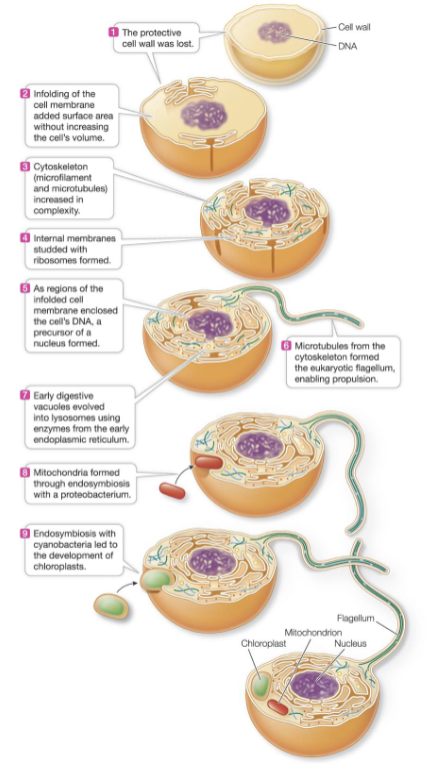
Key Eukaryotic traits and their specifics
• Flexible cell membrane since lost cell wall: Cells can change shape, move in new ways, pinch off bit of surroundings by endocytosis or phagocytosis→ Cells can grow bigger and move
• Complex cytoskeleton: Flagella
• Nuclear membrane: Outer membrane of the nuclear envelope flows directly into the membrane of the rough ER. internal space of the ER is continuous with the nuclear space of the envelope. But, molecules inside the ER lumen or nuclear envelope are still separated from the extracellular space by the plasma membrane.
• Digestive vacuoles
• Organelles: Mitochondria, chloroplasts, Diversity of energy production
• Sexual reproduction: Mitosis, Meiosis* / recombination
How are eukaryotes related: traditional groups included
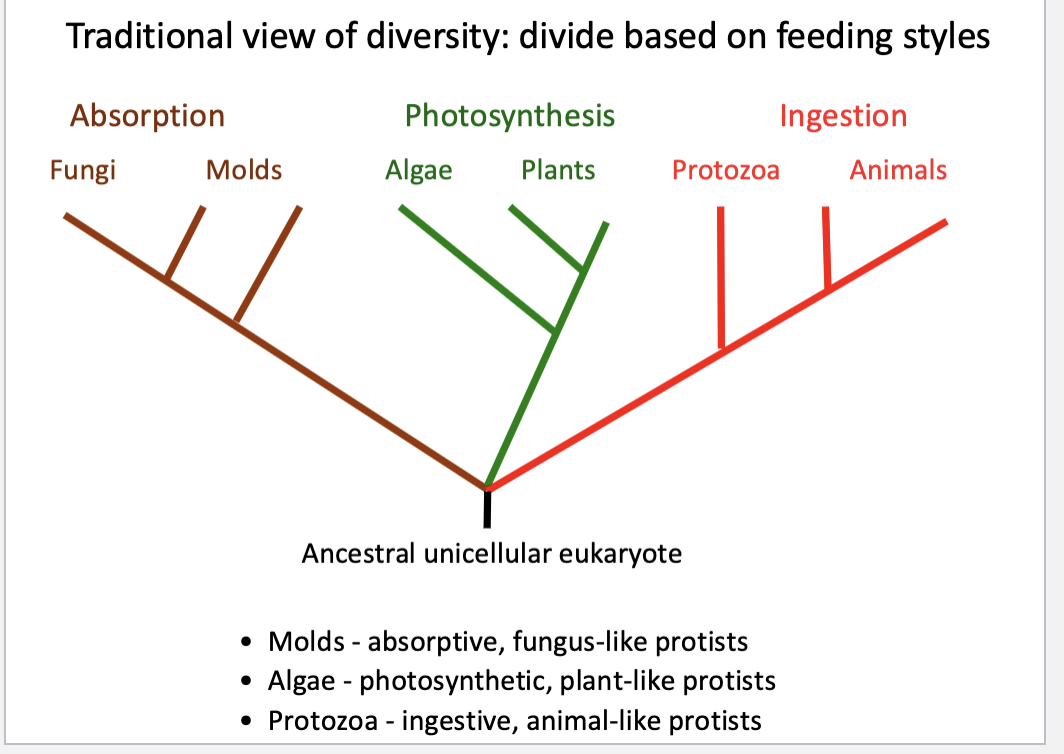
Traditional grouping included: Animals, Plants, Fungi, and Protists (everything else)
• Protists are not a monophyletic group! Typically single celled
• Environmental DNA is helping us describe new species
• The phylogeny is still changing

Traditional view of diversity: divide based on feeding styles
How has our understanding of major eukaryotic groups evolved
Scientists have changed their understanding of how major eukaryotic groups are related as new evidence from DNA and RNA sequences has become available.
Eukaryotes are organisms whose cells have a nucleus. They include animals, plants, fungi, and many protists.
5 major supergroups: Excavata, Amoebozoa, Chromalveolata, Archaeplastida, Opisthokonta
Why has our understanding changed?
Scientists originally grouped organisms based on visible traits, such as movement and appearance.
DNA and RNA comparisons revealed evolutionary relationships that are not always obvious from appearance.
Some traditional supergroups, especially Excavata and Chromalveolata, have been revised or split as new evidence emerged.


Two contrasting hypotheses for the origin of mitochondria
1. Late origin - basal eukaryotes split off before the evolution of mitochondria in other lineages
2. Early origin – Mitochondria arose in eukaryotic common ancestor but were lost in some groups

Genetic and structural evidence across the tree for mitochondria
and implications
• Relics:
Genetic: “Mitochondrial” genes (genes with close homologs
in proteobacteria) in their nuclear genomes
Structural: Mitochondrial remnants
Hydrogenosomes (H2 – generating organelles) - double membrane-bound organelles with some redox reactions but no organized ETC’s
Mitosomes have double membranes
• Implications
Single origin of mitochondria at the base of the eukaryotes
Secondary loss in some lineages of Excavates (and in a number of other groups) - some still have reduced mitochondria that perform other functions, and others lost it entirely.
Metamonada (ciliated) include diplomonads and parabasilids
• Anaerobic
• Diplomonads (e.g. Giardia)
Usually commensals in animal guts
Some parasites – camper’s diarrhea from drinking stagnant water
• Parabasalids – animal symbionts/ parasites
Trichonympha – eukaryotic endosymbiont in termite guts bacterial endosymbionts digest cellulose; other bacterial ectosymbionts (spirochaetes) inserted into the “collar” to make protist mobile
Euglenozoa: Kinetoplastids
They have mitochondria and a distinctive structure called a kinetoplast, which contains mitochondrial DNA.
• Trypanosomes: Have mitochondria (type of kinetoplastid)
Cause sleeping sickness (tse-tse fly)
May contribute to honeybee colony collapse
Euglenozoa: Euglenids
• Single celled with flagellum
• Movement takes energy / ATP: need mitochondria
• Photosynthetic but can switch to being heterotrophic

SAR: Stramenopiles
Have a secondary chloroplast
Two flagella – one covered with hairs
• Diatoms
Photosynthetic unicell
O2 producer
Deposit silica in cell wall
• Brown algae - kelp
Photosynthetic & multicellular
• Oomycetes – water molds
Aquatic saprobes
Heterotrophic absorber
SAR : Alveolates
Secondary chloroplast
Have alveoli – sacs under cell membrane
• Dinoflagellate
Unicellular w/ 2 flagella
Most photosynthetic
Symbionts in corals; red tide “algal” bloom
• Ciliates
Lots of cilia for movement
Heterotrophic
Paramecium
• Apicomplexans
Heterotrophic parasites
Plasmodium falciparum = malaria
SAR: Rhizarians
Secondary chloroplast
Aquatic with pseudopodia
• Cercozoans
Amoeboid or flagella “algae”
May be photosynthetic
(nucleomorph)
• Foraminiferans
Heterotrophs that secrete CaCO3
forming limestone
• Radiolarians
Radially symmetric heterotrophs
Glassy endoskeletons that stiffen
pseudopods
How did organisms replicate ancestrally

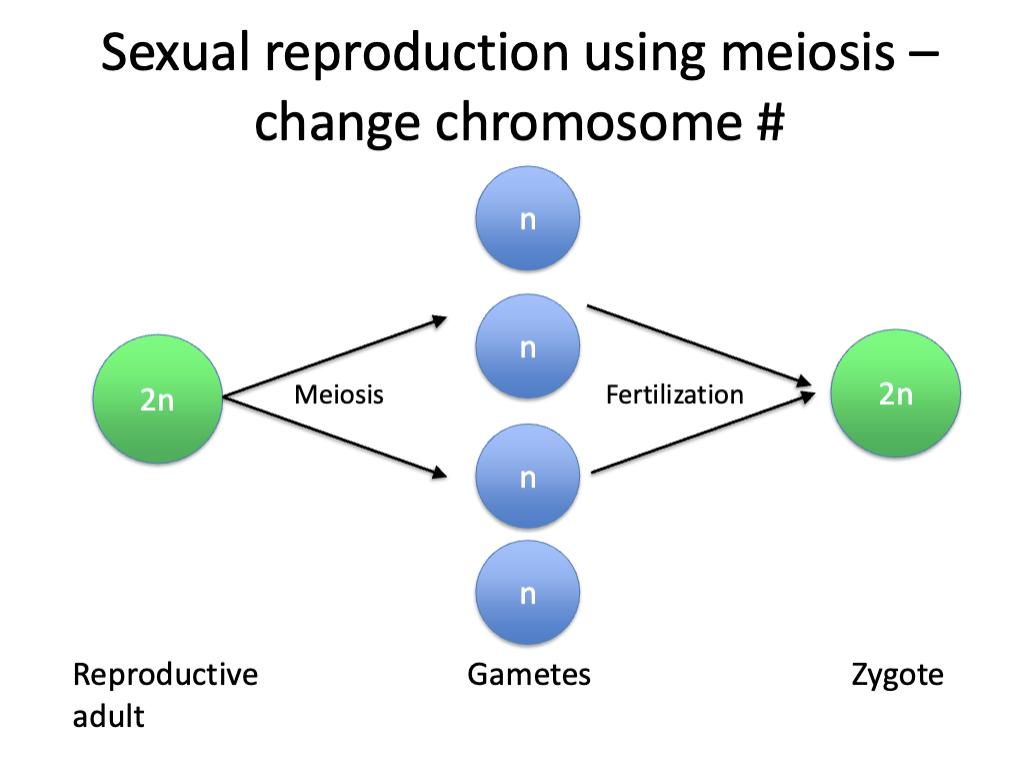
Haploids vs diploids
Haploids: only have one of each chromosome
Diploids: have two of each chromosome

Benefits of sexual reproduction
• In asexual reproduction – make clones of self
If acquire bad mutations, can’t get rid of them
• In sexual reproduction – sex brings together new combinations of alleles
Recombination
Rescue and revitalize genotypes = phenotypes
• Why did this capacity arise in eukaryotes??
New mitochondria bring risks - mitochondria produce energy but also generate reactive molecules that can damage DNA. Harmful mutations, sexual reproduction, and recombination help repair DNA damage and reduce harmful mutation generation.
Generalized sexual life cycle in eukaryotes

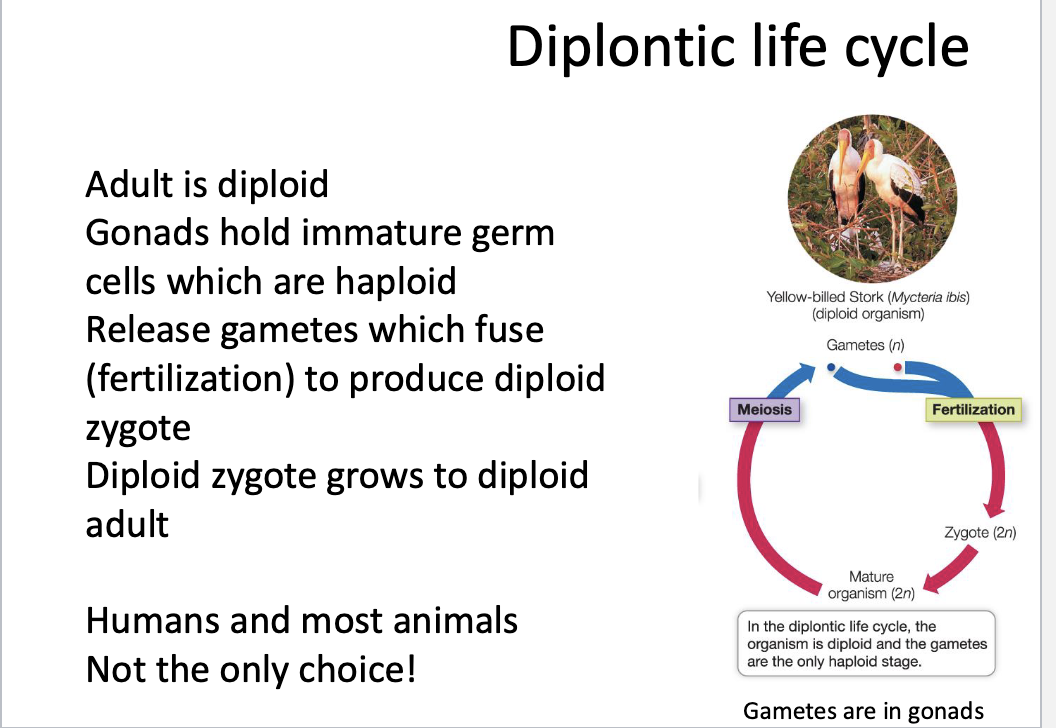
Diplontic life cycle
Animals have diplontic sexual cycles
Haplontic life cycle
Unicellular

Alternation of generations

Typical protist (unicellular eukaryote) - haplontic life cycle
The genetic basis for the evolution of sex is the development of genes and mechanisms that allow DNA to be mixed and exchanged.
Meiosis: Separates chromosomes and creates haploid cells.
Recombination (crossing over): Homologous chromosomes exchange DNA, creating new combinations of alleles.
Fertilization: Combines genetic material from two gametes.
These processes increase genetic variation, help remove harmful mutations, and allow beneficial alleles to come together.


How could a sexual life cycle evolve?
How the sexual life cycle works
1) Haploid cells (n)
The mature Chlamydomonas cell has one set of chromosomes. It can reproduce asexually by dividing to produce genetically similar offspring.
2) Gametes form (n)
Under certain conditions, cells produce gametes of two compatible mating types, shown as \(+\) and \(-\).
3) Fertilization
Two haploid gametes fuse, combining their genetic material to form a diploid zygote (2n), with two sets of chromosomes.
4) Meiosis
The diploid zygote undergoes meiosis, reducing the chromosome number by half and producing haploid cells that continue the life cycle.
How could this have evolved?
The diagram shows the key processes that must work together for a sexual life cycle:
Cell fusion combines genetic material from two cells.
Meiosis reduces chromosome number, preventing chromosomes from doubling every generation.
Recombination creates new combinations of alleles, increasing genetic variation.
These processes may have evolved gradually from older mechanisms for DNA exchange, DNA repair, and cell division.


Chlamydomonas life cycle
The diagram shows how gene expression regulates sexual reproduction in Chlamydomonas, a green alga that can reproduce both sexually and asexually.
1. Asexual reproduction
Mature haploid cells (n) reproduce asexually by dividing to produce genetically similar offspring.
The diagram indicates that neither gsp nor gsm is expressed during this process.
2. Sexual reproduction
Gametes (n): Haploid reproductive cells with one set of chromosomes. There are two compatible mating types, labeled \(+\) and \(-\).
The (+) gamete expresses gsp, while the \(-\) gamete expresses gsm.
Fertilization: The two compatible gametes fuse, combining their genetic material.
Zygote (2n): The diploid cell formed by fertilization. It contains two sets of chromosomes, one from each gamete, and the diagram indicates expression of both gsp and gsm.
Meiosis: The diploid zygote undergoes meiosis, reducing the chromosome number by half and producing haploid cells that continue the life cycle.
Why is this important?
The diagram shows that sexual reproduction requires specific genes to regulate mating and coordinate the transition between haploid and diploid stages. These genetic mechanisms allow gametes to fuse, form a zygote, and restore the haploid state through meiosis.

Two versions (alleles) of the mating-type locus control the entire sexual cycle
The mating type locus encodes the integrated genetic machinery that:
Haploid life cycles in eukaryotes result from:
The mating type locus encodes the integrated genetic
machinery that:
1) transforms cells into two gamete types (+ and -)
2) enables fertilization
3) in the zygote drives development of the zygote
4) enables meiosis to form 4 haploid spores.
Haploid life cycles in eukaryotes result from:
Evolution of the mating-type locus in the haploid common ancestor of eukaryotes
Key Ideas:
• What are key characteristics of eukaryotes?
• How do you know that mitochondria are shared eukaryotic trait?
• How do protists differ from other eukaryotes?
Few key examples
• How did sexual reproduction arise?
What were its original benefits
How do mitosis and meiosis differ? How do vegetative vs reproductive cells differ?
• What is a simple model for the evolution of sex using a mating type locus? How does it work?
1. What are the key characteristics of eukaryotes?
Flexible cell membrane: Eukaryotes lack a rigid cell wall in the general ancestral-trait model, allowing the membrane to change shape and engulf materials. (Some eukaryotes, such as plants and fungi, do have cell walls.)
Complex cytoskeleton: Provides structure, moves materials inside the cell, and helps with cell movement and division.
Nuclear membrane: Surrounds the DNA, separating it from the cytoplasm.
Digestive vacuoles: Membrane-bound compartments that digest food and break down materials taken into the cell.
Sexual reproduction: Allows genetic material to be combined and recombined, increasing genetic variation.
2. How do we know mitochondria are a shared eukaryotic trait?
Nearly all major eukaryotic lineages have mitochondria or organelles derived from mitochondria.
Evidence includes:
Endosymbiosis: Mitochondria evolved from bacteria related to alphaproteobacteria that lived inside an ancestral eukaryotic cell.
Own DNA: Mitochondria retain their own DNA, usually in circular form.
Bacterial-like ribosomes: Their ribosomes resemble bacterial ribosomes.
Double membranes: Consistent with their evolutionary origin through endosymbiosis.
Mitochondria-derived organelles: Some eukaryotes that lack typical mitochondria have reduced organelles derived from them.
Key idea: Mitochondria were likely present in the common ancestor of modern eukaryotes. Some descendants later lost or reduced them, so their absence today does not mean those organisms never had them.
3. How do protists differ from other eukaryotes?
Protists are a diverse collection of eukaryotes that are not classified as animals, plants, or fungi in the traditional classification.
Most are unicellular, but some form colonies or are multicellular.
They have different ways of obtaining energy: photosynthesis, consuming food, or absorbing nutrients.
They can reproduce sexually or asexually.
They belong to multiple evolutionary lineages, rather than one exclusive group.
4. How did sexual reproduction arise, and what were its original benefits?
The exact origin of sex is still debated, but several possible benefits may explain why it evolved.
DNA repair: Recombination may have helped repair damaged DNA by using a related DNA copy as a template.
Removal of harmful mutations: Recombination can separate harmful mutations from beneficial alleles, making natural selection more effective.
New allele combinations: Combining genetic material creates variation that can help populations adapt to changing environments.
Combining beneficial alleles: Recombination can bring advantageous alleles together in the same individual.
Sex may have evolved gradually from earlier mechanisms for DNA exchange, DNA repair, and cell division. It likely required the evolution of coordinated processes for recombination, chromosome reduction, and cell fusion.
Feature | Mitosis | Meiosis |
|---|---|---|
Number of divisions | 1 | 2 |
Daughter cells | 2 | Usually 4 |
Chromosome number | Maintained | Reduced by half |
Genetic similarity | Usually genetically similar | Genetically varied |
Main role | Growth, repair, asexual reproduction | Produces haploid cells for sexual life cycles |
Remember: DNA replicates before both processes, but it does not replicate again between meiosis I and meiosis II.
How do vegetative and reproductive cells differ?
Vegetative cells: Carry out normal life functions, such as growth, metabolism, and maintenance. In Chlamydomonas, a mature haploid vegetative cell can reproduce asexually.
Reproductive cells: Participate in reproduction. Gametes fuse during fertilization to form a zygote.
The terms depend on the organism: a vegetative cell can sometimes switch into a reproductive role, so these are functional distinctions rather than universal cell categories.
What is a simple model for the evolution of sex using a mating-type locus? (continued)
How could a mating-type locus evolve?
A simple model is that an ancestral organism developed genetic differences that made some cells compatible with one another but prevented incompatible cells from mating.
Different mating types emerge: Genetic variation creates alternative versions of a mating-type region.
Genes regulate compatibility: Different mating types express different proteins that help cells recognize compatible partners and coordinate fusion.
Fusion becomes coordinated: Compatible cells fuse to combine genetic material.
Meiosis restores chromosome number: The diploid stage is followed by chromosome reduction, preventing chromosome number from doubling each generation.
The gsp and gsm labels in your diagram illustrate different gene-expression patterns associated with the two mating types and the zygote. This is an example of how genetic regulation coordinates sexual reproduction, not definitive proof of the exact historical sequence in which sex evolved.

When did multicellular organisms first arise?
Stromatolites are colonies of cyanobacteria
These were “discovered” in Australia in protected bay
Similar to those in fossil record back to 3+BY

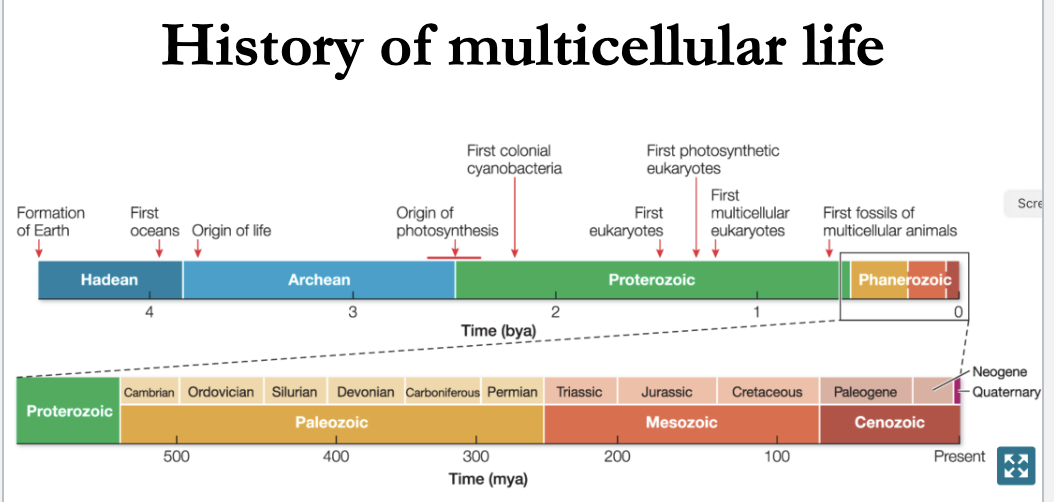
History of multicellular life: when did multicellular organisms first appear?


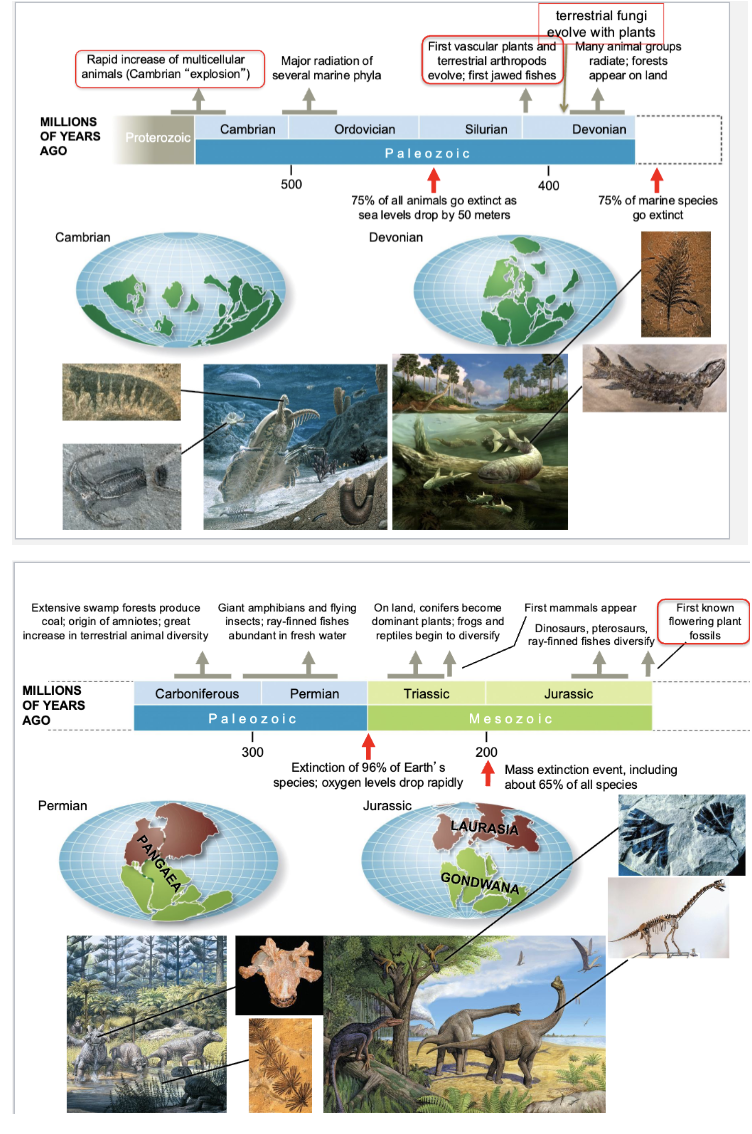
other versions of the history of life
current extinctions may still be happening

What is multicellularity: the 5 requirements
also what cancer cells do instead
• Cooperation among cells for the “good” of organism
• 5 requirements
Extracellular environment
Division of labor
Resource allocation
Proliferation inhibition
Programmed cell death
It tells us that multicellularity provides important benefits and evolved independently multiple times through convergent evolution.
Multicellularity helps organisms grow larger, specialize cells for different jobs, and survive in different environments.
Because it evolved at least 20 times independently, it suggests that these benefits made multicellularity advantageous in many different lineages.

Design strategies of multicellular eukaryotes
Multicellularity - close association of many cells carrying out specialized vegetative and reproductive functions
Several convergent designs of multicellular eukaryotes related to their nutrition:
1. Photosynthetic organisms - convergent designs (flat tubes, tubular stems, attaching roots) help them with selective pressures on land
2. Absorptive organisms - multicellular reproductive/dispersal stages and unicellular or filamentous vegetative stages for feeding and growth.
3. Ingestive organisms (animals) - special tissues to digest
digestive = to ingest, muscular = to move, nervous = to coordinate
Who are the closest unicellular relatives of multicellular eukaryotes?
3 of the four major clades:
land plants: green algae
animals: choanoflagellates
fungi: unicellular opisthokonts (exact one still being debated)
brown algae and others also evolved multicellularity!
Which organisms were the closest relative to land plants?
What is the series of multicellularity
- Charales were once considered strong candidates for the closest relatives of land plants (land plants to Charales 778 MYA)
Molecular phylogeny solved the mystery: Choleochaetales → Charales → land plants
Part of a series: Unicellular → Colonial → Filamentous → Parenchymatous
filamentous = tissue divides along 1 axis
Parenchymatous = tissue can divide along all 3 axes
Pseudoparenchyma = filaments that resemble parenchymatous tissue
How do choanocytes in sponges resemble choanoflagellate protists
Choanoflagellates are the closest living unicellular relatives to animals, and their similarities to sponge cells help scientists understand how multicellular animals evolved.
Choanoflagellates are single-celled organisms, although some form colonies
Choanocytes: specialized feeding cells in sponges that look and function similarly. Both have similar structures, including a flagellum and collar that captures food. Their genomes also share protein domains involved in cell signaling and adhesion.
Why this matters: These similarities suggest the common ancestor of choanoflagellates and animals already had some of the genetic tools needed for cells to communicate with one another. Animals may have later adapted these tools to evolve multicellularity and specialized cell types.
Why would a Choanoflagellate benefit from being reversibly colonial?
Hypothesis: could help with feeding (local currents, able to stay put in a good spot)
More specific and testable: colonies are induced by chemicals from bacterial food.
Experiment: reduce bacteria in choanoflagellate cultures
Result: Choanoflagellates only spontaneously form rosette colonies in the presence of bacteria. The authors went on to isolate a specific chemical from one bacterium.
This means choanoflagellates require a specific chemical signal from bacteria to trigger their transition from single cells into multicellular colonies.
Fungi: The Opisthokont’s dilemma
Mobility, carnivory, consciousness
or
live in dirt and eat dead stuff
5 major fungal clades and how they get around
5 major clades: Chytrids (1k species), Zygomycetes (1k species), Glomeromycetes (180 species), Ascomycetes (65k species), Basidiomycetes (30k species)
ancestor probably similar to chytrids: aquatic, flagellated
like plants and animals, fungi only colonized land after becoming fairly sophisticated
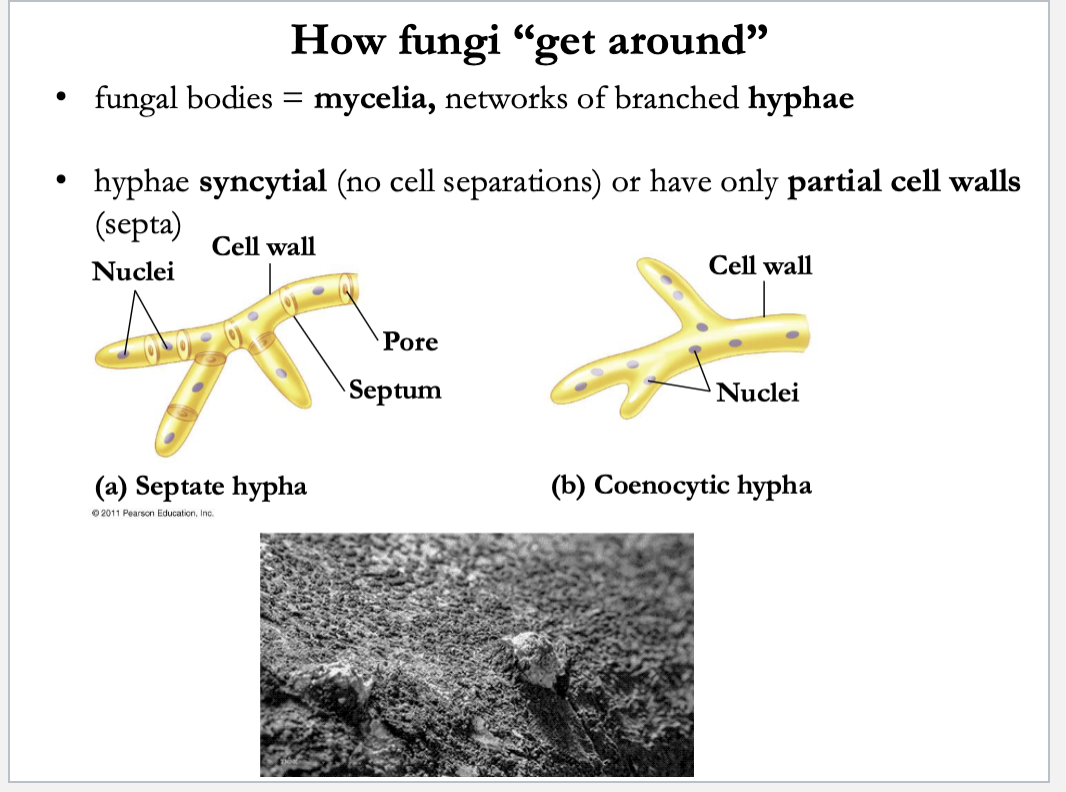
How they get “around”: fungal bodies = mycelia, networks of branched hyphae
hyphal syncytial (no cell separation) have only partial cell walls (septa)
Benefits of multicellularity
Overcome diffusion limitations: As organisms grow larger, diffusion alone becomes less effective at transporting nutrients and oxygen and removing waste over long distances. Multicellular organisms developed specialized structures to help move things.
Example: Villi in small intestine increase surface area, allowing more nutrients to be absorbed.
Cell Adhesion: cells need to stick together to form a multicellular organism.
Animal cells: Adhesion molecules help cells attach to one another
Plant cells: middle lamella acts like a glue to hold together neighboring cell walls.
Divison of labor: cells can differentiate → they become specialized cells for different jobs.
Some cells absorb nutrients; others transport materials or provide structural support - this allows the organism to perform more complex functions.
Multicellular problem 1: How to reproduce
Solution 1
the difference between reproducing with unicell and multicell
Unicellular organisms: often reproduce sexually through binary fission
one cell splits into 2 daughters, or budding, where a new organism grows off the parent
Multicellular organisms: reproduction is more complicated bc they contain many specialized cells that must coordinate to produce a new organism.
organisms needed a new way to reproduce while maintaining / rebuilding
Problem 1: How to reproduce
Solution 2
Produce a single-celled spore or gamete (typically sexual)
Instead of just splitting into 2, multicellular organisms can produce a single cell that can develop into a new organism or combine with another cell.
Gamete: reproductive cell, like an egg or sperm. In sexual reproduction, 2 gametes fuse and form a diploid zygote.
Spore: reproductive cell that can develop into a new organism without fusing with another cell.
Meiosis: usually produces haploid reproductive cells by reducing the chromosome number by 1/2, commonly associated with sexual reproduction.
But not always: Some organisms (like dandelions) can produce through apomixis, which produces seeds without the usual fertilization process.
So, producing reproductive cells or seeds doesn’t always require typical sexual reproduction.
Problem 2: Who gets to reproduce
Only some cells can reproduce and pass genetic info onto the next gen; other cells specialize in jobs like obtaining nutrients, transporting materials, or giving support. These other cells give up their ability to reproduce or have it restricted.
The solution - tight control over cell division (mitotic and meiotic potential): organisms need to control which cells can undergo mitosis (cell division for growth, repair, sometimes asexual reproduction), and meiosis (cell division that reduces chromosome number for sexual cycles)
How this might have evolved: evolution of a mating-type locus → a region of DNA that determines which mating type a cell belongs to.
Example: In Chlamydomonas: + and - mating types have different genetic instructions; compatible cells recognize each other and fuse; the resulting zygote can undergo meiosis, producing haploid cells.
Over evolutionary time, reproductive functions could become more specialized; other cells become ready for specialized tasks.
Sex and the single cell:
Q: Does an organism need to have sex organs to have sex?
Q: Does an organism need to even be multicellular to have sex?
What an organism does need to have sex:
A: No!
A: No!
• Diploid phase of life cycle
• Meiosis to form haploid gametes
• Union of haploid meiotic products (“syngamy” or “fertilization”)
• Multicellular organisms use same sequences as in unicellular organisms.
Within above constraints, there are many ways to do it.
Plants are composed of 3 primary parts made up of 3 tissues

Plant stem cells vs animal stem cells
Shoot apical meristem, Root apical meristem, secondary meristem
Just like animal cells, plant stem cells can divide and produce new cells. However, plant stem cells are concentrated in specific regions called meristems.
Shoot Apical Meristems: located at the tips of shoots and stems, produces new cells that allow plants to grow taller and gives rise to new leaves and shoots.
Root Apical Meristem: located near the tips of roots, protected by root cap. Produces new cells that allow roots to grow longer; the root cap protects the growing tip as it moves through the soil.
Secondary Meristems: include the vascular cambium and cork cambium; allow woody plants to grow wider, increasing stem and root thickness. The vascular cambium produces vascular tissues, while the cork cambium produces protective outer tissue (inside the stem).
Both plant and animal stem cells can self-renew by dividing and can produce cells that differentiate into specialized cell types.
Plant stem cells: Mainly found in meristems and allow plants to keep growing.
Animal stem cells: occur in tissues like bone marrow and skin to help maintain or repair those tissues.


Plant primary growth
xylem and phloem
Small plants grow by primary growth, which is the growth of the stem, including phloem (carries sugar and water) and xylem (only carries water)
Herbaceous plants, like flowers or grasses, only undergo primary growth.
When woody plants get large enough, they undergo secondary growth.
Secondary growth
involves adding additional tissues, which greatly increases their diameter
this includes much more xylem and phloem
because this tissue is added during secondary growth, we call it secondary xylem and secondary phloem.


Woody plant stem layers
Xylem, phloem, cork


How the vascular cambium produces secondary vascular tissues

Primary and secondary growth summary
• Growth at the tips of the plant’s roots and shoots produces the primary body. Primary xylem and primary phloem are in discrete vascular bundles, and there is no cork.
• Secondary growth is caused by precisely oriented cell division in vascular cambium and cork cambium. Together they add secondary xylem (wood), secondary phloem, and cork.
Other growth types
• Vegetative growth
Stem and leaf production
• Reproductive growth
Flower production
• Switch from
apical meristems → leaves, stems
to inflorescence meristems → floral meristems → flower
What are the 4 primary organs flowers are comprised of


Homeotic mutations (hox genes)
• In trying to determine what genes guide flower development and tissue specification, scientists rely on homeotic mutants (naturally occurring or experimental) → natural helps identify which genes are homeotic
• As we’ll see in animal development, homeotic mutations change the identity of one part of the flower into another
• Coen and Meyerowitz (1991) put forward a model for how different genes contribute to flower specification, proposing the flower homeotic code
Homeotic genes are master regulators: transcription factors that turn on a suite of genes. A mutated Hox gene causes a major phenotypic change.
Mutations affect different species in a similar way, showing they share a similar mechanism for flower development → a similar set of homeotic genes.

Coen and Meyerowitz proposed a model
• There were 3 kinds of floral hox genes: A, B and C
• When one gene is knocked out, two neighboring whorls were affected.
Therefore, hox genes are expressed in several overlapping domains
• They proposed it looked like this:

An additional assumption needed:
A and C inhibit each other
ABC model
ABC model
• During the GAE, we’ll think more about the discovery of homeotic mutants and how they helped scientists figure out the ABC model of flower development
• And we’ll think about how different flower characteristics might result from modification of A/B/C expression

The 3 benefits of multicellularity
Overcome diffusion limitations: As organisms get bigger, diffusion alone is less effective at moving nutrients, oxygen, and waste over long distances. Multicellular organisms developed specialized structures to help move things.
Example: Villi in the small intestine increase surface area, allowing more nutrients to be absorbed.
Cell adhesion: cells need to stick together to form a multicellular organism.
Animal cells: adhesion molecules help cells attach to one another.
Plant cells: middle lamella acts like glue to hold together neighboring cell walls.
Division of labor: cells can differentiate and become specialized for different jobs.
Some cells absorb nutrients, others transport materials or provide structural support - this allows the organism to perform more complex functions.
Problem: How to reproduce
2 solutions
binary fission and budding
Unicellular organisms: often reproduce asexually through binary fission (one cell splits into 2 daughters) or budding (a new organism grows off the parent).
Multicellular organisms: reproduction is more complicated because they contain many specialized cells that must coordinate to produce a new organism. They needed a way to reproduce while maintaining/rebuilding multicellularity.
Another solution: produce a single-celled spore/gamete (usually sexual)
instead of just splitting into 2, multicell organisms can produce a single cell that can develop into a new organism or combine with another cell.
Gamete: reproductive cell, like egg or sperm. In sexual reproduction, 2 gametes fuse and form a diploid zygote.
Spore: reproductive cell that can develop into a new organism without fusing into another cell.
Meiosis: usually produces haploid reproductive cells by reducing the chromosome number by half, sexual.
But not always: some organisms, like dandelions, can reproduce through apomixis, which produces seeds without the usual fertilization process. So, producing reproductive cells or seeds doesn’t always require sexual reproduction.

Why study plants
Unique processing resulting in: food origins of agriculture and civilization, modern agriculture, green energy, fiber and shelter, drugs, cotton and timber, biofuels.
Where are the plants? Animals fossilized in the Burgess Shale following
the Cambrian Radiation 540 million years ago. Land plants hadn’t evolved yet, marine animals were still diversifying, and algae existed.
Plants evolved as the first conquerors of land: Who came first and who came later
Colonization of terrestrial environments
• First - plants evolved as a new monophyletic lineage with novel adaptations for surviving on the land.
• Later – plants made terrestrial environment more survivable; existing lineages of animals able to colonize
Who were the first plants and why did they have it easy
First plants were aquatic algae – easy life
• Bathed in nutrients
• Supported against gravity
• Extensive transport often not necessary
• Gametes, offspring transmitted by water
• No problem with desiccation
Possible reasons to become terrestrial and challenges
• More direct sun for photosynthesis (sufficient ozone for UV protection)
• Inorganic nutrients available on land
• Initially, an absence of herbivores
Challenges:
• Ways to transfer gametes
• Protect vulnerable stages (zygotes)
• Withstand gravity
• Conserve water
• Transport nutrients

Did large multicellular algae “crawl” onto the land?
Green algae, red algae, brown algae
Land plants evolved from freshwater algae, not red or brown algae.
Green Algae: closest relative of land plants, some groups share a common ancestor with land plants.
Red: a separate lineage of algae, not land plant ancestor.
Brown: Another separate lineage not ancestor; kelp and seaweed.
Great moment in plant evolution: evolution of land plants allowed photosynthetic organisms to colonize land, opening up new habitats and helping create terrestrial ecosystems.
Early land plants needed adaptations to deal with challenges like drying out, supporting themselves, reproducing without relying entirely on water.
Chloroplasts and chlorophyll were the first traits, evolved before land plants existed, then were inherited, already present in green algae (endosymbiosis)
4 successive radiations of land plants: evolution of land plants viewed as a series of major adaptations to terrestrial challenges.
Each radiation has left living members whose sporophytes exhibit evolutionary innovations for surviving in terrestrial environments
1) bryophytes, 2) Pteridophytes, 3) Gymnosperms, 4) Flowering plants
Embryophytes are land plants
Bryophytes are the only nonvascular

Plant life cycle innovation #1 and how the plant life cycle works
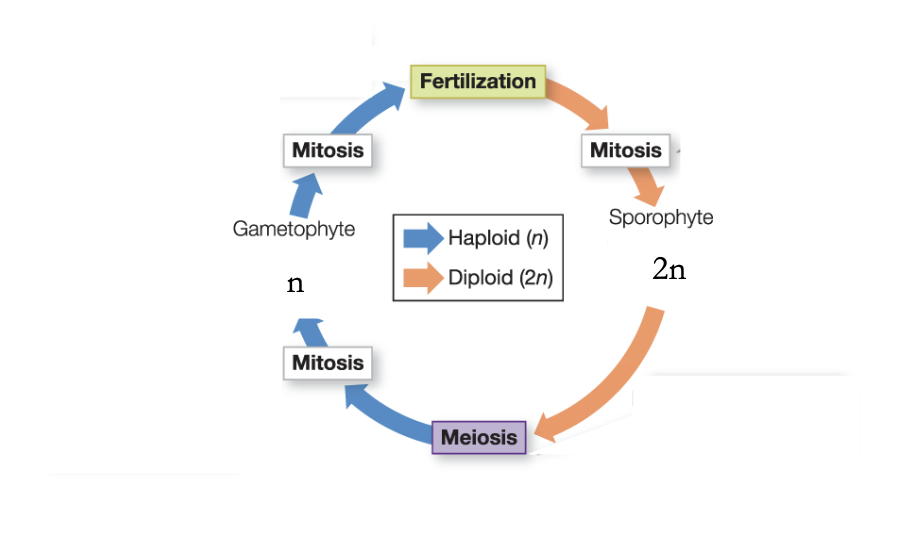
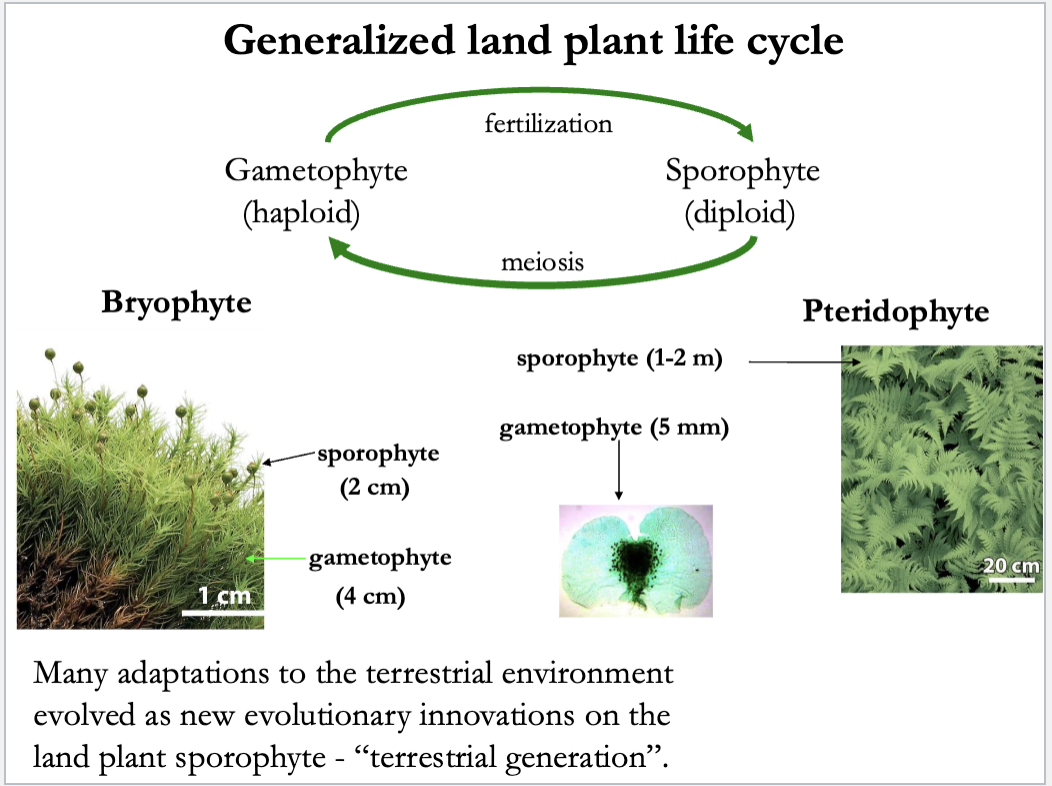
Innovation 1: Evolved a new diploid generation called the sporophyte.
Alternation of generations: Plants alternate between 2 multicellular stages:
Gametophyte (Haploid, n): one set of chromosomes
Sporophyte (diploid, 2n): 2 sets of chromosomes
How it works:
1) Sporophyte (2n) undergoes meiosis to produce haploid spores (n)
2) Spores undergo meiosis and grow into multicellular gametophytes (n)
3) Gametophytes produce gametes (eggs and sperm) through mitosis
4) Fertilization: 2 gametes fuse to form a diploid zygote (2n)
5) The zygote undergoes mitosis and develops into a multicellular sporophyte
Mitosis: maintains chromosome number (n stays n, 2n stays 2n)
Meiosis: halves chromosome number (2n to n)
Fertilization: combines 2 haploid gametes (n+n = 2n)
Why this is an innovation: unlike animals, where the haploid stage is generally limited to single-celled gametes, plants have both a multicellular haploid stage and a multicellular diploid stage.
What are bryophytes and their life cycle
Life cycle:
Gametophyte (n) is the dominant stage
Antheridia produce sperm (n) and archegonia contain eggs
Water is required for fertilization bc sperm must swim to egg
Fertilization: sperm + egg → diploid zygote (2n)
Sporophyte stays attached to and depends on gametophyte for nutrients
Sporophyte produces spores in a sporangium; meiosis makes haploid spores (n)
Spores germinate and grow by mitosis into new gametophytes
Key Takeaway: Bryophytes have a dominant gametophyte stage, a dependent sporophyte stage (relies on gametophyte), and require water for fertilization. They are abundant in moist habitats; persistent gametophytes protect the short-lived sporophytes, zygotes develop into diploid embryos (young sporophytes)
Includes liverworts, hornworts, moss
These are nonvascular (no phloem or xylem) and gametophyte dominant: dominant haploid stage

3 improvements bryophytes have for surviving terrestrial environments
waxy cuticle to reduce water loss and prevent plant from drying out
enclosed embryo is protected and nourished inside the parent plant
stomata are small pores that allow gas exchange (CO2, O2 out) and help regulate water loss.
Pteridophytes and their second innovation
Xylem, phloem, vascular bundles
Pteridophytes - seedless vascular plants
Innovation #2: evolved vascular tissue
Includes: Lycophytes, whisk ferns, horsetails, ferns
• xylem (water and ion transport) and phloem (sugar transport) more efficient intercellular transport
• xylem was fortified with lignin, so it could increase the size → large sporophytes with vascular tissue (produces spores through meiosis; large, visible fern plant with vascular tissue)
• small free-living gametophytes without vascular tissue (produces eggs and sperm)
• xylem - Transports water and ions (minerals) from roots to the rest of the plant. Long, wide cells that are dead at maturity, so they lack cytoplasm. Cell walls have lignin for strength and support.
• phloem - transports sugars throughout the plant. Long, narrow conducting cells with limited cytoplasm. Living cells that move sugars to areas where they’re needed.
Vascular bundles: groups of xylem and phloem tissue found together in stem.
Pteridophyte limitations
Vulnerable gametophyte: the gametophyte is small and delicate, making it more susceptible to drying out.
Require external water for fertilization: sperm must swim through water to reach the egg, limiting reproduction in dry environments.
With a gain of vascular tissue, the sporophyte becomes larger than the gametophyte, means visible part of the plant (physical leaves) are bigger. On ferns, sporangium on the large sporophyte (bigger sporophyte)
Generalized land plant life cycle
Gymnosperms
Anisogamous, mega and microspore
Gymnosperms - vascular plants with naked seeds
Includes: cycads, ginkgoes, conifers, gnetophytes
Innovation #3&4: seeds and pollen (very reduced, microscopic gametophytes)
• 4 major groups ~ 800 tree and shrub species
• Dominant tree species at high elevations and high latitudes, plus certain arid environments
They are heterosporous: meaning they produce 2 different spores. Megaspore= egg, microspore= sperm
The spores themselves are NOT eggs and sperm, they grow into gametophytes that produce them.
Anisogamous: means the male and female reproductive cells differ in size and form.
Gymnosperms - major innovations
#3) The evolution of seeds
Megaspore -> Female gametophyte (egg) retained on sporophyte
Egg fertilized in situ- inside the body/natural place in the organism
Embryo supplied with food
Seed (fertilized ovule) - a three-generation package deal
Germination can wait for favorable conditions!
Can be carried by wind or animals
#4) The evolution of pollen (reduced male gametophyte)
Pollen can be carried by wind (et al.) to the female gametophyte
Now free from water for reproduction!
Seed plants are viewed as genuine land plants
Example: Seed cones, pine pollen, pollen cones
Wind pollination has drawbacks: pollen is released into the air, and most of it never reaches another flower of the same species/right flower. So you need large amounts of pollen to increase the chances it reaches the right flower.


Gymnosperms - fertilization and seed development (how it works)
The megaspore (n) grows into the female gametophyte (and sporophyte covering the ovule), which produces an egg. The pollen grain (male gametophyte) delivers sperm through a pollen tube. Fertilization forms a zygote (2n), which develops into the embryo (new sporophyte). The ovule becomes a seed with a protective seed coat and food supply.
much higher amounts of sporophyte and gametophyte

About angiosperms/how they originated
Angiosperms - vascular seed plants with flowers and fruits as reproductive structures
• 4th radiation of land plants - the origin of flowers
>250,000 species (~ 90% of land plants)
All major domesticated crop plants
• Rapid diversification around 130 mya
• Routine manipulation of animals to carry out sexual reproduction and seed dispersal

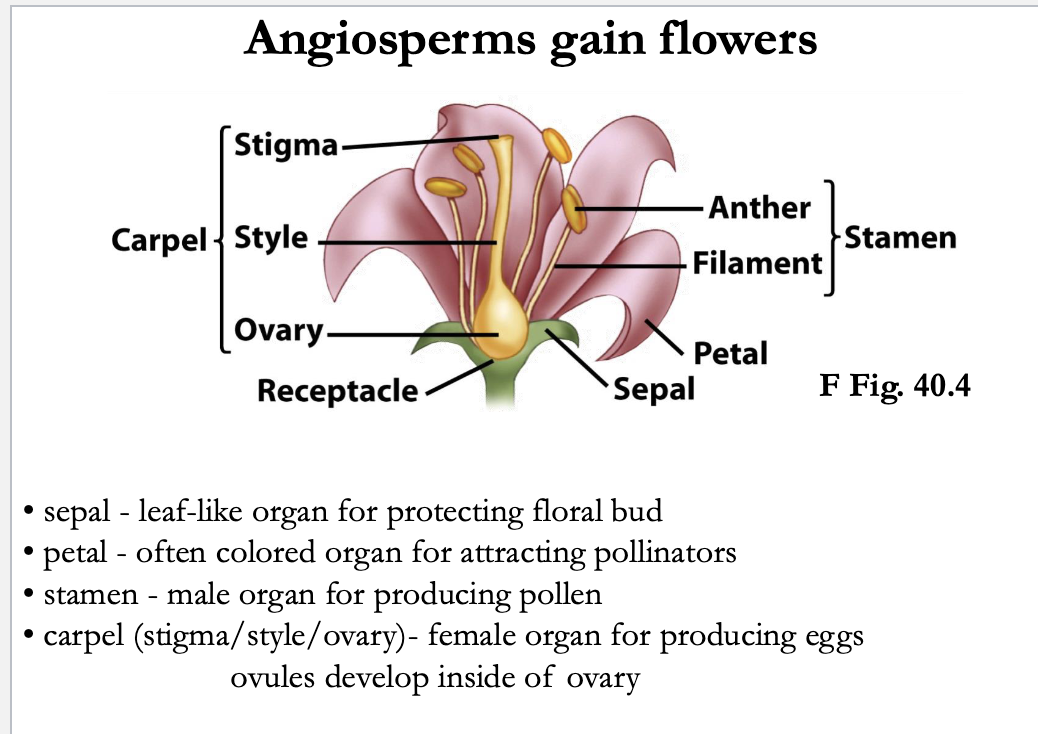
Angiosperms gain flowers: sepal, petal, stamen, carpel
Life cycle
Life cycle: The diploid sporophyte produces flowers. Meiosis produces haploid microspores and megaspores, which develop into pollen grains and the female gametophyte. Pollination delivers pollen to the stigma. A pollen tube carries sperm to the ovule. Double fertilization forms a diploid zygote (2n) that becomes the embryo and triploid (3n) endosperm for food. Ovule becomes the seed → germinates into a new sporophyte.
Gymnosperm vs Angiosperm seeds

Summary of the land plant life cycle

Our genomic heritage – Evolutionary origins of human genes
Most genes are shared by eukaryotes and prokaryotes; very few genes are unique to humans. Where they’re expressed is different.

What is an animal?
• What are the unique unifying features (= derived similarities) of all animals?
What do they do?
How do they do it?
• Key elements
Multicellular
Heterotrophic
Extracellular matrix
Cell adhesion genes
Hox genes – body plan specification
• What they do
Move, eat, interact
Format of animal diversity - the big 5, other characteristics to identify
• Evolutionary relationships on animal tree
• Body plans of major phyla – characteristics (briefly)
• Evolutionary innovations in their common ancestors
• Quick taste of
Form and Function 5 for major
phyla
Gas exchange
Feeding
Transport
Sensory/nervous systems
Support/locomotion

simplified animal phylogenetic tree and the 3 major metazoan groups

Porifera (sponges) - body plan
• Cellular-level organization: multicellular, but limited cell specialization
Cells cooperate, but don’t form obvious tissues
Few cell types - choanocytes, amoebocytes, porocytes
Protist-like in many ways: totipotent, no didstinct germ line, phagocytosis
Cells often totipotent - can divide and develop into every single cell type in an organism and extra embryonic tissues (can form all 3 embryonic germ layers - endo, meso, ectoderm), and supportive tissues like placenta.
Sexual or asexual reproduction
Sponge can change shape, and even reaggregate (reform their bodies after being separated by cells)
Porifera - Form and Function
• Gas Exchange - Not an issue
Filter own volume every 10-20 s!
• Feeding – water flow, Choanocytes & amoebocytes capture food particles via phagocytosis – intracellular digestion = protist-like, yet …
Porocytes – incurrent openings
Interior water system - Can be very convoluted (complex) and have internal
chambers with choanocytes (collar cells) → for primary pumping and filtering
Food absorption takes place inside the animal, but very inefficient feeder.
Key innovation: feeding inside the organism (1st time in life’s evolution)
• Transport: Not a big deal, Wandering amoebocytes
• Sensory/nervous systems
Nope/nope
• Support/locomotion
Up to 4 mm/day! Whew!
Collagen and/or mineral spicules – thin structures made of CaCO3 or SiO2
Formed in specialized cells: sclerocytes
No muscles
Cnidaria - Body Plan: What kind of symmetry, axis, is it diploblastic?
• Radial Symmetry – No preferred orientation except
top and bottom. Multiple planes of symmetry around the central AP axis
• Anterior-Posterior (AP) axis defined by: mouth (anterior), and opposite side (posterior)
• Tissue level organization: Form discrete tissues
• Diploblastic - Two layers
Endoderm -> Gastrodermis (lines the digestive cavity)
Ectoderm -> Epidermis and other cells (e.g., neurons) (outer layer)
Mesoglea* - jelly-like substance in between 2 layers
• Typically two forms
“Sessile” polyp (attached, stationary - ex sea anemone) vs. swimming/medusa (free swimming, often umbrella shaped - ex= jellyfish)
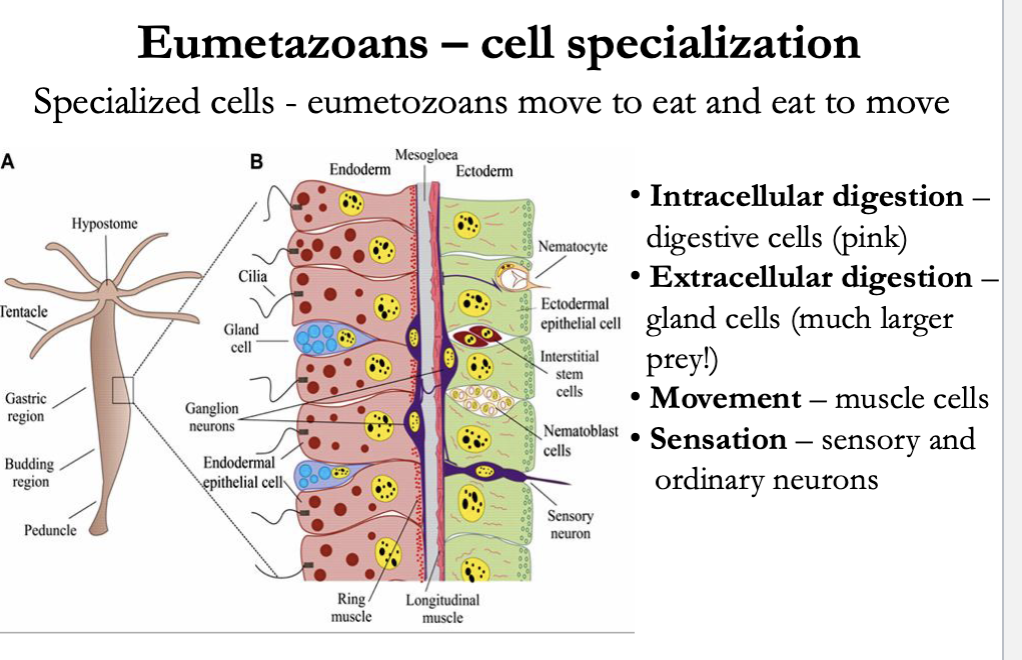
Cnidarians: Eumetazoans – cell specialization
Cnidarians – prey capture
• Cnidocytes (stinging cells)
Inject coiled thread (nematocyst) with toxins into prey
Immobilize prey, Muscle cells move prey to gut
Cnidaria - Form and Function 5
• Gas Exchange - Again, not an issue
Low metabolic rate, lots of surface area
• Feeding
Highly variable
Prey capture using cnidocytes
Photosynthetic symbionts: some cnidarians host algae that provide nutrients
Direct absorption of nutrients (from water)
Digestion - both extracellular (gut cavity) and phagocytosis (intracellular, similar to protists and sponges)
Transport: simple, lack a circulatory system so materials mainly move by diffusion.
Gastrovascular (GV) cavity: distributes nutrients throughout the body; can by highly subdivided to help transport materials to more cells
Sensory/reponse: neurons = simple nervous system, nerve net - neurons form a network throughout the body to detect stimuli + coordinate responses.
No ganglia- no centralized clusters of neurons like those in complex systems. A few species have sense organs (simple eyes)
Support/Locomotion
Can move using “muscles”!!! - Bending or umbrellar beating
About Ctenophores = comb jellies
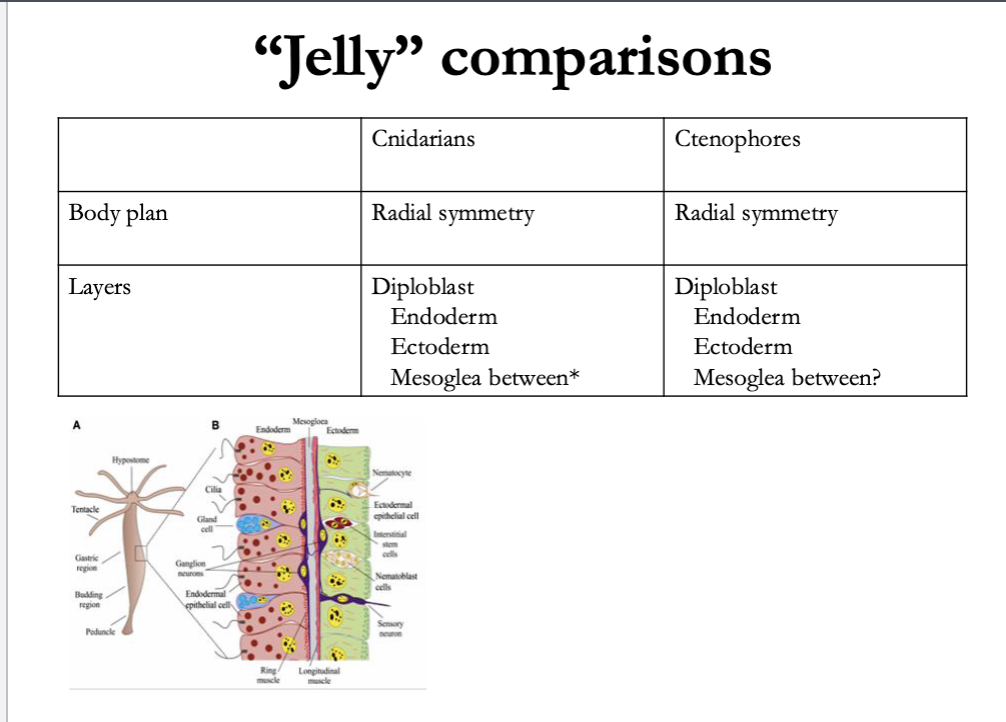
“Jelly” comparisons
• Radially symmetric diploblast (2 tissue layers)
• Ctenes: cilia bearing plates (“combs”) used for swimming
• Broadcast spawning: release eggs + sperm into water for external fertilization
• Flow-through gut: food enters through mouth and waste exits through anal pores.
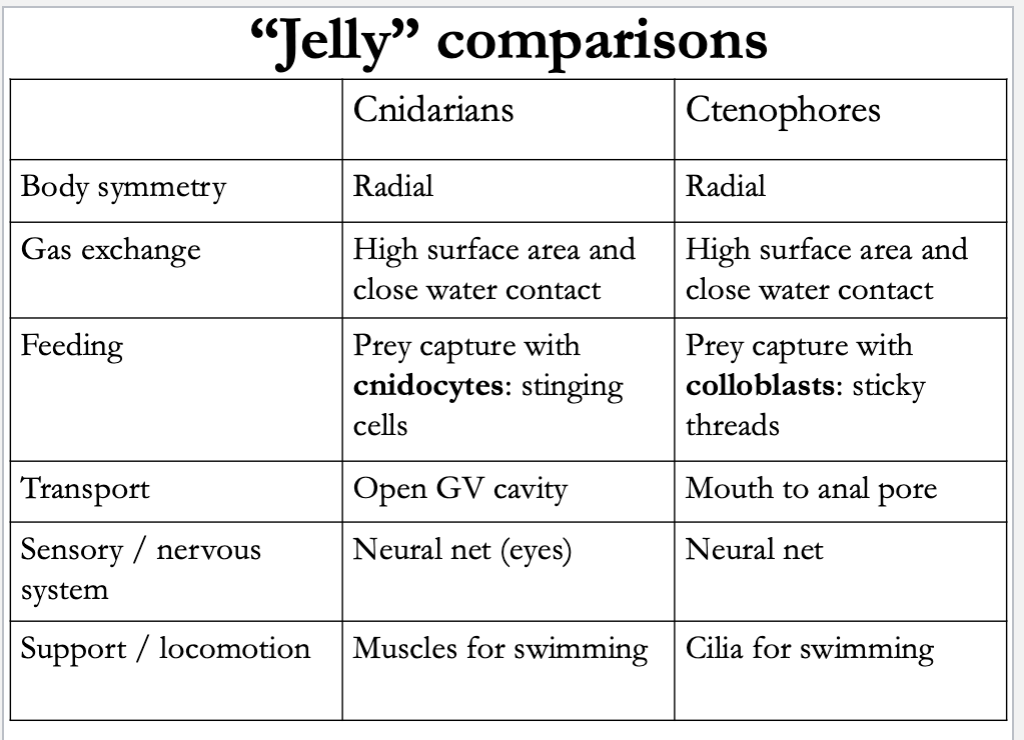
Summary for “basal” animals: all animals, porifera, eumetazoa, cnidarians
• All animals: Multicellularity, cell-cell junctions, collagen and extracellular matrix, a few homeobox genes
• Porifera: Multicellular, but protist-like in many ways
• Eumetazoa: Gastrulation, nerves, muscles, symmetry
• Basal eumetazoans (Cnidaria): Diploblasty*, extracellular digestion, cnidocytes, radial symmetry, neurons, muscle cells for rhythmic movement
Key takeaway: sponges lack true tissues, while cnidarians have organized tissues and basic nerve and muscle systems.
Origins of Bilateria: triploblasty, cephalization
• Triploblasty – three tissue layers, Mesoderm, Arises between ectoderm
and endoderm, Forms “true” muscle, Most organs
• Cephalization – head formation, Preferred orientation in space, Directed movement through the environment, Sense organs in front, Neural integration in the head
Why it helps: body has consistent orientation (front and back), directed movement forward through the environment, sense organs in front to detect food, obstacles and danger ahead, neural integration in head process sensory info and coordinate responses.
Relationships of Protosomes: Lophophore and Trochophore larva
Protostomes: Lophotrochozoa, Annelids, Molluscs, 12-16 other phyla
Unifying features:
Lophophore – ciliated feeding structure OR
Trochophore larva – early developmental stage. Ciliated feeding structure used to capture food, free-swimming larvae stage found in many annelids and molluscs. Not every member has loco or trocho tho.
Protosomes are bilaterally symmetrical animals.

Relationships of Protostomia: Ecdysozoa, ecdysis
• Protostomes: Ecdysozoa- Nematodes, Arthropods, 6-8 other phyla
Unifying feature
Ecdysis (molting) – shedding of older exoskeleton, and secretion of new larger exoskeleton
Annelida Diversity
• Great variation in the body plan of segmented worm
Marine species are particularly variable, with head specializations related to different types of prey capture
Annelida - Body Plan
• Segmentation!!!!
Independent evolution in chordates and arthropods (or bilaterian common
ancestor?)
• Metamerism–repeating segments
• Heteronomy – different segments having different appearance and function
• Limited in annelids, but we’ll see it more prominently in other phyla. May have evolved independently in annelids, arthropods, and chordates, or originated in a common bilateral ancestor.
• Hox genes for Anterior-Posterior axis, also recruited to specify segment identity
Key takeaway: segmentation divides the body into repeating units, while heteronomy allows segments to separate for different functions.
• Possess coelom – fluid-filled body cavity derived from the splitting of mesoderm
• Coelom evolution is complicated- independent origins and losses.
NOT a reliable guide to phylogeny!
However, functionally important for annelid movement - hydroskeleton. In annelids, fluid inside the coelom provides support and works with muscles to help the animal move (fluid gives resistance for muscles to contract)
Annelida - Form and Function 5
Big expansion of hox genes in annelids
Gas Exchange: Across moist surface, Some have gills or other surface
elaborations, Parapodia of marine annelids – motile appendages with gills
• Feeding: Complete digestive tract, Specialized regions (e.g., gizzard – grinds food)
Transport: Closed circulatory system
Dorsal “hearts” – contractile regions
Blue/red/green/no blood pigments
• Sensory/Nervous systems
Ventral nerve cord, several large, ganglia in head = simple brains
Receptive to wide variety of, stimuli, including light.
Simple light-receptive cells to small lens eyes
• Support/Locomotion: Hydrostatic skeleton! With segmentation
Segments can change, shape independently, Not just a bag of fluid
Big expansion of hox genes in annelids: hox genes control body patterning along posterior/anterior (front to back) axis. Annelids may have hox genes that help specify the identity of different body segments.

Mollusca - Diversity
• One of the most diverse phyla – 100K species
• Snails and slugs; oysters and clams; octopuses and squids
• Size ranges from microscopic to 20 m
• Habitats range from deep sea to terrestrial
• Activity level ranges from immobile to “flying”
Mollusca - Body Plan
Coelom reduced: means reduced body cavity, so less space inside the body that’s fully lined by the mesoderm. Is smaller + less developed → rely more on muscular foot and other structures for support and movement.
• Not segmented
• 3-part bodies - muscular foot, visceral
mass (internal organs), mantle – secretes shell
• Calcium carbonate shell: prominent, reduced, or lost
Mollusca - Form and Function
Gas Exchange: Well developed gills in most “Lungs” if terrestrial
• Feeding
Complete digestive tract, Everything from suspension feeding (e.g. bivalves) to macrocarnivory. Rasping radula to octopus beak
Transport: Circulatory systems. Most - open (low pressure)
Most Cephalopods – closed Blood pigments
Blue – hemocyanin (Cu) as oxygen absorbing protein
Well developed heart(s)
Cephalopods – three hearts – 2 gill hearts and 1 systemic heart
• Sensory/Nervous systems: Reflect activity level
Cephalopods – active predators – sophisticated sensory and neural processing comparable to vertebrates!
Convergent lens eye- different tissues!
Octopus – central brain – 170 million neurons, plus large, semi-independent ganglia in arms – 330 million neurons. Intelligence in protostome body plan
Movement: many use foot, slow motion battles. Foot evolves into propulsive device - Squid (20m/hr)

About Ecdysozoans
• 1 M described species
• Cuticle forms an exoskeleton: Hard outer layer
Protection
Limitations
Arthropoda - Body Plan
• Common features of all arthropods:
1. Segmentation: Independent gain from annelids, Strongly heteronomous (meaning different segments have different appearances, appendages, functions)
2. Exoskeleton – external hard parts (chitin)
• 3. Jointed appendages – great diversity
• Land, sea, air – arthropods are there
• Arthropod theme: Unity of plan, diversity of execution But limited size range

Arthropoda - Form and Function
• Gas Exchange: Must overcome low permeability of exoskeleton
Aquatic- Gills (often feathery extensions)
Two terrestrial types:
“Lungs” – localized air exchange organs (a few) or
Tracheae – diffuse channels to all cells (most insects)
• Feeding: Widely variable, but adapted to food source. Most arthropods evolved modified appendages for feeding. Heteronomy!!
• Transport: Open circulatory system, Blood pigments (sometimes), Well-developed heart(s)
• Sensory/Nervous systems: Highly variable, but generally very well developed, including Eyes - Visual receptors; Antennae - Chemoreceptors; “Ears” - Mechanoreceptors
• Support/Locomotion: Exoskeleton, Muscles attached to exoskeleton. Must molt
Protostome summary: multiple origins of locomotion, segmentation, sensory/response systems that are great.
• Multiple origins of effective locomotion
From water to land to air
Use of the coelom as a hydrostatic skeleton - Annelids
Use of a fairly rigid exoskeleton - Arthropods
Use of a muscular foot - Mollusks, especially cephalopods
• Multiple origins of segmentation (or common ancestor?)
Useful for locomotion in annelids
Extreme heteronomy (variable segments) in arthropods
• Separate instances of high speed and great sensory / response systems
Within molluscs
Within arthropods