epi exam 2
 Call Kai
 Learn
 Practice Test
 Spaced Repetition
 Match
 Flashcards
 Knowt Play
1/64

There's no tags or description
Looks like no tags are added yet.
65 Terms
what distinguishes an experimental study from an observational study?
Randomization of study subjects into exposure groups.
Manipulation of the risk factor/treatment
difference between randomization and random sample
Random sampling decides who gets into the study, so the sample represents the population and your results can be generalized (external validity). Randomization decides who gets which treatment once they’re in, so the groups are comparable and confounding is controlled (internal validity).
in public heath, what type of studies are conducted
observational studies: because of ethical consideration and data/costs
purpose of public health is health promotion so not a lot of time to collect data - prefer to use existing data that’s readily available
type of observational studies
descriptive: estimate disease frequency and trends
case reports, case series, cross-sectional
analytical: to generate and test hypotheses, & suggest causation
ecological, case control, cohort
attributes to experimental studies
Randomization of subjects + Manipulation of study factor
experimental studies maintain the greatest
control over the research setting
why conduct research studies?
The entire purpose of conducting any study is to see whether a treatment or an exposure changes an outcome:
prospective studies
start in the present and study groups into the future
retrospective studies
look into the past for associations between suspected causative factors and disease
ecologic studies
The unit of analysis is the group, not the individual
Correlations are obtained between exposure rates and
disease rates among different groups or populations.Marginals only are known.
whats unknown in ecological studies
in an ecological study, the level of exposure of each individual in the population being studied is unknown
types of ecological studies
ecological comparison study and ecological trend study
ecological comparison study
examines exposure rates and disease rates among different groups/populations over the same time period
ecological trend
examines changes in exposure and changes in disease within the same community, country, or other aggregate unit.
ecological fallacy
Observations made at the group level may not represent the exposure-disease relationship at the individual level
occurs when incorrect inferences about the individual are made from group level data
advantages of ecological studies
Quick, simple, inexpensive
May use secondary data
When little is known about the etiology of a disease, this is a good approach to generate hypotheses
disadvantages of ecological studies
Ecological fallacy
Limited ability to adjust for influence of extraneous (confounding) variables
Secondary data/sources. Summary data e.g. average per capita levels, → Imprecise measurement of exposure and disease
cross sectional study
a type of prevalence study looking at a single period of observation
exposure and disease histories collected simultaneously
do not measure the temporal order of cause and effect
what does a cross sectional study measure
more commonly current disease to current exposure
also current disease to past exposure
what are the 4 steps in a cross sectional study
Develop what it is you wish to measure (disease, exposure, group affected)
Determine target population and select sample
(probability sample)random sample thats true representation
Appropriate measure (level) of exposure and outcome
Data collected, analyzed to determine measure of
association
uses and strengths of cross sectional study
Quick, cheap, no follow up
Estimation of the magnitude and distribution of a health problem
General population studies (national health interview survey) – results generalizable to general population.
Intervention planning (planning health services)
May generate etiologic hypotheses
limitation and weakness of cross sectional study
Not useful for low-prevalence (rare) diseases. Too few cases turn up in a snapshot, so you’d need a huge sample.
Cannot study etiology (causes).
It gives prevalence data, not incidence data, so you see existing cases rather than new ones.
It can’t establish temporality. Exposure and disease are measured at the same time, so you don’t know which came first and can’t confirm cause and effect.
Survivors (survival bias). Only people who are alive and still have the disease get captured. That makes it hard to separate factors linked to getting the disease (risk) from factors linked to surviving with it.
what can case control studies tell us
Better understand the causes of disease by establishing risk factors for a disease
Or in clinical trial to establish whether a treatment is effective or not
attributes in case control
Initial classification of subjects is Disease Status
Disease is always determined before Exposure/Risk factor
Individual Cases and Controls are always selected first, at the start of the study
Exposure is determined later
retrospective (look at disease and backwards to the exposure)
a single point of observation
why are incident cases used for case control studies
because we are interested in factors that lead to developing the disease rather than factors that affect the duration of the disease
whats measure of association is used for case control
odds ratio


what does an odds ration of 1, 2, 0.5 mean?
odds ratio = 1: teh odds of exposure are equal among cases and controls
odds raton =1: the cases were twice as likely as controls to be exposed
when does an OR provide a good approximation or risk
controls are representative of a target population
cases are representative of all cases
what are the strengths of case control studies
small study size
quick, and inexpensive
most efficient design to study etiology of rate disease
study disease with long induction periods
evaluate multiple exposure (useful when little is known about the disease)
limitation of case control studies
provide indirect estimate of risk
timing of exposure-disease in difficult to determine
misclassification
great chan of bias
not efficient for rare exposure
cohort study
an observational study that follows a group of people who do not have the disease/outcome but have the potential to develop it, to see who develops it over time based on their exposure status.
measure of association for cohort studies
relative risk
attributable risk
relative risk

attributable risk
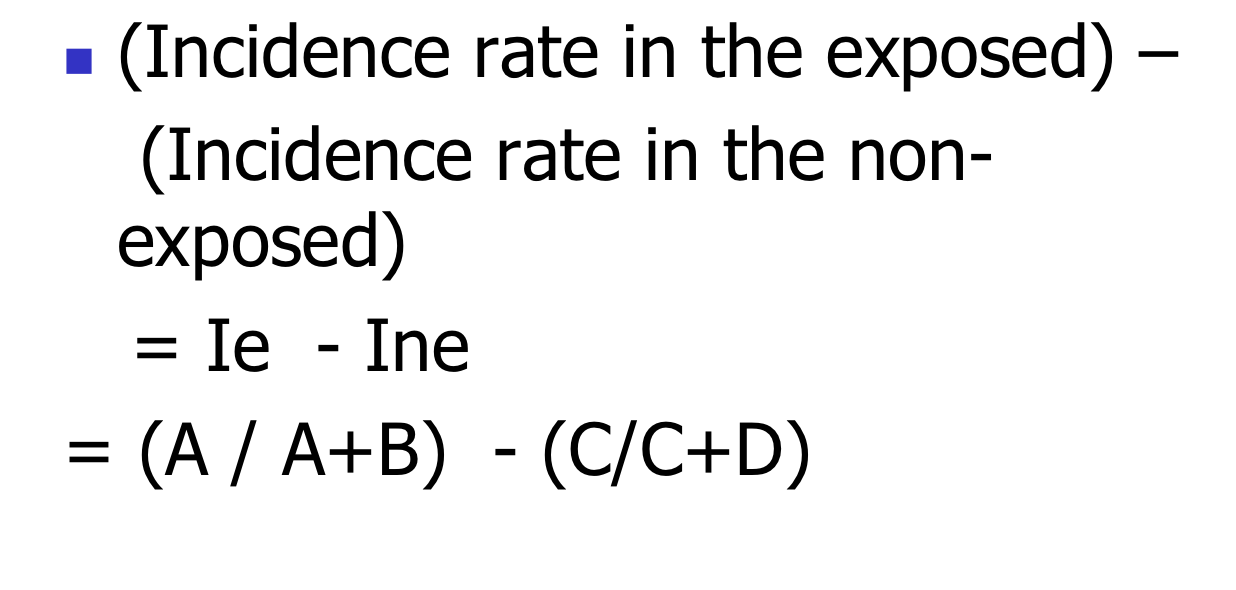
Cohort formation options: what’s the main difference?
Cohort formation options: what’s the main difference?Population-based: sample the general population; exposure is unknown until the first data collection point. Best for common exposures.
Special exposure (e.g., occupational): pick people already known to be exposed. Best for rare exposures.
advantages of cohort studies
Only observational study design which provides a direct estimation of risk
Permits multiple outcomes
Permits study of rare exposures (e.g. special cohorts)
Demonstrate temporal sequence between exposure and disease
Learn length of the time period between exposure and disease
limitation of cohort studies
Large sample size, multiple follow up points and long follow up period
Loss of subjects to follow up
Exposure misclassification as exposures may change over long follow up period
prospective cohort study
Purely prospective in nature; characterized by determination of exposure levels at baseline (the present), and follow-up for occurrence of disease at some time in the future
retrospective cohort study
Retrospective cohort studies make use of historical data to determine exposure level at some baseline in the past.
am-bidirectional cohort study
combines retrospective and prospective elements in the same study. You use existing records to look back at exposure (and possibly outcomes) that already happened, then keep following the same group into the future to capture more outcomes.
vietnam war for example
nested case-control
Defined as a type of case-control study in which cases
and controls are drawn from the population in a cohort study
advantages of nested case-control studies
Provide a degree of control over confounding factors exposure and other data on subjects have been collected over time
Reduce cost because exposure information is collected
types of follow up
Active: the investigator uses direct contact with the cohort to get data on outcome or change in risk factor(mailings, phone calls, written invitations to return to study sites).
Passive: no direct contact with cohort members. Possible when other databases containing the outcomes of interest are collected and available to researchers.
what does randomization ensure
it ensures compatibility between the study groups at outset of teh study
blinding
aka masking is done to maintain the integrity of a study and reduce the potential for bias (single blind vs double-blind)
ensures comparability of study groups throughout the study
prophylactic trial:
evaluates the effectiveness of a substance that is used to prevent disease; it can also involve a prevention program
therapeutic trial
involves the study of curative or palliative drugs or a new surgical procedure to improve the patient’s health
Equipoise
a state of legitimate uncertainty or indecision as to a choice of treatment or best course of action to take must exist.
Genuine confidence that a treatment may be worthwhile, enough to give it to some individuals
and genuine reservations about the treatment, enough to withhold it
measure of association for experimental study designs
rate ratio
percent relative effect
rate ratio

percent relative effect
.

strength of clinical trial
Provide the greatest control over: amount of exposure, timing and frequency of exposure, the period of observation,
ability to randomize reduces the likelihood that groups will differ significantly in factors other than the intervention under study
limitation of clinical trial
Artificial setting
Adherence to protocol is difficult to enforce.
Ethical dilemmas
Intent-to-treat vs. efficacy analysis?
ITT: analyze all participants in the group they were randomized to, regardless of compliance. Preserves randomization; reflects real-world effectiveness.
Efficacy: analyze only those who followed the protocol. Shows effect under ideal conditions; can be biased.
Hawthorne effect (“placebo effect”)?
participants, consciously or unconsciously, change their behavior simply because they are being studied.
Mere participation in a study may result in behavior change
Is the basis for placebo control in clinical trials
community health trial
An experimental study where the intervention is assigned to entire communities rather than individuals. Used for population-level interventions (e.g., water fluoridation, health campaigns). Outcomes are compared between intervention and control communities.
internval valididy
the extent to which differences in outcome between groups in a study can be attributed to the hypothesized effects of an exposure, an intervention, or other causal factor being investigated