Biology Chapter 6
 Call Kai
 Learn
 Practice Test
 Spaced Repetition
 Match
 Flashcards
 Knowt Play
1/48

There's no tags or description
Looks like no tags are added yet.
49 Terms
What are the three kinds of cellular respiration?
Aerobic Respiration, Anaerobic Respiration, and Fermentation
Anaerobic Respiration
essentially the same as aerobic respiration, except that an inorganic molecule other than O2 is the final electron acceptor at the end of the ETC. Alternative electron acceptors include nitrate, sulfate, and carbon dioxide. The number of ATPs generated per molecule of glucose depends on the electron acceptor, but it is always lower than the ATP yield for aerobic respiration.
Fermentation
the process of glycolysis occurs to make 2 ATP, 2 pyruvate, and 2 NADH. The NADH produced by glycolysis does not go through the ETC. Instead, the electrons from the NADH reduces the pyruvate either to form alcohol, ethanol, lactate, or lactic acid. The NADH is oxidized to form NAD+, which is essential for glycolysis to continue. Provides enough energy for some single-celled anaerobic species.
What are the three stages of aerobic cellular respiration?
Glycolysis, Krebs Cycle, and Electron Transfer Chain/Phosphorylation
Glycolysis
a metabolic pathway occurring in the cytosol of all cells. One molecule of glucose (six-carbon) splits into two molecules of pyruvate (three-carbon). This process harvests energy in two forms: Some of the electrons from glucose are transferred to NAD+, forming NADH and two molecules of ATP are generated.
What is the net yield of ATP and NADH at the end of glycolysis?
2 ATP and 2 NADH
What are the two stages of glycolysis?
Energy investment and energy harvesting
Energy Investment

The cells spends two molecules of ATP to activate glucose, redistributing energy in the molecule and splitting it in half. Glucose is converted to glucose-6-phosphate, then the molecules are rearranged to form fructose-6-phosphate. Another phosphate is added to this through ATP being converted to ADP, which forms fructose-6-bisphosphate. This is broken down into phosphoglyceraldehyde (PGAL) and Dihydroxyacetone phosphate which then turns into another PGAL. 2 molecules of ATP are utilized during the process.
Energy Harvesting
2 PGALs go through a series of processes to form 2 molecules of pyruvate. In these processes, ATP and NADH are made

Transition Step
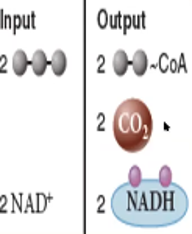
After glycolysis, pyruvate moves into the mitochondrial matrix where it is oxidized. A molecule of CO2 is removed from each pyruvate, and NAD+ is reduced to NADH. The remaining acetyl group is transferred to a molecule called coenzyme A to form acetyl coenzyme A (acetyl CoA). This then enters the Krebs cycle. Because 2 pyruvate go into this step, it releases 2 carbon dioxide and 2 NADH.
Krebs Cycle
Each acetyl CoA combines with a four-carbon molecule, oxaloacetate, to produce a 6-carbon molecule, Citrate, releasing the CoA. Then, citrate goes through a series of reactions. During these rearrangements of the chemical bonds, the energy in the bonds is released and used to make ATP, NADH, and FADH2. Carbon dioxide is released during the cycle. At the end of the cycle, the molecules re-create oxaloacetate, so the cycle can repeat.

The Number of ATPs, NADH, and FADH2 molecules produced at the end of the Krebs Cycle
Products after 2 cycles: 4 carbon dioxide, 2 ATP, 2 FADH2, and 6 NADH. Turns twice for each glucose because each glucose yields 2 acetyl CoA.
Electron Transport Chain/ Electron transfer Phosphorylation
The NADH and FADH2 transfer their electrons to an electron transport chain in the inner mitochondrial membrane. The ETC harnesses the energy from these electrons to pump protons from the matrix into the intermembrane compartment, forming a proton gradient. The final acceptor is O2, which combines with H+ to form water. The proton gradient moves down a hydrogen ion channel back to the matrix, which is coupled to ATP synthase. The energy released from the protons moving down the channel activates ATP synthase, which adds a phosphate to ADP to form ATP. Yields 34 ATP.
The Equation for Aerobic Cellular Respiration

Reactants: 1 glucose and 6 oxygen
Products: 6 carbon dioxide, 6 water, and 36 ATP
What are the two methods by which ATP is made in the cell?
Substrate-Level Phosphorylation and Chemiosmotic Phosphorylation
Substrate-level Phosphorylation
A phosphate is transferred from a high-energy donor molecule to ADP, forming ATP. An enzyme transfers a phosphate from a high-energy donor molecule to ADP to form ATP. Shown by ATP formed during glycolysis and Krebs cycle.

Chemiosmotic Phosphorylation/Oxidative Phosphorylation
Proton gradient provides energy for ATP synthase to phosphorylate ADP to form ATP. ATP synthase produces ATP via this. Reactions that produce ATP using ATP synthase and the potential energy of a proton gradient
Net Yield of ATPs at the end of aerobic cellular respiration
Substrate-level phosphorylation: 4 ATP (2 each from glycolysis and Krebs)
Chemiosmotic Phosphorylation: 34 ATP
Transporting 2 NADH from glycolysis into the mitochondrion requires 2 ATP so the net yield is 36 ATP for one molecule of glucose.
Explain the Role of O2 in Respiration
In aerobic respiration, O2 is the final electron acceptor in the ETC, which combines with hydrogen to form water, which is a product of aerobic respiration. It is required in aerobic respiration, but not fermentation or anaerobic respiration.
How do Fats enter the energy extracting pathways?
It is split into glycerol and fatty acids by enzymes in the small intestine. Glycerol is converted to pyruvate by enzymes. The fatty acids become Acetyl CoA.
How do proteins enter the energy extracting pathways?
They are digested into amino acids. The nitrogen is stropped from the amino acid and excreted as urea. Then, depending on the side chain (R group) the remainder of each molecule either enters the energy pathways as pyruvate, acetyl CoA, or an intermediate of the Krebs Cycle.
How do Starch and Glycogen (Polysaccharides) enter the energy extracting pathways?
in the mouth and small intestine, enzymes snip the long polysaccharide chains into individual glucose monomers, which generate ATP by entering the pathway as glucose molecules.
Anaerobic Respiration
essentially the same as aerobic respiration, except that an inorganic molecule other than O2 is the final electron acceptor at the end of the ETC. Alternative electron acceptors include nitrate, sulfate, and carbon dioxide. The number of ATPs generated per molecule of glucose depends on the electron acceptor, but it is always lower than the ATP yield for aerobic respiration. Generates ATP in the absence of oxygen using anaerobic metabolic pathways.
What are the 2 kinds of fermentation reactions?
Alcoholic Fermentation and Lactic Acid/Lactate Fermentation
Alcoholic Fermentation
metabolic pathway in which NADH reduces the pyruvate from glycolysis, producing ethanol and CO2. NADH is oxidized to produce NAD+.

Lactic Acid/Lactate Fermentation
metabolic pathway in which NADH from glycolysis reduces pyruvate, producing NAD+ and lactic acid or lactate.

How many ATPs are produced during fermentation?
2 from the glycolysis
Why is it important for NADH to be regenerated during fermentation?
because it ensures that glycolysis occurs again. It continues the process. NAD+ regeneration during both these pathways is crucial to the survival of the organism. When the supply of NAD+ is exhausted, glycolysis would stop, energy production would cease, and the organism would almost instantly die.
Cellular Respiration
the process by which cells release chemical energy from carbohydrates. Includes the catabolic pathways of aerobic respiration, fermentation, and anaerobic respiration, which break down organic molecules for the production of ATP.
Anaerobes
organisms that generate ATP in the absence of oxygen using anaerobic metabolic pathways. Ex. Bacteria and single-cell protists that inhabit sea sediments, animal guts, etc.
Facultative Anaerobes
organisms that can perform both aerobic and anaerobic respiration. Ex. yeast and animal muscle cells
ATP
a molecule whose high-energy phosphate bonds power many biological processes
Aerobic Respiration
complete oxidation of glucose to CO2 in the presence of O2, producing ATP. Steps: glycolysis, Krebs Cycle, and electron transport chain. Cells of plants and animals use this.
ATP Synthase
enzyme complex that admits protons through a membrane, triggering the phosphorylation of ADP to ATP
Mitochondria
organelle that houses the reactions of cellular respiration in eukaryotes
Matrix
fluid enclosed by the inner mitochondrial membrane; site of the transition step and Krebs cycle
Inner Mitochondrial Membrane
site of the electrons transport chain and ATP synthase enzyme
Intermembrane Compartment
space between the outer and inner membrane of a mitochondrion
Cristae
folds of the inner membrane that house electron transport chain proteins. Folds of the inner mitochondrial membrane along which many of the reactions of cellular respiration occur.
Pyruvate
the three-carbon product of glycolysis
NADH
coenzyme that carries electrons in glycolysis and cellular respiration
Acetyl CoA
molecule that enters the Krebs cycle in cellular respiration; product of partial oxidation of pyruvate
FADH2
coenzyme that carries electrons in respiration
Glycolysis Reactants
Glucose
Glycolysis Products
2 ATP, 2 NADH, and 2 molecules of pyruvate
How is Respiration related to photosynthesis?
The reactants of one are the products of the other.
In which organism does each of the fermentation pathways occur?
Alcoholic Fermentation: yeast
Lactate Fermentation: human muscle cells
Why do all organisms need ATP?
It powers the chemical reactions and functions that keep cells alive. It is the only form of energy that cells can use.
How do organisms get oxygen to their cells?
By breathing/inhaling.