Bio QuestionBank: Prokaryotes, Eukaryotes & Viruses
 Call Kai
 Learn
 Practice Test
 Spaced Repetition
 Match
 Flashcards
 Knowt Play
1/54

Earn XP
Description and Tags
Comprehensive review flashcards in fill-in-the-blank format covering prokaryotic biology, eukaryotic and protistan evolution, and viral mechanics from the Bio QuestionBank.
55 Terms
Fossil evidence of the earliest living organisms dates back about __________.
3.8 billion years
The fossil record extends approximately __________ back in time.
3.5 billion years
Conditions on early Earth differed from modern Earth because only early Earth was intensely bombarded by __________.
large space debris
Unlike Earth's modern atmosphere, primitive Earth's atmosphere did not contain __________.
free oxygen
The first genetic material to exist on early Earth was most likely __________.
RNA
Fossilized stromatolites resemble structures formed by bacterial communities found today in some __________.
shallow marine bays
In 3.5-billion-year-old stromatolite microfossils, the discovery of a __________ would be surprising because eukaryotes had not yet evolved.
nucleus
In bacteria, small circular molecules of DNA that replicate independently of the chromosome are called __________.
plasmids
A prokaryote's essential genetic information is localized in the region called the __________.
nucleoid
The external hair-like bacterial appendages that allow cells to join together for gene transfer are called __________.
pili
The motor of a typical prokaryotic flagellum is embedded within the __________ and plasma membrane.
cell wall
Bacterial binary fission resembles eukaryotic mitosis because both processes produce __________ daughter cells.
genetically identical
Archaebacteria differ structurally from eubacteria primarily in their absence of __________ in the cell wall.
peptidoglycan
The fundamental basis for dividing prokaryotes into bacteria and archaea was genetic traits such as __________ sequences.
ribosomal RNA
Genetic variation in bacterial populations cannot result from __________.
meiosis
If an E.coli strain lacks an F factor and phages are absent, beneficial mutations can still be horizontally transferred via __________.
transformation
A bacterium regenerating from an endospore that lacked its parent's plasmids will probably lack __________ genes.
antibiotic-resistant
If all prokaryotes suddenly vanished from the planet, the recycling of __________ would be greatly reduced.
nutrients
A bacterium living in the human intestine and digesting food contents is nutritionally classified as an __________.
anaerobic chemoheterotroph
In an E.coli evolution experiment, if the vertical axis is Darwinian fitness, the most valid measure is the number of offspring or close kin that survive to __________.
reproductive age
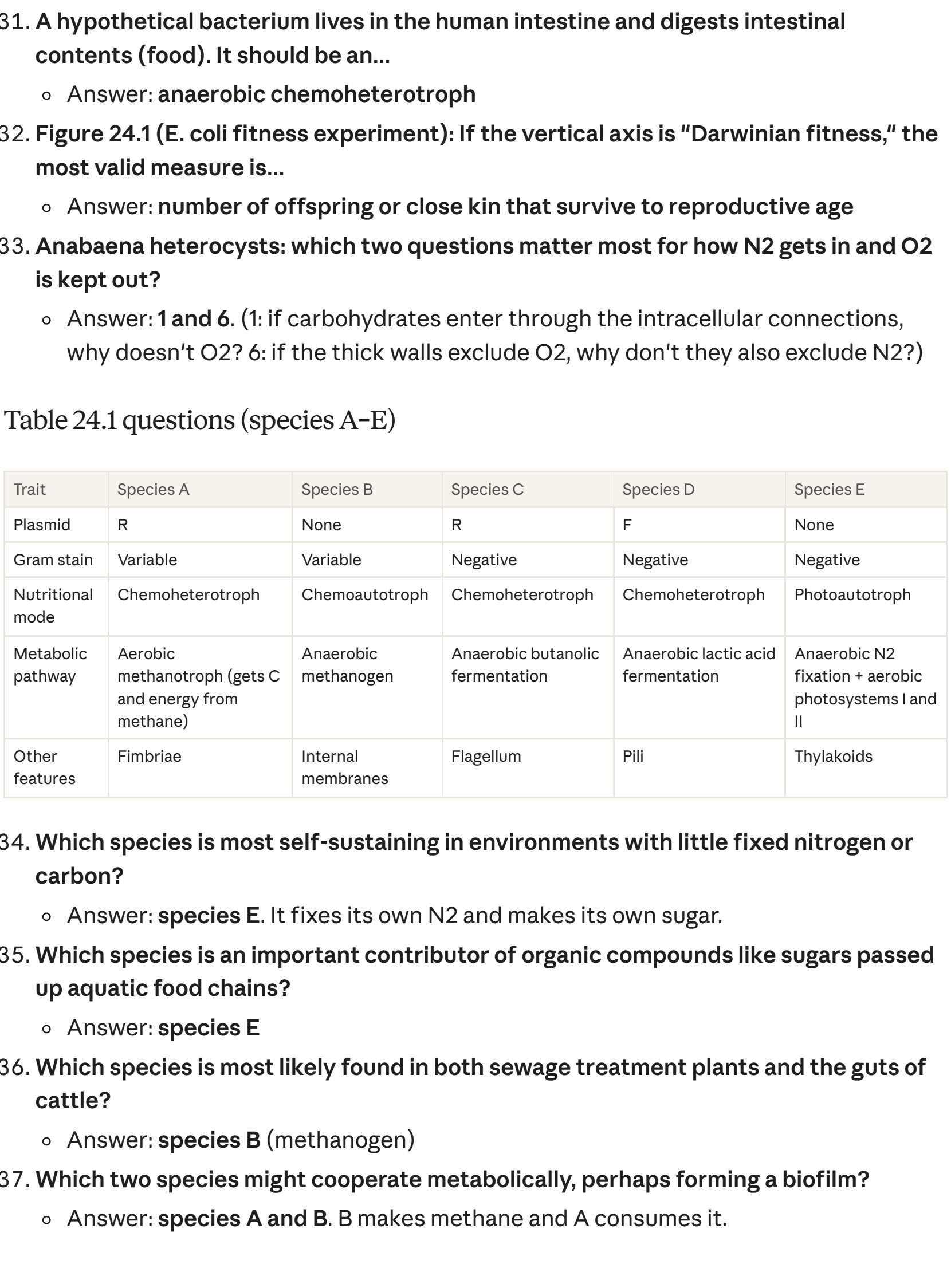
Based on Table 24.1, the species that is most self-sustaining in environments lacking fixed nitrogen or carbon is __________.
species E
Based on Table 24.1, the species most likely to be found both in sewage treatment plants and the guts of cattle is __________.
species B
Based on Table 24.1, the two species that might cooperate metabolically in a biofilm where one generates methane and the other consumes it are __________.
species A and B
The greatest ecological impact organisms have ever had was when early cyanobacteria released oxygen during the __________ step of photosynthesis.
water-splitting
Endotoxins are composed chemically of __________, whereas exotoxins are proteins.
lipopolysaccharides
An organism that obtains both carbon and energy by ingesting prey or decomposing organic matter is a __________.
chemoheterotroph
When Bdellovibrio bacteriovorus penetrates a gram-negative prey cell with a slimy layer, it crosses structures in the sequence: capsule, outer LPS membrane, __________, and plasma membrane.
peptidoglycan
Bacteria in high-sugar preserves die primarily due to __________ from the cell.
water loss
The chronological sequence in the origin of life is: synthesis of organic monomers, synthesis of organic polymers, formation of __________, and formation of DNA-based genetic systems.
protobionts
According to the endosymbiotic theory, mitochondria originated from engulfed, originally free-living __________.
proteobacteria
Plastids that are surrounded by more than two membranes serve as direct evidence of __________.
secondary endosymbiosis
The eukaryotic supergroup containing red algae, green algae, and all land plants is __________.
Archaeplastida
The oldest taxonomically resolved eukaryotic fossil is a red alga that lived __________ ago.
1.2 billion years
In colonial organisms, plant cell colonies adhere primarily by cell walls, whereas animal cell colonies are held together by __________.
proteins
The two parasitic protist genera that evade human immunity by frequently altering surface proteins are __________ and Trypanosoma.
Plasmodium
A snail-like, coiled porous test composed of calcium carbonate is characteristic of __________.
foraminiferans
Giardia cysts are functionally most analogous to the __________ of bacteria.
endospores
All protists are cellularly classified as __________.
eukaryotic
All protists possess __________, though in some anaerobic lineages they are degenerate and termed mitosomes or hydrogenosomes.
mitochondria
An endosymbiont cyanelle is determined to have transitioned into an organelle once genes have transferred from the cyanelle genome to the __________.
nuclear genome
In Paulinella chromatophora, photosystems are embedded in the __________ of the two surrounding phospholipid bilayers.
innermost
Dinoflagellates characteristically possess __________ flagella.
two
The last common ancestor shared by fungi and animals was most likely a __________.
single-celled eukaryote
In retroviruses, the enzyme reverse transcriptase synthesizes DNA using __________ as a template.
viral RNA
RNA viruses exhibit unusually high mutation rates because viral genome replication lacks __________.
proofreading
A virus's host range is determined by specific surface proteins on the virus and complementary receptors on the __________.
host
If yellow mottle virus has a capsid of 180 identical capsomeres across 20 facets, each facet is composed of __________ proteins.
9
If a bacterium is infected by a chimeric phage with T2 proteins and T4 DNA, the progeny phages will have __________ protein and T4 DNA.
T4
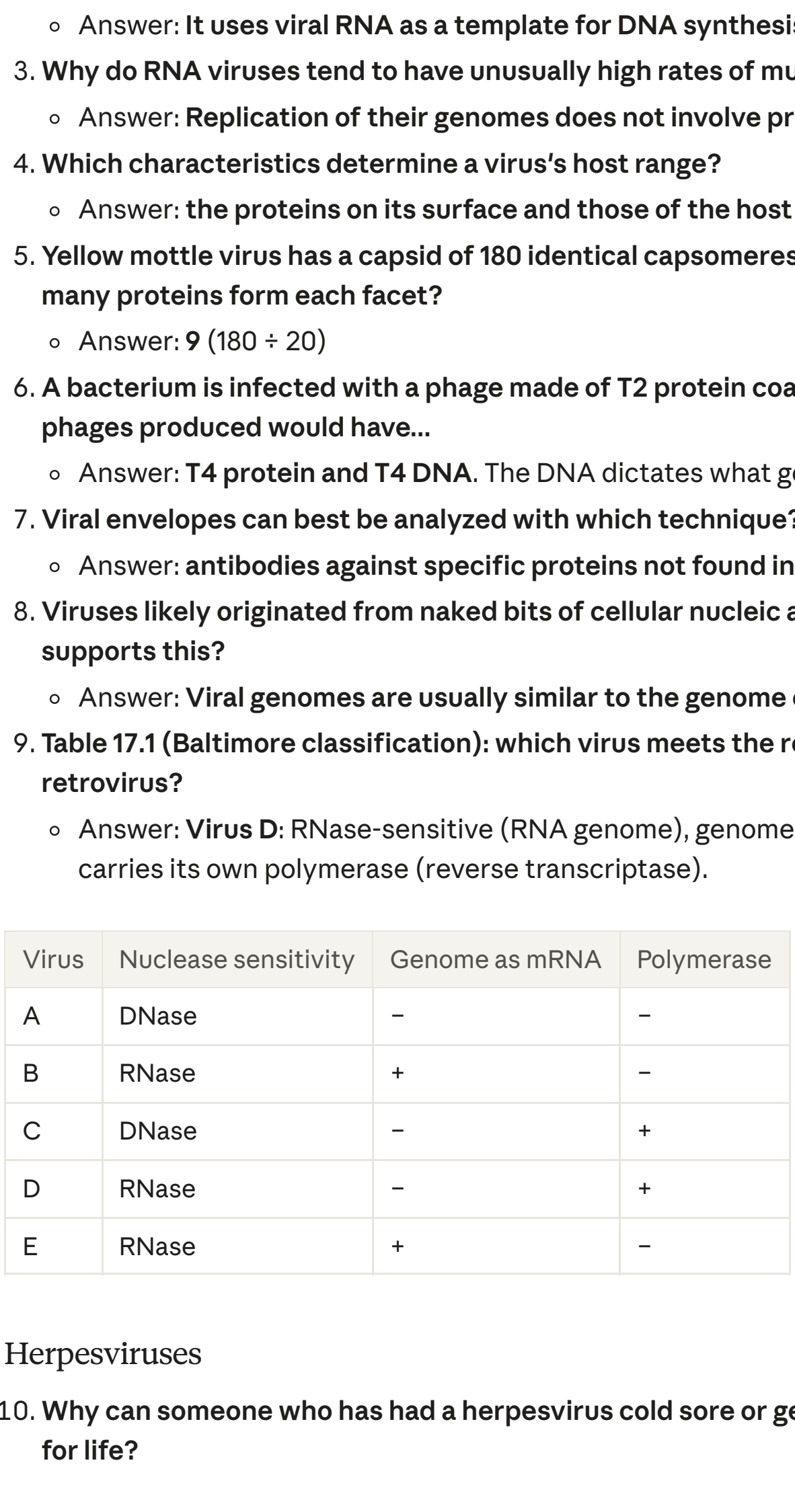
According to Table 17.1, the virus that meets the requirements of a retrovirus is __________.
Virus D
Herpesvirus causes recurring lifelong flare-ups because viral genome copies remain as mini-chromosomes inside host cell __________.
nuclei
To remain latent within an infected cell, herpes simplex virus must shut down host cell __________.
apoptosis
Within plant hosts, viral infections spread cell-to-cell primarily through microscopic channels called __________.
plasmodesmata
An unknown pathogen can be distinguished as bacterial rather than viral because only bacteria can grow alone on a __________.
nutrient medium
The best predictor of the long-term tissue damage caused by a virus is the infected host cell's ability to undergo __________.
normal cell division
During the lysogenic cycle of lambda phage, the viral genome replicates synchronously along with the __________.
host genome