ACER 10/7 Lecture #12: MO Theory Part 1
 Call Kai
 Learn
Learn Practice Test
 Spaced Repetition
 Match
Match Flashcards
 Knowt Play
1/21

There's no tags or description
Looks like no tags are added yet.
Name | Mastery | Learn | Test | Matching | Spaced | Call with Kai | Chat |
|---|
No analytics yet
Send a link to your students to track their progress
22 Terms
Describe Molecular Orbital Theory (MO Theory). How is it different from the other models?
Electrons occupy molecular orbitals, which are created from atomic orbitals and spread throughout the entire molecule.
This means that the electrons are delocalized over the molecule, which is different from the Lewis and VB models where electrons are localized on an atom or between two atoms.
How are molecular orbitals created? Compare this to VB Theory.
How many MOs are created?
Molecular orbitals combine the valence shell orbitals of every atom in the molecule.
Similar to VB Theory, this is done through the LCAO method, which will create the same number of MOs as the number of AOs that were combined.
What is the LCAO method?
LCAO stands for the Linear Combination of Atomic Orbitals.
It mathematically combines individual wavefunctions (aka orbitals) by adding together wavefunctions that are in the same phase (constructive interference) and subtracting wavefunctions that are not in the same phase (destructive interference).
Compare the three different types of molecular orbitals (MOs).
How are they made? How do their energies compare?
How are they indicated on an MO energy-level diagram?
Antibonding MOs are made when wavefunctions are subtracted. They are higher in energy than other orbitals in the same subshell.
Indicated by an asterisk next to the standard symbols (σ* or π*)
Bonding MOs are made when wavefunctions are added. They are lower in energy than other orbitals in the same subshell.
Indicated by standard symbols denoting bond symmetry (σ or π)
Nonbonding MOs are made when orbitals do not interact, either because they lack the appropriate symmetry or because they are significantly different in energy level. They are higher in energy than bonding MOs and lower in energy than antibonding MOs (simply drawn at the same level as the parent orbital).
Indicated by nb
One type of molecular orbital is higher in energy than the other types. Why does this happen?
Antibonding MOs have an angular node that is created when wavefunctions cancel out.
This node pushes electrons away from the internuclear region between two atoms, causing the nuclei to repel each other. This repulsion destabilizes the molecule and increases its energy.
What is a homonuclear diatomic molecule?
A molecule made of two identical atoms
What is a heteronuclear diatomic molecule?
A molecule made of two non-identical atoms
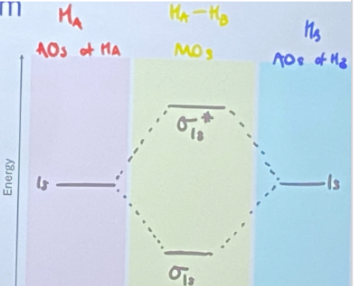
How do you draw an MO energy-level diagram for a period 1 homonuclear diatomic molecule? You can explain in words or draw the MO diagram for a period 1 homonuclear diatomic molecule (He2 or H2).
The diagram has three parts: the left and right parts are for atomic orbitals of either atom in the molecule and the middle part is for molecular orbitals formed from the atomic orbitals.
The y-axis is energy.
On the left and right, each valence atomic orbital is drawn with their electrons.
Each side contains a 1s orbital.
In the middle, the molecular orbitals (σ and π) are drawn according to their energy.
This would be σ1s below σ1s* for period one. σ1s and σ1s* should be spaced equally apart from the 2s atomic orbitals.
Valence electrons fill them following the same rules (Aufbau Principle, Puali Exclusion Principle, Hund’s Rule).
How many electrons are needed to form a bond in MO theory? Compare this to the Lewis and VB theories.
One electron can form a bond in MO theory, unlike Lewis and VB theories which require two electrons. This would form a half-bond (0.5 bonds) with half the strength of an electron pair.
How do you calculate bond order in MO theory? Compare this to Lewis and VB theories.
MO Theory: BO = ½(# of electrons in bonding orbitals - # of electrons in antibonding orbitals)
Lewis Theory: BO = # of bonds/# of bonding groups
VB Theory: BO = # of shared electron pairs or BO = # of σ bonds + # of π bonds
Can He2+ exist? Compare Lewis, VB, and MO theories.
Yes, it can exist and has been created.
It cannot exist according to Lewis theory because it violates the octet rule.
It can exist according to VB theory where bonds are simply overlapping orbitals, so the full s-orbital of He can form a bond with the half-full s-orbital of He+ to create a three electron bond.
It can exist according to MO theory where the three electrons would fill σ1s (two electrons) and σ1s* (one electron) to get a bond order of 0.5.
For period 2 homonuclear diatomic molecules, how do the valence atomic orbitals form molecular orbitals?
How does the orientation of p orbitals impact the molecular orbital that is formed?
There is one 2s orbital from each atom, which forms a σ2s and a σ2s* orbital.
There are three 2p orbitals (2pz, 2py, 2px) from each atom, which form a σ2p, a σ2p*, two π2p, and two π2p* orbitals.
The two Pz orbitals directed head-on towards each other form σ orbitals.
The Px and Py orbitals perpendicular to the internuclear axis will overlap side-by-side to form π orbitals.
List these orbitals in order of increasing energy for a homonuclear diatomic molecule without s-p mixing and with s-p mixing:
σ2s, σ2s*, σ2p, σ2p*, π2p, π2p*
Without s-p mixing: σ2s < σ2s* < σ2p < π2p < π2p* < σ2p*
With s-p mixing: σ2s < σ2s* < π2p < σ2p < π2p* < σ2p*
What is s-p mixing? What elements does it apply to? How does it affect the energy levels of molecular orbitals?
s-p mixing happens to 2nd period homonuclear diatomic molecules Li2 through N2 as well as 2nd period heteronuclear diatomic molecules with at least on atom that is Li through N.
It happens because the 2s and 2p orbitals are close enough in energy that they mix.
This causes the σ2p orbital to be higher in energy than the π2p orbital. Additionally, the σ2s and σ2s* orbitals are no longer evenly spaced.
What is the HOMO and LUMO?
HOMO: Highest occupied molecular orbital
LUMO: Lowest unoccupied molecular orbital
If the lowest unoccupied molecular orbital level has multiple orbitals (for example, there are two π2p orbitals), then the LUMO is…
all of the orbitals, since they are degenerate and essentially act like one large orbital.
Draw the MO diagram for period 2 homonuclear diatomic molecules without s-p mixing. Which molecules are these?
Identify the HOMO and FUMO.
O2 and F2
The π2p* orbitals are the HOMO and the σsp* orbital is the FUMO.

Why does s-p mixing not occur in O2, F2, or Ne2?
These elements have greater differences in the energies of their 2s and 2p orbitals.
This is because as Zeff increases across a period, the 2s orbitals become smaller and lower in energy.
Draw the MO orbital of a period 2 heteronuclear diatomic molecule with s-p mixing.
Explain how and why the relative energy levels of atomic orbitals are different compared to a homonuclear diatomic molecule.
In a heteronuclear diatomic molecule, there is an unequal sharing of electrons (polarity) that causes the energy levels of the atomic orbitals to be lower (for the more electronegative atom) or higher (for the less electronegative atom).
The more electronegative atom pulls electrons closer to it which is more stable so its atomic orbitals are lower in energy compared to the less electronegative atom.


Identify each type of MO diagram shown here. What type of molecule is each one for?
Left: Homonuclear diatomic molecule with s-p mixing (Li2 through N2)
Middle: Homonuclear diatomic molecule without s-p mixing (O2, F2, Ne2)
Right: Heteronuclear diatomic molecule with s-p mixing
What kind of molecular orbital do heteronuclear diatomic molecules have that homonuclear diatomic molecules don’t?
What is special about this orbital? How does this compare to Lewis structures?
Nonbonding orbitals have practically the same energy as the orbitals they are created from.
As a result, the electrons in this orbital do not contribute to bond order and are essentially like the lone pair electrons in Lewis structures which don’t participate in bonding.

Draw the MO energy level diagram and write the configuration.
NO- exhibits s-p mixing and is polar so the energy levels of O are lower than the same energy levels for N.
