Population/Community Ecology Exam 2
 Call Kai
 Learn
 Practice Test
 Spaced Repetition
 Match
 Flashcards
 Knowt Play
1/42

There's no tags or description
Looks like no tags are added yet.
43 Terms
population
group of individuals of same species that live in same area and interact with each other
Abundance
pop size (number individuals) or density (individuals per area)
Population Concepts
1. We estimate population abundance and density with sampling, & we use models to predict
2. Populations of a species are dynamic: they vary over time and space
3. Patchy populations are limited by habitat suitability, historical factors, and dispersal
4. The dispersion of individuals depends on essential resources, competition, dispersal, and behavioral interactions
Population Dispersal
1) Emigration: male (mates) vs female (nutrition) distribution
2) wind transport - dandelion
3) H2O transport - salmon fry
4) passive navigation - portoguese man o’war genetic polymorphism
5) animal vector
6) coordinated gamete release - coral
density independent vs dependent dispersal
density independent: passive dispersal depend on natural kinetic energy (eg wind, gravity)
density dependent: active dispersal depend on population size, resource competition, habitat quality, and habitat size
natal dipersal
permanent movement from where organism give birth to new place to reproduce - eg male lions leave pride
breeding dispersal
adults move between breeding attempts
Metapopulation
a population of subpopulations/groups connected when individuals move between patches
limits to population distribution
Patchy distribution: limited by habitat (large scale - climate, small scale - soil)
dispersal limitation - seeds/species cannot expand to take up all possible habitat eg devils hole pupfish
What determines dispersal distancce
1) Proximate Causes
A. Environmental dispersal
-absent or highly variable resources
-parental aggression
B. "Innate" dispersal
-genetic predisposition to disperse (e.g., migration cues via body condition, etc.)
2) Ultimate Causes - evolutionary underpinnings
inbreeding avoidance - avoiding extinction vortex
2. competition for mates
3. competition for resource
Life History
record of major events related to growth & development, reproduction, and survival
Measuring growth & development: size at maturity, metamorphosis, speed of juvenile growth
Measuring reproduction: age at first reproduction, frequency/number of reproductive events, sexual vs asexual reproduction, size vs number of offspring
measuring survival: juvenile vs adult survival probability, cost of reproduction, senescence, lifespan

Life History Generation Time Equation

Life HIstory Vital Rates Chart
Tradeoffs between survival and reproduction - when reproduce and size vs quantity
Amount variation
fish > amphibians/reptiles > birds > mammals

Logistic Population Growth
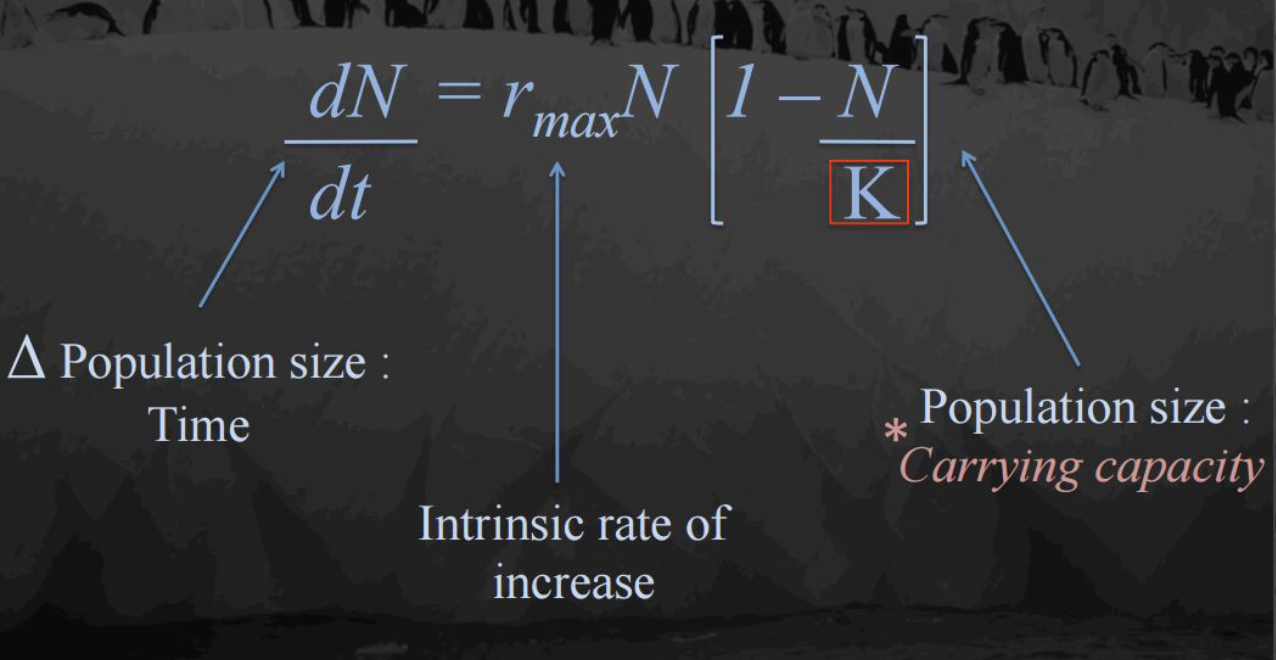
r vs k selected species
r selected species: maximize population growth; early maturity, lots of babies, less survive, small parental investment; unstable habitats so below carrying capacity
k selested species: maximize competitive success in crowded environment; delayed maturity, few offspring, high parental inestment, long generation time; stable habitats so near/at carrying capacity
survivorship curves

Factors in population change
Growth: births and immigration
Decline: deaths and emigration
Population Growth Phases
Lag phase → exponential phase → stationary phase → death phase

carrying capacity over time
Carrying capacity, K, not constant over time, it changes and represent range of values
Delayed Density Dependence

Delayed Density Dependence rτ
when rτ < 0.368, no fluctuation at K
when 0.368 < rτ < 1.57 damped oscillation at K
when rτ > 1.57 indefinite fluctuations at K - stable limit cycle/stable equilibrium state
based on intraspecific competition
Allee affect
balance between context small population density limiting growth and positive density dependence for the minimum viable population
about how much individuals can find each other in space
When population is large, positive relationship between population density and the reproduction and survival of individuals
When the population is small, increased difficulty of finding mates or reproducing at low population size (negative relationship).

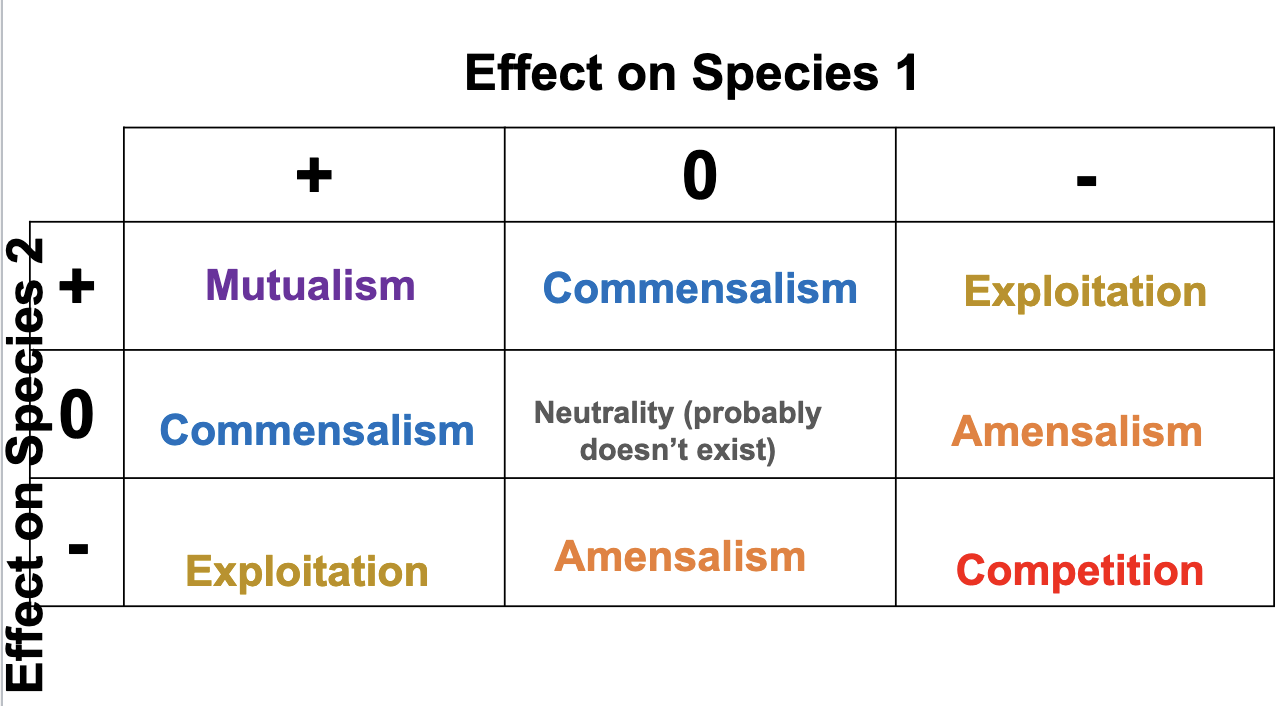
community interactions (+, 0, -)
Exploitation: +, -
Amensalism:
intraspecific vs interspecific competition
Intraspecific: Competition between individuals of the same species
Interspecific: Competition between different species
Competition and Distribution
competition → uniform distribution
Territoriality (inter or intra) occur when benefits of controlling the
territory > costs of defending
Interspecific Competition Equation
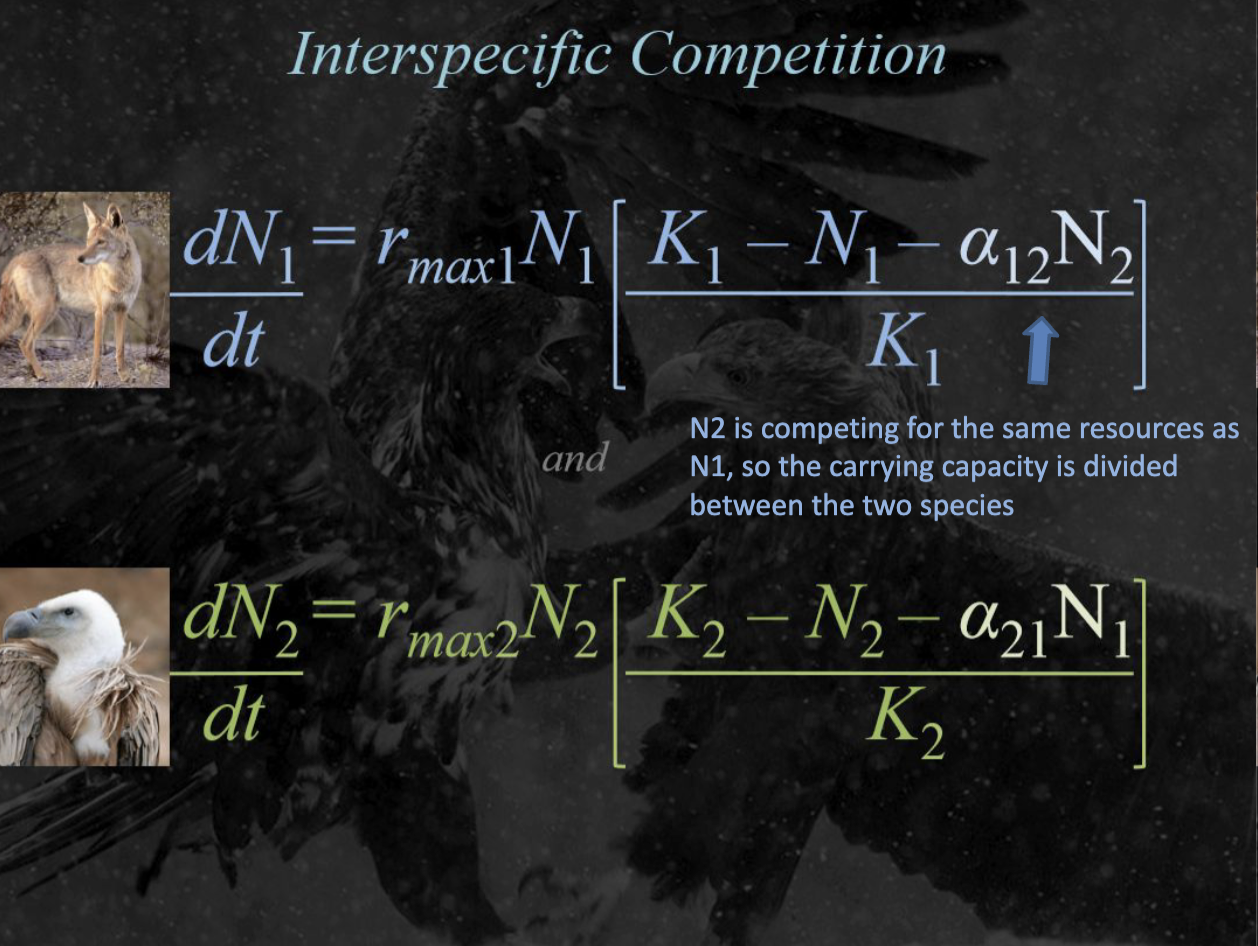
Conditions under Lotka-Volterra for stable coexistence
intraspecific competition has a greater effect than interspecific competition
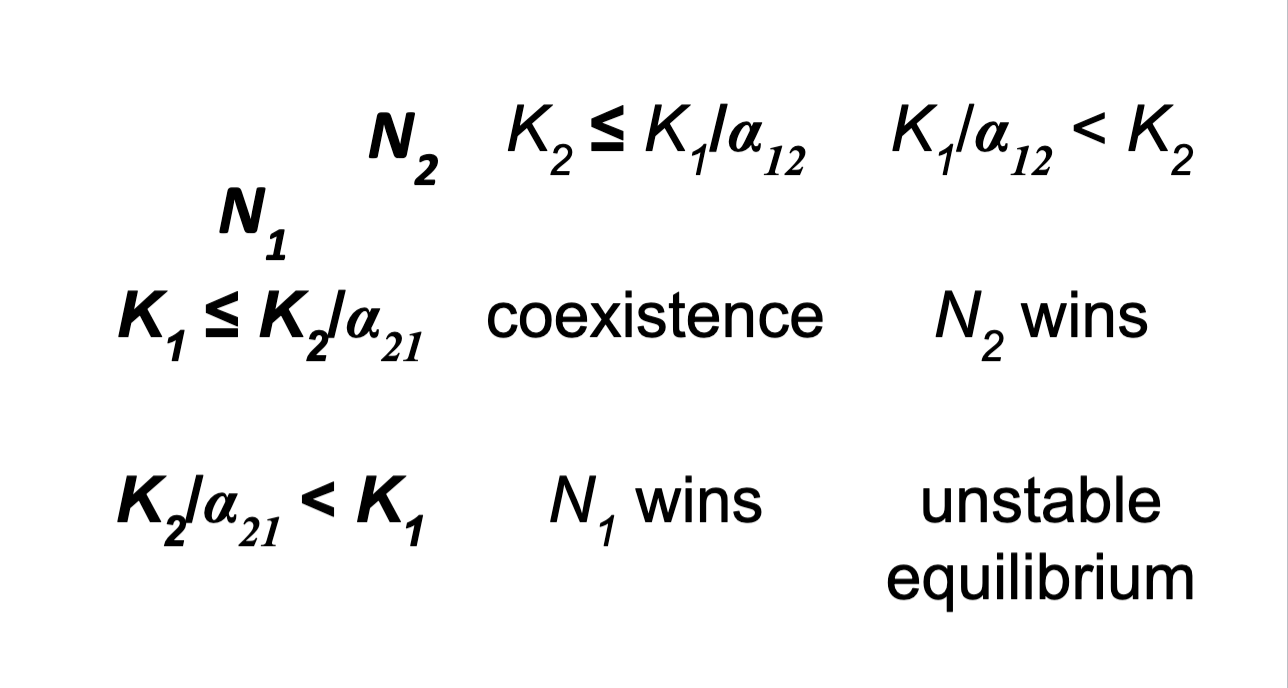
Lotka-Volterra two species competition outcomes

Lotka-Volterra two species competition outcomes (K2/K1)