Vet Med Term - Chapter 6
 Call Kai
 Learn
 Practice Test
 Spaced Repetition
 Match
 Flashcards
 Knowt Play
1/179

There's no tags or description
Looks like no tags are added yet.
180 Terms
Digestive system (or tract) / alimentary system / gastrointestinal (GI) system (or tract)
Body system that is a long, muscular tube that begins at the mouth and ends at the anus
Functions of digestive system
intake and digestion of food/water
Absorption of nutrients
Eliminations of solid waste products
Structures of digestive system
mouth or oral cavity
Pharynx
Esophagus
Stomach
Small intestines
Large intestines
Accessory organs of digestion
Mouth / oral cavity
Mechanical and chemical process of digestion begins in mouth
Or/o & Stomat/o
Mouth
Oral cavity contains
lips
Cheeks
Hard and soft palates
Salivary glands
Tongue
Teeth
Periodontium
Lips
Form the opening to oral cavity
Cheil/o and labi/o
Lips
Labia
Med term for lips
Labium
Single lip
Cheeks
Forms walls of oral cavity
Bucc/o
Cheeks
Buccal
Pertaining to or directed toward cheek
Palate
Forms roof of mouth
Palat/o
Palate
Hard palate
Forms body rostral portion of palate that is covered with specialized mucous membrane
Rugae
Irregular folds that are apart of the specialized mucous membranes of the hard palate
Rug/o
Wrinkle or fold
Soft palate
Forms flexible caudal portion of palate
involved in closing off nasal passages during swallowing so food does not move into nostrils
Tongue
Moveable muscular organ used for tasting/processing food, grooming, and articulating sound
Gloss/o and lingu/o
Tongue
Papillae
Elevations on tongue
may appear:
Filiform
Fungiform
Vallate
Filiform
Threadlike
Fungiform
Mushroomlike
Vallate
Cup-shaped
Frenulum
Band of connective tissue that connects tongue to ventral surface of oral cavity
Lingual surface of cheek
Is side adjacent to tongue
Maxilla / mandible
Boundaries of oral cavity
Gnath/o
Jaw
Prognathia (sow mouth)
Having an elongated or overshot mandible
Brachygnathia (parrot mouth)
Having a shortened or undershot mandible
Dent/o, dent/i, odont/o
Teeth
Dentition
Refers to teeth as a whole
arranged in the maxillary and mandibular arcades
Endodontics
Branch of dentistry that involves treatment of diseases that affect the tooth pulp
Exodontics
Branch of dentistry that involves extraction of teeth and related procedures
Oral surgery
Branch of surgery that involves surgical correction of the jaw, gums, and inside of the mouth
Orthodontics
Branch of dentistry that involves the guidance and correction of malocclusion
Periodontics
Branch of dentistry that studies and treats the diseases of tooth-supporting structures
Deciduous dentition / primary dentition
The temporary set of teeth that erupt in young and are replaced at/near maturity
Decidu/o
Shedding
Permanent dentition
Set of teeth designed to last a lifetime
Mixed dentition
Period when both deciduous and permanent teeth are present
Retained deciduous tooth
Deciduous tooth that has not been shed and may be extracted professionally
4 types of teeth
incisor
Canine
Premolar
Molar
Incisor / I
Front tooth used for cutting
Canine / fang / cuspid / C
Long, pointed bonelike tooth located between incisors and premolars
Cusp
Having tapering projection
Cuspid
Having one point
Premolar / bicuspids / P
Cheek tooth found between canine and molars
called bicuspids bc they have 2 points
Molar / M
Most caudally located permanent cheek tooth used for grinding
Molar came from Latin word
To grind
Dental formula
Represents type and # of each tooth found in the species
only one side of mouth is represented and is preceded by a 2 to indicate that the arrangement is the same on both sides
Cheek teeth
Premolars and molars
Needle teeth
Deciduous canines and third incisor of pigs
Wolf teeth
Rudimentary premolar 1 in horses
Milk teeth
First set of teeth
Tusks
Permanent teeth of pigs
Carnassial tooth
Large, shearing cheek tooth; upper P4 and lower M1 in dogs; upper P3 and lower M1 in cats
Fighting teeth
Set of six teeth in llamas that include upper vestigial incisors and upper and lower canines on each side
Selenodont
Animals with teeth that have crescents on their grinding surfaces (eg ruminants)
Lophodont
Animals with teeth that have ridged occlusal surfaces (eg equine)
Bunodont
Animals with teeth that have worn, rounded surfaces (eg swine)
Hypsodont
Animals with continuously erupting teeth (eg cheek teeth of ruminants)
Pleurodont
Animals with teeth attached by one side on the inner jaw surface (eg lizards)
Brachydont
Animals with permanently rooted teeth (eg carnivores)
Dental formula for adult dog
2 (I 3/3, C 1/1, P 4/4, M 2/3)
total = 42
Dental formula for adult cat
2 (I 3/3, C 1/1, P 3/2, M 1/1)
total = 30
Dental formula for adult bovine, sheep, goat
2 ( I 0/4, C 0/0, P 3/3, M 3/3) or 2 ( I 0/3, C 0/1, P 3/3, M 3/3)
total = 32
Dental formula for adult horse
2 ( I 3/3, C 1/1, P 3-4/3, M 3/3)
total = 40 or 42
Dental formula for adult pig
2 ( I 3/3, C 1/1, P 4/4, M 3/3)
total = 44
Dental formula for adult female llama
2 ( I 1/3, C 1/1, P 2/1, M 3/2)
total = 28
Dental formula for adult male llama
2 ( I 1/3, C 1/1, P 2/1, M 3/3)
total = 30
Dental formula for adult rabbit
2 ( I 2/1, C 0/0, P 3/2, M 3/3)
total = 28
Dental formula for adult ferret
2 ( I 3/3, C 1/1, P 3/3, M 1/2)
total = 34
Dental formula for adult chinchilla
2 ( I 1/1, C 0/0, P 1/1, M 3/3)
total = 20
Dental formula for adult gerbil
2 ( I 1/1, C 0/0, P 0/0, M 3/3)
total = 16
Dental formula for adult hamster
2 ( I 1/1, C 0/0, P 0/0, M 3/3)
total = 16
Dental formula for adult rat and mouse
2 ( I 1/1, C 0/0, P 0/0, M 3/3)
total = 16
Dental formula for adult guinea pig
2 ( I 1/1, C 0/0, P 1/1, M 3/3)
total = 20

Triadan system
each tooth has a 3 digit #
1st digit (quadrant #) → represents the quadrant where the tooth is located
2nd and 3rd digit → represents individual teeth; starts at rostral midline and increases in # from rostral to caudal

Ex of Triadan system in dogs and cats
Incisors are 01
incisor on right maxilla = 101
Incisor on left maxilla = 201
Incisor on left mandible = 301
Incisor on right mandible = 401

Tooth anatomy
enamel
Cementum
Dentin
Pulp
Apical foramen
Periodontia
Alveoli
Alveolar bone
Periodontal ligament
Gingiva
Gingival sulcus

Enamel
Hard white substance covering the dentin of crown of tooth
located in crown
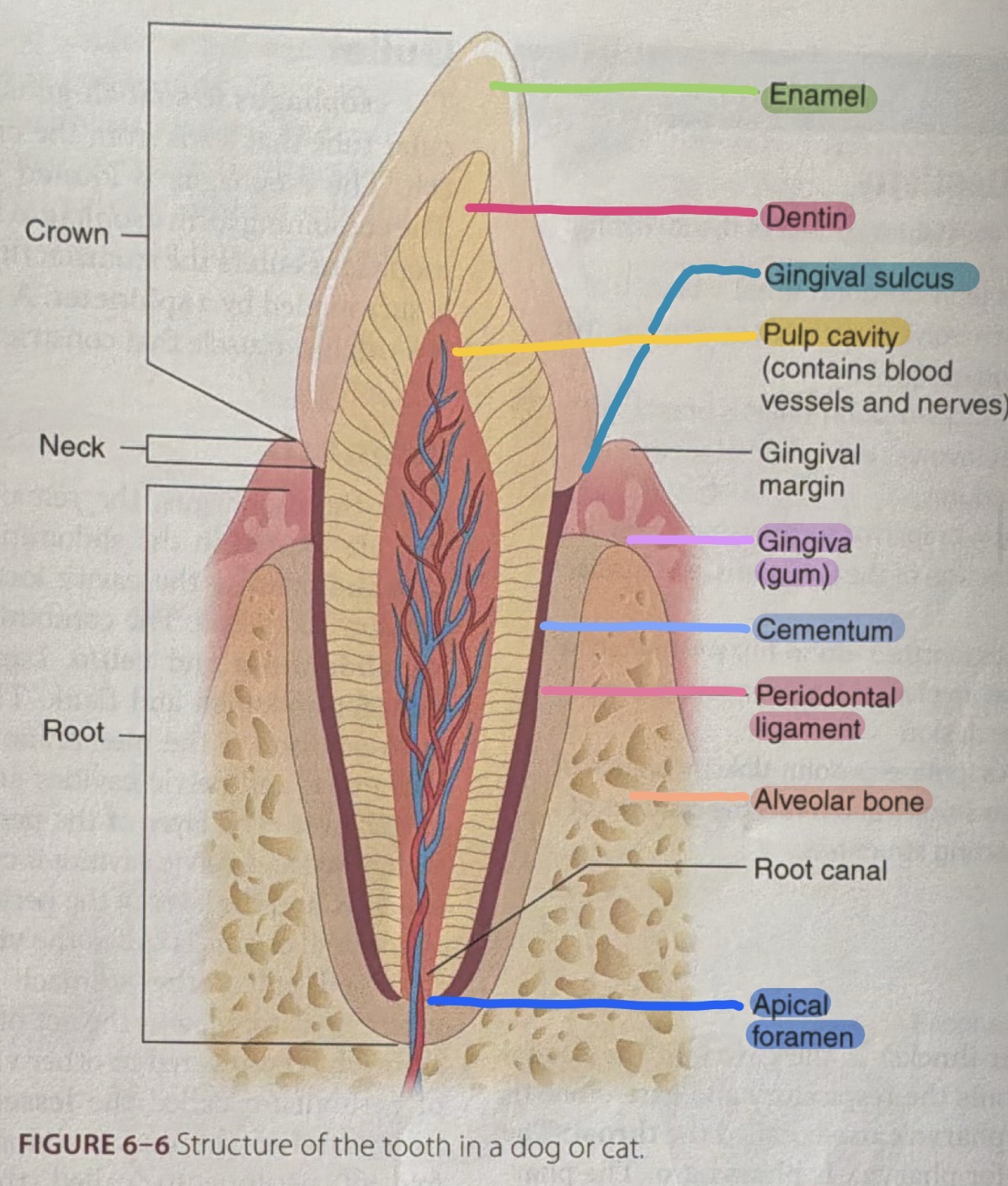
Cementum
Bonelike connective tissue that covers roof of tooth
located in root

Dentin
Connective tissue surrounding tooth pulp

Pulp
Inner part that contains nerves, vessels, and loose connective tissue

Apical foramen
Hole at tip of root where nerves and blood vessels enter tooth

Periodontia
Structures that support teeth

Alveoli (single: alveolus)
Sockets or saclike dilations teeth are situated to

Alveolar bone
Thin layer of compact bone that forms tooth socket
surrounds roots of teeth

Periodontal ligament
Fibrous structure that holds tooth in alveolus
contains collagen fibers that are anchored to cementum and alveolar bone

Gingiva (gums)
Mucous membrane that surrounds teeth and forms mouth lining
Gingiv/o
Gums

Gingival sulcus
Space that surrounds tooth
located between tooth and gingival margin

Salivary glands
Group of cells that secrete a clear substance containing digestive enzymes (saliva)
Sialaden/o & sial/o
Salivary glands
Saliva
Moistens food, begins digestive process by aiding in bolus formation and some digestive enzymes activity (amylase in some species), and cleanses the mouth

Mandibular salivary gland
Found near mandible

Sublingual salivary gland
Found under tongue

Zygomatic salivary gland
Found medial to zygomatic arch