Week 8 MolBio Flashcards
 Call Kai
 Learn
 Practice Test
 Spaced Repetition
 Match
 Flashcards
 Knowt Play
1/21

There's no tags or description
Looks like no tags are added yet.
22 Terms
Eukaryotes = how many types of R. pol?
3. Pol I = makes pre-ribosomal RNA
Pol II: makes mRNA + noncoding RNA
Pol III: Transfer RNA (tRNA) + noncoding RNA + makes pre-ribosomal RNA
specific promoters + unique transcription factors
Yeast (Eukaryotic R. Pol II)
12 subunits: RPB1-RPB12
CTD = tail of 7 amino acids + in domain of RPB1
CTD: site of phosphorylation
CTD = key factor in transcriptional progression
CTD Transcription patterns
different positions of CTD are phosphorylated by other kinases based on the stage of transcription and this difference in positioning helps cellular machinery to call specific items needed for that phase

How do promoters bind to R. Pol II
promoters on DNA bind to R. pol II w/help of trancription factor protein TBP (TATA box- Binding Protein).
TBP binds to TATA box bending DNA so R. pol can swoop in and make a transcription bubble

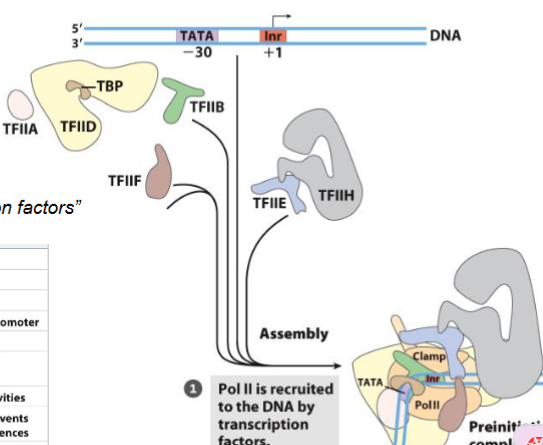
Assembly of pre-initiation complex
A bunch of transcription factor proteins help recruit R. pol II to bind to DNA

Transcription Factor Proteins
TBP: binds to TATA box
TFIIA: stab bind TFIIB + TBP to promoter
TFIIB: binds to TBP, ‘recruits’ it to Pol II-TFIIF complex
TFIID: NEEDED to start initiation if prom = no TATA box
TFIIE: recruits TFIIF
TFIIF: binds tightly to Pol II, binds to TFIIB + stops binding of Pol II to nonspecific DNA seq
TFIIH: unwinds DNA at promoter (helicase activity), phosphorylates Pol II (at CTD), recruits nucleotide-excision repair proteins
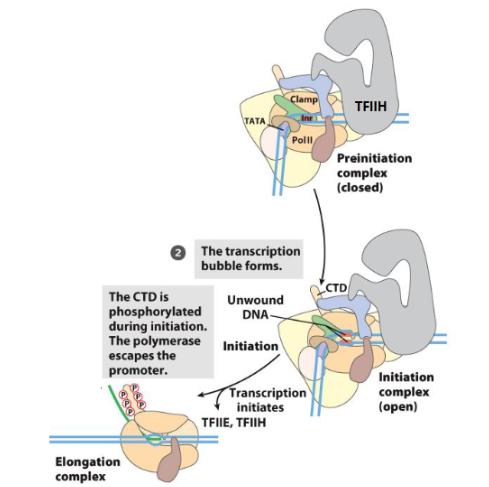
Initiation
Helicase activity of TFIIH facilitates unwinding of DNA, forming transcription bubble
CTD is phosphorylated on serine residues by kinase domain of TFIIH and CDKs
TFIIH and TFIIE dissociate
RNA Pol II clears the promoter
Elongation and Termination

RNA Processing
a

Transcription and Transcription in Eukaryotes
NOT COUPLED. SEPARATE. Transcription happens in Nucleus and Translation happens in Rough ER/Ribosomes. (thats why mRNA is processed to prevent degradtion)
5’ Cap details
What the 5' Cap is: A 7-methylguanosine group attached to the 5' end of the RNA via a unique 5',5'-triphosphate linkage.
The CTD Connection: The cap-synthesizing complex doesn't just float around—it hitches a ride directly on the phosphorylated CTD tail of RNA Polymerase II so capping can happen co-transcriptionally right as the mRNA emerges.

Addition of the Poly(A) tail
a
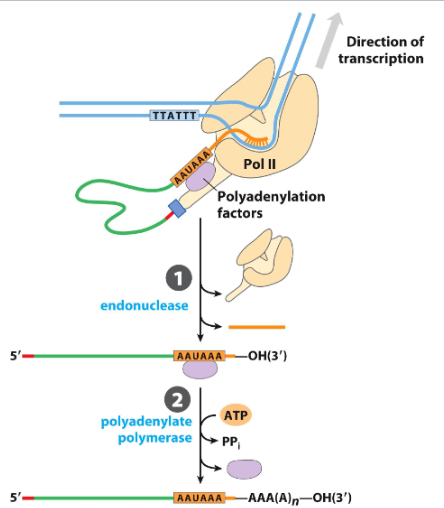
Polyadenylation factors
AAUAAA: polyadenylation/cleavage signal in mRNA sequence
Polyadenylation factors: Recognize and bind the cleavage signal
Endonuclease: Cleaves mRNA 10-30 nucleotides downstream of AAUAAA
Polyadenylate Polymerase: Synthesizes polyA tail (80-250 nucleotides) starting at cleavage site
Introns and Exons
Introns: unimportant non-coding portions of transcript
Exons: coding portions of transcript
Introns cleaved after capping while polyadenylation happens
Ovalbumin gene = 7700 bp is 1872 nucleotides after processing w/cap
Mechanism of splicing
Transesterification Reaction

Group I Intron Splicing Mechanism

Group II Intron Splicing Mechanism

What is spliceosome?
A spliceosome is a ribonucleoprotein made up of both RNA and protein molecules

Splicesomal Splicing mechanism, Part I
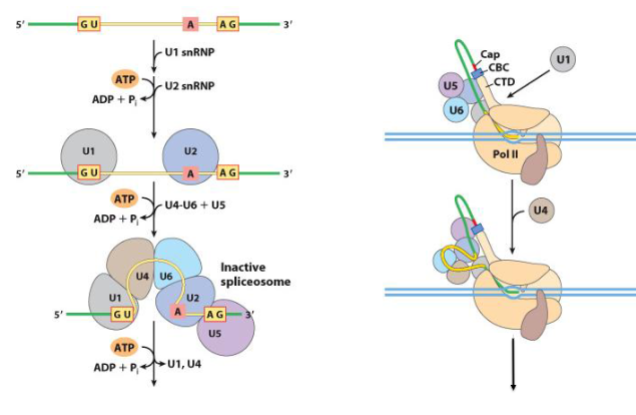
Splicesomal Splicing mechanism, Part II

Why do we need introns?
Alternative splicing: basically, the exons can be rearranged in different orders which leads to different isoforms of the same protein from the transcript = greater genetic diversity
5 protein classes needed to activate transcription
Activators: bind to enhancer sequence(s)
Architectural regulators: allow looping of DNA to facilitate interactions between proteins bound to sequences that are far away
Co-activator: intermediaries between activator and Pol II complex
Basal transcription factors - TFII proteins for Pol II
Chromatin Remodeling Complexes (not shown)