Endocrine System Signaling
 Call Kai
 Learn
Learn Practice Test
 Spaced Repetition
 Match
Match Flashcards
 Knowt Play
1/16

There's no tags or description
Looks like no tags are added yet.
Name | Mastery | Learn | Test | Matching | Spaced | Call with Kai | Chat |
|---|
No analytics yet
Send a link to your students to track their progress
17 Terms
How do hormones exert a biological effect on a tissue?
Hormones stimulate or inhibit actions at the cellular level by binding to receptors
there are hormones that are lipid soluble and can diffuse across the plasma membrane and these lipid soluble membranes can bind to receptors that are located in the cytosol
- receptors located in the cytosol are called intracellular receptorslipid soluble hormones include steroids,
all steroid hormones bind to intracellular receptors
amino acid hormones are not lipid soluble they are water soluble except there is one exception which is the thyroid hormone
- thyroid hormone is lipid soluble and binds to intracellular receptorsall membrane bound receptors bind amino acid based hormones
How do hormones target some cells and not others?
Target Cell Specificity
- hormones only target cells that have the receptor for that hormone but do not target cells that do not have their receptor
- when the cell does not have the receptor for the hormone, the cell is not stimulated
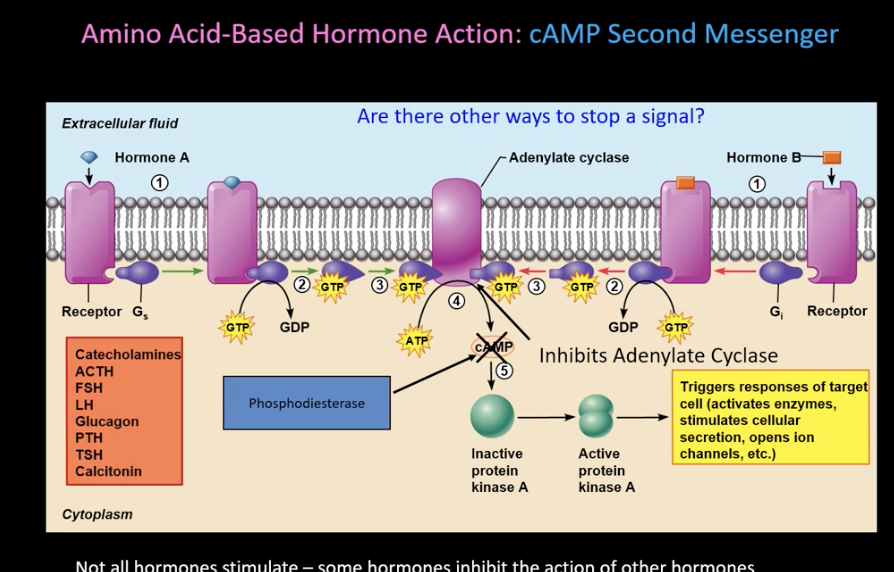
cAMP second messenger (how it is made, excitatory)
receptor on the left and hormone can bind to this receptor
- generally talking about amino acid based hormones and are water soluble not lipid soluble
- they can not diffuse across the plasma membrane and enter the cytosol and because of this these hormones stimulate the cell by acting through a receptorhormone binds a receptor
- hormone is considered 1st messengerreceptor changes shape
this then stimulates the small G protein which will kick out a GDP and pick up a new molecule of GTP
this changes the G protein shape which causes the G protein to move and interact with an enzyme called: adenylate cyclase
adenylate cyclase breaks down a molecule of ATP to AMP (cleave off 2 phosphates)
then the adenylate cyclase takes the remaining phosphate and attaches it to the adenosine molecule which makes it a circular molecule and produces molecule called cyclic AMP
during these we spend two ATP to produce cyclic AMP which is the second messenger

cAMP second messenger (excitatory)
cyclic AMP is the signaling molecule in the cytosol that was created by the hormone binding to the receptor
Cyclic AMP makes things happen inside the cell but it depends on the specific target cell, some exmaples:
- open up ion channels in the membrane
- activate protein kinases
- activate gene transcription in nucleus
cAMP second messenger (how its made, inhibitory)
have receptor with different hormone binding to receptor
when hormone binds, receptor changes shape and interacts with the G protein
- the Gi means g protein inhibitoryG protein kicks out the GDP molecule and picks up a GTP molecule
then the G-protein moves and interacts with adenylate cyclase (enzyme) which it then inhibits
the Gi protein stops the production of the second messenger, cyclic AMP
But if there are more excitatory the cAMP will be continue to be made

How is the production of cyclic AMP controlled?
by having excitatory and inhibitory second messenger systems
excitatory pathway increases cyclic AMP production
inhibitory pathway slows down cyclic AMP production
- the inhibition of cyclic AMP does not remove it from the cell, it just stops the production of new cyclic AMP being produced
How does cyclic AMP get removed from the cell?
phosphodiesterase
- enzyme that degrades cyclic AMP in the cytosol and is always activeits what stops second messenger signaling
when we stimulate the production of cyclic AMP, cyclic AMP can activate its processes but phosphodiesterase comes along and breaks the cyclic AMP down
Steroid Based Intracellular Hormone Signaling (a regulatory sequence)
receptor is present in the cytosol
the receptor has a “chaperone” molecule associated with it (a protein) to prevent the receptor does not translocate into the nucleus
- receptor wants to bind to DNA in the nucleus, but we want it to be purposeful and not randomwhen we secrete the appropriate steroid hormone, that hormone binds to its receptor and the “chaperone” protein molecule falls of of the receptor
now, receptor hormone complex can migrate into the nucleus, through the nuclear pores and once in the nucleus, the hormone receptor complex is going to bond to response elements on the DNA
- the response elements either relax and expose the TATA box to the RNA polymerase and the gene will be transcribed OR
- it will cause the DNA to tighten up and hide in the TATA box, preventing the transcription of the genethis is what gets us secondary sex characteristics for males and females
- males: testosterone binds to the androgen receptor and the androgen response receptor will bond to androgen response elements in the DNA
-females: estrogen binds to the estrogen receptor, then the estrogen receptor enters the nucleus and binds to the estrogen response cells in the DNAprimary target for the intracellular receptors is the DNA, specifailly the response elements in the DNA

How do we Regulate Hormone Activity?
Hormone Concentration
- rate of release: influences the amount of hormone present
- the greater concentration of hormone present, the greater the likelihood that hormone bind to receptors
- rate of inactivation/removal: the liver breaks the hormone down and the kidneys will remove it
- ½ life: the time required for a hormones blood level to decrease by 50%
- if a hormone has a longer ½ life its going to be present in the bloodstream for longer and have greater signaling effects
- we regulate the amount of concentration of the hormone by how rapidly we secrete the hormone into the bloodstream, and how rapidly we break down and remove that hormone from the blood stream
- gives us an idea that the probability of hormone binding to if any given amount of receptor
How do we Regulate Hormone Activity?
Receptor Concentration (AKA receptor density)
- cells can increase or decrease the number of receptors expressed
- this affects the cells sensitivity to any given amount of hormone
- dart target: receptor of hormone, the more dart boards, the higher the likelihood that a child will hit a dart board
- if a cell wants to be stimulated by a hormone it will increase the number of receptors or if its being overstimulated by a hormone, it will decrease the number of receptors
- cells have the ability to increase and decrease the number of receptors for a given hormone on its cell surface or in its cytosol
How are hormones removed from the blood?
degrading enzymes
- the liver contains enzymes and these enzymes breakdown hormones and drugs
- the hepatocytes in the liver contain well develop and smooth endoplasmic reticula that are very effective at degrading hormones
- the by products of this break down are secreted back into the fluids of the body and the kidneys will filter them out and remove them and excrete them via urine
Interaction of hormones at target cells (synergism)
synergism: where there are at least two different hormones that stimulate the same outcome independently
- the two or more hormones do not interact, they only stimulate the same outcome at around the same time which creates a larger outcome or an additive affectunironically work together
Interaction of hormones at target cells (Antagonism)
antagonism: one or more hormones opposes the action of another hormone
- hormones have opposite affects
- if one increases the outcome the other inhibits the outcome
-ex: g protein secondary receptors for amino acid hormones
Interaction of hormones at target cells (permissiveness)
Permissiveness: one hormone can not exert its effects without another hormone being present
- only one of the two hormones causes the desired outcome, but it cant do it endless the permissive hormone is also present
- ex: growth hormone and thyroid hormone (the permissive hormone), without thyroid hormone growth hormone does not work effectively
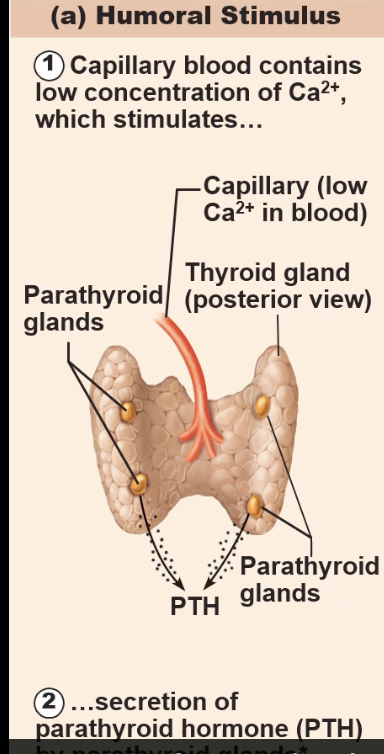
Mechanisms that Stimulate an increase of hormone by a gland (humoral)
refers to some factor in the blood that stimulates or inhibits the secretion of hormones
- could be blood calcium or blood glucose concentrations
- non signaling moleculethe molecules either stimulate or inhibit the secretion of a hormone by the gland
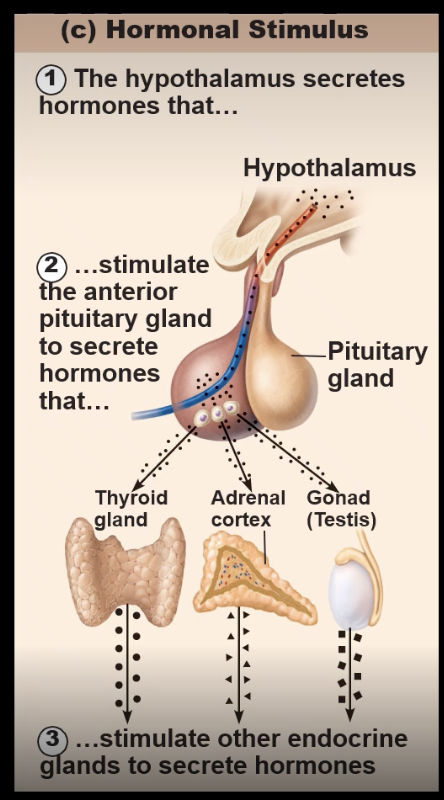
Mechanisms that Stimulate an increase of hormone by a gland (hormonal)
regulated by the hormones
- hormone secretion can be induced or inhibited by the presence of another hormone
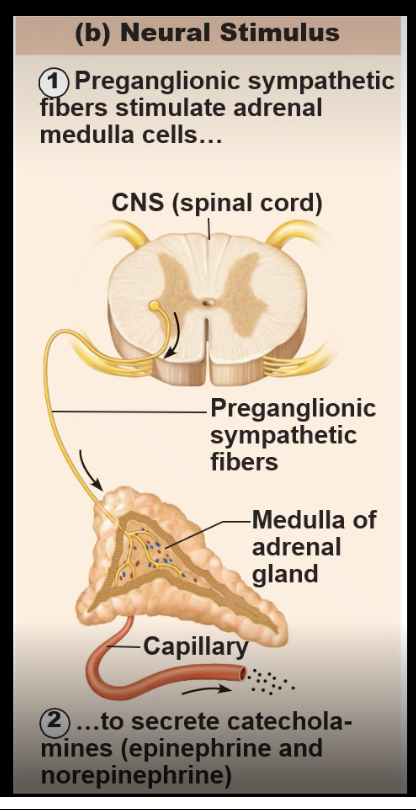
Mechanisms that Stimulate an increase of hormone by a gland (neural)
regulated by direct nervous system input
ex: sympathetic division pre ganglionic fiber travels out to the adrenal medulla and stimulates the secretion of catecholamines (which is epinephrine and SOMETIMES norepinephrine)
- only example where this is the primary effect