Astronomy Exam 3
 Call Kai
 Learn
 Practice Test
 Spaced Repetition
 Match
 Flashcards
 Knowt Play
1/102

There's no tags or description
Looks like no tags are added yet.
103 Terms
If a material is transparent, then it…
transmits light well
Grass appears green because…
it reflects green light and absorbs other colors.
Everything looks red through a red filter because…
the filter transmits red light and absorbs other colors.
Which of the following is an example of reflection or scattering?
Red light hits a red sweatshirt
Which statement correctly describes units that can be used to measure energy and power?
Energy is measured in joules, and power is measured in joules per second.
How much energy is needed to power a 100-watt light bulb for 1 second?
100 joules
We can see each other in the classroom right now because we
reflect visible light
A wave has peaks and troughs that can move matter up and down when the wave interacts with matter. The frequency of a wave is…
the number of peaks passing by any point each second
The wavelength of a wave is…
the distance between two adjacent peaks of the wave
How are wavelength, frequency, and energy related for photons of light?
Longer wavelength means lower frequency and lower energy.
From lowest energy to highest energy, which of the following correctly orders the different regions of electromagnetic radiation?
radio, infrared, visible light, ultraviolet, x-rays, gamma rays
From lowest frequency to highest frequency, which of the following correctly orders the different regions of electromagnetic radiation?
radio, infrared, visible light, ultraviolet, x-rays, gamma rays
From shortest wavelength to longest wavelength, which of the following correctly orders the different regions of electromagnetic radiation?
gamma rays, x-rays, visible light, ultraviolet, infrared, radio
Which of the following statements about x-rays and radio waves is not true?
X-rays travel through space faster than radio waves
Which of the following statements about x-rays and radio waves is true?
X-rays travel through space at the same speed as radio waves
Red light has a lower energy per photon than blue light. Therefore, red light has…
Lower frequency, longer wavelength than blue light.
Which statement about photons is true?
An infrared photon has less energy than an x-ray photon, but travels at the same speed
protons behave like…
both waves and particles
why cant we see radio waves?
Radio waves have wavelengths too long for the eye to detect
The visible light portion of the electromagnetic spectrum has wavelengths ranging from about 400 to 700 nanometers (nm). Which of the following statements is true?
Blue light has wavelength of about 400 nm, red light has wavelength of about 700 nm
Which of the following best describes the sizes of atoms?
Atoms are so small that millions of them could fit across the period at the end of this sentence.
What is a molecule?
a group of two or more atoms bound together
The diameter of a typical atom is about ________ the diameter of its nucleus.
100,000 times
What is the overall electrical charge of an atom with 6 protons, 6 neutrons, and 5 electrons?
+1
Which of the following statements about electrical charge is true?
a positive charge and a negative charge will attract each other.
An iron atom has an atomic number of 26 and an atomic mass number of 56. If it is neutral, how many protons, neutrons, and electrons does it have?
26 protons, 30 neutrons, 26 electrons
A gold atom has an atomic number of 79 and an atomic mass number of 197. If it is neutral, how many protons, neutrons, and electrons does it have?
79 protons, 118 neutrons, 79 electrons
Oxygen has atomic number 8. How many times must an oxygen atom be ionized to create an O+5 ion, and how many electrons will the ion have?
It must be ionized five times; it will have three electrons.
If a proton inside the nucleus of an atom suddenly turned into a neutron, while the atom retained its original number of electrons, what properties of the atom would change?
both its atomic number and electrical charge, but not its atomic mass number
At extremely high temperatures (e.g., millions of degrees), which of the following best describes the phase of matter?
a plasma consisting of positively charged ions and free electrons
Molecular dissociation is the process in which…
The bonds between atoms in a molecule are broken.
When a neutral atom loses an electron, we say that it becomes…
ionized
AN electron-volt is…
an amount of energy much smaller than a joule
The idea that energy in atoms has distinct energy levels is part of the branch of physics that is called…
quantum physics
What do we see when white light passes through a cool cloud of gas?
an absorption line spectrum
When an electron in an atom goes from a higher energy level to a lower energy level, the atom may…
emit a photon of a specific wavelength.
An electron in an atom can go from a lower energy level to a higher energy level if the atom…
Absorbs a photon of a specific wavelength.
When an electron drops to a lower energy level in an atom, but no other interactions take place…
The atom may emit a photon of light of a specific wavelength.
What must be true in order for an atom to absorb a photon?
The photon must have energy matching the difference in energy between two energy levels in the atom AND the photon must have enough energy to remove an electron from the atom (A and C)
Spectra from neutral atoms compared with spectra from ionized atoms of the same element…
have different sets of spectral lines.
How does the spectrum of a molecule differ from the spectrum of an atom?
A molecule has additional spectral lines due to changes in its rotational and vibrational energies.
Which of the following objects does not produce a spectrum that is a close approximation to a thermal radiation spectrum?
Hot, transparent gas
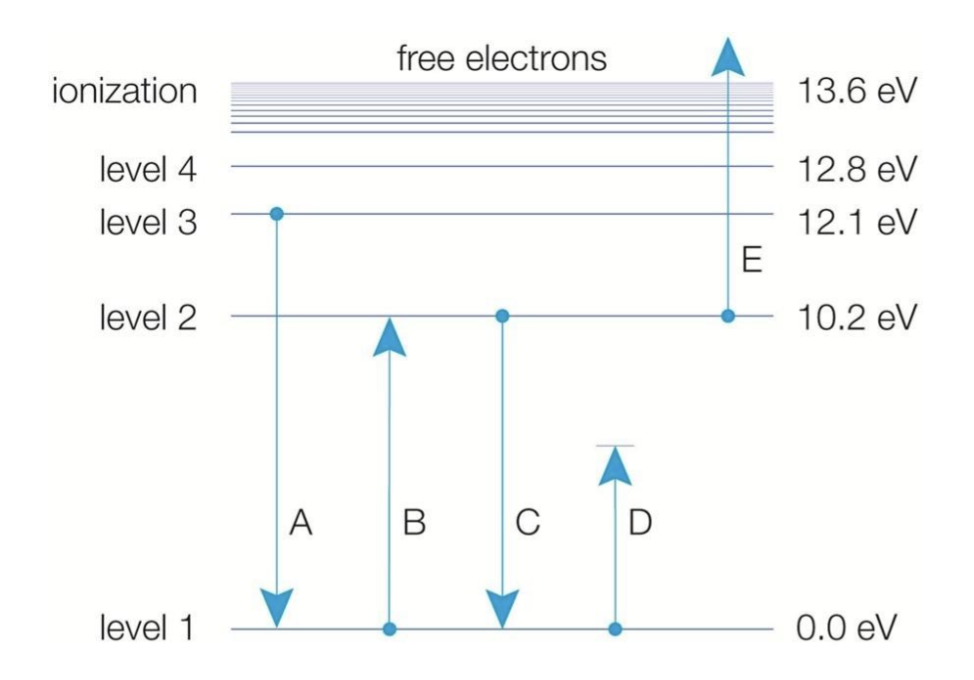
The diagram above represents energy levels in a hydrogen atom. Each level is labeled with its energy (above the ground state of Level 1) in units of electron/volts (eV). The labeled transitions represent an electron moving between energy levels. Which transition represents an electron that absorbs a photon with 10.2 eV of energy?
B

The diagram above represents energy levels in a hydrogen atom. Each level is labeled with its energy (above the ground state of Level 1) in units of electron/volts (eV). The labeled transitions represent an electron moving between energy levels. Which transition represents the electron that emits a photon with the highest energy?
A

The diagram above represents energy levels in a hydrogen atom. Each level is labeled with its energy (above the ground state of Level 1) in units of electron/volts (eV). The labeled transitions represent an electron moving between energy levels. Which transition represents an electron that is breaking free of the atom?
E

The diagram below represents energy levels in a hydrogen atom. Each level is labeled with its energy (above the ground state of Level 1) in units of electron/volts (eV). The labeled transitions represent an electron moving between energy levels. Which transition, as shown, is not possible?
D
Thermal radiation is defined as…
radiation that depends only on the emitting object's temperature
Which of the following statements about thermal radiation is always true?
A hot object emits more total radiation per unit surface area than a cool object.
A gas heated to millions of degrees would emit…
mostly x-rays
You are heating two chunks of metal of the same size and shape. One is made of lead and is heated to 400 K. The other is made of iron and is heated to 350 K. Which of the following statements apply to the thermal radiation the two chunks emit?
The lead spectrum peak is at a shorter wavelength than the iron spectrum peak
You are heating two chunks of metal of the same size and shape. One is made of lead and is heated to 400 K. The other is made of iron and is also heated to 400 K. Which of the following statements apply to the thermal radiation the two chunks emit?
The two spectra peak at the same wavelength
Which of the following stars has the hottest surface temperature?
the blue star
Suppose you see two stars: a blue star and a red star. Which of the following can you conclude about the two stars? Assume that no Doppler shifts are involved. (Hint: Think about the laws of thermal radiation.)
The blue star has a hotter surface temperature than the red star
From laboratory measurements, we know that a particular spectral line formed by hydrogen appears at a wavelength of 121.6 nanometers (nm). The spectrum of a particular star shows the same hydrogen line appearing at a wavelength of 121.8 nm. What can we conclude?
The star is moving away from us
We have obtained spectra of two hydrogen gas clouds and are studying an emission line that has a laboratory wavelength of 656.3 nm. This emission line appears in Cloud A's spectrum with a wavelength of 660.1 nm and in Cloud B's spectrum at 670.2 nm. What can we conclude about
these clouds?
They are both moving away from us, and Cloud B is moving faster than Cloud A.
One of the absorption lines of hydrogen has a rest wavelength of 656 nm. Suppose you observe this line in four different stars, and find this line at the wavelengths show below. Which wavelength represents the star that is moving toward Earth the fastest?
630 nm
If a hydrogen emission line appears at 656 nm in the laboratory, what can we say about a cloud of hydrogen gas, with an emission line at 680 nm?
It is receding away from us
The spectrum of Star A has an absorption line of hydrogen at 660.0 nm. The spectrum of Star B has an absorption line at 666 nm. The wavelength of this transition in the laboratory is 656 nm. What can I say about Star A and Star B?
Both stars are moving away from me, Star B is faster than Star A.
If one object has a large redshift and another object has a small redshift, what can we conclude about these two objects?
The one with the large redshift is moving away from us faster than the one with the small redshift.
You observe the same spectral line in two stars that are identical in every way except that one rotates faster than the other. How does the spectral line differ between the two?
The line in the faster rotating star is broader
One star is emitting mostly visible light, and another star is emitting mostly infrared light. Which star is hotter?
The star emitting visible light.
Which of the following stars is the hottest?
a blue star
When an atom's electrons fall down to lower energy levels in a thin cloud of hot gas, what is produced?
an emission line spectrum
We know the Sun is primarily made from hydrogen and helium on the basis of its
spectrum
One star is emitting primarily visible light, and another star is emitting primarily infrared light. Which star is hotter?
The star emitting visible light is hotter.
Betelgeuse is the bright red star representing the left shoulder of the constellation Orion. All the following statements about Betelgeuse are true. Which one can you infer from its red color?
Its surface is cooler than the surface of the Sun.
Which of the following describes the light that can be detected from a person?
The person reflects many wavelengths of visible light and emits infrared light.
Four different objects have spectra that peak in the wavelength regions listed below. Which peak wavelength region is associated with the coldest of the four objects?
x-rays
We know how fast a distant galaxy is moving away from us on the basis of its…
spectrum
Which of the following objects would produce an emission line spectrum?
a hot, low-density neon gas
We can see other people because people
reflect visible light.
We can see the Moon because it…
reflects visible light.
Which of the following observational techniques is most appropriate for measuring Doppler shifts?
spectroscopy (taking a spectrum)
If two objects are the same size, but one object has a temperature 3 times as hot (in Kelvin) as the other object, the hotter object emits
81 times as much energy

Hydrogen has an absorption line at a rest wavelength of 656.28 nm. This line is shifted to 656.50 nm in the spectrum of a star. How fast is the star moving? Hint: The Doppler shift formula is…where the speed of light is c ≈ 300,000 km/
about 100 km/s away from us.

Suppose that an ion has an absorption line at a rest wavelength of 1000.0 nm. This line is shifted to 1000.1 nm in the spectrum of a star. How fast is the star moving? Hint: The Doppler shift formula is… where the speed of light is c ≈ 300,000 km/s
about 30 km/s away from us.
What is the purpose of the lens in an eye?
to bend light entering the eye so that it is focused onto the retina
The place where light is brought into focus (to form an image) in the human eye is called the
retina
A camera is designed to bring light into focus (to form an image) on its
detector
What is the benefit of a longer exposure time when making an image?
It allows the detector to collect more total light
How do the light-collecting area and best possible angular resolution of telescope with a 10-meter diameter mirror compare to that of a telescope with a 5-meter diameter mirror?
The 10-meter telescope has 4 times the light collecting area, and its angular resolution is better by a factor of 2.
How does the light-collecting area of a telescope with a 10-meter diameter mirror compare to that of a telescope with a 5-meter diameter mirror?
The 10-meter telescope has 4 times the light collecting area.
How does the best possible angular resolution of a telescope with a 10-meter diameter mirror compare to that of a telescope with a 5-meter diameter mirror?
The 10-meter telescope's angular resolution is better by a factor of 2
Suppose the angular separation of two stars is smaller than the angular resolution of your eyes. How will the stars appear to your eyes?
The two stars will look like a single point of light.
Suppose two stars are separated in the sky by 0.1 arcseconds. If you take a picture of them with the SOAR telescope, which has an angular resolution of 0.6 arcsecond, what will you see?
one point of light that is the blurred image of both stars
If you want to see the image formed by a telescope, you should place your eye at the location of the telescope's
focus
Which of the following is one important reason why most large astronomical telescopes are reflecting telescopes rather than refracting telescopes?
Reflecting telescopes have their heaviest component (the mirror) at the bottom rather than the top of the telescope's tube
Which of the following measurements can be made only by recording and comparing the amount of light received from an astronomical source at many different times?
he rate at which a variable star brightens and dims
Which of the following could not be determined by an observation that only uses spectroscopy?
the angular size of a distant galaxy
What is meant by spectral resolution?
It is a measure of how close two spectral lines can be and still be distinguishable.
Some stars vary in brightness. What observing technique is best for observing the details of the changes in brightness?
Time-monitoring because we want to track how the brightness changes with time.
What do astronomers mean by light pollution?
Light pollution refers to light used for human activities that brightens the sky and hinders astronomical observations.
What causes stars to twinkle?
bending of light rays by turbulent motions of air in Earth's atmosphere
What is the purpose of adaptive optics?
to reduce the distorting effects of atmospheric turbulence for telescopes on the ground
Which of the following is not a good reason to place an observatory on a remote mountain to?
allow observations at ultraviolet and x-ray wavelengths
Which of the following wavelength regions cannot be studied at all with telescopes on the ground?
x-rays
Earth's atmosphere is most transparent to all wavelengths of ________ light.
visi