Plant Growth and Light Responses
 Call Kai
 Learn
 Practice Test
 Spaced Repetition
 Match
 Flashcards
 Knowt Play
1/47

There's no tags or description
Looks like no tags are added yet.
48 Terms
The main types if tropism
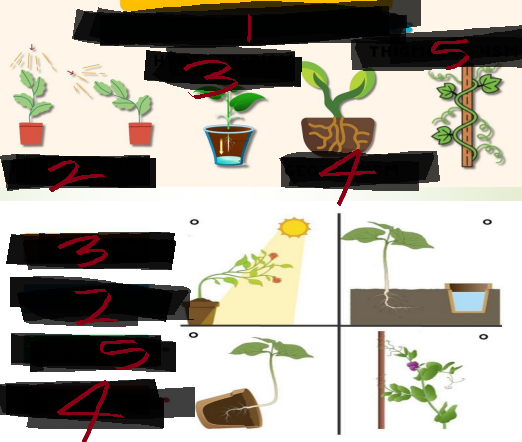
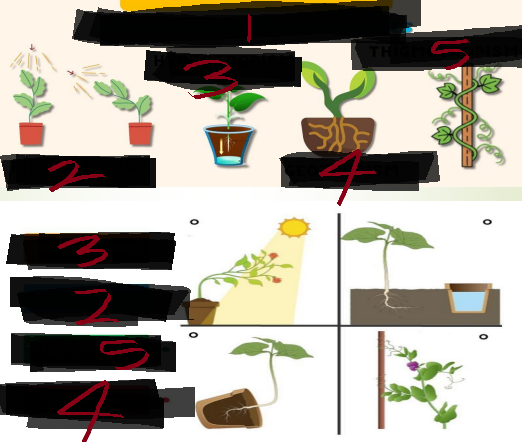
Phototropism
Geotropism
Thigmotropism
List the non-main types of tropism
Hydrotropism
Chemotropism
Thermotropism
Positive vs negative tropism
Positive: growth toward the stimulus. Negative: growth away from the stimulus.
Define geotropism and give both directions
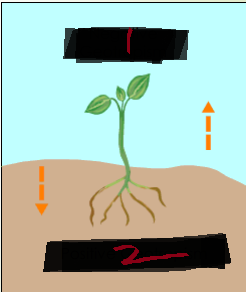
Growth in response to gravity ("geo" = earth). Positive: toward the centre of the earth, down with gravity (roots grow down). Negative: away from the centre of the earth, against gravity (stems grow up).
Roots show negative geotropism.
False. Roots show positive geotropism; stems show negative.
Why is geotropism important?
It pulls roots down to anchor the plant, and roots can get the water and minerals they need if they stay in the soil.
How does auxin explain directional bending?
Bending is driven by asymmetric auxin distribution. In shoots, auxin accumulates on the shaded side, promoting cell elongation and bending toward light. In roots, auxin redistribution suppresses elongation on the lower side, causing downward growth aligned with gravity.
Define phototropism and its importance.
Growth response to light direction ("photo" = light), e.g. stems growing toward a window. It positions leaves to receive adequate light for photosynthesis.
Define thigmotropism and give examples
Growth in response to touch or contact ("thigmo" = touch). Examples: tendrils on a sweet pea, vines on a wall or fence, climbing plants wrapping around objects. A plant touched regularly may be stunted, sometimes dramatically
Define hydrotropism, chemotropism and thermotropism with an example each.
Hydrotropism: growth in response to water (roots toward moisture). Chemotropism: movement caused by chemical stimuli (a pollen tube always grows toward the ovules so reproduction can occur). Thermotropism: bending toward or away from heat (Rhododendron leaves curl in cold temperatures).
Thigmotropism vs thigmonasty?
Thigmotropism is a directional growth response to touch (cucumber tendrils on a support). Thigmonasty is a non-directional, rapid response that does not involve growth (Mimosa pudica folding its leaves when touched).
Which rapid responses are not tropisms, and why?
Mimosa pudica (the "sensitive plant") and the Venus flytrap. They do not involve growth.
Which is NOT a tropism?
Mimosa folding its leaves on touch
Pollen tube growth toward the ovule is an example of ______ tropism
Chemotropism.
What is a tropism?
A plant's growth response (movement) to an environmental stimulus. "Tropo" means "turn". Responses can be affected by gravity, light, touch and seasonal changes.
What two roles does light play in plants?
Energy for photosynthesis, and an environmental signal that regulates growth, development and orientation. Through photoreceptors, plants adjust germination, stem elongation, leaf expansion and flowering.
Define photomorphogenesis.
Developmental programs activated by light quality, quantity and duration.
Light-grown vs dark-grown seedlings?
Light-grown (photomorphogenesis): short hypocotyls and expanded cotyledons. Dark-grown (skotomorphogenesis): elongated and pale.
Name the three photoreceptors listed on the slide and what each absorbs.
Phytochrome: absorbs red and far-red light (the slide calls it a blue pigment, Pr).
Cryptochrome: a group of pigments absorbing blue light and long-wavelength UV.
Protochlorophyllide a: absorbs red and blue light and is reduced to chlorophyll a.
Which receptor family senses which wavelength range? (UV-B)
UVR8; 290-315 nm
Which receptor family senses which wavelength range? (UV-A and blue)
CRYs, PHOTs; 320-390 nm and 390-500 nm
Which receptor family senses which wavelength range? (Green)
ZTL/FKF1/LKP2; 530-570 nm
Which receptor family senses which wavelength range? (Red/ far-red)
PHYs; 600-750 nm
Which light responses do these receptors control?
Seed germination, seedling de-etiolation, leaf development, flowering and senescence.
Who discovered the role of light and dark periods in flowering, and what followed?
Garner and Allard in 1920 found that periods of light and darkness control flowering in some plants. This led to the discovery of the light-absorbing pigment, named phytochrome.
What does phytochrome control?
Flowering, photoperiodism, lettuce seed germination and other morphological phenomena. Also seed germination, stem elongation, leaf expansion, chloroplast development and shade-avoidance responses.
What are Pr and Pfr, and what does their interconversion allow?
Phytochromes are red/far-red photoreceptors in two photo-interconvertible forms: Pr (inactive) and Pfr (active). Light-driven interconversion lets plants sense the red-to-far-red ratio and trigger transcriptional programs for growth and flowering.
Pr is the ______ form of phytochrome and Pfr is the ______ form
Inactive; active.
What happens under canopy shade?
The red/far-red ratio is low. Phytochrome signalling promotes elongation so the plant can escape the shade and reach light
How might phytochrome affect gene expression?
All cells carry the same genetic information, and differences arise from differences in gene activity (genes activated or deactivated during development). Phytochrome is hypothesised to control gene activity: it can activate some inactive genes or block some active genes.
Define photoperiodism.
The plant's flowering response to the length of the day (the length of the light period or dark period). It is a response to seasonal changes in illumination length.
Compare the three photoperiodic plant groups.
Long-day plants (LDP) | Light period is longer than a critical length |
Short-day plants (SDP) | Light period is shorter than a critical length |
Day-neutral plants (NDP) | Regardless of day length |
Describe the tobacco example
Some tobacco grown in long days does not flower or fruit, even at 15 feet. Grown in short days (winter months) it flowers at about 5 feet. It flowers only under short days (less than 14 hours of light) and not in long days (more than 14 hours).
Tobacco and soybean are long-day plants
False. They are short-day plants (SDP).
Which plants flower regardless of day length?
NDP
LDP stands for ______ and is found in regions of ______ latitude
Long-day plants; large (high)
What is biological time (the biological clock)?
Periodic, rhythmic movements or processes of plant organs. The organism needs a regulator (clock) for the timing of these changes. Examples: some flowers open in the morning and close at nightfall; sunflowers turn to follow the sun. Duration varies from hours to days, months or years
Rhythm vs period?
Rhythm is the recurrence of the phenomenon. Period is the time required to return to the same starting point.
What are circadian rhythms?
Daily rhythms that are not exactly daily: their duration is not always 12 or 24 hours and can be 20 or 27 hours (approximately daily). Examples: flower opening and closing, leaf movement, growth rate. They continue under laboratory conditions when light and temperature are held constant.
What does the circadian clock do?
It synchronises with day-night cycles and gates photosynthesis, hormone signalling and growth. It interacts with photoreceptors (including phytochromes) to coordinate photoperiodic flowering and daily physiology. Photosynthesis is concentrated in the light period, other processes at night.
Summarise lecture 10 in one line.
Light governs plant life beyond photosynthesis: it directs orientation (tropisms), shapes development (photomorphogenesis), acts through phytochromes to control growth and flowering, and entrains biological time.
1
Plants growth moements
2
Phototropism

3
Hydrotropism

4
Geotropism

5
Thigmotropism

1
Negative Geotropism
2
Positive Geotropism