Key Concepts in the Copernican, Darwinian, and Freudian Revolutions
 Call Kai
 Learn
Learn Practice Test
 Spaced Repetition
 Match
Match Flashcards
 Knowt Play
1/13

There's no tags or description
Looks like no tags are added yet.
Name | Mastery | Learn | Test | Matching | Spaced | Call with Kai | Chat |
|---|
No analytics yet
Send a link to your students to track their progress
14 Terms
Copernican Revolution
Shift in the field of astronomy from a geocentric understanding of the universe, centered around Earth, to a heliocentric understanding, centered around the Sun, as articulated by the Polish astronomer Nicolaus Copernicus in the 16th century.

Geocentrism
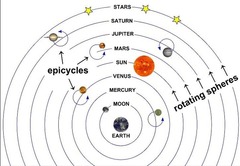
Concept that the planets, as well as the sun and the moon, moved in a circular motion around the Earth, as stated by Claudius Ptolemy.
Darwinism
Theory of biological evolution developed by Charles Darwin, stating that all species of organisms arise and develop through the natural selection of small, inherited variations.

Natural Selection
Process by which organisms change over time as a result of changes in heritable physical or behavioral traits, allowing better adaptation to the environment.
On the Origin of Species
Darwin's book published in 1859 that first formulated the theory of evolution by natural selection.
Evidence for Evolution
Supported by a wide variety of scientific disciplines, including paleontology, geology, genetics, and developmental biology.
Main Points of Evolution Theory
"All life on Earth is connected and related to each other," and diversity of life is a product of "modifications of populations by natural selection."
Fitness
In the Darwinian sense, the ability of an organism to survive and contribute its genes to the next generation.
Social Behavior in Evolution
Plays an obvious role in evolution, such as the ability to find food, avoid predation, or defend one's young.
Freudian Revolution
Movement founded by Sigmund Freud, focusing on psychoanalysis as a method for treating mental illness and explaining human behavior.
Influence of Childhood
Freud believed that events in our childhood greatly influence our adult lives, shaping our personality.
Neuroses
Problems during adulthood that may arise from anxiety originating from traumatic experiences in a person's past.
The Unconscious Mind
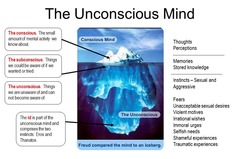
Part of the psyche that contains thoughts and memories not accessible to conscious awareness.
The Psyche
The totality of the human mind, conscious and unconscious.