(finished) Botany - Ecology/Cycles
 Call Kai
 Learn
Learn Practice Test
 Spaced Repetition
 Match
Match Flashcards
 Knowt Play
1/11

Earn XP
Description and Tags
Name | Mastery | Learn | Test | Matching | Spaced | Call with Kai | Chat |
|---|
No analytics yet
Send a link to your students to track their progress
12 Terms
Why is plant diversity important?
Can support wide variety of pollinators and beneficial wildlife, herbivores, and insects
Different root structures/nutritional needs=better soil health/erosion prevention
For human global food supply, pharmaceuticals, and tourism
One threat won’t wipe out the whole area
Plant competition
When neighboring plants vie for limited resources e.g. light, water, nutrients, germination sites, pollinators, or growth space.
e.g. allelopathy *where plants release allelochemicals” to inhibit the growth, germination, or reproduction of neighboring plants) or faster growth (takes space/resources)
Plant biochemistry
The scientific study of chemical processes and molecular compounds that occur inside plants.
Botany
Plant
Definitions?
Botany: The scientific study of plants
Plant: Any multicellular, eukaryotic, usually photosynthetic life-form in the kingdom Plantae
Plants in: Carbon cycle
Photosynthesis (see general flashcards; takes in CO2) and cellular respiration (equation exact opposite of photosynthesis: C6H12O6 (aka glucose) + 6O2 → 6CO2 + 6H2O. Used to turn glucose into energy (ATP) in mitochondria, with CO2 byproduct.)
Transfers C via food web eating
Decomposition of plants return C into soil or the atmosphere
Plants in: Water cycle
Absorbs groundwater and returns it as vapor via transpiration
Uses water for photosynthesis
Prevents runoff (less soil erosion)
Allows better infiltration of water back to aquifers by breaking up soil via roots
Plants in: Phosphorus cycle
Plants take up inorganic phosphate from the soil, and may then be eaten.
Once inside the plant or animal, the phosphate is incorporated into organic molecules e.g. DNA. During decomp, the organic phosphate is returned to the soil, and bacteria/fungi make it available to plants/inorganic again via mineralization.
Plants in: Nitrogen cycle
Legumes have nodules that hold nitrogen-fixing bacteria (that turn atmospheric N2 into usable NH3); Nitrogen fixation
When plants are decomposed by bacteria/fungi, ammonia (NH3) and ammonium (NH4+) is released, which plants can use; ammonification
Plants in: Sulfur cycle
Plants take in SO4 in the soil that entered via rain, rock erosion, etc
When they decompose, release H2 4TH (hydrogen sulfide) gas.
Roles of plant in environmental management (5)
Carbon sequestration
Temperature control via shade and transpiration
Soil erosion control
Runoff control and filtration
Flood reduction via better aquifer recharging
Ecological succession
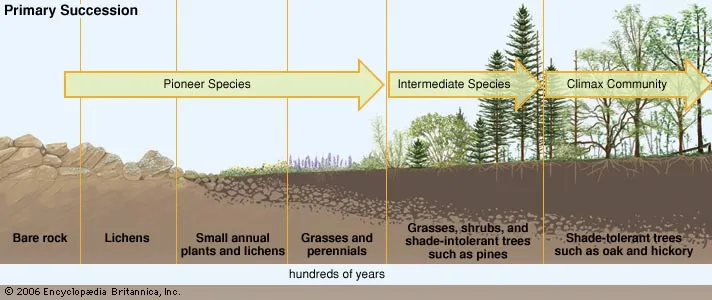
Pioneer stage: Hardy pioneer species e.g. lichen or grasses grow in the nutrient-poor conditions. By breaking down rocks/contributing organic matter, makes soil.
Intermediate stage: Seral community forms. Larger plants e.g. shrubs, small trees, and herbaceous plants grow/contribute more shade/organic matter, improving soil. Attracts animals (nutrients cycling, seed dispersal)
Climax stage: Self-sustaining ecosystem with diverse flora/fauna; large trees e.g. hickories, oaks
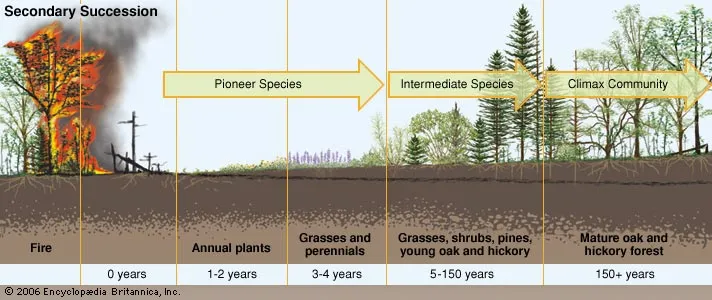
Secondary ecological succession
Primary succession, except it happened after a disturbance e.g. natural disaster or human activity set it back some steps.
Pioneer stage: Pioneer species prevent erosion of existing soil/stabilize and contribute to it.