Off hindlimbs WS + Off all limbs WS
 Call Kai
 Learn
 Practice Test
 Spaced Repetition
 Match
 Flashcards
 Knowt Play
1/39

There's no tags or description
Looks like no tags are added yet.
40 Terms
CASE 1
5 year old female neuter Dachshund Sudden onset of left hind monoparalysis 24 hours prior to presentation. No history of trauma. Paralysis occured whilst out unaccompanied in the garden, but a yelp was heard. Neurological examination:
•General examination NAD
•Left hind absent voluntary movement, absent withdrawal, absent myotatic reflexes, deep pain present.
•No spinal pain
•Panniculus reflex intact
•Forelimb and right hindlimb examination within normal limits
•Cranial nerve examination NAD
THOUGHTS...
-Absence of reflexes suggest LMN
-localisation: L4-S3 as normal FL and HL affected
-left side affected
-only patella and withdrawal reflex affected so L4-S1 affected
-perineal reflex not mentioned so likely intact so less likely S2-S3
-sciatic and femoral nerves may be affected
-IVDD seen in Dachshunds but maybe would see both limbs affected
-helping with pain suggests trauma which may have caused spinal compression, fracture of vertebral column, disc extrusion which Dachshunds are prone
-stroke to spinal cord will likely affect one side more than the other (stroke can be haemorrhagic or ischaemic)
-ischaemia is more common in spinal cords such as fibrocartilaginous embolism (FCE) but need MRI to confirm and we will see a hyperintense small area
-FCE has sudden onset and affects one side
-radiograph rules out fracture
-check for even gaps in the vertebral column
case 1 ddx
Degenerative: IVDD-> but only one limb
Anonmalous
Metabolic
Neurologial: nerves in the limb
Idiopathic
Trauma: fracture-> limb or spinal -> not likely spine, m injury
Vascular: ischemia, haemorrhage, embolism (FCE)

case 1 xray
To look for fractures/ ovious trauma -> rule out ddx
Follow to ventral spinal canal= even
Assess gaps between VB are even = vertebral disc
Horsehead= facets grasp
Want straight line and even
Theres no fracture here
case 1 likely outcome
Vascular most likely= ischeamic myopathy= fec
Localisation= lmn l4-s1
Pain sensation maintain -> so better prognosis
Conserbvtive managemetn and nsaids
Physio to maintain strength and rehanbilitation of limb
Mri-> definitive diagnosis -> can refer
for ischaemic myopathy (FEC) what is it likely to be due to in cats and dogs
Cats= can have a primary cause
Dogs= more likely a sporadic event
CASE 2
3 month old chocolate labrador Progressive history of dificulty walking on the hindlimbs, progressing over 2 weeks Neurological examination:
•General examination NAD
•Forelimb examination NAD
•Hindlimb extensor rigidity such that unable to walk
•Difficult to demonstrate withdrawal or myotatic reflexes and resents attempts to flex hindlimbs
•Pain sensation from paws apparently present
•No spinal pain
•Panniculus reflex intact
THOUGHTS...
-progressive
-both HL affected
-localised to a neuromuscular condition and not spinal
-spastic paralysis which suggests UMN but with UMN should be able to flex the limbs
-Panicculus pathway= sensory pathway into the sc and a motor pathway back to the cutaneous trunci m -> localise lesions if an affected area is absent
ddx for case 2
D: hip dysplasia
A: congenital abnormality of sc or vb column
M
N:
I: neosporum
t:
V;

case 2 radiography
potential hip problem, everything else fine
what is the outcome for case 2
Neospora canis
Neuromuscular localisation= issue with m n or joint
Vertical transmission from mother
Unusual gait= rigidity and m atrophy
Can test the mother
how does neiospora infect puppies
Congenitally infected puppies
The majority present as muscle atrophy with hyperextension of hindlimbs, ataxia, hindlimb paresis, a 'bunny-hopping' gait, ascending to paralysis, head tilt, difficulty in swallowing, etc.
There may be neonatal death with generalized pneumonia, myocarditis, encephalitis, hepatitis, etc.
Multiforme signs may be seen in animals with encephalomyelitis.
infection can cause fetal death.
Cutaneous neosporosis may be manifested by pyogranulomatous ulcerative dermatitis.
how does neospora present in older dogs
In adult dogs it causes more brain issues

CASE 3
Rapidly progressive paraparesis
3 year old castrated male DSH Rapidly progressive paraparesis (weakness or partial loss of voluntary movement in both hindlimbs) developing over 48 hours. Non-ambulatory paraparesis. Neurological examination:
•General examination NAD
•Cranial nerve examination NAD
•Fore limb examination NAD
•Hind limbs non-ambulatory (cant walk) paraparesis with increased hindlimb tone.
•Resentment of spinal palpation, but generally resented whole examination
•Withdrawal reflexes and pain sensation present
•Absent tail movement
THOUGHTS...
-increased tone and reflexes present suggests UMN so T3-L3 as FL normal
-FIP
-may be tail pull injury and usually due to trauma
-lymphoma on differential so may do some screening/bloods/US however rapid onset makes neoplasia less likely
-radiograph allows us to rule out tail pull → sacrococcygeal junction (is fine ehre)

ddx for case 3
Anomalous = Congenital
Trauma = tail pull (absent tail mm)
Infectious - FIP, toxoplasma, FeLV, feline parvovirus, mycoplasma
Neoplasia = lymphoma (rapid onset so less likely)
Vascular = haemorrhage or FEC (pain present so does not fit), saddle thromboembolism
Degeneration = IVVD
if bloods show this
- Neutrophilia and serum protein and globin elevation
what are you sus of (outcome for case)
FIP
causing pyogranulomatous meningomyelitis in dry form would suspect as young cat,
pain on palpation,
would do bloods and check for neutrophilia, globulins and serum protein elevation which would suggest FIP.
Localisation = T3 L3
Confirm - MRI, CSF (referral)
Long term course of antibiotics
What are the three types of ataxia?
-cerebellar
-propioceptive
-vestibular
CASE 4
Sudden onset hindlimb ataxia
5 year old female neuter Dachshund Sudden onset development of hindlimb ataxia 24 hours prior to presentation. Previous bout of apparent ataxia 2 week previously had resolved on conservative management.
THOUGHTS...
-video of gait shows back legs ataxia and some weakness
-Paresis with ataxia suggests spinal cord problem
Weakness and drunk= spinal region-> likely proprioceptive (affects ascending sensory tracts -> cant feel limbs to know where to position them)
No head tilt so not vestibular
case 4 ddx
Degenerative = IVDD
Neoplasia
Vascular = haemorrhagic + ischaemic FEC
Inflammatory + infectious
CASE 1
9 month old female Chihuahua:
Sudden onset of cervical pain with non-ambulatory tetraparesis (weakness and reduced voluntary movement in all 4 legs).
Owner concerned that they may have rolled on the dog overnight.
Neurological examination:
§General examination NAD
§All limbs voluntary movement.
§Withdrawal reflexes, myotatic reflexes and deep pain present in all limbs
§Resentment of cervical manipulation
§Cranial nerve examination NAD
Thoughts...
C1-C5
-UMN
-affecting all limbs
Toy breed= common for subluxation
ddx for case 1 chiuauwau
D N/A
A N/A
M N/A
N N/A
I -MUO, bacterial meningitis, SRMA (steroid responsive meningitis arteritis)
T - atlantoaxial subluxation, ANNPE (acute non compressive nucleus pulposus extrusion-> is a form of IVDD)
V N/A

outcome for case 1 chihuahua
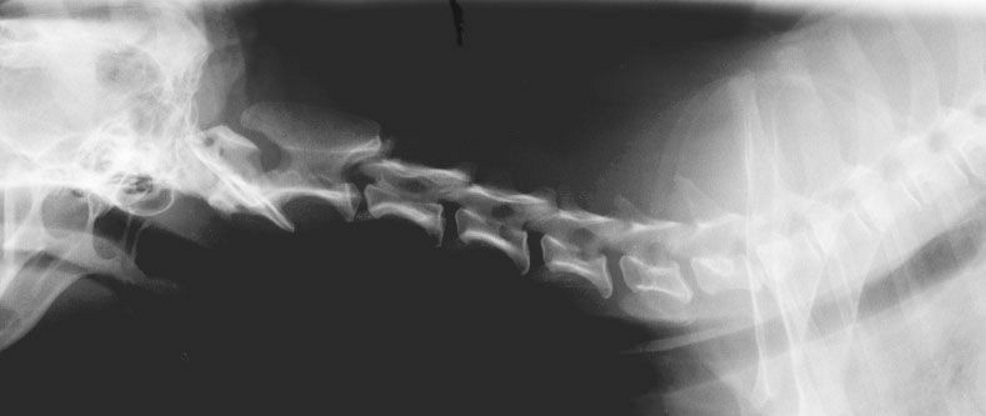
Increased distance between the c1 and c2
Atlantoaxial subluxation: Diagnosis is supported by increased distance (> a few mm) between the dorsal aspects of C1 and C2 when viewed on a lateral survey radiograph
normal radiograph
treatment for case 1 chihuahua
Conservative management - brace (avoid excessive mm ventro flexion esp)
Pain killers - Nsaids, Gaba
Referral- Atlantoaxial fusion or brace (care with swelling causing asphyxiation)
CASE 2
Sudden onset cervical pain
11 month old cocker spaniel
Rapid onset of cervical pain and lethargy, 2 days prior to presentation with no apparent progression
Neurological examination:
§T 39.5oC
§General examination otherwise NAD
§Resentment of cervical manipulation and palpation
§Proprioception and segmental reflexes NAD
§Cranial nerves NAD
Thoughts...
-pyrexia→ has infection?
-UMN (still has intact reflexes)
Hunched
Stiff/slow to sit
Resentment - pain
High temperature = infection
No localisation
Pain in neck - joints, IV disc, muscle, + soft tissues
Acute onset on pyrexia + neck pain = meningitis (infectious/inflammatory)
ANNPE Acute Non-Compressive Nucleus Pulposus Extrusion
ddx for case 2 cocker spaniel
D IVDD (likely too young), syringomyelia (unlikely if not CKCS)
A Congenital issue
M N/A
N Lymphoma
I - discospondylitis, , bacterial/viral meningitis
T ANNPE (likely too young) soft tissue injury, fracture / subluxation (unlikely)
V N/A
Infectious/inflammation - bacterial/viral meningitis
Immune mediated - steroid response meningitis arteritis SRMA
X-ray for disco (osteomyelitis), CSF for SRMA (neutrophilic)
what is srma
This is a neurological immune mediated disorder causing inflammation of the meninges and associated blood vessels in the brain and spinal cord. non-infectious and responds well to steroids.
case 2 further diagnostics
CSF = 1000WBC/ul = neutrophilla
IgA serum/csf
C reactive protein increase
outcome?
SRMA - Steroid responsive meningits arteritis
Immune system attack meninges and cause inflammation + fever
Prednisolone = 24 mg/kg/day for 12 weeks, then taper to alternate day
therapy and decreasing doses over several months
Additional immunosuppression - azathioprine or ciclosporine is considered on
a case-by-case basis in cases refractory to prednisolone.
syringomyelia
caused by chiari like malformation in ckcs-> blocks CSF and builds up in sc
Discospondylitis
• Bacterial infection and subsequent abscess formation of the vertebral bodies and/or intervertebral disc, with or without extension into the spinal canal and compression or trauma of the spinal cord.
how is meningioencephalitis different to SRMA
is non-infectious and doesn't respond to steroids. We see inflammation in meninges and parenchyma.

CASE 3
Sudden onset/progressive nonambulatory tetraparesis
§Sudden onset of cervical pain following running into tree at exercise 3 days ago.
§Progression to non-ambulatory tetraparesis on recovery from GA to obtain radiographs
§Neurological examination: not performed
Thoughts...
trauma

differentials for case 3 caesar
D N/A
A N/A
M N/A
N - vertebral osteosarcoma w/ pathological fracture
I
N/A
T ANNPE, fracture / subluxation
V - vertebral haematoma

case 3 xrays
diagnosis and treatment?
C2 = large dorsal process
Fragment = C3
Narrowed disc space
Hairline fracture C3
Spinal stabilisation w/ hemilaminectomy for fracture, or conservative
management w/ neck brace
hemilaminectomy ?
A hemilaminectomy is a minimally invasive spinal decompression surgery in which a surgeon removes only one side of the vertebral lamina to relieve nerve compression
how has the anaesthtic made this case 3 worse
(Anaesthesia makes subluxation worse as relaxed muscles cannot hold discs in place but this image is a full fracture and not subluxation)
CASE 4
Rapid onset/progressive non-ambulatory tetraparesis
§2 week progressive history inability to walk.
§Initially just affecting hindlimbs progressing to affect forelimbs
§General examination NAD
Neurological examination
-Video shows generalized weakness of FL +HL but not neck
Cannot stand
Alert + distressed
Weakness
Neuromuscular - nerves, junction + muscle
Tetanus would be rigidity, MG as would get worse with exercise and improve
with rest
ddx for case 4 cat lily
D N/A
A N/A
M renal disease →Hypokalaemia = ventroflexion
N N/A
I - idiopathic polyradiculoneuritis (immune mediated disease, causes inflam of the peripheral n roots -> progresive m weakness and paralysis), Immune mediated polyneuropathy (targets the peripheral n), FIP, tetanus, botulism, myasthenia gravis (autoimmune, skeletal m weakness
T botulism which is a progressive generalised weakness caused by toxin ingestion
V N/A
how is muscular weakness in cats diff in the neck
-important to note that cats do not have nuchal ligament in neck so when they have muscular weakness they cannot lift their head
what is myasenthia gravis
causes generalised weakness but they get weaker with exercise and diagnosed with blood test
what is idiopathic polyradiculoneuritis
starts distally and progresses,
no diagnostic test and requires conservative managment

case 4 lily outcome
Immune mediated polyneuropathy -> treat with immunosuppressives, (preds)
What is wobbles?
CCSM (caudalcervical spondilo myolopathy)
-compression of spinal cord in caudal spine due to overgrowth of bone
-short movement in FL, long movement in HL
-Ataxia in all limbs
-could be caused by disc protrusion causing overgrowth of ligaments around spine and instability of vertebrae