China (1600 BCE - 900 CE)
 Call Kai
 Learn
Learn Practice Test
 Spaced Repetition
 Match
Match Flashcards
 Knowt Play
1/7

There's no tags or description
Looks like no tags are added yet.
Name | Mastery | Learn | Test | Matching | Spaced | Call with Kai | Chat |
|---|
No analytics yet
Send a link to your students to track their progress
8 Terms

What: embroidered silk gauze funerary shroud
Where: Tomb of unknown woman in Mashan, Hubei Province, China 300 BCE
Material: Embroidered silk gauze. Four end complex gauze with layered chain stitches
Function: Decorative scrolled motifs of animals and mythical creatures (not vegetal). Found in a modest tomb for an unknown woman in her 40s — possibly dressed beyond her station or fallen from wealth. Her silks are the best preserved from this period
Themes:
Decorative ornamentation (?)
luxury in funerary space
legibility vs abstraction
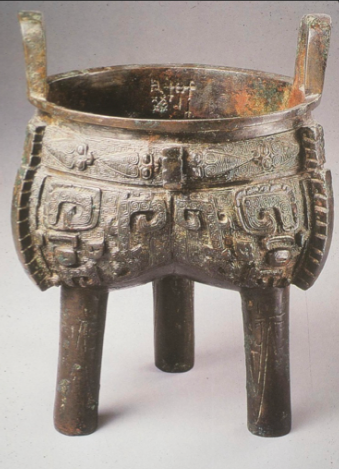
What: called “Fu Gui ding” (meaning Father Gui cauldron) — Bronze ritual vessel (ding)
Where: ?? Is this Fu Hao’s tomb?
Materials: Cast bronze. Clay model would have been made first, then clay positive was used to make a section mold. The clay positive was then carved down by an even layer which would become the thickness of the bronze. held in place with chaplets (spacers) and cast upside down. The shape of the piece molds influenced the design, as the seams were emphasized as axes of symmetry.
Function: Used to cook and offer food to ancestors during rituals (i think)
Themes:
Modes of technology (casting) contribute to the design
Ritual feasting (?) - feasting in the afterlife

What: Ritual bronze axe
Where: Fu Hao’s tomb, Henan, China, 13th century BCE.
Materials: Cast bronze
Function: Find in enormous tomb alongside human bones, some in coffins, others in piles, as well as puppies. Some of the people have shackles on and no heads — heads found in pits nearby. The death of a royal was probably very bloody. Symbols on axe show two tigers with jaws open surrounding a head. Was it a symbol of authority? Shamanism? Execution tool?
Themes:
Royal power
symbolic tools
Weapons for the afterlife

What: Funerary suit made of jade tablets sewn together
Where: Prince Liu Sheng tomb, enormous tomb carved into rock, Mancheng, China, 2nd C BCE
Materials: Jade tablets joined with gold wire
Function: Status symbol, made of extremely precious materials. Possibly used to preserve the body or to trap po soul aspect (yin, passive, material, ghost). Funnels and medical instruments found nearby point to possible belief in need for medicine in the afterlife - continuity of body
Themes:
Containment (of body, of soul?)
Ritual use of tools

What: Mountain shaped incense burner - “Hill censer”
Where: Prince Liu Sheng tomb, enormous tomb carved into rock, Mancheng, China, 2nd c BCE
Materials: Bronze decorated with gold and silver, precious inlays
Function: Represents sacred mountain surrounded by clouds. Smoke represents fog - yin principle - dark, wet, cold, female, passive, earth. Burner itself represents yang - creation, bright, hot, male, active, heaven (I THINK. feels counter-intuitive)
Themes:
miniaturization to symbolize cosmology. intimacy created through small scale
interactive, sensuous object - creates scent, visual

What: Ritual wine vessel (hu)
Where: Prince Liu Sheng’s tomb in Mancheng. Died 113 BCE
Material: Bronze with gold and silver inlays.
Function: very large wine vessel with ornamental writing which conveys a prayer for the pleasure and healthiness of the contents
Themes:
Feasting in the afterlife
stylized inscription - may not even have been read by the Prince
writing as aesthetic motif, similar to silk piece

What: Mise glaze dish
Where: Underground palace at Famen Temple, China, before 874 CE
Material: Porcelain with mise glaze meaning “secret color.” Evidence of firing spurs on the bottom prevent glaze from sticking while firing. Mise glaze creates luminous green color that resembles jade.
Function: Indented design resembles hammered silver showing exchange between material techniques
Themes:
exchange between material techniques
value placed in refined technique

What: Monstrance in the shape of a bodhisattva which displays relic, gifted to emperor Yizong for his birthday by a priest
Where: Excavated from crypt at the True Relic Pagoda, Famen Temple, China, 871 AD
Materials: Silver, partly gilded, inset with pearls
Function: Created to display a relic of the buddha. Held the inner most chamber of the 7 nestic reliquary, which was found containing a “bone” made of jade. The emperor requested to view the relic to give him good health - ended up dying not a few years later.
Themes:
ritual object
miniaturization for intimacy and preciousness
Preciousness to emphasize spiritual purpose