Genetics- MT 2- Lect 8 (10/07/2026)
 Call Kai
 Learn
 Practice Test
 Spaced Repetition
 Match
 Flashcards
 Knowt Play
1/13

There's no tags or description
Looks like no tags are added yet.
14 Terms
Yanofsky
Yanofsky showed that the order of mutations in a gene matches the order of amino acid changes in its protein. He also provided evidence that recombination can occur between different nucleotide positions within a single codon
Trp-auxotroph
Could not produce tryptophan
intragenic suppression
second mutation within the same gene compensates for the first mutation
Crick and Brenner
They caused frameshift mutations in rllB using intercalators which leads to slippage during replication
Crick and Brenner (intercalating agents) provided evidence that:
The genetic code is read in triplets of nucleotides.
Reading frame matters
Adding or deleting 1 or 2 nucleotides shifts the reading frame.
Adding or deleting a multiple of 3 nucleotides preserves or restores the reading frame downstream.
A second mutation can compensate for an earlier frameshift mutation so one exposure to the intercalator proflavine and then another exposure could be + then -
How can eukaryotic gene expression be regulated
Chromatin Condensation- Euchromatin and heterochromatin
Primary RNA transcript processing- splicing, polyadenylation and 5’ cap addition activate
degradation of mrna a bit earlier which would create less gene products
you can pause translation or affect the rate which can cause different genes to be expressed
When you process proteins you could activate smt
you can also add different modifying groups sugars lipids etc
both DNA and histones can be methylated, but acetylation is primarily associated with histones but boulette said
methylation be for dna expecially cytosine near promoters
cis- acting regulatory elements
DNA sequences that regulate gene expression (enhancers, promoters, silencers)
Promoter- located close to the gene it controls and usually contains the TATA box and other proximal control elements
Promoter is necessary for basal transcription factors to able to recruit RNA polymerase 2 if we are talking abt mRNAs
Enhancer- increases transcription could be far upsteram or far downstream
trans- acting regulatory elements
Why are enhancers necessary in multicellular organisms
Enhancers allow fine tuning of gene expression in response to different transcription factors (because in each cell type you make different transcription factors) but enhancers allow much more precise control over:
Where a gene is expressed (which cell or tissue).
When a gene is expressed (developmental stage or response to signals).
How much a gene is expressed (level of transcription).
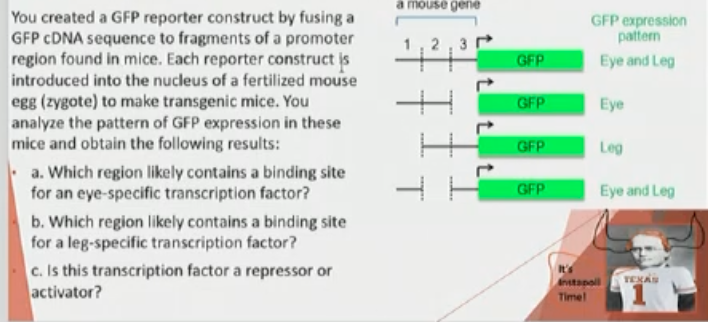
How to devise an experiment to identify a genes enhancer
Scientists attach a suspected enhancer to a promoter and GFP reporter gene (a gene that produces a green glowing protein to measure gene expression) and insert it into an organism.
More green fluorescence = More gene expression.
Eye-specific GFP = Only the eyes glow because eye cells have the specific activator proteins that bind to the enhancer.
No increase in GFP = No enhancer activity detected under those conditions.
Main idea: GFP helps scientists identify enhancers and determine where they increase transcription.
Answer is on the other side
Look for where there is a - that means that there is no promoter as it could not work at all that tis where the promoter is the + means reduced meaning no enhancer in the segment that was removed

Answer it
a-1 b-3 c- activate