Art Hum Unit 1 - The Parthenon
 Call Kai
 Learn
Learn Practice Test
 Spaced Repetition
 Match
Match Flashcards
 Knowt Play
1/69

There's no tags or description
Looks like no tags are added yet.
Name | Mastery | Learn | Test | Matching | Spaced | Call with Kai | Chat |
|---|
No analytics yet
Send a link to your students to track their progress
70 Terms
Parthenon — identification
Iktinos and Kallikrates (architecture); Pheidias and workshop (sculpture); Pentelic marble; 447–432 BCE.
Parthenon — historical context
Built on the Athenian Acropolis under Pericles during Athens' fifth-century BCE political and cultural ascendancy.
Parthenon — broader significance
Temple of Athena and expression of Athenian civic identity, religious devotion, and imperial power.
Acropolis
Elevated fortified/sacred precinct; the Parthenon stands on this feature of Athens.
Propylaia
Monumental gateway controlling and framing the approach to the Athenian Acropolis.
Pentelic marble
Fine-grained marble from Mount Pentelikon used for the Parthenon's architecture and sculpture.
Doric order
Greek architectural order with relatively plain capitals and a frieze of alternating triglyphs and metopes.
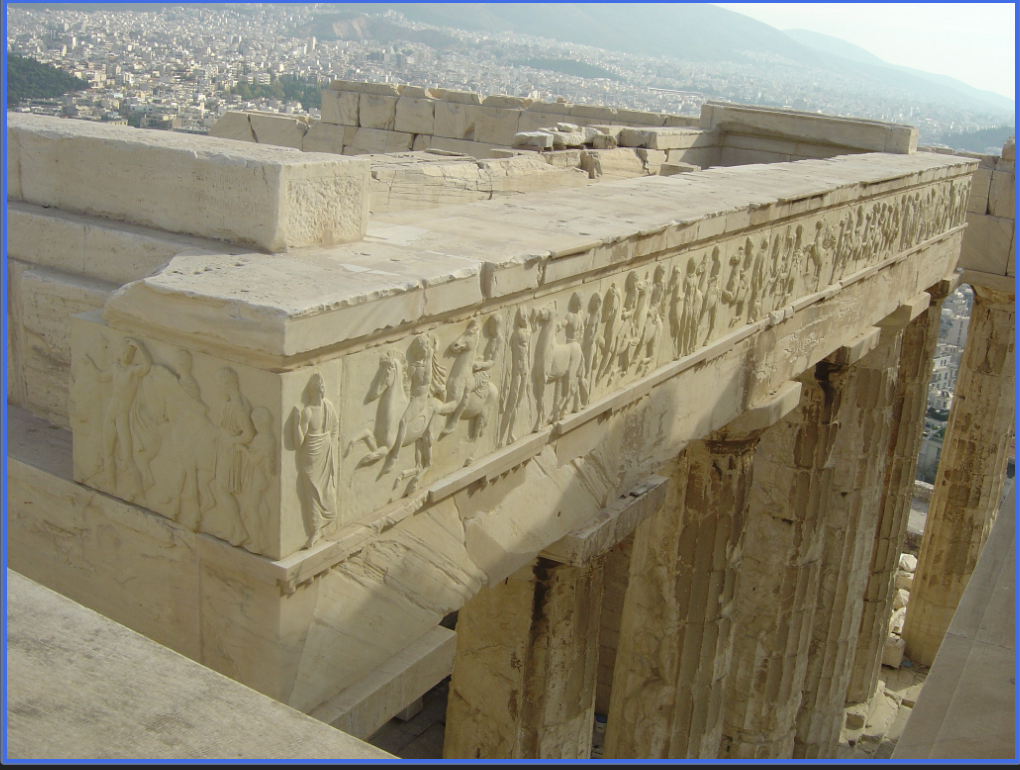
Ionic order
Greek architectural order characterized by volute capitals and often a continuous frieze; the Parthenon’s inner wall has some of these elements.
Column
Vertical architectural support consisting of shaft and capital, sometimes with a base.
Colonnade
A row or series of columns forming a supporting or enclosing architectural element.
Capital
Uppermost part of a column, between the shaft and the structure above it.
Shaft
The long vertical body of a column beneath its capital.
Base
Bottom support of a column; standard Greek Doric columns have no separate base.
Cornice
Projecting upper molding at the top of the entablature or architectural façade.
Pediment
Triangular space beneath the sloping roofline at the end of a classical temple.
Parthenon east pediment
Birth of Athena; sculptural program supervised by Pheidias, 447-432 BCE.
Parthenon west pediment
Contest of Athena and Poseidon for the patronage of Athens; fifth century BCE.
Pedimental sculpture
Sculpture designed for the triangular field of a pediment, with poses adapted to its varying height.
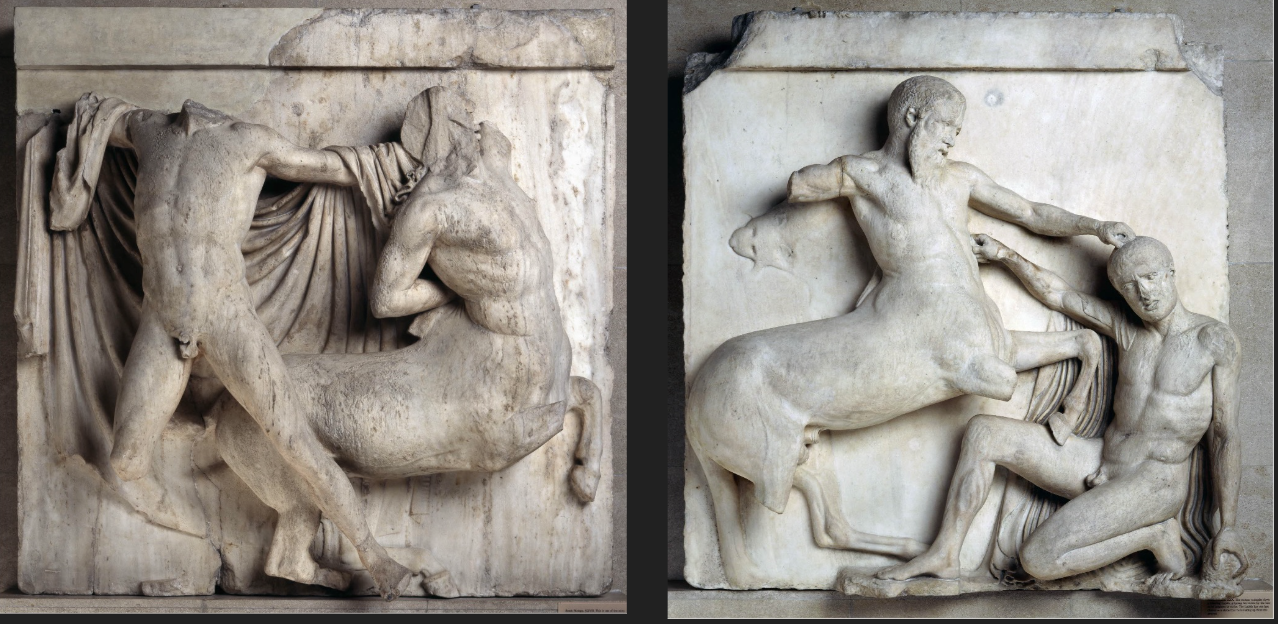
Metopes
Square sculptural panels alternating with triglyphs in a Doric frieze.
Triglyphs
Three-grooved blocks alternating with metopes in a Doric frieze.
Parthenon metopes — identification
Pheidias and workshop, Pentelic marble, ca. 440 BCE; reliefs showing mythic conflicts.
Parthenon metopes — significance
Mythic clashes such as Lapiths versus Centaurs can evoke struggles between order and disorder.
Parthenon Ionic frieze — identification
Pheidias and workshop, Pentelic marble, chiefly ca. 442–438 BCE; continuous sculptural band.
Panathenaic procession
Athenian religious festival/procession for Athena; commonly associated with the Parthenon's Ionic frieze.
Cella (naos)
Inner chamber of a Greek temple, housing its cult image.
Athena Parthenos
Monumental gold-and-ivory cult statue of Athena made by Pheidias for the Parthenon's cella.
Optical refinements
Deliberate subtle adjustments to forms and lines, including entasis, curvature, and inclination.
Entasis
Slight convex swelling of a column shaft, counteracting a visually rigid appearance.
Inclination
Slight inward lean of columns or architectural elements in a classical building.
Curvature
Subtle upward bending of apparently horizontal elements, such as the Parthenon's stylobate.
Post-and-lintel construction
Structural system of vertical supports carrying horizontal beams; used in Greek temples.
Relief sculpture
Sculpture attached to a background plane; high version of this projects farther than low version.
Sculpture in the round
Freestanding three-dimensional sculpture viewable from multiple angles.
Polychromy
Use of multiple colors; ancient Greek architecture and sculpture were often painted.
Naturalism
Representation that seeks convincing anatomy, bodily movement, and appearances observed in life.
New York Kouros — identification
Unknown sculptor; marble; ca. 590–580 BCE; Archaic Greek statue.
New York Kouros — visual characteristics
Rigid frontal stance, left leg advanced, stylized hair and anatomy, and relative symmetry.
Doryphoros — identification
Polykleitos; lost Greek bronze original ca. 450–440 BCE; known through Roman marble copies.
Doryphoros — significance
Classical ideal of harmonious proportion, balanced posture, and contrapposto (most weight on one foot, creating an S shape).
Contrapposto
Weight shift onto one leg producing an asymmetrical balance of hips and shoulders.
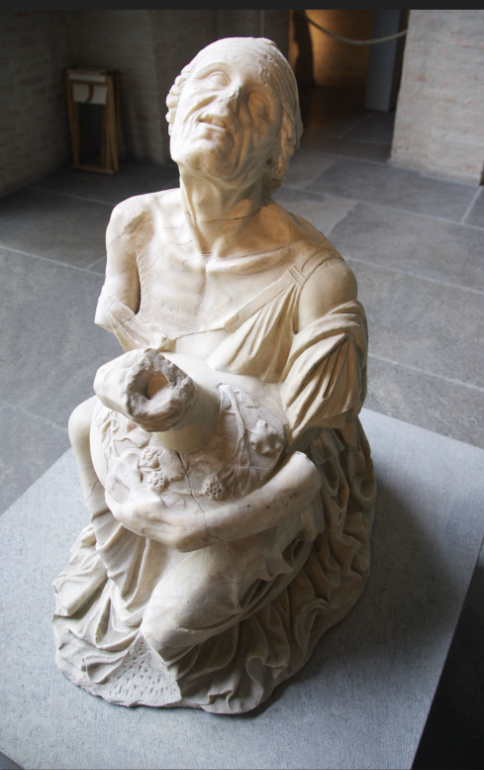
Drunk Old Woman — identification
Unknown Hellenistic sculptor; lost Greek marble original of late 3rd–early 2nd century BCE; Roman marble copy.
Drunk Old Woman — significance
Hellenistic interest in age, vulnerability, emotional expression, and subjects outside idealized youth.
Archaic Greek sculpture
Greek sculpture associated with frontal, relatively rigid, stylized human figures such as kouroi.
Classical Greek sculpture
Emphasizes harmonious proportion, idealized naturalism, and balanced bodily movement.
Hellenistic Greek sculpture
Often emphasizes expressive poses, individualized subjects, dramatic emotion, and bodily variety.
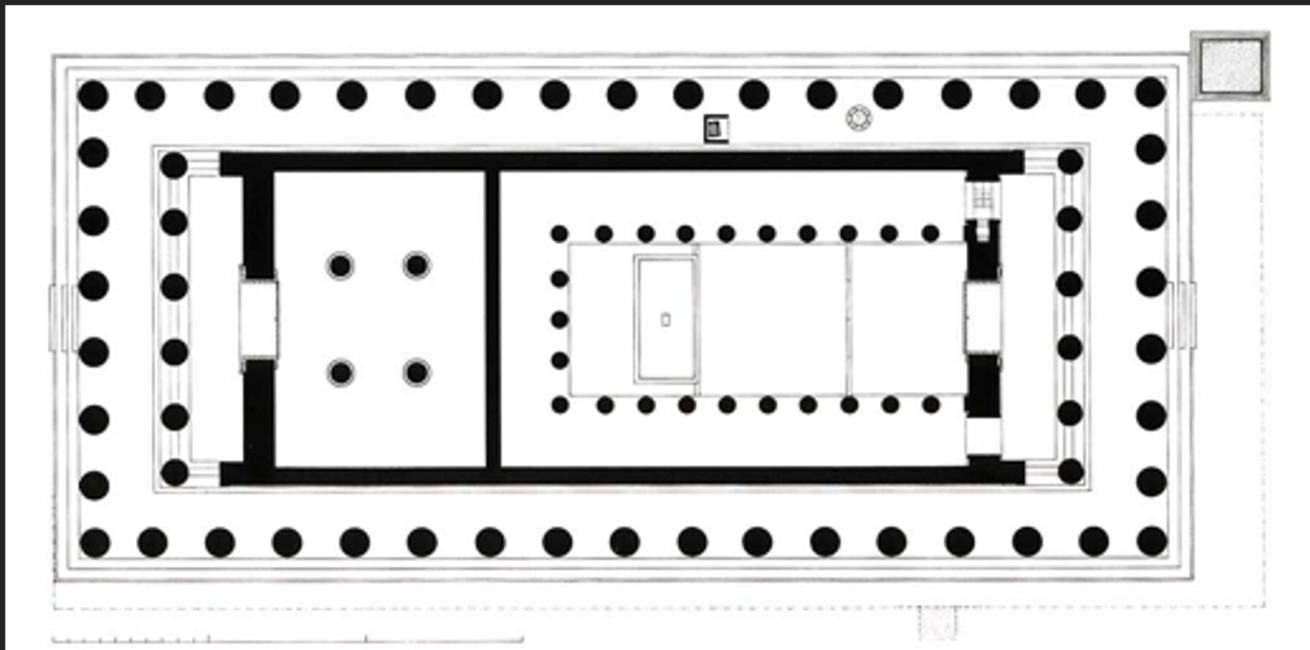
Floor plan / ground plan
Horizontal diagram showing a building's spatial organization as if viewed from above.
Section
Diagram of a building as if cut through to show internal vertical relationships.
Elevation
Flat representation of a building's exterior or interior face.
Elgin Marbles debate
Debate over the British Museum's retention versus repatriation of Parthenon sculptures to Greece.
Mary Beard — The Golden Age of Athens
Beard examines how an idealized “Golden Age” narrative obscures Athens’s exclusions, imperial power, and the limits of democracy.
Jeannette Greenfield — The Elgin Marbles Debate
Greenfield examines Elgin’s disputed authority, removal and damage, Greek claims for reunification, and the universal museum defense.
Beard — Why question the phrase “Golden Age of Athens”?
Beard challenges celebratory narratives: Athenian democracy and cultural splendor existed alongside empire, hierarchy, and exclusion.
Beard — Who could participate in Athenian democracy?
Male citizens exercised political rights; women and enslaved people were excluded, complicating claims of equality.
Beard — What was the link between empire and democracy?
Imperial resources partly financed compensation for civic participation, supporting democracy alongside unequal imperial power.
Beard — Why is Pericles central to the Parthenon story?
His leadership became closely linked with the Acropolis rebuilding and the idealized narrative of fifth-century Athenian achievement.
Beard — How is Athens’s past presented to modern tourists?
The Acropolis sound-and-light spectacle promotes a heroic story of Persian victory, Pericles, and democracy; Beard scrutinizes it.
Greenfield — What are the Greek arguments for return?
Parthenon sculptures belong to an architecturally unified monument and to Greece’s cultural and historical identity.
Greenfield — What issues surround Elgin’s permission?
Elgin obtained Ottoman authority (a firman), but its meaning, legitimacy, and the scope of removals are contested.
Greenfield — How might removal itself matter ethically?
The account describes removal of carved elements and damage to architectural fabric, not merely transfer of loose artifacts.
Greenfield — What is the universal museum counterargument?
Keeping the sculptures in Britain can be defended as widening international access to a shared cultural heritage.
Greenfield — Why distinguish legal title from cultural justice?
Return involves legal disputes but also questions of cultural identity, historical loss, and ethical responsibility.

image
The Parthenon image
image
The Parthenon - Ground plan image

image
The Parthenon - West Pediment (Athena vs. Poseidon for patronage of Athens) image

image
The Parthenon - East Pediment (birth of Athena) image
image
The Parthenon - Metopes image
image
The Parthenon - (Ionic) Frieze image

image
New York Kouros (590 BCE) image

image
Doryphoros (450 BCE) image
image
Drunk Old Woman (200 BCE) image