lecture 14 - Anticoagulants/Inhibitors of platelet aggregation
 Call Kai
 Learn
 Practice Test
 Spaced Repetition
 Match
 Flashcards
 Knowt Play
1/57

There's no tags or description
Looks like no tags are added yet.
58 Terms
what is Ximelagatran
Direct thrombin competitive inhibitor
Has to be administered as a pro-drug
Intended to be a replacement for
warfarin
Risk of liver damage upon continued
use
Voluntarily pulled from the marked

what is Atecegatran
Direct thrombin competitive
inhibitor (reached phase 2 clinical trials:
not approved discontinued)
A new version of Ximelagatran Apparently
produces no liver damage
Still has to be in a pro-drug form for
absorption.
Proposed Use: prevent clots after joint
surgery used to prevent clots in atrial
fibrillation
Non-Benzamidine IIa inhibitors
Argatroban
features of Argatroban
Direct thrombin
competitive inhibitor
Not orally active
Given as continuous IV infusion
t ½ = 39 to 51min
Used in patients with heparin-induced
thrombocytopenia (HIT)
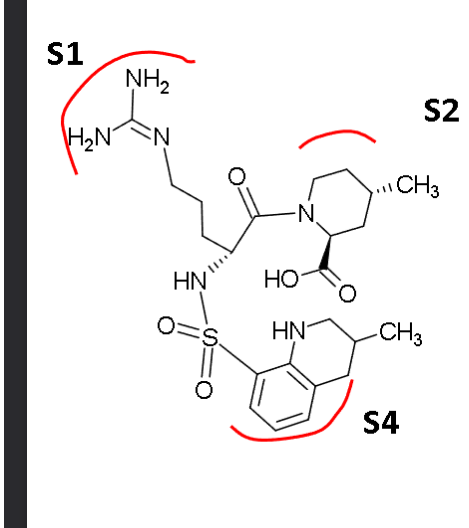
how does Xa active site look like
Active site of IIa and Xa are very similar. Note: same
binding pocket numbering

what is Rivaroxaban
Rivaroxaban is a direct competitive Factor Xa inhibitor.
When rivaroxaban binds Factor Xa, it occupies the enzyme's catalytic site and prevents normal substrate binding.
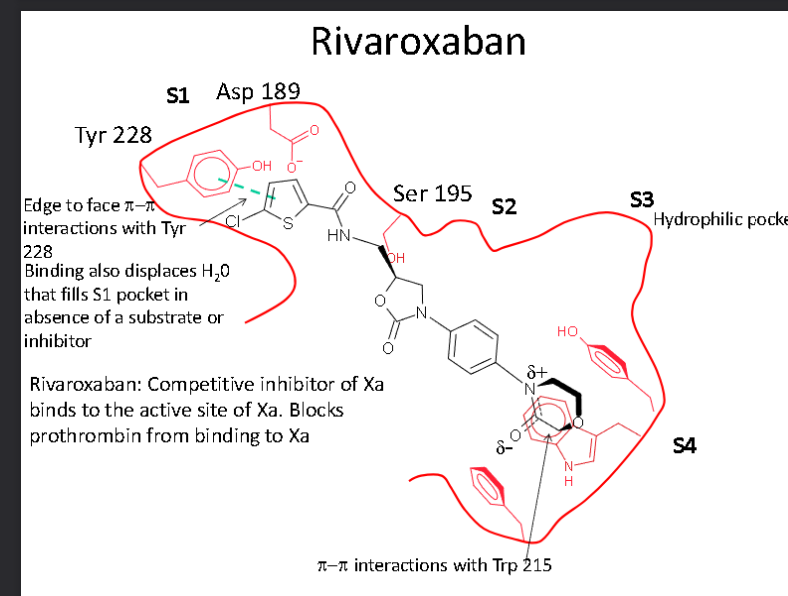
What happens at S2 and S3? for rivaroxaban
S2: Accommodates the relatively compact portion of the inhibitor.
S3: Provides a hydrophilic environment where polar functional groups can contribute to binding.
The important concept is that these regions help position rivaroxaban correctly within the active site.
How does rivaroxaban bind S4?
The aromatic region of rivaroxaban interacts with Trp215.
Your lecture specifically highlights π–π interactions.
These interactions occur between the aromatic group of rivaroxaban and the aromatic side chain of tryptophan.
Your slide also shows a partial positive and partial negative charge near the interacting groups, illustrating how electrostatic features can contribute to stabilizing the interaction.
Key takeaway: Aromatic interactions with Trp215 help stabilize rivaroxaban in S4.
Why is rivaroxaban different from dabigatran?
Feature | Dabigatran | Rivaroxaban |
|---|---|---|
Target | Thrombin (IIa) | Factor Xa |
S1 interaction | Positively charged benzamidine with Asp189 | Aromatic interactions with Tyr228 |
Important S4 residue | Trp215 | Trp215 |
Requires charged benzamidine | Yes, in active dabigatran | No |
Drug class | Direct thrombin inhibitor | Direct Factor Xa inhibitor |
Why was benzamidine originally used?
Benzamidine is a broad-spectrum inhibitor of most serine proteases it acts as a mimic of arginine in the substrate. As part of a more complex inhibitor, this group fits
in the S1 site of IIa and Xa producing potent inhibitors.
At physiological pH, the amidine is predominantly positively charged.
The positive charge on benzamidine forms an ionic interaction with Asp189.
what is downside to benzamide
it is charged at
physiological pH drastically reducing absorption and necessitating formation of a pro-
drug (like dabigatran).
Removal of the benzamidine group from IIa and Xa inhibitors eliminates potency
How did scientists solve this problem for Factor Xa inhibitors?
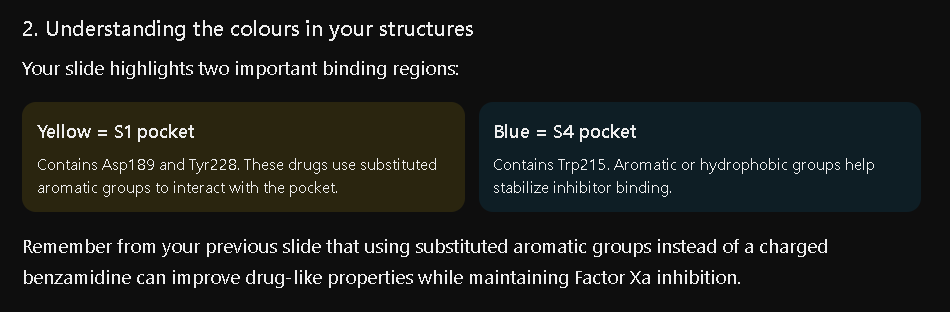
nstead of using benzamidine, scientists introduced substituted aromatic groups.
Your slide shows three examples:
A chlorinated pyridine ring.
A methoxy-substituted benzene ring.
A chlorinated thiophene-containing group.
These groups do not carry the same permanent or strongly favoured positive charge as benzamidine.
Therefore, they can improve membrane permeability while still providing favourable enzyme-binding interactions.
how can they bind strongly without an ionic interaction?
for Xa inhibition without having a charge that reduces absorption. These substituted
aromatic groups appear to form - interactions with Tyr 228 at the bottom of the S1
pocket without the need for Asp 189 charge interaction. This strategy does NOT
WORK with IIa inhibitors. These groups also help to select for Xa vs IIa inhibition.


what is between the yellow and blue structures
blue is exosite and yellow is active site
Rivaroxaban is used for:?
Prevention of venous thromboembolism (VTE) after hip or knee replacement surgery.
Treatment and prevention of DVT and pulmonary embolism (PE).
Prevention of stroke and systemic embolism in patients with atrial fibrillatio
renal elimination is important, so kidney function must be considered when dosing.
what is Apixaban (Eliquis)
Direct competitive Xa
inhibitor
Uses: same as rivaroxaban.
High renal elimination means dosage adjustments
needed in the case of renal impairmen
when is Betrixaban used and what does it substituted benzamidine bind to
For the prevention of venous thromboembolism with hip and knee surgery
S4 NOT S1

what is Betrixaban metabolized by
Not metabolized by CYP3A4 but also not
highly excreted by kidney. Mostly biliary
excretion and elimination in feces. Only
requires dose reductions in patients with
severe renal impairmen
what is Edoxaban used for
Edoxaban is also a direct Factor Xa inhibitor.
For the prevention of stroke and embolism in
patients with atrial fibrillation.
Treat DVT or PE
how is Edoxaba eliminated
how to monitor Xa inhibitors
– Not normally required
– With all Xa inhibitors require dosage adjustments in renal failure
• Adjustment depends on level of renal impairment based on CrCl, different for
each drug
Side effects of Xa inhibitors
– Bleeding is the most common and serious side effect
• On a continuum from minor nose bleeds, occasional blood in the urine,
to more serous internal bleeding such as gastrointestinal bleedin
Contraindications of Xa inhibitors
– Active bleeding, pregnancy and breast feeding
– heparin, warfarin, NSAIDs, or antiplatelet drugs
How are Factor Xa inhibitors reversed
Antidotes
– Concentrated clotting factors II, VII, IX, and X
– Andexanet alfa - is a modified recombinant Factor Xa protein that acts as a decoy.
Recombinant modified human factor Xa decoy protein binds apixaban and rivaroxaban.
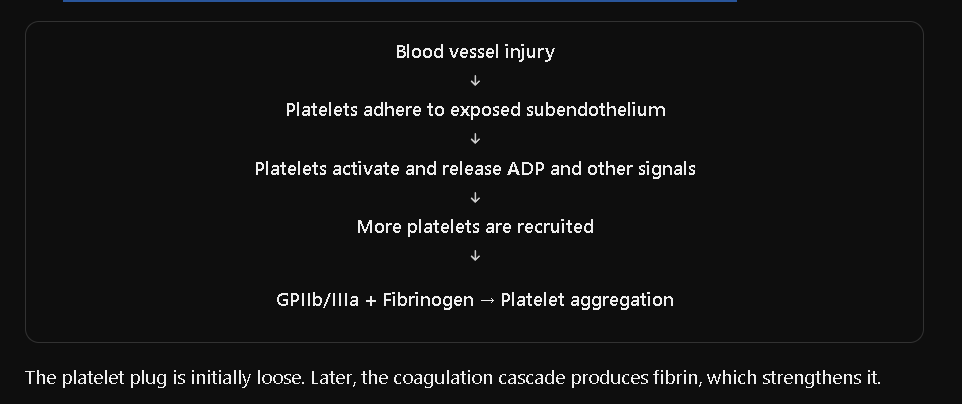
What is primary hemostasis?
Primary hemostasis is the process where platelets form a temporary plug to stop bleeding after a blood vessel is injured.
what are the 3 main steps involved in primary hemostasis
Platelet adhesion: Platelets attach to the damaged blood vessel.
Platelet activation: Platelets release chemical signals that recruit and activate more platelets.
Platelet aggregation: Platelets stick to one another to form a loose platelet plug.
latelet adhesion: How do platelets attach to the blood vessel?
When a blood vessel is injured, its underlying collagen and von Willebrand factor (vWF) become exposed.
Two important platelet receptors help with adhesion.
GPIb:
GPIa/IIa:
function of GPIb:
Binds to von Willebrand factor.
vWF helps anchor platelets to the injured vessel.
GPIa/IIa: function
Binds to exposed collagen.
Helps stabilize platelet adhesion.
Platelet activation: What activates platelets?
A. ADP → P2Y₁ / P2Y₁₂ receptors
COX-1 → Thromboxane A₂ (TxA₂)
function of ADP
Activated platelets release ADP (adenosine diphosphate).
ADP binds to P2Y₁ and P2Y₁₂ receptors on nearby platelets, promoting their activation and recruitment.
This helps amplify platelet aggregation.
MedChem connection: Drugs such as clopidogrel, prasugrel, ticagrelor, and cangrelor inhibit the P2Y₁₂ receptor.
what does COX-1 do
Platelets contain an enzyme called cyclooxygenase-1 (COX-1).
COX-1 participates in the production of thromboxane A₂.
TxA₂ promotes platelet activation and aggregation.
what inhibits cox-1
aspirin (ASA) inhibits COX-1 and COX-2.
By inhibiting platelet COX-1, aspirin decreases TxA₂ synthesis, reducing platelet activation.
How does ADP cause platelet aggregation? explain the signaling pathway
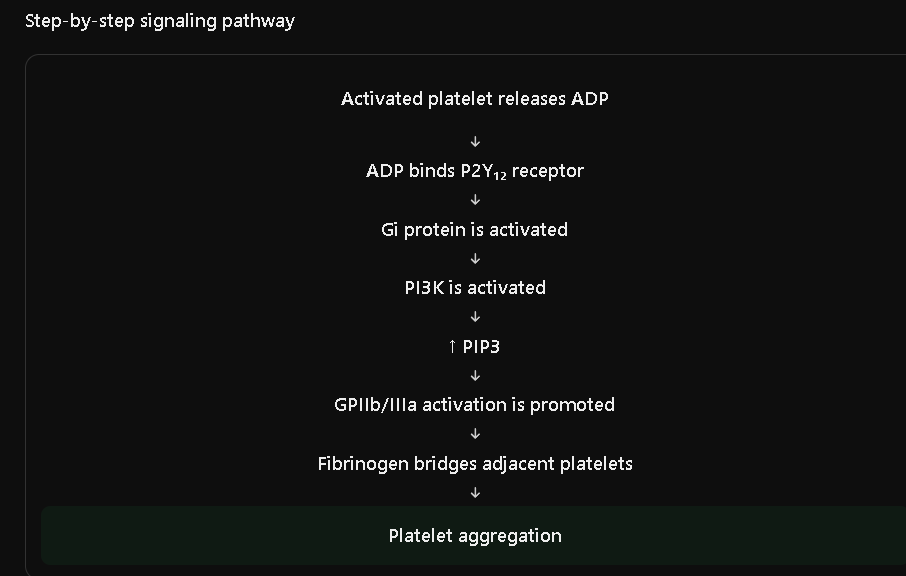
what is PI3K and PIP3
PI3K stands for phosphoinositide 3-kinase.
It increases production of PIP3, an intracellular signaling lipid.
PIP3 helps activate downstream pathways that promote GPIIb/IIIa activation.
what is an example of a irreversible non-competitive antagonist for p2y12 mechanism
Clopidogrel or prasugrel
what is an example of a competitive antagonis for p2y12 mechanism
Ticagrelor, Cangrelor
what type of receptor is P2Y12
is a G-protein-coupled receptor (GPCR) found on platelets. specifically Gi protein
Activation of Platelets summary

what type of drug is clopidogrel
, the clopidogrel molecule you swallow is not the active inhibitor.
It is a prodrug, meaning it needs metabolic activation.
What happens to clopidogrel in the intestine?
Pgp1 is P-glycoprotein, an efflux transporter.
It can transport clopidogrel back toward the intestinal lumen, limiting the amount that reaches circulation.
The clopidogrel that is absorbed can travel to the liver for metabolism.
How is clopidogrel metabolized?
Once clopidogrel reaches the liver, it can follow two different metabolic pathways.
Esterase pathway
CYP pathway
what happens in Pathway A: Esterases (~85%)
This converts clopidogrel into an inactive carboxylic acid metabolite.
Therefore, most of the absorbed drug does not become an active antiplatelet agent.
what happens on Pathway B: CYP2C19 activation
The remaining portion can undergo oxidative metabolism.
Clopidogrel → 2-oxo-clopidogrel via CYP2C19.
2-oxo-clopidogrel → active thiol metabolite through further CYP-mediated metabolism.
The active metabolite contains a reactive –SH (thiol) group.
This functional group is important for the drug's irreversible interaction with P2Y₁₂.
How is prasugrel activated?
Prasugrel is an inactive prodrug, meaning it must undergo metabolism before it can inhibit platelet aggregation.
Step 1: Esterase hydrolysis
Step 2: CYP oxidation
Prasugrel vs clopidogrel?

Active Clopidogrel or Prasugrel
do what?
alkylate P2Y12
receptor irreversibly. They are non-competitive
antagonists of P2Y12 preventing platelet aggregation.
what is Formation of active Clopidogrel dependent on
is dependant on
CYP2C19 activity
– Clopidogrel activity influenced by genetic variation in
CPY2C19 making dosing difficult
how many oxidation steps in Formation of active prasugrel and is it dependent on CYP2C19
has only one oxidation step CYP2C19 is not critical and CYP2C19 gene variation does not effect active prasugrel formation
• Despite this prasugrel has a higher risk of bleeding
than clopidogrel so its not the first choice
what does P2Y12 receptor look like
TM2: Transmembrane helix 2.
TM3: Transmembrane helix 3.
two important cysteine residues:
Cys97
Cys175
black loop connecting them is an extracellular portion of the receptor.
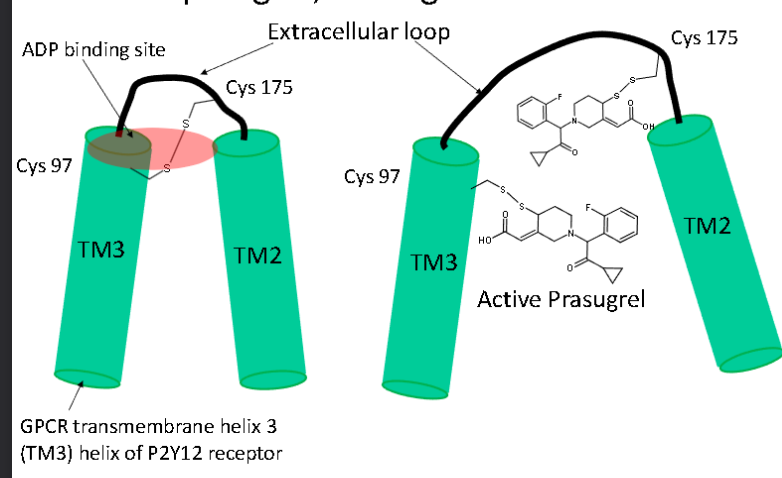
how does clopidogrel/prasugrel
bind
Active form of clopidogrel/prasugrel forms disulfide bond with P2Y12 receptor
cysteines that disrupts the ADP binding site resulting in non-competitive antagonism
what is Ticagrelor
Competitive antagonist of the P2Y12 receptor
– Does not alkylate the recepto
features of ticagrelor
• Does not require metabolism to make it into an active form
• Potential alternative to prasugrel or clopidogrel
• Taken PO, bid
Has a “similar” structure to ADP

when is ticagrelor used
For the secondary prevention of
MI or stroke. Acute Coronary
Syndromes (ACS) (=unstable
angina, and MI) who are getting
percutaneous coronary
intervention (PCI) and/or coronary
artery by-pass graft (CABG
what is Cangrelor
The other P2Y12 receptor antagonists take time to work. Cangrelor has a rapid onset of
action and rapid recovery after stopping. Has a short t½-
Originally intended to be given with other P2Y12 antagonists to produce immediate
antiplatelet activity while other P2Y12 antagonists started to work
features of Cangrelor
• Competitive antagonist of the P2Y12 receptor
– Does not alkylate the receptor
• IV only: bolus and/or continuous IV. Not metabolized by CYPs
• Not cleared by kidneys No dosage adjustments in renal failure

Cangrelor PK/PD
Very shot t1/2 =3-6 min (rapidly dephosphorylated)
Rapid onset 2min
Rapid recovery of platelet function 30-60min after
discontinuation