amino acids
 Call Kai
 Learn
 Practice Test
 Spaced Repetition
 Match
 Flashcards
 Knowt Play
1/19

There's no tags or description
Looks like no tags are added yet.
20 Terms
Nonpolar
GLAM VIP FW
Polar uncharged
NYC QTS
Acidic polar
ascidic
negative charge R grp
Basic
His Lys Arg basic
Positive charge
Aromatic
WTY smells good
Proline is?
Rigid
Histidine is?
Can act as acid and base, imidazole ring
Which are involved in post translational modifications
OH: serine, thr ,tyr —> can accept phosphate group
NH3: asn and OH: ser, thr —> attachment sites of sugars
Which has SH?
Cys has SH — can disulfide bond.
Essential amino acids
PVT TIM HALL
pneumonic not based on codes

pk1? pk2? pkr?
pk2--> amino grp
pk1--> carboxyl grp
pkr--> r grp
zwitterionic form?
all grps neutral in amino acid
pk=pH -->?
pk> pH -->?
pk<ph —>?
1. equal- no change
2. acidic environment (grp is protonated)
3. basic environment (grp is deprotonated)
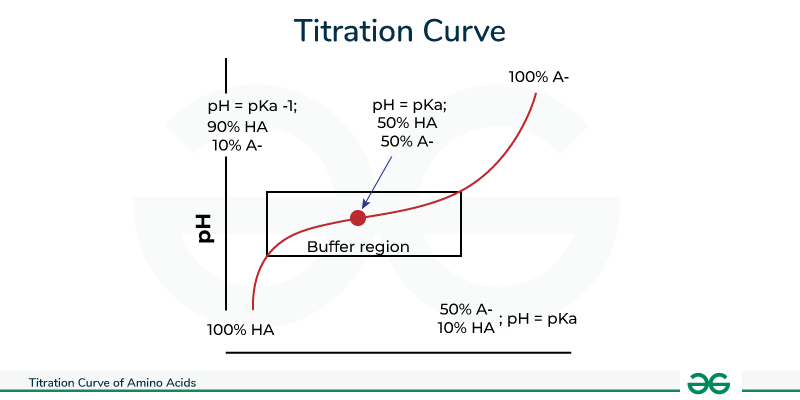
what do labels and plateaus mean?Isoelectric Point?
y axis: pH increases, x acis: OH- increases (solution getting more alkaline)
starting low? (low pH), the amino acid is fully protonated
buffering regions: plateaus horizontal-looking sections where adding base causes very little change in pH. Centers around pka value.
At pka= Half-equivalence point: The concentration of the protonated form equals the concentration of the deprotonated form
Isoelectric Point: What it is: The pH at which the amino acid carries a net charge of zero (the zwitterion form).
for simple amino acids: pI= pka1+pka2/2
sits at the inflection point or halfway between the pka
how to determine amino acids looking at Isoelectric Point?

henderson hasselbalch equation
calculates the pH of a buffer solution or estimates the ionization ratio of a weak acid and its conjugate base

PTMs - reactive side chains
Phosphorylation,
Acetylation methylation ubiquitination
Glycosylation
Oxidation and disulfide bond
Hydroxylation
Ser Thr Tyr
Lys Arg
Asn Ser Thr
Cys Met
Pro Lys
charge at ph 7
COO-
NH3+
this is at ph 7. No need to apply changes
Ph <pka
Group protonated
NH3+
Or neutral COOH
ph > pka
group deprotonated
neutral NH2
Or COO-