BIo 1AL
 Call Kai
 Learn
Learn Practice Test
 Spaced Repetition
 Match
Match Flashcards
 Knowt Play
1/57

There's no tags or description
Looks like no tags are added yet.
Name | Mastery | Learn | Test | Matching | Spaced | Call with Kai | Chat |
|---|
No analytics yet
Send a link to your students to track their progress
58 Terms
Categorical Data
Nominal- groups or categories without structure (Color, Major, etc)
Ordinal- groups or categories with structure (t shirt size, grade, etc)
Numerical Data
Discrete- can only be measured in terms of whole numbers ( number of students)
Continuous- measured on a scale in which we can uses fractions or decimals(gpa)
AU= Arbitrary units
Does not have unites but bigger the number the greater the change in fluorescence. Remember PTC florescent experiment where they measured CA+2
How do we know if cells are alive and functioning?
If a cell doesn’t respond to one signal, you can’t immediately conclude that the signaling pathway is missing. The cell might just be dead, unhealthy, or the experiment might have failed.
So you use a positive control: give the cells a different signal that you already know should cause a response.
If the cells respond to the second signal, then you know they are alive and capable of signaling, and the lack of response to the first signal is meaningful.
If they don’t respond to either signal, then you have to consider that the cells may not be viable or the assay may not be working.
Dose Réponse Curve
EC50- is the half maximal effective concentration, or the concentration at which you get half of the max response

T- test
An inferential statistic used to dermic if there is a significant difference between the means of 2 groups
2 questions to asked
Paired/correlated or independent?
Paired/ correlated- data in the 2 groups are from the same samples (measuring cellular repine in one cell before and after a drug treatment)
Independent- data in the 2 groups are from totally different experiments (EC50 dat for PTC and PROP)
One tailed or two tailed
Two-tailed- You want to see if there is a difference in the means in either direction (if there is a difference in the EC50 means)
One tailed- you want to see if there is a difference in the means in one specific direction (is it higher or is it lower)
Hypothesis Testing
Null hypothesis- The means of the groups are the same. In other words, any difference we see in the means is due to random chance
The results of the t test will be a p value (between 0-1)
The p value is the probability of obtaining our results if the null hypothesis is correct (differences are due to chance)
A p value of 0.02 means there is a 2 percent chance of obtaining our results due to chance
We typically reject the null hypothesis when p is greater than or equal to 0.05 and say that there is a significant difference in the means
Greater than 0.05 we fail to reject the null

There is no significant difference between the average rate of axonal transport with or without the drug. Any difference you see will be due to chance
Paired, one tailed t test
We fail to reject the null hypothesis.
CHI square test
A statistical test primary used to whether two categorical variables are likely to be related or not
For example:
Variable 1: genotype = AA, AG, GG
Variable 2: phenotype = normal, affected
The test asks whether genotype and phenotype seem related, or whether the pattern could reasonably happen by chance.
degree of freedom
number of columns -1 times number of rows minus 1

expected= (row number)(column total)/ grand total
For Deaf + Normal Airways:
Deaf row total = (98\)
Normal Airways column total = (185)
Grand total = (316)
=57.4
x² value
Find expected value for every column and then use the equation.
X²= (observed -expected)²/expected
After finding for each value add them together
chart will br provided to interpret results

Accuracy vs precision in scientific measurement
Accuracy- how close are the measurements to a specific value
Precision- how close are the measurements to each other
Standard deviation (SD) → precision
Small SD = measurements are close together = high precision
Large SD = measurements are spread out = low precision
Mean → used to judge accuracy, but only when you compare the mean to the true/accepted value
Mean close to true value = high accuracy
Mean far from true value = low accuracy
Micropipettes can accurately and precisely transfer small volumes
P20: volumes between 2 microliters and 20microliters
P200: volumes between 20 microliters and 200 micrliters
P1000: volumes between 200 microliters and 1000 microliters (ml)

C1V1=C2V2
How does a spectrophotometer work?
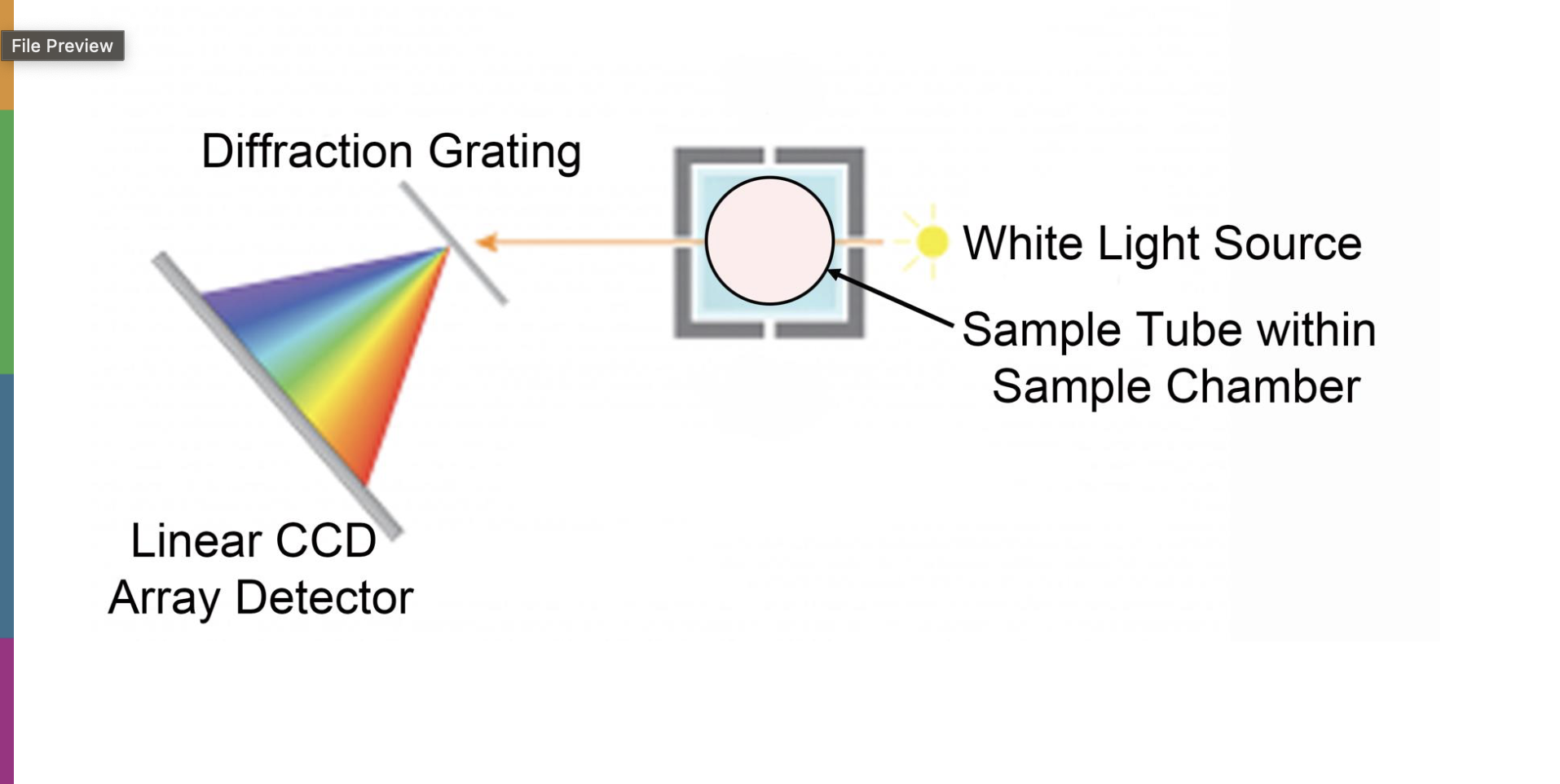
Absorption spectrum
when absorbance is high the transmittance is low
High transmittance = lots of light passes through
Low transmittance = little light passes through because more light is absorbed

Increased concentration = Increased absorbance
Abs=-logT
Abs=-log I0/I1
I0 is the light coming in It is the light that escapes
Which wavelength of light should you look at?
always look at maximum absorbance

R²
tells you how well the best-fit line matches the data points.
R² close to 1 = points are very close to the line → strong fit
R² close to 0 = points are scattered away from the line → poor fit
How to measure concentration of a solution
1. Measure the absorbance of a blank first (the solvent that the solute
is dissolved in, like water or a buffer) All other samples will be measured relative to the blank
2. Make solutions of a substance of known concentration (serial dilutions!)
3. Measure absorption spectrum and determine the best wavelength to measure absorbance (λmax)
4. Measure the absorbance of the known concentrations to create a standard curve
5. Measure absorbance of a solution of unknown concentration
6. Compare it to the standard curve to infer its concentration

difference between a concave and a convex lens
our eyes are convex
a flashlight is a concave lens

Resolution does not equal magnification
Resolution is the ability to distinguish between 2 closely spaces object (not to see small objects)
Contrast
refers to the ability to distinguish details when compared to the background or adjacent ares. Staining cells with dyes enhances contrast the difference in light intensity between the brightest and darkest parts of the specimen.
using a 4x objective what is total magnification
40x
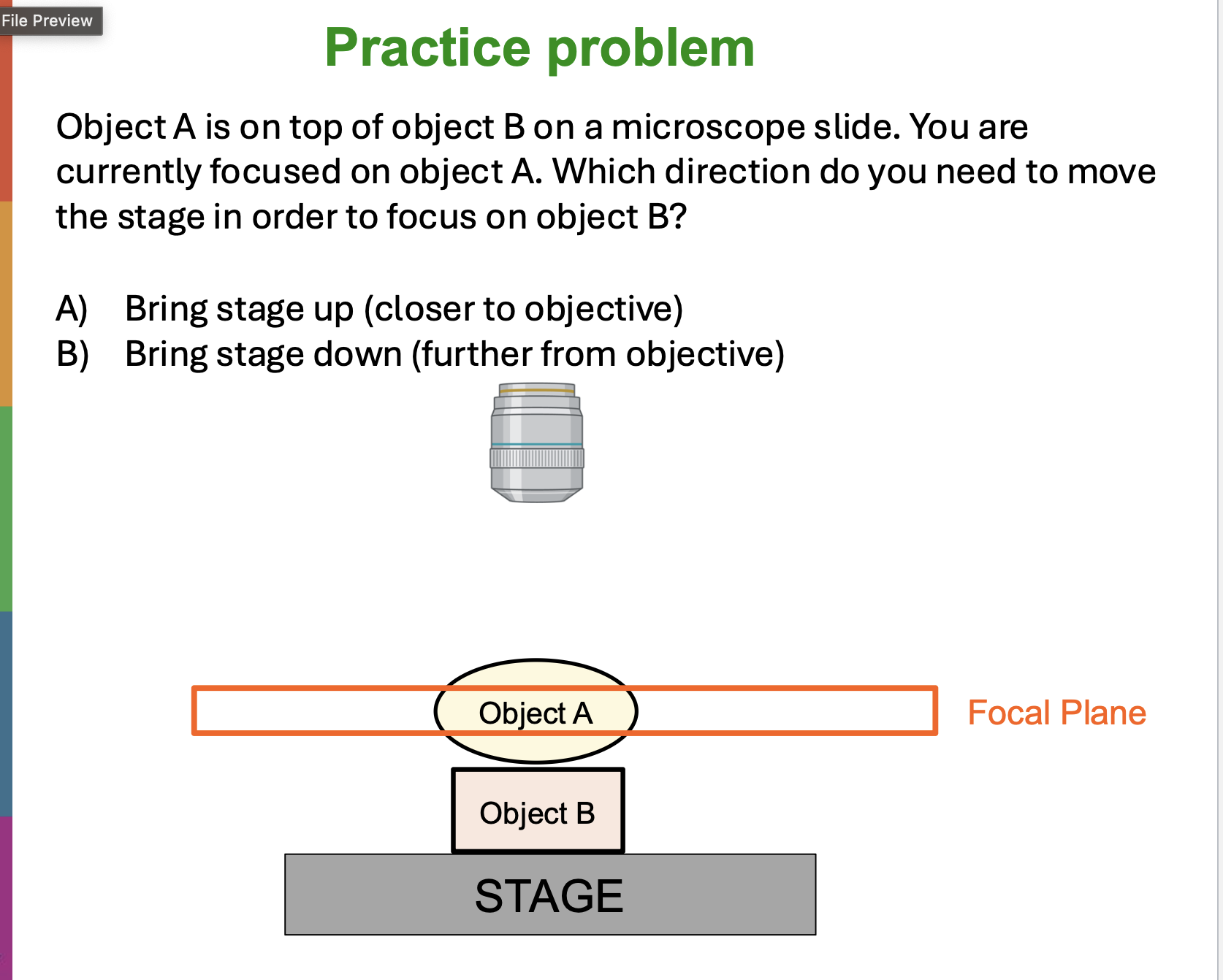
You bring the stage up will no longer be able to see A
How do you know what is in the focal plane
the only thing you will see is the stuff in the focal plane so make sure to know what you are looking for

A,B,C
A higher NA means:
more light enters the objective
better resolution
a brighter, more detailed image
Higher numerical aperture decrease depth of field
Increase numerical aperture increase resolving power
Increase numerical aperture decrease the distance between two adjacent
lines in the reticle
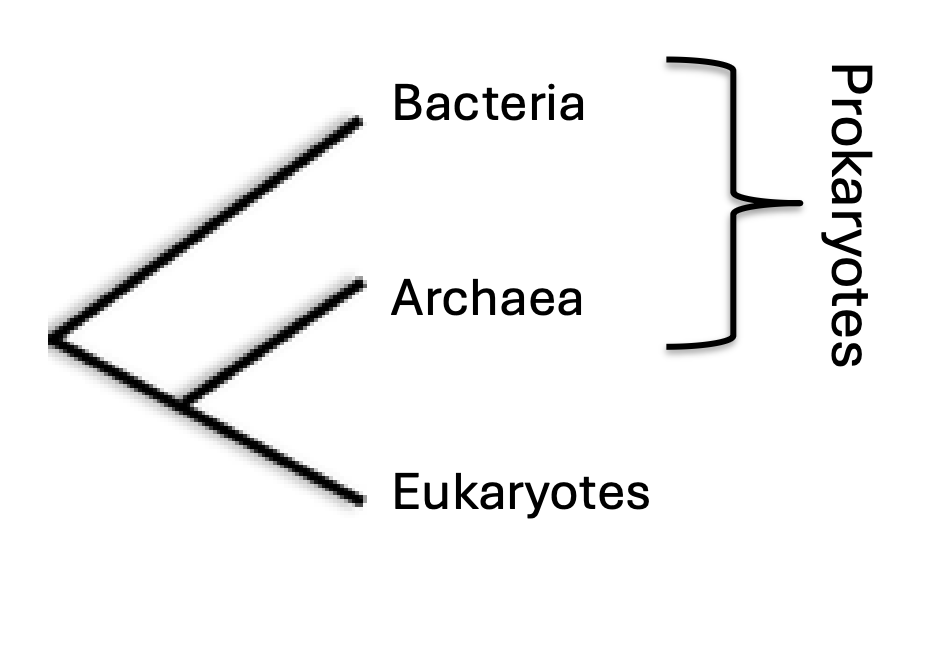
Prokaryotes vs Eukaryotes
Prokaryotes and eukaryotes
Plasma membrane
cytoplasm
DNA and RNA
Ribosomes
remember the hypothesis where they were free floating bacteria
Eukaryotes
Membrane bound organelles (structures inside eukaryotic cells that are surrounded by their own membrane.)
nucleus
Cytoskeleton
A highway system supports the structure of the cell and think about microtubles where dynein goes to the negative end and Kinesin goes to the positive side
actin Filament
one of the 3 main parts of the cytoskeleton
It is a thin protein filament made from actin subunits, and it helps with:
Cell shape and support
Cell movement
Muscle contraction with myosin
Cytokinesis during cell division
Moving vesicles or structures near the cell membrane
Myosin’s are the motor proteins for Actin, Myosin walks towards the + end of Actin
It uses energy from ATP to generate movement.
The main idea is:
Actin = track
Myosin = motor that walks along the track
Myosin is important for things like:
muscle contraction
cell movement
cytokinesis
moving cargo inside cells
In muscle, myosin pulls on actin filaments, which causes the muscle to contract.
So if kinesin and dynein move on microtubules, myosin moves on actin filaments.
Amoeba proteus
It is:
a eukaryote → it has a nucleus and membrane-bound organelles
usually found in freshwater
able to move using pseudopodia (“false feet”)
able to eat by phagocytosis (the cell engulfs a large particle or microorganism by wrapping its membrane around it and bringing it inside)
amoeba-like cell crawls using actin + myosin.
Actin pushes the front forward
At the front of the cell, actin proteins polymerize into actin filaments.
This pushes the membrane outward and forms a lamellipodium, which is a type of pseudopod.
The front attaches to the surface
The extended front makes focal contacts with the substratum.
These contacts use proteins like integrins to grip the surface.
Myosin pulls the back forward
Myosin II interacts with actin at the rear.
It contracts the actin network and pulls the back of the cell toward the front.
Then the cycle repeats.

Paramecium
A Paramecium is a single-celled eukaryotic protist. It has a nucleus and other membrane-bound organelles, and it moves using cilia.
The cilia are the tiny hair-like projections covering the outside surface of the Paramecium. They beat back and forth to:
move the cell through water
help sweep food toward the oral groove
cilia propels food into the oral groove
microtubule containing extensions that project from cells to move
cilia movement microtubules are bound to a base so they can’t move straight up so they just swing side to side
cilia is also in our respiratory system cilia sweep the mucus and particles up the airways and into the mouth


D
Summary of cell movement
Amoeboid movement (Amoeba proteus, immune
cells)
o Actin polymerization at leading edge
o Actin and myosin interactions
• Cilia (Paramecia, airway cells)
o Cilia are made of microtubules and dynein
o Cilia help paramecia move and to move particles into cell
o Cilia on cells in airways help move mucus
diffusion
random movement of molecules from high to low concentration
Small cells rely on diffusion to distribute molecules and organelles through the cytoplasm
Diffusion over long distances is slow
The rate of diffusion varies with the size of the molecule/object temperature, the viscosity of the medium and with distance
T=L²/D
T=time
L=length
D=Diffusion coefficient

Cytoplasmic streaming
The movement of cytoplasm inside a cell.
It helps move things like:
organelles
nutrients
vesicles
other cell materials
around the cell.
It is often driven by myosin motor proteins moving along actin filaments. Need ATP to make the track and to move along the track.
For example this can mix cytoplasm in large cells like Nitella(plant cell) where diffusion is too slow
steady state
cytoplasmic streaming can keep happening continuously while the cell stays in a “steady state.”
The main idea is that myosin uses ATP to move organelles along F-actin filaments:
Mitochondria make ATP
Myosin hydrolyzes ATP → ADP + Pi
That energy lets myosin move organelles along F-actin
At the same time, the actin cytoskeleton is constantly being remodeled: making of the track
G-actin = individual actin protein subunits
F-actin = polymerized actin filament
G-actin can polymerize into F-actin
F-actin can depolymerize back into G-actin
The important part is the box at the bottom:
Steady state does NOT mean nothing is happening. It means things are happening at equal rates.
So:
ATP is constant: use=production
and
F- actin filaments constant: polymerization=depolymerization
Therefore, the total amount of ATP and F-actin can stay roughly constant even though ATP is constantly being used and actin filaments are constantly being assembled and broken down.

Cytoplasmic streaming would decrease a lot or eventually stop.
Why:
Cytochalasin blocks actin polymerization
→ G-actin can’t efficiently build/maintain F-actin filaments
→ the actin “tracks” get disrupted
→ myosin has fewer tracks to move along
→ organelle movement and cytoplasmic streaming slow down or stop.
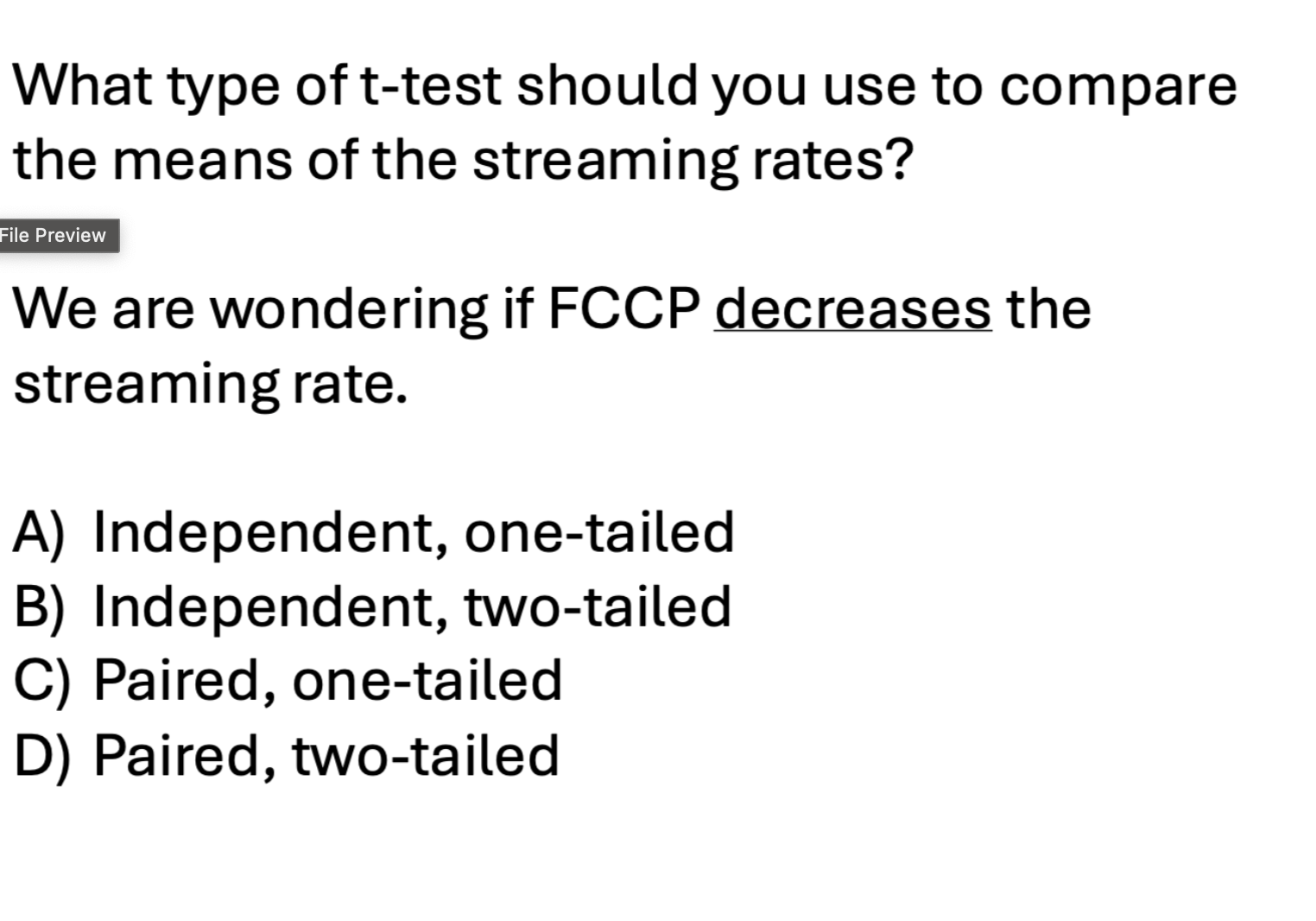
C or A the cell could die and you have to grab another 1
Control
A control is a condition in a science experiment that allows a scientist to isolate the effects of a manipulated variable. (orange juice has vitamin c)
A negative control is a condition that is treated the same as all other experimental samples but is not expected to produce a change/result. This helps demonstrate that any changes observed in the experiment are indeed due to the experimental variable/condition. (water has no vitamin C)
A positive control is a condition that is expected to produce a knownoutcome. This confirms the experiment can produce results under experimental conditions. (put vitamin c tablet in water has vitamin c)
Summary of organelle movements
• Diffusion fast over short distances (to 100 μm) but slow over long distances (mm)
• Cytoplasmic streaming in Nitella and Elodea
-Organelles + Myosin move on Actin filaments
- Rate of movement = ATP/time x step size/ATP
• Organelle movements in animal cells
-Dynein (to -end) and kinesin (to +end) on microtubules (tubulin)
Chloroplasts are the site of photosynthesis
The cell is around 60 microns and a individual chloroplast is very small

Light has Energy
Inverse relationship between wavelength and energy the longer the wavelength the lower the energy.
Chloroplast pigments collect energy from visible light. Pigments are just something that absorb lights. Reflects green light that’s why we see plants as green they do not absorb green light

How does a chlorophyll molecule work in isolation
the out going photon is weaker because some energy is loss by heat

Photosystem


RF value

What does DCMU do
Its a drug that blocks the electrons transport chain
The stream is going to slow down
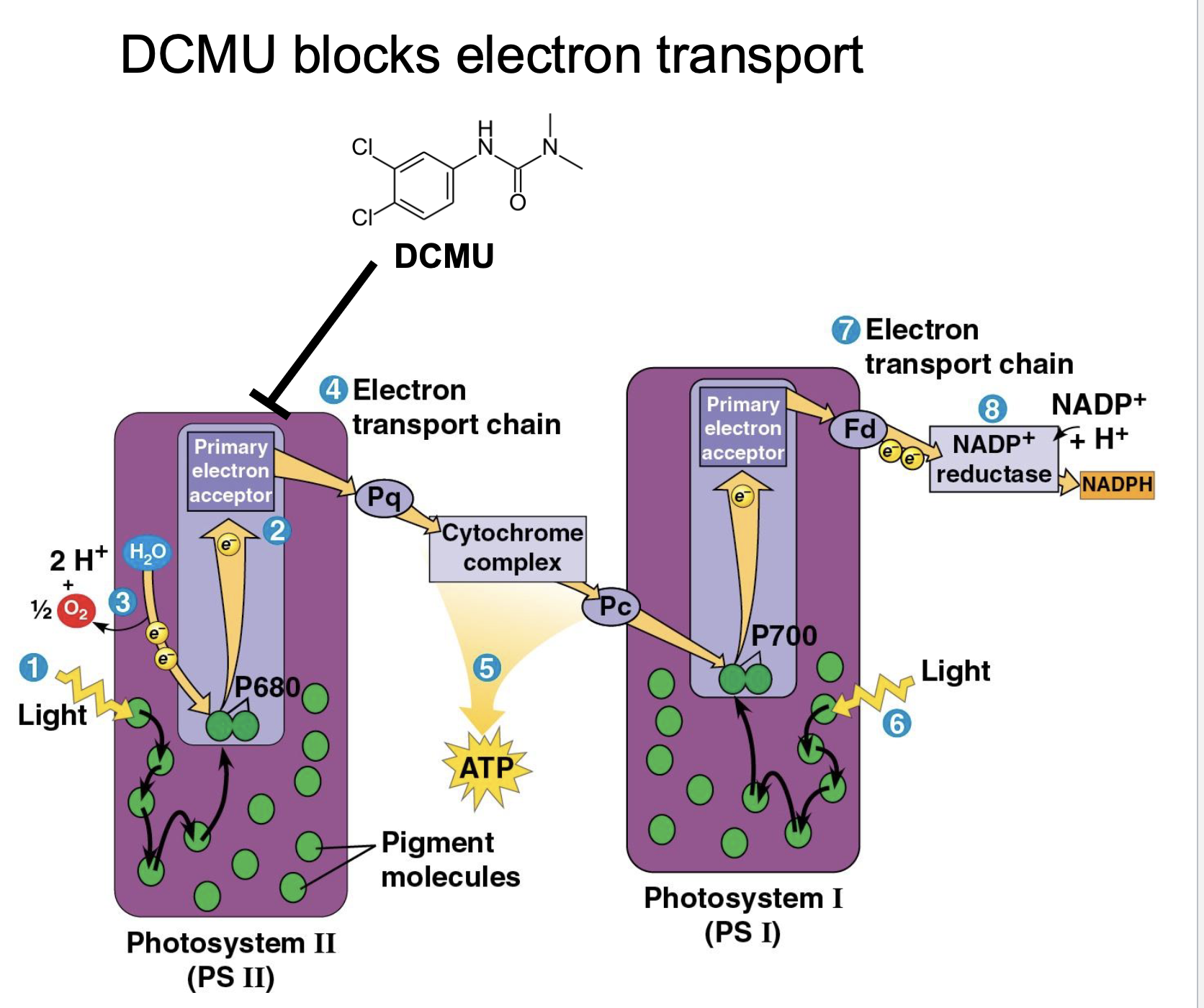
What does methylamine do to the electron transport chain
makes the electron transport chain move faster


A
What if it was ATP
It would decrease ATP because you need a concentration gradient to generate ATP

Light

it would slow down because you can't speed up a if DCMU blocks the electron transport chain

light 1-.1/0-1=-.8 =.8
dark 1-.6/0-1=.4
.8-.4=0.4
Defined vs. undefined
Defined medium means you know the exact chemical composition and amount of every ingredient.
Example:
5 g glucose
2 g NaCl
1 g NH₄Cl
You know exactly which molecules are present.
Undefined (complex) medium means at least one ingredient has an unknown/variable chemical composition.
Common giveaways:
yeast extract
tryptone
peptone
blood
meat extract
Defined = exact chemicals known
Undefined = mixture containing lots of unknown molecules
Enriched
Enriched medium has extra nutrients added to encourage microbial growth, especially organisms with more nutritional requirements.
Things such as:
yeast extract
tryptone
blood
vitamins
amino acids
Enriched = “give the bacteria lots of food.”
Selective
Selective medium makes it easier for certain organisms to grow while inhibiting or discouraging others.
For example, you might use:
high salt
antibiotics
unusual pH
particular nutrients
Selective = “Who is allowed to grow?”
Differential
A differential medium allows you to visually distinguish different organisms that grow.
Usually there's some kind of indicator that changes:
color
appearance
precipitate
colony characteristics
Differential = “How can I tell the bacteria apart?”