mse 220 chapter 14 and 15
 Call Kai
 Learn
 Practice Test
 Spaced Repetition
 Match
 Flashcards
 Knowt Play
1/38

There's no tags or description
Looks like no tags are added yet.
39 Terms
Polyethylene (PE)
Repeating unit: [−CH2−CH2−]n, Chemical formula: C2H4 , Molar mass: 28.05gmol−1
ThermoPlastic
Polypropylene (PP)
Repeating unit: [−CH2−CH(CH3)−]n, Chemical formula: C3H6, Molar mass: 42.08gmol−1
ThermoPlastic
Polyvinyl chloride (PVC)
Repeating unit: [−CH2−CH(Cl)−]n, Chemical formula: C2H3Cl, Molar mass: 62.49gmol−1
ThermoPlastic
Polystyrene (PS)
Repeating unit: [−CH2−CH(C6H5)−]n, Chemical formula: C8H8, Molar mass: 104.15gmol−1
thermoplastic
PTFE (Teflon)
Repeating unit: [−CF2−CF2−]n, Chemical formula: C2F4, Molar mass: 100.02gmol−1
thermoplastic
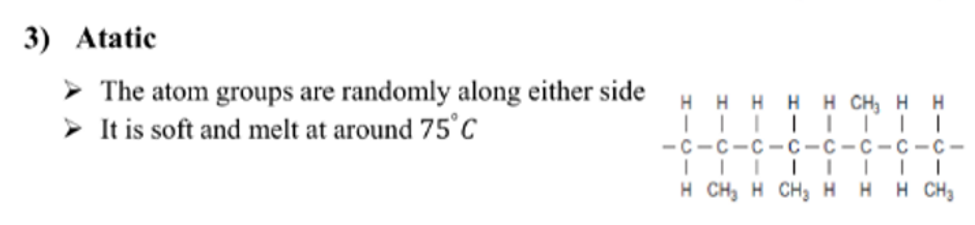
Isotactic


Syndiotactic


atatic

Polymers and linking

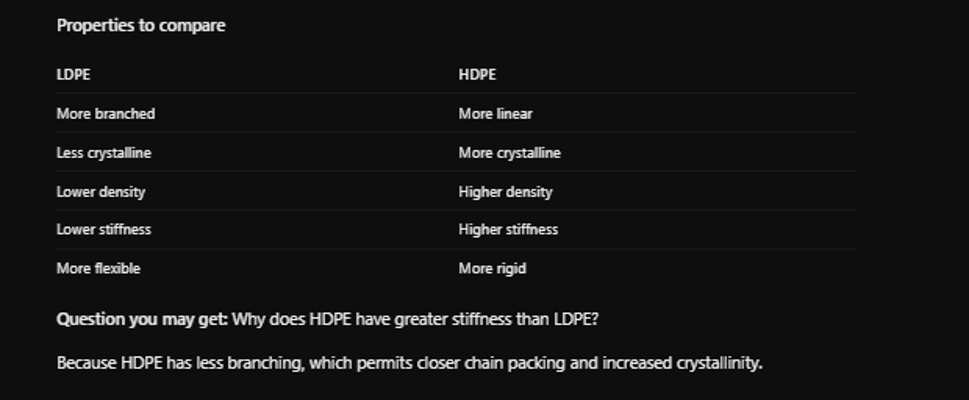
LDPE (low-density polyethylene) and HDPE (high-density polyethylene
Polymer Structure

Crystaline properteis

what increases crystallinity

Types of Polymers
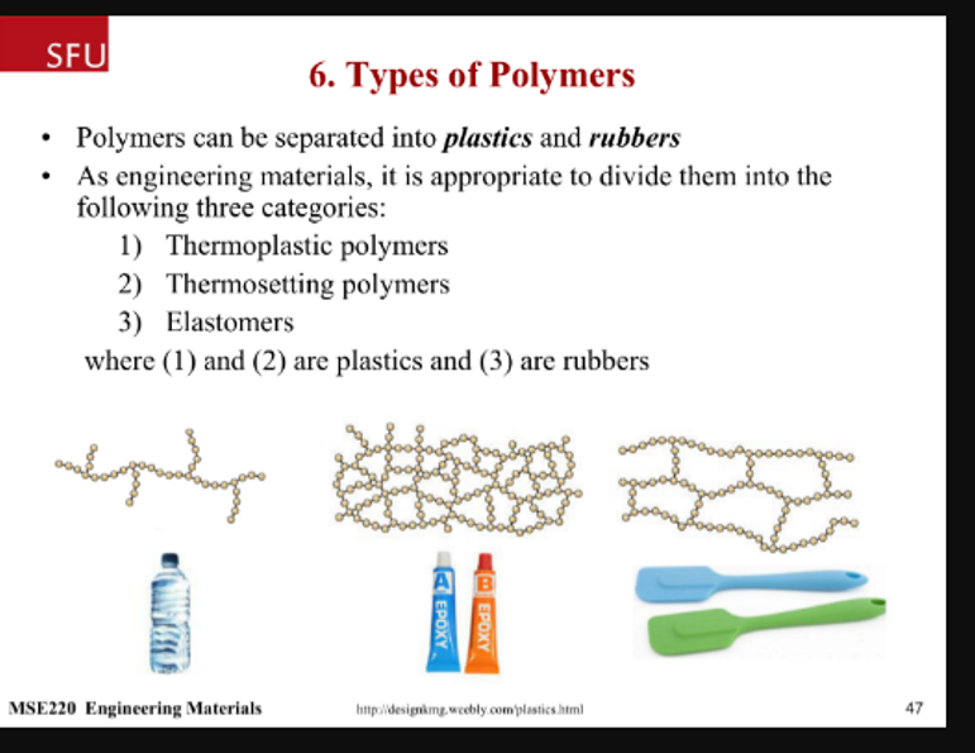
ThermoPlastics

ThermoSet

Elastomers

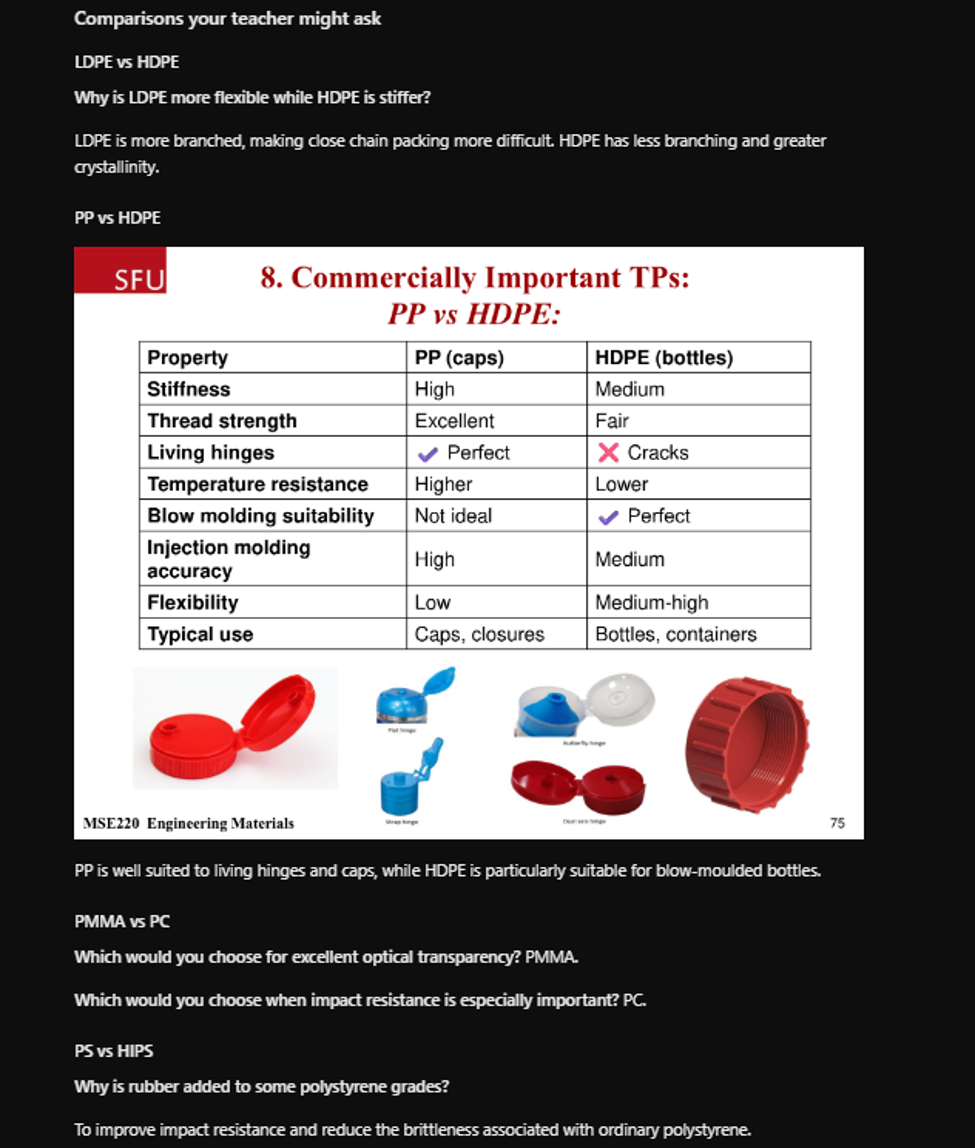
PP vs HDPE
What happens when you heat Polymers
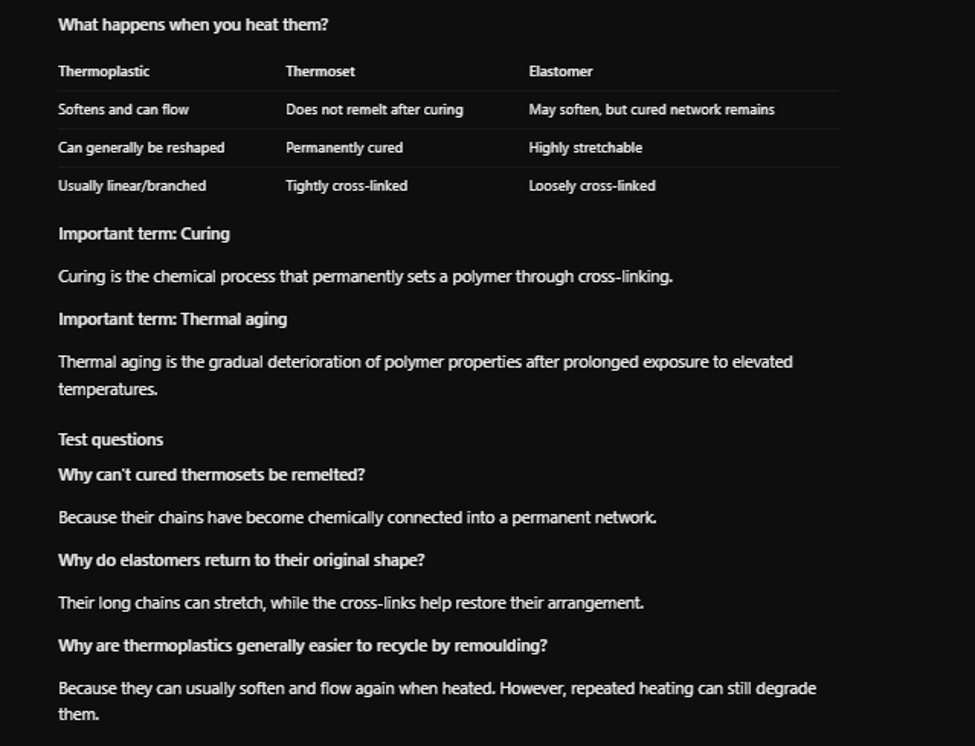
Curing
A chemical process that permanently sets a polymer through the formation of covalent cross-links.
Thermal aging
The gradual deterioration of physical and mechanical polymer properties resulting from prolonged exposure to elevated temperatures.
Stiffness
A material's resistance to elastic deformation, where a higher elastic modulus (E) produces less stretching or bending under an applied load.
Strength
The capacity of a material to withstand mechanical stress before yielding, failing, or rupturing.
Ductility
The measure of a material's ability to undergo significant plastic deformation prior to fracture.
Toughness
The capacity of a material to absorb mechanical energy and deform plastically before fracturing.
Viscoelasticity
Mechanical behavior exhibiting both viscous and elastic characteristics, causing deformation to depend on both applied load and loading duration.
Thermal conductivity
The intrinsic ability and rate at which a material conducts and transfers heat through its structure.
Thermal expansion
The fractional change in dimensions or volume of a material resulting from changes in temperature.
Reason HDPE is stiffer than LDPE
HDPE has minimal chain branching, allowing chains to pack closely into high-crystallinity regions, whereas LDPE contains extensive branching that prevents close packing.
Cooling rate effect on polymer crystallization
A slowly cooled molten sample is far more likely to crystallize because polymer chains have sufficient thermal mobility and time to organize into an ordered lattice.
Cause of opacity in partially crystalline polymers
Crystalline regions (crystallites and spherulites) have a different refractive index than amorphous regions, which scatters incident light.
Stiffness comparison: HDPE vs. LDPE
HDPE is significantly stiffer due to its higher crystallinity and tighter chain packing.
Reason cured thermosets cannot be remelted
Their polymer chains are permanently joined into a continuous, covalently cross-linked 3D network that degrades and chars upon heating rather than melting.
Mechanism of elastic recovery in elastomers
Coiled, flexible polymer chains uncoil under applied tensile stress, while cross-links prevent permanent chain slippage and pull the network back to its original shape upon release.
Reason thermoplastics can be recycled by remolding
Their chains are held together by secondary intermolecular forces rather than permanent cross-links, enabling them to reversibly soften and flow when heated.
Reason polymers are commonly utilized as electrical insulation
Their valence electrons are tightly bound in covalent bonds, giving them extremely high electrical resistivity and negligible free charge carriers.
Reason polymers are favored for lightweight applications
They are composed of light elements (C, H, O, N) with relatively open chain arrangements, giving them much lower densities than metals and ceramics.
Cause of long-term polymer deformation under constant load
Polymers exhibit viscoelastic behavior, leading to time-dependent molecular rearrangement and plastic deformation known as creep.
Reason polymers are often unsuitable for high-temperature machine components
Elevated temperatures cause polymers to exceed their glass transition (Tg) or melting (Tm) points, leading to thermal softening, severe loss of strength, or thermal oxidation.