Unit 8: Work Motivation
 Call Kai
 Learn
 Practice Test
 Spaced Repetition
 Match
 Flashcards
 Knowt Play
1/33

Earn XP
Description and Tags
Exam 3 Material
34 Terms
Organization psychology focuses on …
the social and psychological context of the workplace
what people experience at work, and how those experiences change job attitudes and behaviors
motivation, job attitudes, occupational health, leadership
“___ has become the top issue on the minds of business leaders, directing us to an entirely new model of management” - Bersin by Deloitte
Employee engagement
What is “work motivation”?
“Set of energetic forces (that originate both within as well as beyond an individual’s being) to initiate work-related behavior”
3 components of motivation: direction, intensity, & persistence
What are the 3 components of motivation?
direction
intensity
persistence
Work motivation is a force that drives people to behave in a way that:
Energizes - results in expenditure of effort
Directs - channels effort or behavior toward an object or place, with direction or purpose
Sustains - maintains effort over time
intrinsic vs extrinsic motivation
Intrinsic motivation - inherent enjoyment derived from a task (Gerhart & Fang, 2017)
Extrinsic motivation - performance of an activity to attain a separable outcome (Ryan & Deci, 2000)
REMEMBER: Motivation is not synonymous with ___
performance
motivation is one the many antecedents of performance
Performance = …
motivation x ability x environment
Work motivation is an area of I-O dominated by theories, such as…
expectancy theory
self-regulation theory
Maslow’s hierarchy of needs
goal-setting theory
work design (aka “job design”) theory
equity theory
Vroom’s expectancy theory
Motivational force = E x I x V
Expectancy: effort → performance
“If I try hard, my performance will improve”
Instrumentality: performance → reward
“If I achieve this goal, I will be rewarded”
Valence: reward = thumbs up
“I value the reward associated with achieving this goal”

Explain the following from Vroom’s expectancy theory: “Should I be motivated to study for Exam #1?”
If you perceive no expectancy, instrumentality, or positive valence, then you have no motivation to engage in the behavior in question

What are some strengths and weaknesses of expectancy theory?
Strengths:
Very testable
Concrete recommendations for organizations to motivate employees
Weaknesses:
May be overly rational
Findings are not always stable across individuals
Predicts better for more rational decision makers
Equity theory (Adams, 1965)
Motivation compares one’s inputs and outcomes with another person’s to determine fairness

Inequity motivates action to restore fairness - If you are under-rewarded, or your ratios are lower than someone else’s you may:
Reduce inputs (slacking off)
Leave the situation (quit)
Change the person you compare yourself to
Increase outcomes (ask for a raise, steal from the organization)
Change your perception of the situation
What are some strengths and weaknesses of equity theory?
Strengths
People regularly evaluate rewards against contributions and others’ contribution/reward rations
Explains varied motivated responses to inequity
Introduces workplace justice, an important organizational psychology theme
Weaknesses
Subjective “equity sensitivity”
Predicts motivation to do “something,” not precisely which behavior
Does not explain why inequity is so distressing that people change work circumstances
Maslow’s hierarchy of needs (1943)
Humans satisfy basic needs first - once lower-level needs are satisfied, they no longer serve as motivators
Needs include: physiological, safety, belongingness and love, esteem, and self-actualization

How could you use equity theory to motivate workers?
Physiological needs: vending machines, cafeterias
Safety needs: wages, salaries, good working conditions
Belongingness and love needs: creating team spirit, doing outside activities
Esteem needs: give rewards and recognize performance
Self-actualization: encourage creativity, provide challenges
What are some strengths and weaknesses of Maslow’s hierarchy of needs theory?
Strengths
Varied needs motivate work behavior
People need their needs met to be healthy and well-adjusted
Weaknesses
Assumes orderly movement through levels and no agency over goals
Higher-level needs are self-focused (individualized)
Goal-setting theory (Locke and Latham, 2009)
Directing effort toward specific goals - goals underpin and direct behavior
Most effective when employees accept and commit to goals, goals are SMART, and feedback about progress is provided
SMART goals are …
specific, measurable, attainable, relevant, & time based
Goals direct effort toward desirable outcomes, but can produce unintended consequences when they are:
Too narrow: focus on measured work and ignore the rest
Excessively emphasized: prioritize attainment over ethics
Too difficult: cut corners or reduce self-efficacy
High-pressure rewards/punishments: do “whatever it takes”
Not balanced with quality, learning, collaboration, or customer outcomes
Describe the example of Wells Fargo taking goals too far
Pressure to sell multiple products per customer - checking accounts, credit cards, other financial services
Intense sales-target pressure
Accounts/products opened without consent
Customer fees and credit consequences
Products sold displaces customer needs
“Eight is great” focus
Result: “Wells Fargo agrees to pay $3 billion to resolve criminal and civil investigations into sales practices involving the opening of millions of accounts without customer authorization”
Motivation is maximized when employees are committed to __, __, yet __ goals
specific, difficult
attainable

What are some strengths and weaknesses of goal-setting theory?
Strengths
Elegant and simple
Practical, easy to apply
Directs action and attention
Weaknesses
SMART goals are difficult in complex jobs
People have multiple goals
Overly hard goals can lower self-efficacy
Competition and tunnel vision
Self-regulation theory
A family of theories about motivation
People consciously set goals that guide and direct behavior toward attainment
People self-monitor progress, seeking feedback on how “on target” they are
Accurate feedback enhances likelihood of goal attainment
When the current status differs from the desired status, people adjust: revise the goal or change their behavior

What does the following diagram demonstrate?
Self-regulation theory
What are some strengths and weaknesses of self-regulation theory?
Strengths
Integrates strong aspects of other theories
Accounts for motivation over time (persistence)
Weaknesses
Not one theory - hard to define and test
Not all work offers adequate feedback
Some individuals self-regulate better than others
Job design theory
Aka “work design theory” (Hackman & Oldman, 1976)
Job characteristics foster effort - the way a job is designed has a major impact on motivation
Is concerned with job enrichment
job enrichment
designing work to enhance individual motivation to perform it
What aspects of the job itself motivates you to work hard?
Job characteristics: that induce motivation
Skill variety: number of differ activities, skills, and talents required
Task identity: completing the whole process from beginning to end
Task significance: impact on other people’s lives or work
Autonomy: freedom, independence, and choice on the job
Job feedback: direct, clear information about performance effectiveness from job activities
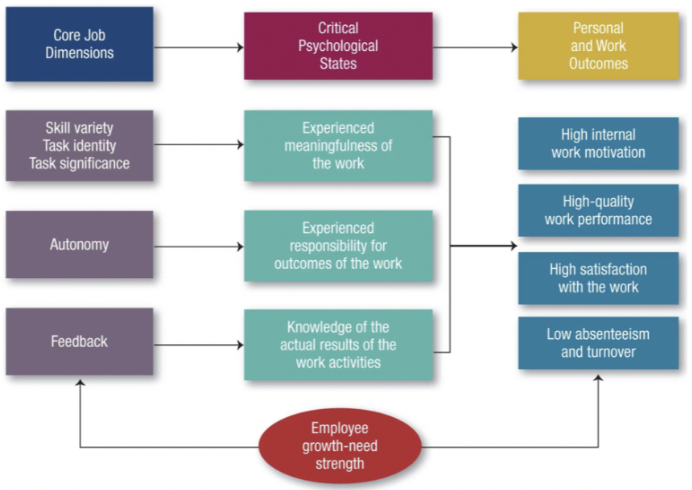
What does this diagram demonstrate?
Job characteristics model
What are some strengths and weaknesses of job design theory?
Strengths
Focuses on aspects of motivation organizations can more easily influence
Weaknesses
More responsibility generally brings expectations of higher pay
Not all jobs can be redesigned to enhance motivation
There are many more theories of work motivation - If all these theories about motivation are different, can they all be right?
Each focuses on different aspects of the motivation process
Each has limited applicability and explanatory power
Many theories address different facets of ___ some employees work harder than others
why