Glycogenesis, glycolysis and gluconeogenesis
 Call Kai
 Learn
 Practice Test
 Spaced Repetition
 Match
 Flashcards
 Knowt Play
1/64

There's no tags or description
Looks like no tags are added yet.
65 Terms
What is glycogen?
Storage form of glucose in animals.
Highly branched polysaccharide.
Primarily stored in the liver and skeletal muscles.
Contains approximately 10,000–60,000 glucose residues per particle.
What are the four major pathways of glucose metabolism?
Pathway | Function |
|---|---|
Glycogenesis | Synthesize glycogen |
Glycogenolysis | Break down glycogen |
Glycolysis | Break down glucose to produce ATP |
Gluconeogenesis | Produce new glucose |

Glycogenesis
Synthesize glycogen from glucose
Glyco- Glycogen
genesis- build/synthesize
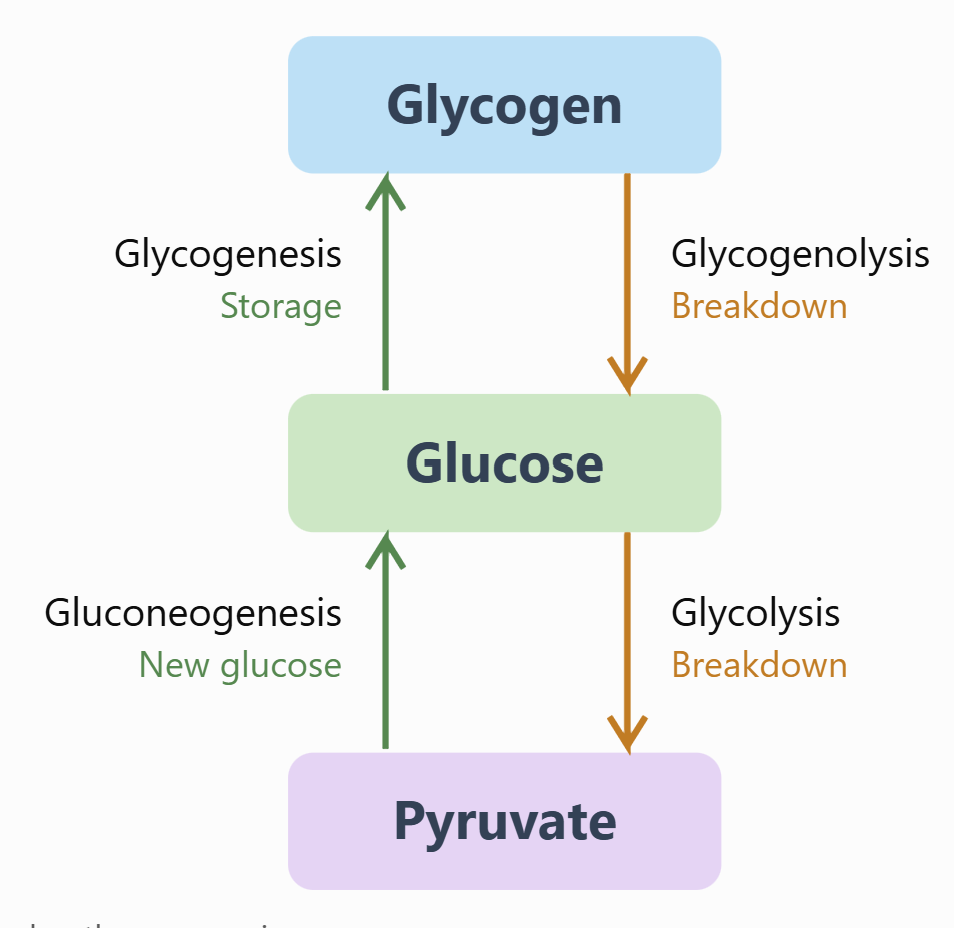
Glycogenolysis
The process of breaking down glycogen → glucose
glyco- (sugar)
gen- (origin/producer)
ly- (breaking down) + -sis (process/state)

Glycolysis***
Glyco- break down glucose → Pyruvate (4 ATP)
Lysis- break

Gluconeogenesis
Produce new glucose
gluco-from glucose
neo-new
geneis-production/ create
What is the difference between liver and muscle glycogen?
Liver glycogen | Muscle glycogen |
|---|---|
Maintains blood glucose | Provides local energy |
Important during fasting | Important during exercise |
Can release free glucose | Used primarily for glycolysis |
Glycogen Structure
What types of glycosidic bonds are found in glycogen?
α(1→4): Linear chains.
α(1→6): Branch points.

Glycogen Structure
Why is glycogen highly branched?
Creates many non-reducing ends.
Multiple enzymes can work simultaneously.
Allows rapid glucose storage and release.
Glycogen Structure
What is glycogenin?
Protein at the center of glycogen.
Initiates glycogen synthesis.
Attaches initial glucose residues to a tyrosine residue.
Glycogen Structure
At which ends does glycogen synthesis and breakdown occur?
Non-reducing ends.
Glycogen has many non-reducing ends.
Allows rapid metabolism.
Glycogen Structure:
How to identify reducing end
C1–OH = Free = Reducing end.
right side
free anomeric carbon thar can open up
look for the O-O bond and see if its free or not
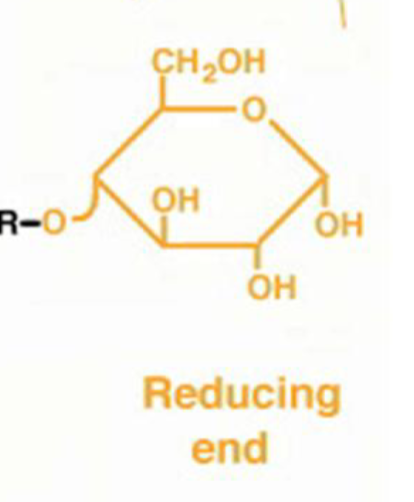
Glycogen Structure
How to identify non-reducing end
C1–O–R = Locked = Non-reducing end.
LEFT
USE FOR SYTHESIS AND BREAKDOWN OF GLYCOGEN

Glycogenesis — Glycogen Synthesis
What is glycogenesis?
Synthesis of glycogen from glucose.
Anabolic pathway.
Stimulated by insulin.
Requires energy.
Glycogenesis — Glycogen Synthesis
What enzyme synthesizes glycogen?
Glycogen synthase.
Adds glucose residues to glycogen.
Uses UDP-glucose as the glucose donor.
Glycogenesis — Glycogen Synthesis
What is the sequence of glycogen synthesis?

Glycogenesis — Glycogen Synthesis
What is UDP-glucose?
Activated form of glucose.
Direct glucose donor for glycogen synthesis.
Produced using glucose-1-phosphate and UTP.
Glycogenesis — Glycogen Synthesis
What enzyme produces UDP-glucose?

Glycogenesis — Glycogen Synthesis
What does inorganic pyrophosphatase do?
Hydrolyzes pyrophosphate (PPᵢ).
Produces two inorganic phosphates.
Drives UDP-glucose formation forward.

Glycogenesis — Glycogen Synthesis
Why is UDP-glucose used instead of glucose-1-phosphate?
Glucose donor | ΔG° | Favorability |
|---|---|---|
Glucose-1-phosphate | +7.4 | Unfavorable |
UDP-glucose | −3.2 | Favorable |
UDP-glucose makes glycogen synthesis energetically favorable.
Negative ΔG° indicates a favorable reaction under standard conditions.
Glycogenolysis — Glycogen Breakdown
What is glycogenolysis?
Breakdown of stored glycogen.
Catabolic pathway.
Releases primarily glucose-1-phosphate.(G1P)
Important during fasting and exercise
Glycogenolysis
What enzyme breaks down glycogen?
Glycogen phosphorylase.
Removes glucose residues from non-reducing ends.
Uses inorganic phosphate (Pᵢ).
Glycogenolysis
What is the glycogen phosphorylase reaction?
Uses inorganic phosphate.
Does not directly require ATP.
Produces G1P not G16.***

Glycogenolysis:
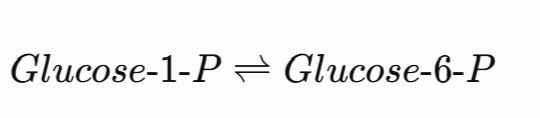
What happens to glucose-1-phosphate after glycogenolysis?
Converted into glucose-6-phosphate.
Enzyme: phosphoglucomutase.
Glycogenolysis
What happens to glucose-6-phosphate in the liver versus muscle?
muscle→ glycolysis → produce ATP
liver → free glucose → released in2 bloodstream

Glycogenolysis
Glycogenolysis pathway

Glycogenolysis
What is the difference between glycogenesis and glycogenolysis?
Feature | Glycogenesis | Glycogenolysis |
|---|---|---|
Function | Storage | Breakdown |
Enzyme | Glycogen synthase | Glycogen phosphorylase |
Important molecule | UDP-glucose | Inorganic phosphate |
Metabolism | Anabolic | Catabolic |
Hormone | Insulin | Glucagon in liver*** |
Regulation of Glycogen Metabolism
What is the difference between a kinase and a phosphatase?
Kinase: Adds phosphate.
Phosphatase: Removes phosphate.
Phosphorylation can activate or inhibit enzymes.
Regulation of Glycogen Metabolism:
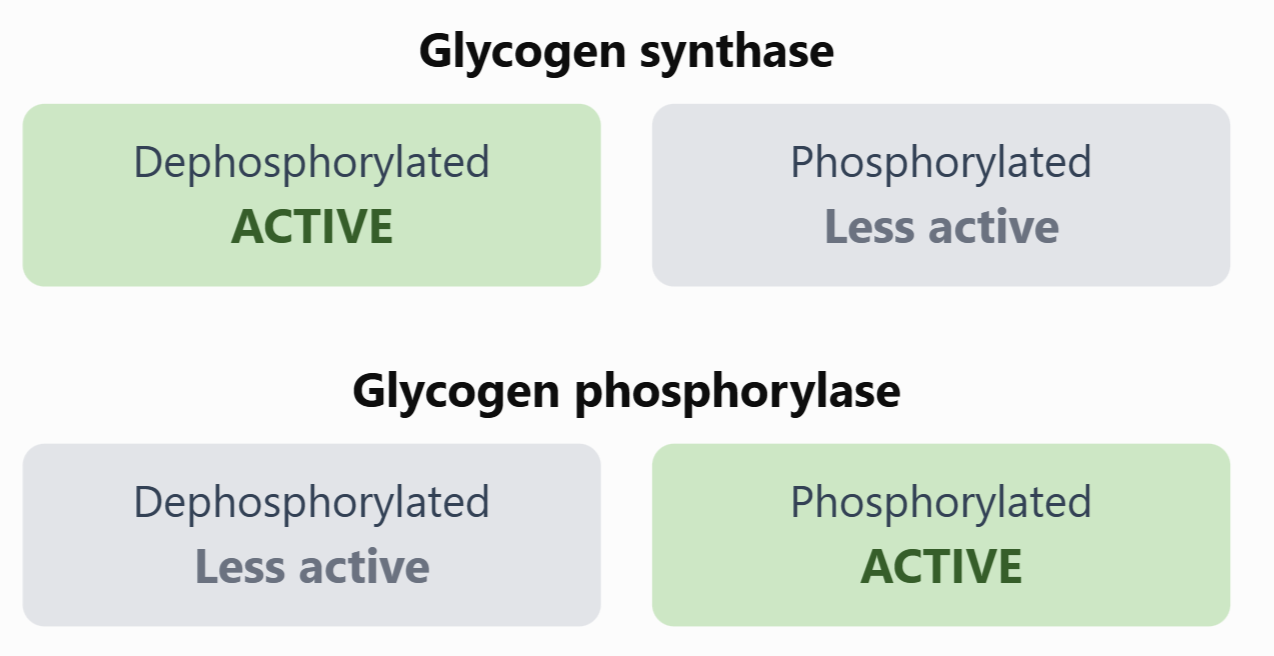
When is glycogen synthase active?
Dephosphorylated form.
Glycogen synthase a. (Form a = active form.)
Promotes glycogen synthesis.
synthase = for synthesis

Regulation of Glycogen Metabolism
When is glycogen phosphorylase active?
Phosphorylated form.
Glycogen phosphorylase a. (Form a = active form.)
Promotes glycogen breakdown.
Regulation of Glycogen Metabolism
How does insulin affect glycogen metabolism?
Released when blood glucose increases.
Activates glycogen synthesis.
Inhibits glycogen breakdown.
Promotes glucose storage.
Regulation of Glycogen Metabolism:
How does glucagon affect liver glycogen metabolism?
Released when blood glucose decreases.
Promotes glycogen breakdown.
Inhibits glycogen synthesis.
Helps increase blood glucose.
Regulation of Glycogen Metabolism:
What is the difference between glycogen and glucagon?
Glycogen: Storage polysaccharide.
Glucagon: Hormone regulating blood glucose.
Gluconeogenesis
What is gluconeogenesis?
Production of new glucose.
Anabolic pathway.
Requires energy.
Occurs primarily in the liver.
Gluconeogenesis
What are the major starting molecules for gluconeogenesis?
Pyruvate.
Lactate.
Oxaloacetate.

Gluconeogenesis
When does gluconeogenesis become particularly important?
Prolonged fasting.
Starvation.
During or following exercise.
When glycogen stores become depleted.
Gluconeogenesis
How many pyruvate molecules are needed to produce one glucose?
Two pyruvate molecules.
Each pyruvate contains three carbons.
Glucose contains six carbon
2(3C) pyruvate → 6(C) glucose
Gluconeogenesis:
Why is gluconeogenesis not simply reversed glycolysis?
Seven glycolysis reactions are readily reversible.
Three reactions are essentially irreversible.
Requires four alternative enzymes.
Gluconeogenesis:
Which glycolysis steps are irreversible?
Step | Enzyme |
|---|---|
1 | Hexokinase |
3 | Phosphofructokinase-1 |
10 | Pyruvate kinase |
Memory trick: 1, 3, 10 — three steps you cannot simply reverse.
HPP
Gluconeogenesis Bypass Reactions
What four enzymes are unique to the gluconeogenesis bypasses?
Glycolysis step | Gluconeogenesis enzyme |
|---|---|
10 | Pyruvate carboxylase |
10 | PEP carboxykinase |
3 | Fructose-1,6-bisphosphatase |
1 | Glucose-6-phosphatase |
10-10-3-1
PP-F-G
Gluconeogenesis Bypass Reactions
How is glycolysis step 10 bypassed?
Pyruvate → Oxaloacetate → PEP.
Requires two enzymes. (pyruvate carboxylase and PEP carboxykinase)
Uses ATP and GTP.
Gluconeogenesis Bypass Reactions:
What does pyruvate carboxylase do?
Pyruvate → Oxaloacetate.
Uses ATP.
Adds CO₂.
Requires biotin.
Occurs in mitochondria.
Gluconeogenesis Bypass Reactions
What does PEP carboxykinase (PEPCK) do?
Oxaloacetate → PEP.
Uses GTP.
Releases CO₂.
Gluconeogenesis Bypass Reactions
How does the carbon count change during the step 10 bypass?
Molecule | Carbon count |
|---|---|
Pyruvate | 3 |
Oxaloacetate | 4 |
PEP | 3 |
CO₂ is added, then removed.
No net carbon gain.
Gluconeogenesis Bypass Reactions
Which enzyme bypasses glycolysis step 3?
Fructose-1,6-bisphosphatase.
Removes phosphate from fructose-1,6-bisphosphate.
Produces fructose-6-phosphate.
-removed via hydrolysis

Gluconeogenesis Bypass Reactions
Which enzyme bypasses glycolysis step 1?
Glucose-6-phosphatase.
Removes phosphate from glucose-6-phosphate.
Produces free glucose.

Gluconeogenesis Bypass Reactions:
Why can't skeletal muscle release significant free glucose into the bloodstream
Lacks (G6P) activity.
Uses (G6P) for glycolysis.
Glycogen primarily supplies its own energy needs.
Gluconeogenesis Bypass Reactions:
Do phosphatases produce ATP when removing phosphate?
No.
Use water to hydrolyze phosphate groups.
Release inorganic phosphate (Pᵢ).
Regulation of Glycolysis and Gluconeogenesis
What is reciprocal regulation?
One pathway is activated while the opposing pathway is inhibited.
Prevents unnecessary energy consumption.
Glycolysis and gluconeogenesis are reciprocally regulated.
Regulation of Glycolysis and Gluconeogenesis
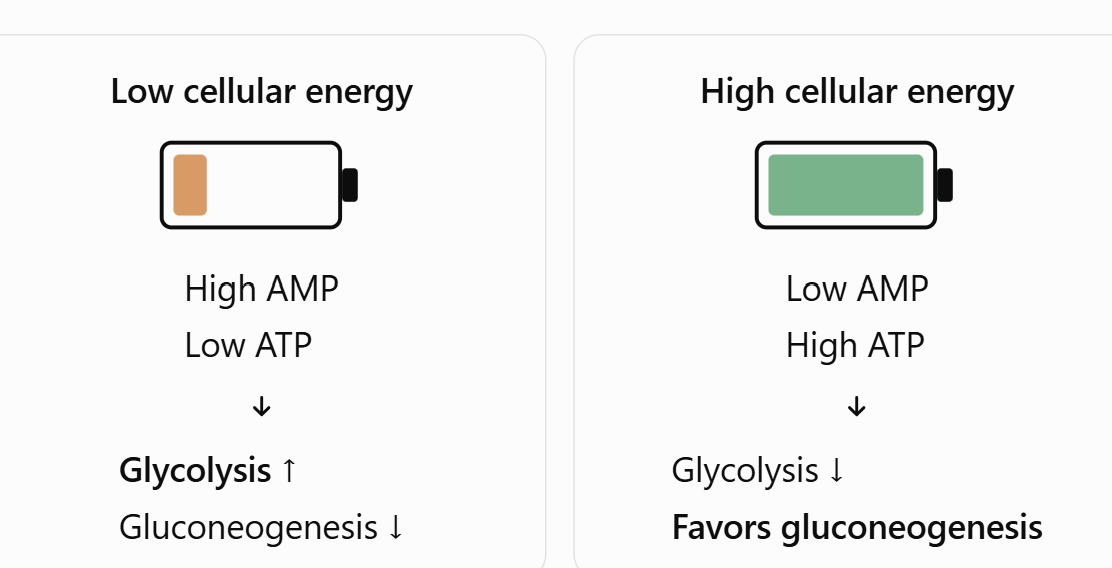
What does high AMP indicate?
Low cellular energy.
Low ATP availability.
Glycolysis is favored.
Regulation of Glycolysis and Gluconeogenesis
How does high AMP affect PFK-1 and fructose-1,6-bisphosphatase?
Activates PFK-1.
Inhibits fructose-1,6-bisphosphatase.
Promotes glycolysis.
AMP = ATP Missing, Please make more.
Regulation of Glycolysis and Gluconeogenesis
How do ATP and citrate affect PFK-1?
High ATP inhibits PFK-1.
High citrate inhibits PFK-1.
Slows glycolysis when sufficient energy is available.
Regulation of Glycolysis and Gluconeogenesis:
What type of regulation involves AMP, ATP and citrate binding to regulatory sites?
Allosteric regulation.
Binding occurs away from the active site.
Changes enzyme activity.
Regulation of Glycolysis and Gluconeogenesis:
How do insulin and glucagon regulate liver glucose metabolism?
Pathway | Insulin | Glucagon |
|---|---|---|
Glycogenesis | ↑ | ↓ |
Glycogenolysis | ↓ | ↑ |
Glycolysis | ↑ | ↓ |
Gluconeogenesis | ↓ | ↑ |
insulin favor Glycogenesis, (glucose→ glycogen) Glycolysis (glucose → pyruvate) (less glucose and more glucagon + engery)
Glucagon favor Glycogenolysis (glycogen → glucose) Gluconeogenesis (pyruvate → glucose) more glucose
Energy Requirements of Gluconeogenesis
How much energy is required to produce one glucose from two pyruvate?
Six ATP/GTP molecules directly consumed.
Two NADH consumed.
4-2-2

Energy Requirements of Gluconeogenesis
Which gluconeogenesis reactions consume energy?
Enzyme | Energy consumed per glucose |
|---|---|
Pyruvate carboxylase | 2 ATP |
PEP carboxykinase | 2 GTP |
Phosphoglycerate kinase | 2 ATP |
G3P dehydrogenase | 2 NADH |
Energy Requirements of Gluconeogenesis:
How much energy is required to produce three glucose molecules from pyruvate?
6 pyruvate.
12 ATP.
6 GTP.
6 NADH.
Energy Requirements of Gluconeogenesis
What are the ATP-equivalent values
Electron carrier | ATP equivalents |
|---|---|
NADH | 3 ATP |
FADH₂ | 2 ATP |
Energy Requirements of Gluconeogenesis
What is the total ATP-equivalent cost of gluconeogenesis from pyruvate, including NADH?
Feature | Glycolysis | Gluconeogenesis |
|---|---|---|
Starting material | Glucose | 2 pyruvate |
Product | 2 pyruvate | Glucose |
ATP/GTP | Produces 2 ATP net | Consumes 6 equivalents |
NADH | Produces 2 | Consumes 2 |
Metabolism | Catabolic | Anabolic |
The Cori Cycle
What is the Cori cycle?
Metabolic cycle between liver and muscle.
Recycles lactate into glucose.
Important during intense exercise.

The Cori Cycle
What happens in the muscle during the Cori cycle?
Glucose → Pyruvate → Lactate.
Produces ATP through glycolysis.
Lactate enters the bloodstream.
The Cori Cycle
What happens in the liver during the Cori cycle?
Lactate → Pyruvate → Glucose.
Uses gluconeogenesis.
Glucose returns to muscles through blood.
The Cori Cycle
What enzyme converts lactate into pyruvate?
Lactate dehydrogenase.
Catalyzes a reversible redox reaction.

The Cori Cycle
Why is the Cori cycle important?
Recycles lactate.
Maintains glucose availability.
Supports continued glycolysis during intense exercise.
Transfers the energetic burden of making glucose to the liver.
The Cori Cycle
What is the net energy cost of the Cori cycle?
Muscle produces 2 ATP.
Liver consumes 6 ATP/GTP equivalents.
Net cost: 4 ATP equivalents.