Test 3 Ecology and Evolution
 Call Kai
 Learn
 Practice Test
 Spaced Repetition
 Match
 Flashcards
 Knowt Play
1/84

There's no tags or description
Looks like no tags are added yet.
Name | Mastery | Learn | Test | Matching | Spaced | Call with Kai | Chat |
|---|
No analytics yet
Send a link to your students to track their progress
85 Terms
Greek, Roman, Chinese, and Middle Eastern Philosophers
Discussed ideas about life and the natural world before Darwin
Essentialism
Species were believed to be unchanging over time
Catastrophism
Earth and life were shaped by catastrophic events.
Carl Linnaeus
Developed taxonomy, the classification of organisms (Kingdom, Phylum, Class, Order, Genus, Species) (1707-1778)
James Hutton
Proposed that Earth changes gradually over long periods and is very old. He was against catastrophism (1726-1797) (Geologist)
Thomas Malthus
Suggested that much human suffering was due to population growth beyond capacity to be supported- more offspring produced than could survive (1776-1834) (Economist)
Jean-Baptiste Lamarck
One generation prior to Darwin. Proposed life evolves as environment changes. Mechanism: use and disuse, inheritance of required characters (1744-1829)
Georges Cuvier
Founded paleontology and supported catastrophism (1769-1832)
Charles Lyell
Built on Hutton's ideas, arguing that geological processes occurring today also operated in the past. Geologist. Born the year Hutton died. Felt the earth must be old. (1797-1875)
Alfred Russel Wallace
Independently developed an idea of evolution by natural selection similar to Darwin's.
Darwins Voyage on the HMS beagle
Darwin was about 22 when he began his voyage aboard the HMS Beagle.
The voyage lasted approximately five years.
He traveled around the world, including along the coast of South America.
He returned in 1836 and developed his evolutionary theory over the following years.
His observations of organisms, fossils, and differences between environments helped him develop his ideas.
Darwin did not invent the idea that evolution occurs. His major contribution was proposing natural selection as a mechanism that explains how evolutionary change happens.
How other peoples ideas influenced Darwin
Three especially important influences were:
Hutton and Lyell: Earth is very old and changes gradually. This suggested that there was enough time for major changes in living things to occur.
Malthus: Populations produce more offspring than can survive because resources are limited. This helped Darwin recognize competition and differences in reproductive success.
Wallace: Independently developed natural selection, helping establish the significance of this mechanism.
Lamarck and other earlier thinkers also contributed to the broader discussion of whether species change over time.
After Darwin came back
Hutton- 1st to propose (write down) differential survival (natural selection) as a mechanism of evolution but never published it
Lamarck and Lyell also described selection (1818,1831)
1859 Darwin published Origin of Species
- He gathered evidence supporting evolution as fact
- He proposed a mechanism by natural selection
Alfred Wallace
5 people independently came up with natural selection, because evidence was being gathered
Darwin Observations Number 1
Unity of Life
Organisms share some things in common. For example, different animals have similar underlying anatomical structures (two ears, parts of flowers)
Explanation: Species descend from common ancestors
Darwin Observation Number 2
Diversity of Life
Organisms differ in their characteristics, even when they are related (human ears dont look exactly like dog ears)
Explanation: Common ancestry and diversification explain differences among species
Darwin Observation Number 3
Organisms match their environments
Organisms often have traits suited to their surroundings
Explanation: Natural selection produces adaptation over generations
Darwins Two Conclusions From Observations
1. Common ancestry: Species descend from common ancestors. This explains the unity and much of the diversity of life. (widely accepted after 1859)
2. Natural selection: Natural selection drives diversification and adaptation. This helps explain diversity of life and why organisms match their environments. (not widely accepted till 1930s)
Why was natural selection eventually accepted
Scientific understanding of genetics developed over time:
1900: Mendel's work on inheritance was rediscovered. This helped explain how traits are passed from parents to offspring.
1910s: Mutations became better understood as sources of genetic change.
Around 1950: The structure of DNA and the molecular basis of mutations were discovered.
1970s: Researchers gained more evidence of DNA variation within populations.
1930s: Enough information about inheritance and population change had accumulated for natural selection to gain broad acceptance.
Exam takeaway: Natural selection gained acceptance as evidence accumulated connecting inheritance, genetic variation, and changes in populations.
Evolution
1. Descent (genetic inheritance) with modification (mutations): Genetic information is inherited from ancestors and changes over time
2. Modern Definition: A genetic change of a population from one generation to the next
Proximate Cause
Explains how something happens or its immediate cause.
Often involves genes, regulatory sequences, and metabolic pathways.
Example: Genes influence a bird's feather color
Ultimate Cause
Explains the deeper evolutionary origin of a trait.
Involves inheritance from ancestors and mutations over generations.
Example: Evolutionary history explains how that feather-color variation originated and was inherited.
Ultimate Source of Evolutionary Change
Genetic variation is necessary for evolution. Mutation creates new DNA sequence changes, which can produce new alleles and other forms of genetic variation.
Without genetic variation, evolutionary mechanisms have no differences to act upon.
Where must a mutation occur to be inherited
A mutation can occur in an individual cell, but whether it is inherited depends on which cell is affected.
Germline mutation: Occurs in a cell that contributes to eggs or sperm. It can be passed to offspring.
Somatic mutation: Occurs in a body cell that does not contribute to eggs or sperm. It generally is not passed to offspring.
A mutation first occurs at the level of a cell. If inherited, it can then affect the genetic makeup of a population over generations.
Remember: A mutation in one cell of an organism is not the same thing as an entire population evolving.
Base-Pair Substitution
One DNA base is replaced with another.
Insertion or deletion (indel)
DNA bases are added or removed.
Gene duplication
A copy of a gene is created
Chromosome rearrangement
Chromosome segments change their arrangement
Recombination
Genetic material is reshuffled into new combinations
Horizontal gene transfer
Genetic material moves between organisms other than through ordinary parent-to-offspring inheritance.
Copy-number variation
Individuals differ in how many copies of a DNA segment they have
Allelic variation
Different versions of a gene exist in a population.
Nearly Neutral Theory of Molecular Evolution
The nearly neutral theory concerns mutations whose effects on reproductive success are so small that random chance can have a major influence on whether they persist or disappear
Most mutations have little or no effect on phenotype.
Many mutations are detrimental.
Some mutations are beneficial
A mutation with a very small effect may behave almost neutrally, especially in a small population where genetic drift is influential
Relationship between Mutation and Evolution
(The raw material upon which all evolutionary mechanisms act (mutation/variation) (no variation, no evolution) (mutations do not occur when needed- if the environment changes and a new trait is needed but does not exist in the population, the population will go extinct = the mutation must proceed the need) (Standing genetic variation- variation on stand by to be used in the future if needed, produced by random (with respect to some future need) variation in the past).
Evolutionary potential depends on standing genetic variation
Population
A group of organisms of the same species in a defined area
Gene pool
All the alleles present in a population
Fixation
When an allele reaches a frequency of 1, or 100%, at a particular locus
Hardy-Weinburg equilibrium
A model in which genotype frequencies remain constant across generations when the required conditions hold
Mutation
A new mutation occurs on one DNA molecule (one chromosome) in one cell of one individual
Hardy-Weinburg Equations
For a gene with two alleles: A and a
p = frequency of allele A
q = frequency of allele a
p + q = 1
The genotype-frequency equation is: p² + 2pq + q² = 1
p² = homozygous dominant: AA
2pq = heterozygous: Aa
q² = homozygous recessive: aa
How to determine if a population is in Hardy-Weinburg equilibrium
Hardy-Weinberg equilibrium is the null model: it predicts no change in genotype frequencies from one generation to the next when evolutionary mechanisms are absent.
The usual conditions include:
A sufficiently large population.
No selection that changes reproductive success among genotypes.
No mutation affecting the allele frequencies.
No gene flow changing the population's allele frequencies.
Random mating.
Your class notes specifically emphasize the absence of evolutionary mechanisms and a large population size.
If the observed counts differ, that does not automatically prove evolution is occurring. Sampling variation can cause differences, especially in small populations. A formal test, often a chi-square test, can help determine whether the differences are larger than expected by chance
Your notes use cystic fibrosis as an example.
C^+= normal allele
C = recessive disease allele
C^+C^+ = unaffected, non-carrier
C^+/C = unaffected carrier
C/C = affected
Suppose the disease frequency is 1/2500
Step 1: Identify q^2
Affected individuals have genotype C/C, so:
q^2=1/2500=0.0004
Step 2: Find q
q= square root of 0.0004=0.02
Step 3: Find p
p=1-q=1-0.02=0.98
Step 4: Calculate carrier frequency.
2pq=2(0.98)(0.02) = 0.0392
The predicted carrier frequency is 0.0392, or 3.92%.
Step 5: Predict the number of carriers.
If the population contains 63 students:
63(0.0392) = 2.47
That is approximately 2–3 carriers in a class of 63, as a population-based prediction. It does not establish whether any particular student is a carrier.
Determining whether two populations are reproductively isolated
Your notes list this as a Hardy-Weinberg application, but do not include the actual problem-set example.
The general idea is to compare allele or genotype frequencies between populations.
Similar frequencies can be consistent with gene flow, but do not prove it.
Different frequencies may suggest limited gene flow or reproductive isolation, but can also result from selection, drift, mutation, or different population histories.
Important: Differences in allele frequencies alone do not prove reproductive isolation. You need evidence that the populations do not freely interbreed or exchange genes.
Adaptive Evolution
Natural selection
Traits correlate with differences in reproductive success.
Differences in reproductive success
Large populations, where more genetic variation may be available for selection
Example
A beneficial color variation becomes more common because its carriers produce more offspring.
Remember: About selection favoring certain traits
Neutral Evolution
Genetic drift
Trait differences have no meaningful relationship to reproductive success.
Random differences in reproductive success
Small populations, where chance has a larger effect
Example
An allele becomes more common by chance, even though it provides no advantage
Remember: About random changes in frequencies
Selection
Different reproductive success among individuals because of their traits. The trait confers a reproductive advantage in a particular environment
Positive Selection
Is when a new mutation confers a reproductive advantage and becomes more common in the next generation
Negative Selection
Is when a new mutation convers a reproductive disadvantage and becomes less common in the next generation
Why Reproductive Success Matters More Than Survival
Evolution concerns which genes are passed to the next generation.
Consider these two organisms:
Organism A survives for 80 years but produces no offspring.
Organism B survives for only 20 years but produces many offspring.
Organism B may contribute much more genetic material to the next generation.
This is why the phrase “survival of the fittest” can be misleading. In evolutionary biology, fitness refers to reproductive success relative to other individuals, not simply strength, health, or lifespan.
Survival matters when it affects the opportunity to reproduce, but survival alone does not guarantee genetic contribution to future generations.
Evolutionary Algorithm
1. Genetic variation exists
2. Individuals reproduce differently
3. Offspring inherit genetic information
4. Allele frequencies may change
Conditions Required for Evolution
Evolutionary change requires heritable genetic variation for the population's genetic composition to change.
Important conditions and mechanisms include:
Mutation: Introduces new DNA variation.
Selection: Different inherited traits affect reproductive success.
Genetic drift: Chance changes allele frequencies.
Gene flow: Alleles move between populations.
Non-random mating: Certain genotypes are more likely to mate with one another, changing genotype frequencies.
Why is evolution inevitable in your class's model? Because reproduction, inheritance, mutation, and chance differences in reproductive success continually generate opportunities for genetic frequencies to change.
One qualification: not every mechanism changes allele frequencies in every generation. For example, non-random mating alone can change genotype frequencies without changing allele frequencies.
Genetic Drift and Population Size
Genetic drift is a random fluctuation in allele or trait frequencies between generations.
It occurs because reproductive outcomes are not perfectly predictable. Some individuals leave more offspring than others simply by chance.
In a small population, chance has a larger effect on allele frequencies.
In a large population, chance effects tend to average out more, although drift still occurs.
Founder and Bottleneck
Both are forms of genetic drift and can reduce genetic diversity or change allele frequencies.
Your notes associate the founder effect with the Amish population and the bottleneck effect with cheetahs.
Founder Effect
A small number of individuals establish a new population. Their alleles may not represent the original population's genetic diversity
Bottleneck Effect
A population suddenly becomes much smaller, such as after a disaster. The surviving individuals carry only a sample of the original genetic variation
Gene Flow and Population Divergence
Gene flow occurs when individuals move between populations and reproduce, transferring alleles.
For example, if a bird migrates to a new population and mates there, its alleles can enter that population's gene pool.
Gene flow can:
Introduce alleles into a population.
Increase genetic variation within a population.
Reduce genetic differences between populations by making their gene pools more similar.
Memory trick: Gene flow generally makes populations more alike; genetic drift can make populations more different.
Non-Random Mating
Occurs when individuals are more likely to mate with particular genotypes or types of individuals.
According to your notes, when all individuals contribute equally to the next generation, non-random mating can change genotype frequencies but not allele frequencies on its own.
For example, increased mating between individuals with similar genotypes can increase the frequency of homozygous genotypes
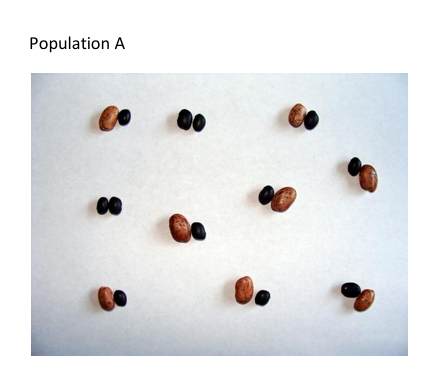
Population A looks like someone paired up red beans with black beans. It doesn’t look like random pairing. There are two pairs of black beans because frequency of red beans, so there wasn’t any more red beans to pair them up with. Probably not in H-W equilibrium.
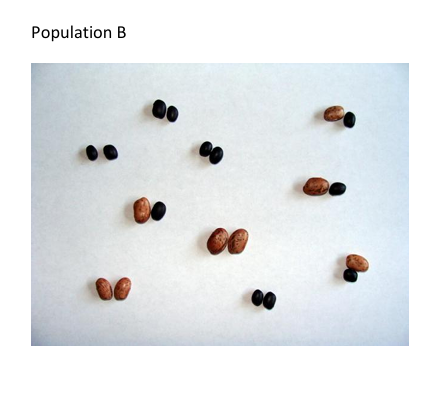
Population B looks as if the pairing of beans was done randomly. Given that the black and red beans are almost in equal frequency, but black a bit more common, I’d expect a few homozygous red pairings, a few heterozygotes, and slightly more black bean homozygotes compared to red homozygotes. More likely than the others to be in H-W equilibrium.

Population C looks like someone paired up beans of the same kind together. This one doesn’t look like random pairings either. Probably not in H-W equilibrium.
Adaptation noun
A trait that improved reproductive success
Ex: A bird having a long beak that helps reach its food, survive, and produce more offspring
Adaptation verb
The process whereby a character changes resulting in improved reproductive success
Ex: Over generations, birds with longer beaks may leave more offspring, causing longer beaks to become more common in a population
Adaptation is not guaranteed to occur
Populations may adapt to environmental changes, or they may become extinct if they cannot survive and reproduce successfully
Evolution is not limitlessly creative
It works with existing traits and random mutations rather than designing completely new organism from scratch
Adaptation is not inevitable because:
Mutations may not produce a useful trait.
A population may not have enough genetic variation to adapt.
Environmental conditions may change too quickly.
A population may go extinct before it can adapt.
When the environment changes, two major outcomes are possible:
Adaptation: Individuals with beneficial heritable traits reproduce more successfully, and those traits become more common over generations.
Extinction: If a population cannot survive and reproduce under the new conditions, it may eventually die out.
Adaptations resulting from pre-existing characters
Modification of existing characters, a human had five fingers but the thumb was a nub, over time the thumb modified to a true finger
Addition of new characters acquisition of new trait from another species via horizontal gene transfer (how we can make ATP from mitochondria is from bacteria) (Beetle)
Loss of characters humans have no tail now but ancestors has tails, embryo has a tail (tapeworms don’t have a gut, a mouth, and no intestines, evolved from ancestors that has a gut- free living flatworms lived in other organisms guts so they didn’t need one
A design process not driven by body wanting something its driven by random mutations in combination with selection
Explain how selection, in combination with random mutations, it a design process
Evolution can act as a _________ because random mutations introduce genetic variation, while natural selection favors heritable traits that improve reproductive success.
The process works like this:
Random mutations create genetic differences among individuals.
Some differences affect survival and reproductive success.
Individuals with beneficial traits tend to produce more offspring.
Those traits become more common over generations.
Over time, accumulated changes can produce complex adaptations.
Example: Eye structures may have evolved through the cumulative modification of light-sensitive proteins, light-detecting cells, pigment cups, lenses, and irises. Each stage could provide an advantage over earlier stages.
The process is not intentional. Organisms do not develop traits because they want or need them. Mutations occur without regard to whether they will be beneficial, and selection influences which heritable variations become more common
Fitness
Lifetime reproductive success, fitness matters over age in evolution
Relative fitness
A trait can only be an adaptation if individuals with the trait have > (higher) fitness than individuals with other trait. Compares reproductive success of individuals with different traits in the same population
A trait can be considered an adaptation when individuals with that trait have higher fitness than individuals with alternative traits in the relevant environment.
Relative fitness matters because evolution depends on differences in reproductive success. Traits associated with higher fitness tend to become more common over generations
Example: If darker-colored insects survive predation more often than lighter-colored insects and produce more offspring, darker coloration has higher relative fitness in that environment.
Positive Selection
Favors a heritable trait or genetic variant because it increases reproductive success.
Camouflaged insects avoid predators and produce more offspring (higher fitness)
Negative (purifying) selection
Removes or reduces the frequency of harmful genetic variants because they decrease reproductive success.
A harmful mutation reduces survival or the ability to reproduce (lower fitness)
Selection
Different repordtuve success of individuals because of their traits
Differing manifestations of positive/negative selection
Directional selection
Disruptive selection
Stabilizing selection
Sexual selection
Balancing selection
Directional selection
Directional selection favors one extreme of a trait distribution, causing the population’s average trait value to shift in one direction.
Example: If larger-horned rams win more mating competitions, larger horns may become more common over generations
Disruptive selection
Disruptive selection favors individuals at both extremes of a trait distribution over individuals with intermediate traits.
Example: If birds with either very large or very small beaks can access abundant food sources, while birds with medium-sized beaks cannot feed as effectively, both extremes may be favored
Stabilizing selection
Stabilizing selection favors intermediate traits and selects against both extremes.
Example: If newborns of intermediate birth weight have higher survival than extremely small or extremely large newborns, intermediate birth weight is favored
Sexual selection
Selection is acting differently in males and females
Intrasexual
Intersexual
Intra (within) sexual
Individuals of the same sex compete for access to mates.
Example: Male rams butt heads to compete for mating opportunities.
Rams with larger horns may win more competitions and reproduce more successfully
Females are not involved they are grazing in another place while fights are happening
Inter (between) sexual
One sex chooses mates based on preferred traits.
Example: Female birds of paradise may prefer males with elaborate colors or displays.
Preferred traits may become more common because individuals possessing them obtain more mating opportunities.
Shorer tails and dull colors may have parasites so females pick the brighter and longer tails, females are picky so they have good offspring
Balancing selection
Occurs when opposing selective forces maintain multiple genetic variants in a population instead of allowing just one variant to become dominant
Frequency- dependent selection
Heterozygote advantage
Frequency-dependent
Fitness of a trait varies with the frequency of a trait
Ex: Large fish is eaten on his side by smaller prey, and the prey has a mouth that becomes asymmetric. The rare trait has a higher fitness
Heterozygote advantage
Individuals with two different alleles at a gene have higher fitness than individuals with either of the two matching-allele genotypes.
- Example: People heterozygous for the sickle-cell allele can have increased resistance to severe malaria in malaria-endemic environments, although the advantage depends on the environment.
What is the selective agent?
Bucket of M&Ms you pick all yellows, you are selective agent
Inter- females mate with the most brightly colored males, females is the selective agent
Intra- two males butting heads, the selective agent is the interaction between the two males
Cheetah is chasing gazelle, selective agent is the cheetah because they are weeding out the slower gazelles
The predator on the right side of the fish is becoming more common over time, the interaction between prey and predator is the selective agent
Bird that eats bugs, bug is camouflaged, and some not as well camouflaged, camouflaged becomes more common, bird is the selective agent
Adaptation is continuous and imperfect
Adaptation is continuous
Cumulative effects
Perfect adaption is never reached
The fallacy of evolution as progression
Adaptation is continuous
There is never a moment where adaptation isn’t happening) (hairs on pinky toe- is not leading to reproductive success) (resistance to covid virus- could impact reproductive success) (adaptation is not perfect because no organism is adapted perfectly to the environment where they live)
1) Detrimental mutations are always occurring
2) Environment is always changing- as soon as population is almost adapted to the heat, cold weather comes and now they don’t have enough fur to keep them warm. Another one is flu, we adapt to the environment (flu) and then another strain comes along
3) Adaptations are modifications, not original optimal designs- if you want a vehicle that works well in running up and down beach, think about the characteristics it needs to work optimally, but they just took old cars and modified them. Which would work better? The brand-new car, not the modified one
4) Some mutations are recessive; detrimental mutations cannot be eliminated by natural selection- Genotype/phenotype table in notes
Cumulative effects
The evolution random processes in our notes. Complex adaptations can develop through the gradual accumulation of many small changes across generations
Example: The evolution of the eye
Light-sensitive proteins respond to light.
Light-detecting cells (neurons) allow organisms to detect light more effectively.
A pigment cup helps detect the direction of light.
A lens improves focusing.
An iris regulates the amount of light entering the eye
Each modification may provide a benefit, even if it does not produce a fully developed eye. Organisms with useful intermediate structures can survive and reproduce, allowing further changes to accumulate
(Bacteria doesn’t have 2-5 and they survive just fine. Organisms that gain these adaptations have greater reproductive success)
Perfect adaptation is never reached
Organisms are never perfectly adapted because of several limitations:
Detrimental mutations continually occur. Not all mutations are beneficial, and harmful variants can persist.
Environments change. A trait that is beneficial under one condition may become harmful under another.
Evolution modifies existing structures. Natural selection works with inherited structures rather than creating an entirely new, optimal design from scratch.
Recessive harmful mutations can persist. Natural selection may not easily eliminate them when they are hidden in heterozygous individuals.
Examples of imperfect adaptation (non-optimal design) include:
The human esophagus and windpipe sharing a region of the throat, which creates a risk of choking.
The tendency of humans to store excess energy as fat, which can be disadvantageous in environments where food is plentiful.
Structures that remain even when they provide little or no current reproductive benefit, such as hair on the human pinky toe
Fallacy of evolution as progression
Evolution is not a ladder leading toward perfection or greater complexity. It is a process in which populations change in response to their environments.
Humans did not evolve from modern chimpanzees. Humans and chimpanzees share a common ancestor.
Single-celled organisms did not evolve with the goal of eventually producing humans.
Some organisms evolve greater complexity, while others evolve reduced complexity or lose structures that are no longer useful.
The success of a trait depends on the environment and reproductive consequences, not on whether it makes an organism more advanced.