ACC 2361 Exam 2
 Call Kai
 Learn
Learn Practice Test
 Spaced Repetition
 Match
Match Flashcards
 Knowt Play
1/105

There's no tags or description
Looks like no tags are added yet.
Name | Mastery | Learn | Test | Matching | Spaced | Call with Kai | Chat |
|---|
No analytics yet
Send a link to your students to track their progress
106 Terms
Adjustments involve one ____ and ______ accounts
income statement; balance sheet
Deferral adjustments happen when money moves-
-first
This can look like using a prepaid asset or deceasing a deferred revenue into revenue
Accrual adjustments happen when money moves-
-later
This can look like la company paying taxes on the income it earns this period or a a company interest revenue being earned on investments this month but not received in cash until a later month.
One asset —> One expense
One Liability —> One Revenue
What adjustments is this…?
This is a Deferral adjustment
One asset —> One Revuene
One Liability —> One expense
What adjustment is this…?
This is a Accrual adjustment
what are two rules you do not break when adjusting?
Cash is never a part of adjusting journal entry
Each journal adjustment only effects one balance sheet and one income statement
Contra accounts are-
-accounts that is an offset to reduction of another account.
If you see a contra account, it’s on a…?
A.) A short term asset like supplies
B.) A long term asset like Equipment
B.) A long term asset like Equipment
Because we have a long term asset on the books for years, but we also want to know how the cost that’s been used up
Depreciation look like what in a journal entry?
Accumulated Depreciation under assets and
Depreciation expense under expense
Accumulated Depreciation maybe be recorded as a asset, but a increase to Accumulated Depreciation is a credit instead of a debit. Why is that?
Accumulated Depreciation is a contra account.
When you’re adjusting, are you adjusting the unadjusted trial balance or the adjusted trial balance?
You are adjusting the unadjusted trial balance
Which is a internal report?
A.) Income statement
B.) Balance sheet
C.) Trial balance
C.) Trial balance
Dealer is a acronym to help remember debits and credits.
What does it stand for?
Dea- Dividends, expenses, asset
Ler- Liability, equity, revenue
Supplies being used up is a what?
Supplies being used is a deferral.
It’s a asset to expense
Wages owed over 5 days is what?
Wages owed over 5 days is a accrual
It’s a liability to a expense
A closing journal entry involves what accounts?
A closing journal entry involves temporary accounts (revenues, expenses, and dividends)
What do we need before we make the financial statement?
We need a adjusted trail balance
The order you need to make finical statement from the adjusted statement is
Income statement
Statement if retained earnings
Balance sheet
Permanent accounts are things on the-
-balance sheet
To close revenue you need to-
-debit the revenue
To close expense you need to-
-credit the expense
Net income (or loss) and dividends are transferred to what?
They’re transferred to retained earnings.
Post closing trial balance-
-prepared to check that debits and credits are equal and that al temp accounts have been closed.
What is the first step in the completed accounting cycle?
The first step is to Analyze transactions
The accrual trap refers to only-
-counting days that belong to the period
The company pays it’s workforce on Fridays for a five day work week ending that day. The Payroll for a week is $50,000. The accounting year ends December 31st
What is the journal entry for wage expenses going to look like if the week starts on the 30th?
A.) $0
B.) $50,000
C.) $30,000
D.) $20,000
D.) $20,000 since they’ve only done 2 day’s work.
Which is not a deferral adjustment?
A.) Supplies used during the period
B.) Rent benefit expired during the period
C.) Wage expense incurred but not recorded
D.) Gift cards being redeemed
C.) Wage expense incurred but not recorded
The expended accounting equation is-
Assets= Liabilities + Stock holder’s equity (Common stocks+ Retained earnings)
T/F Revenues are incurred when a business does the work
True! Revenues can be based on goods and services.
T/F expenses are incurred when a business pays for the services it received?
False! expenses ae when a business uses something up
If you increase net income, a company increases its what?
you increase it’s stockholders’ equity.
There are 4 types of financial statements. What are they?
Income statement
Statement of retained earnings
Balance sheet’s purpose
Statement of cash flows
Income statement looks at a certain ____ of operations
period
A balance sheet looks at a certain ___ of operations
Point in time
If you see the title “For the Year Ended December 31”
Between an income statement and a balance sheet, you’re looking at…?
You’re looking at a Income statement
First Corporation had Retained Earnings at the end of December 31, 2025, of $452,000. During 2026, the company had net income of $172,000 and declared dividends of $20,200. The amount of Retained Earnings reported on the balance sheet as of December 31, 2026, will be:
$603,800.
$452,000+ 172,000 - 20,200= $603,800.
If expenses exceed revenues, which of the following correctly indicates the structure of the journal entry that is used to close revenue and expense accounts?
Debit Retained Earnings, debit Expenses, and credit Revenues.
Debit Revenues, debit Retained Earnings, and credit Expenses.
Debit Revenues, debit Expenses, and credit Retained Earnings.
Debit Expenses, credit Revenues, and credit Retained Earnings.
Debit Revenues, debit Retained Earnings, and credit Expenses.
Retained earnings equation is-
R.E end = R/E beg + Revenues – Expenses - Dividends
You are preparing a journal entry to record each of the initial business activities on September 1.
On September 1, booked the race track for a private organization that will use the track one day per month for $2,500 each time, to be paid in the following month. The organization uses the track once during the month, on September 30.
What’s the journal entry?
No Journal Entry Required
The money is to be paid later and we’ve done no work, and no one has used any resources.
Since revenues and expenses are not always recorded in the period the company incurs them, we need to make-
-adjustments to the accounting records at the end of the period to ensure assets and liabilities are reported at appropriate amounts.

Fill in the blanks
expense; revenue

Fill in the blanks
Revenues; expenses
remember, (A)ccrual —> (A)bout what I’d expect

Fill in the Blank
The blank- Retained earnings
On the unadjusted balance in Supplies was $910 at December 1st, 2024 the company then bought $50 of supplies on December 15th. A year-end count showed $100 of supplies on hand.
How much supplies expense was there?
$910 of supplies at the start + $50 of supplies= 960
And there was only 100 at the end so
960-100= 860. $860 was used up (expensed)
A ___ is generally defined as an attempt to deceive others for personal gain.
fraud
Employee fraud is often grouped into three categories. What are they?
Corruption
Asset misappropriation
Financial statement fraud
What type of fraud is is the most common but the least expensive?
A.) Corruption
B.) Asset misappropriation
C.) Financial statement fraud
B.) Asset misappropriation
What type of fraud is is the least common but the most expensive?
A.) Corruption
B.) Asset misappropriation
C.) Financial statement fraud
C.) Financial statement fraud
What type of fraud is is the second least common but the second most expensive?
A.) Corruption
B.) Asset misappropriation
C.) Financial statement fraud
A.) Corruption
This type of fraud involves misreporting amounts in the financial statements, usually to portray more favorable financial results than what actually exist.
Financial statement fraud.
To explain why employees commit fraud there is a-
employee fraud triangle
What are the components of the employee fraud triangle?
Incentive, Opportunity, Rationalization
If a employee has a reason for committing fraud, the employee has…?
…the employee has incentive
What is The Sarbanes-Oxley Act (SOX)?
A law passed in 2002 to restore investor confidence after mass frauds.
What does Sarbanes-Oxley Act (SOX) tackle?
Counteracting Incentives
Reduce opportunities
Encourage Honesty
Under the SOX act, there are fines up to 5 million dollars plus jail time up to 20 years. What aspect of the triangle does this tackle?
A.) Incentive
B.) Opportunity
C.) Encourage honesty
A.) Incentive
Under the SOX act, There has to be a audit committee on the board of directors that has to be independent of management. they are meant to evaluate on internal controls. What aspect of the triangle does this tackle?
A.) Incentive
B.) Opportunity
C.) Encourage honesty
B.) Opportunity (This is what SOX affects the most)
Under the SOX act, companies are requires to have tip lines, whistleblower protection, and the code of ethics for senior financial officers. What aspect of the triangle does this tackle?
A.) Incentive
B.) Opportunity
C.) Encourage honesty
C.) Encourage honesty
In the Fraud triangle, if a employee as a reason to commit fraud, wither person or outside pressure, this is a example of…?
The Fraud triangle factor: Incentive
In the Fraud triangle, if a employee has the means to commit fraud, usually as a result of weak internal controls, this is a example of…?
The Fraud triangle factor: Opportunity
In the Fraud triangle, if a employee commits fraud but feels justified to do so, this is a example of…?
The Fraud triangle factor: Rationalization
Internal control-
-Actions taken to promote effective and efficient operations, protects assets, enhance accounting information, and adhere to laws and regulations
What is not on the components of the employee fraud triangle?
A.) Incentive
B.) Collusion
C.) Opportunity
D.) Rationalization
B.) Collusion
A adjustment is a type of journal entry, but it has a defining feature. What is that feature?
The defining feature is adjustments are made to the accounting records, specifically, at the end of the period

Identify the picture above.
The picture above is a T-account

T/F A trial balance of any kind is internal report. (meaning it’s not given to the public)
True! The public sees the the financial statements
What happens between the unadjusted trail balance and the adjusted trial balance?
You record and post the adjustments
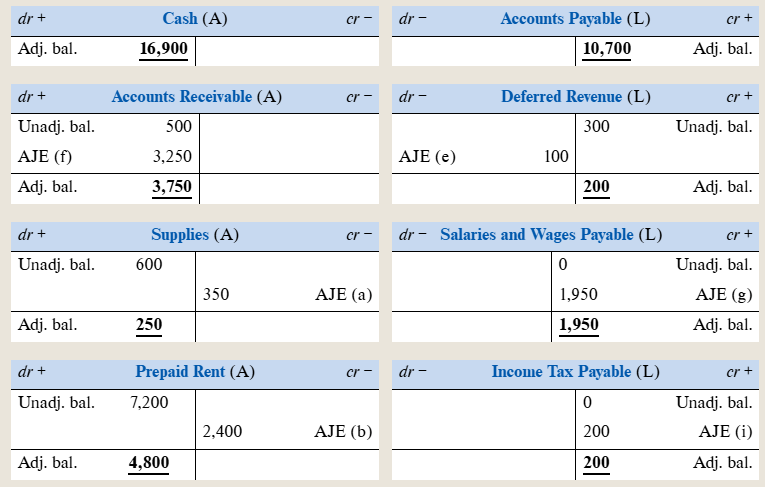
T/F In adjusting journal entries, Debits and Credits must me equal.
True! They are equal in Unadjusted, adjusted, and closing entries

Fill in the blanks.
Debit: Retained earnings by $750
Credit: Dividends by $750
This is closing so we are trying to Zero out dividends and dividends takes away from retained earnings.
T/F Dividends are never mixed in with revenues and expenses closing entries because it’s not part of computing the net income?
True! Net Income= Total revenue- Total expenses
Net Income=
Total revenue- Total expenses
Retained earnings equation is-
R.E end = R/E beg + Revenues – Expenses - Dividends

Solve:
R.E: 10,000
Since debits and credits need to equal and since credits is up by 10,000- to balance out it’s R.E of 10,000
T/F When Closing, you can Debit a expense.
False! You only credit the expense when closing.

Solve:
Debit: 1,000. (R.E can be debit or credited. depends if it’s positive or negative)
Are these in the right order?
1. Analyze transaction
Record in the journal
Post the the ledger (T-accounts)
Prepare the unadjusted trail balance
Record and post adjustments
Prepare the Adjusted trail balance
Prepare the financial statements
Close the temporary accounts (at the end of the year)
Prepare the post close trial balance
Yes! This is the right order
The 3 objectives off internal controls are-?
-operations, reporting, and compliance
The five principles of control activities are-
Establishing responsibility, Segregate duties, Restricts access, Document procedures, independently verify
If a boss assigns one employees to one task each so if a error happens the boss knows who it is, the boss is using what internal controls?
Establishing responsibility
At a Ross store, there is someone on cash register, someone who takes the money to the bank, and the accountant who records the transaction. This is a example of what internal control?
Segregate duties
The internal control of Segregate duties states-
-that one human should not initiate approve, record, and have access to the assets in one transaction
What is the best description of the difference between Establishing responsibility and Segregate duties?
A.) Establishing responsibility makes sure no one employee has all responsibility and Segregate duties assigns one task to one person
B.) Establishing responsibility makes sure a group of employees are assigned to one task so responsibility is spilt equally and Segregate duties makes sure no one employee has all responsibility
C.) Establishing responsibility makes sure one employees are assigned to one task so responsibility identifiable and Segregate duties makes sure no one employee has too much access to assets
C.) Establishing responsibility makes sure one employees are assigned to one task so responsibility identifiable and Segregate duties makes sure no one employee has too much access to assets
In Amazon, lower level employees (like warehouse workers/ delivery drivers) don’t have access to go in and chnage the amazon balance sheet. What internal control is this?
Restrict access
In the five principles of internal control Restrict access-
-Secure physical and electronic access to assets and information
Document procedures means-
-using prenumbered documents in sequence, one document number, one accounting entry.
independently verify means-
Someone checks the work of the others.
When you are reconciling the bank, you are using what principle of control?
When you are reconciling the bank, you are using independently verify because you are checking the bank balance against your own.
Using password protection is a example of what control?
Using password protection is a example of restricting access
Which is not a principle of control?
A.) Establishing responsibility
B.) Customer satisfaction
C.) Segregate duties
D.) Restricts access
E.) Document procedures
F.) Independently verify
B.) Customer satisfaction
T/F Cash has it’s own internal controls
True! the goal is to make sure the business receives the appropriate amount of cash and safety deposits it.
Which is not a reason cash it’s own internal controls?
A.) Cash is easy to forge
B.) Cash is most often the asset stolen
C.) Cash has no label saying who it belongs to
D.) Cash is a valuable asset
A.) Cash is easy to forge
What is the purpose of a bank reconciliation?
The purpose is to make sure that the bank statement and cash account are both at the appropriate amount.
You want to determine the correct cash balance
Why might our bank and our book’s differ?
On the bank’s side→ The company has recoded items the bank doesn’t know about yet.
On the business side→ The bank has record items that the business doesn’t know about until the statement arrives.
T/F for bank reconciliation, there are only errors on the bank’s side
False! There can be errors on our books and on the banks
T/F When reconciling the bank, it will always include cash
True! Cash will always be a part of it.
Which side do these transactions happen on?
+ deposits in transits (Add)
This is money that is going to reach the bank soon
- Outstanding checks
This is money we have sent out in a check that hasn’t been cashed out yet
Bank errors (add or subtract)
They happen on the bank side
Which side do these transactions happen on?
+ Interest earned
Interest on money you have on your account
- Bank service charge
Money the bank charges you for using the bank
- NSF→ Non sufficient funds
A check that someone else has written you has bounced.
+/- EFT transfers
Electronic transfer of funds. Transfers in or out
Some transferred us money or we transferred out.
+/- ___ own mistakes
They happen on the company’s side
Deposits in transits-
-are recorded on the company’s book but are not yet on the Bank’s books.
Outstanding Checks-
-are checks that the recipient has yet to cash out.
NSF checks stand for…?
NSF checks stand for Non sufficient finances
Thsi is when someone gives you a check that later boucned because they did not have sufficient funds