Lecture 21 - Final Exam Review
 Call Kai
 Learn
 Practice Test
 Spaced Repetition
 Match
 Flashcards
 Knowt Play
1/195

There's no tags or description
Looks like no tags are added yet.
196 Terms
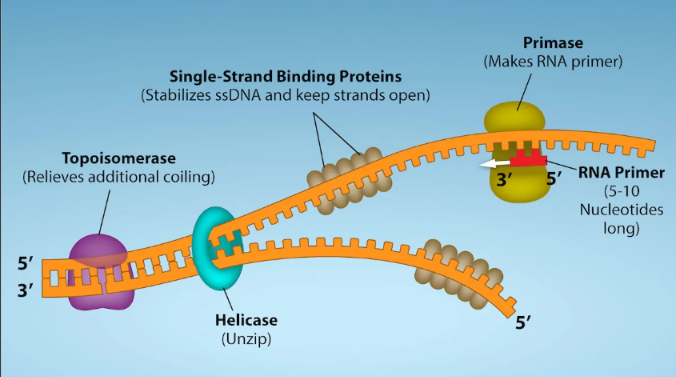
Prokaryotic replication steps 1–4
DNA unwinds at the origin of replication
helicase opens the DNA forming replication forks extended bidirectionally
single-strand binding proteins (SSD) coat the DNA to prevent rewinding
topoisomerase binds ahead of the fork to prevent supercoiling

Prokaryotic replication steps 5–8
Primase synthesizes RNA primers complementary to the DNA strand
DNA polymerase III adds nucleotides to the 3'-OH end of the primer
elongation of both leading and lagging strands continues
the leading strand replicates continuously while the lagging strand replicates discontinuously by forming Okazaki fragments
Prokaryotic replication steps 9–11
RNA primers are removed by the exonuclease activity of DNA polymerase I
gaps are filled by DNA Pol I adding dNTPs
gap between the two DNA fragments is sealed by DNA ligase, which forms phosphodiester bonds
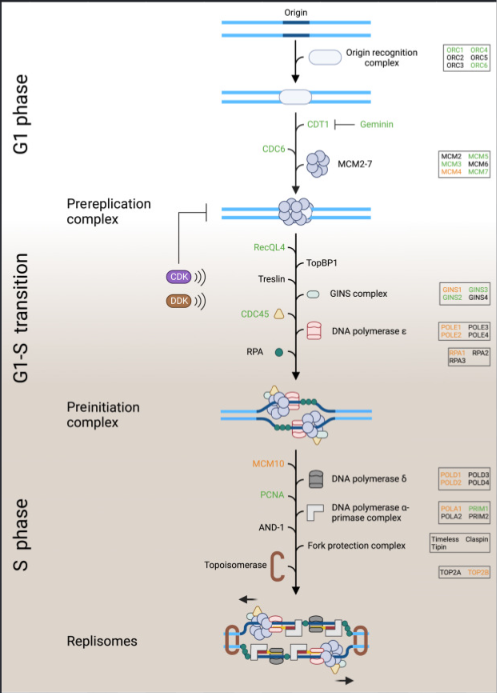
Eukaryotic replication initiation
Multiple origins of replication
ORC (origin recognition complex) recognizes and binds an origin
ORC recruits the helicase loading proteins Cdc6 and Cdt1 plus other replication proteins to form the Pre-RC complex
DNA Pol α/primase synthesizes an RNA primer and briefly extends it (initiation begins)

Replisome
The complex molecular machine that carries out DNA replication
composed of three DNA polymerase complexes (α, δ and ε)
one of which synthesizes the leading strand while another synthesizes the lagging strand

Replisomes per dividing DNA
Two, for bidirectional replication
they continue at both forks in the middle of the cell
separate from the DNA as the termination site replicates
Where replication occurs
Prokaryotes: inside the cytoplasm
eukaryotes: inside the nucleus
Prokaryotic DNA polymerases
Five (I, II, III, IV, V):
I is involved in synthesis, proofreading, repair and removal of RNA primer
II is a repair enzyme
III is the main polymerizing enzyme
IV and V are repair enzymes under unusual conditions
Eukaryotic DNA polymerases
Five (α, β, γ, δ, ε):
α is a polymerizing enzyme for primer synthesis
β is a repair enzyme
γ does mitochondrial DNA synthesis
δ is the main polymerizing enzyme for the lagging strand
ε is the main polymerizing enzyme for the leading strand
Origins of replication: prokaryotes vs eukaryotes
Prokaryotes have only one origin
eukaryotes have multiple origins
Okazaki fragment length
1000–2000 residues in prokaryotes
150–200 residues in eukaryotes
Initiation proteins: prokaryotes vs eukaryotes
Prokaryotes use protein A and B
eukaryotes use the Origin Recognition Complex (ORC)
Replication speed
About 2000 bp/s in prokaryotes
slow, some 100–200 bp/s in eukaryotes
Helicase: prokaryotes vs eukaryotes
DnaB in prokaryotes
the MCM complex in eukaryotes
End replication problem
A eukaryote-only problem causing the loss of 30–200 nucleotides with each DNA replication and cell division
telomerase is the enzyme that extends the telomeres of chromosomes
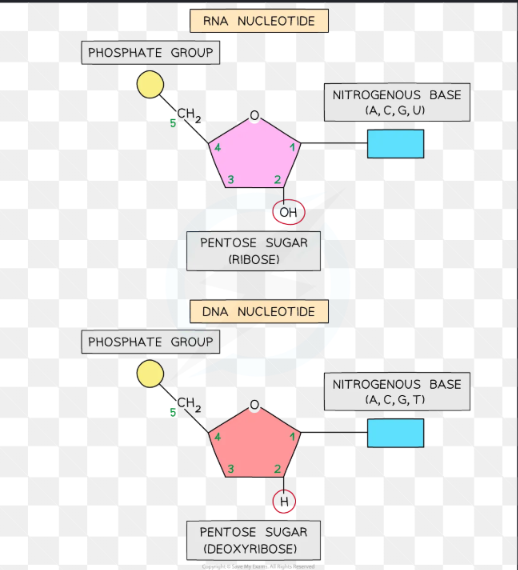
Shared composition of DNA and RNA
A pentose (5-carbon) sugar
four types of bases
a phosphate group attached to the 5' carbon of the sugar
backbone of alternating phosphate and sugar units connected by phosphodiester bonds

Three main differences between RNA and DNA
The sugar in RNA is ribose instead of deoxyribose
DNA is double stranded while RNA is generally single-stranded
RNA contains uracil in place of thymine

Three phases of prokaryotic transcription
Initiation, elongation and termination

E. coli RNA polymerase subunits
Five subunits: two α, one β, one β', one ω — plus the σ subunit (α2ββ'ωσ)
this complete enzyme is called the holoenzyme
Transcription initiation
The sigma (σ) subunit recognizes a specific promoter site on the DNA upstream from the gene (the −35 region and −10 region) and unwinds the DNA locally to produce a ternary complex of RNA pol, RNA and DNA
What happens to sigma after initiation
The σ factor is released from the transcriptional complex, leaving the core enzyme (α2ββω) to continue elongation of the RNA transcript
Transcription terminator
A GC-rich region that is a palindrome, followed by an AT-rich sequence
Rho (ρ) factor
An additional protein that helps recognize the termination site and stop transcription, releasing the RNA transcript and dissociating from the DNA
Processing of prokaryotic mRNA
The RNA transcribed from protein-coding genes requires little or no modification prior to translation
Prokaryotic vs eukaryotic mRNA
Prokaryotic mRNAs have no introns and need no processing; eukaryotic mRNAs must have introns spliced out and exons reconnected, must gain a 5'-cap and 3'-polyA tail, and lack a ribosome binding site (SD site)
Why capping is necessary
Capping adds a methyl group to the 5'-end of the transcribed RNA, protecting against degradation by exonucleases and allowing the transcript to be recognized by the cell's translational machinery
Why polyadenylation is necessary
Adding a long chain of adenine nucleotides (poly-A tail) to the 3'-end improves the stability of the RNA transcript and facilitates its export from the nucleus
Two types of gene regulation
Positive regulation, instigated by activators (and sometimes inducers), and negative regulation, instigated by repressors
Activator
When an activator or inducer binds to an operon, the transcription process either increases in rate or is allowed to continue
CAP as an activator example
In the presence of cAMP, CAP binds to the promoter and increases RNA polymerase activity; in the absence of cAMP, CAP does not bind and transcription occurs at a low rate
Repressor
When a repressor binds to an operon, the transcription process is slowed or halted
Trp repressor example
When tryptophan is absent, the repressor by itself does not bind the operator, so the operon is active and tryptophan is synthesized; when tryptophan is plentiful, the repressor is triggered, turning off further synthesis
Messenger RNA (mRNA)
Genetic coding templates used by the translational machinery to determine the order of amino acids incorporated into an elongating polypeptide
Transfer RNA (tRNA)
RNA that forms a covalent attachment to individual amino acids and recognizes the encoded sequence of the mRNA to allow correct insertion of amino acids into the elongating polypeptide chain
Ribosomal RNA (rRNA)
RNA assembled together with numerous ribosomal proteins to form the ribosome; ribosomes engage the mRNA and form a catalytic domain into which tRNAs enter with their attached amino acid
Codon
A triplet of three nucleotides that imparts specificity for a particular amino acid
Breakdown of the 64 codons
61 encode amino acids; AUG is the start codon and also the Met codon; UAA, UAG and UGA are stop codons
tRNA structure elements
Three major loops (T, D, variable and anticodon), four base-paired regions, an anticodon triplet, and a 3'-terminal CCA sequence where the appropriate amino acid attaches by an ester bond
3D shape of tRNA
An L-shaped tertiary structure resembling a hockey stick, with the amino acid attachment site at one end (tip of the handle) and the anticodon at the other (blade of the stick)
Silent mutation
A nucleotide substitution that leads to no change in the protein sequence
Missense mutation
A nucleotide substitution that changes the amino acid sequence
Nonsense mutation
A nucleotide substitution that creates a stop codon
Frameshift mutation
Caused by insertions and deletions in protein coding sequences
Activation step of translation
Attachment of an amino acid to tRNA by aminoacyl-tRNA synthetases, which catalyze formation of an ester bond between the carboxyl group of the amino acid and the 3'-hydroxyl group of the appropriate tRNA
Prokaryotic translation initiation
Three initiation factors (IF1, IF2, IF3) and GTP bind to the small (30S) ribosomal subunit; the initiator aminoacyl tRNA and mRNA attach; then the large (50S) subunit joins to form the 70S initiation complex
Requirement for chain elongation
The presence of a peptidyl tRNA at the peptidyl (P) site, or in the first elongation cycle an fMet-tRNAfMet
Elongation step 1
The second aminoacyl tRNA binds at the ribosomal aminoacyl (A) site, escorted by elongation factor EF-Tu carrying two bound GTPs; as the tRNA binds, the GTPs are hydrolyzed and EF-Tu is released, with EF-Ts helping recycle EF-Tu
Elongation step 2
A peptide bond forms between the carboxyl group of the terminal amino acid at the P site and the amino group of the newly arrived amino acid at the A site, catalyzed by the peptidyl transferase activity of the 23S rRNA in the large subunit
Elongation step 3 (translocation)
After EF-G-GTP binds the ribosome and GTP is hydrolyzed, the tRNA carrying the elongated polypeptide translocates from the A site to the P site, the discharged tRNA moves from P to the E (exit) site and leaves, and the mRNA moves along so the next codon enters the A site
Termination of protein synthesis
Depends on release factors that recognize the three stop codons; when UAG, UAA or UGA arrives at the A site a protein release factor binds, causing the polypeptide to be transferred to a molecule of water, releasing it from the tRNA and dissociating the elongation complex
Three protein targeting routes
Co-translational import, insertion of integral membrane proteins, and post-translational import
Three roles of chaperone proteins
They keep the polypeptide partially unfolded after synthesis in the cytosol so binding of the transit sequence and translocation can occur; they drive translocation by binding and releasing the polypeptide within the matrix in an ATP-requiring process; and they often help the polypeptide fold into its final conformation
Gene regulation
How a cell controls which genes, out of the many in its genome, are "turned on" (expressed)
Why gene expression regulation is needed
By altering gene expression, organisms can adapt to environmental challenges; transcription control can result in tissue-specific gene expression; and gene regulation is responsive to hormones, heavy metals, chemicals and even light
Operon
A group of bacterial genes transcribed together under a single promoter (polycistronic expression), containing regulatory sequences that act as binding sites for regulatory proteins
Role of small molecules in bacterial regulation
Regulatory proteins often bind small molecules, which can make the protein active or inactive by changing its ability to bind DNA
Inducible vs repressible operons
Inducible operons can be turned on by the presence of a particular small molecule; repressible operons are on by default but can be turned off by a small molecule
Three genes of the lac operon
lacZ, lacY and lacA, transcribed as a single mRNA under control of one promoter
lacZ and lacY products
lacZ encodes β-galactosidase, which splits lactose into glucose and galactose that can be fed into glycolysis; lacY encodes the membrane-embedded transporter β-galactoside permease, which helps bring lactose into the cell
Lac operon promoter
The binding site for RNA polymerase, the enzyme that performs transcription
Lac operator
A negative regulatory site bound by the lac repressor protein; it overlaps with the promoter, so when the repressor is bound RNA polymerase cannot bind and start transcription
CAP binding site
A positive regulatory site bound by catabolite activator protein; when CAP is bound it promotes transcription by helping RNA polymerase bind the promoter
Lac operon: glucose present, lactose absent
No transcription — the lac repressor stays bound to the operator, and cAMP is low so CAP is inactive and cannot bind DNA
Lac operon: glucose present, lactose present
Low-level transcription — the repressor is released because the inducer allolactose is present, but cAMP is low so CAP remains inactive, giving only low, leaky transcription
Lac operon: glucose absent, lactose absent
No transcription — cAMP is high so CAP is active and bound to DNA, but the lac repressor is also bound to the operator (no allolactose), acting as a roadblock to RNA polymerase
Lac operon: glucose absent, lactose present
Strong transcription — the repressor is released by allolactose and cAMP is high so CAP is active and bound, helping RNA polymerase bind the promoter
Eukaryotic regulation: chromatin accessibility
The structure of chromatin can be regulated; more open or "relaxed" chromatin makes a gene more available for transcription (euchromatin vs heterochromatin)
Eukaryotic regulation: transcription
Sets of transcription factor proteins bind specific DNA sequences in or near a gene and promote or repress its transcription into RNA — the main control point for many genes
Eukaryotic regulation: RNA processing
Splicing, capping and addition of a poly-A tail can be regulated, as can exit from the nucleus; different mRNAs may be made from the same pre-mRNA by alternative splicing
Eukaryotic regulation: RNA stability
The lifetime of an mRNA in the cytosol affects how many proteins can be made from it; small regulatory RNAs called miRNAs can bind target mRNAs and cause them to be chopped up
Eukaryotic regulation: translation and post-translational modification
Translation of an mRNA may be increased or inhibited by regulators such as miRNAs; proteins can also be chopped up or tagged with chemical groups, affecting their activity or behavior
Recombinant DNA technology
The joining together of DNA molecules from two or more different species that are inserted into a host organism to produce new genetic combinations of value to science, medicine, agriculture and industry
Plasmid
A small double-stranded DNA molecule, usually circular, that can exist independently of host chromosomes in bacteria, fungi and yeasts; plasmids have their own replication origins, replicate autonomously, are stably inherited, and exist in multiple copies
Essential components of an expression vector
An origin of replication, promoter and terminator, ribosome binding site, gene of interest (ATG to stop codon), and a selection marker — the first four being organism specific
Copy number by origin
ColE1 is high copy number (50–100), P15A is medium copy (10–20), and SC101 is low copy (3–5)
Common antibiotic selection markers
AmpR (ampicillin), KanR (kanamycin), CmR (chloramphenicol) and TetR
Five major steps of DNA recombination technology
Obtain a DNA fragment containing the gene of interest (DNA isolation/gene synthesis and PCR); isolate a suitable plasmid from a bacterium; cut the fragment and the plasmid with the same restriction enzymes; insert the fragment into the plasmid using ligase; and verify the correct recombinant plasmid construct
PCR step 1: denaturation
The reaction mixture is heated to 95 °C for about 15–30 seconds to denature the template DNA into single strands by breaking the hydrogen bonds between base pairs
PCR step 2: primer annealing
The mixture is rapidly cooled to a defined temperature allowing the two primers to bind the sequences flanking the target DNA on each strand; the annealing temperature is specific to the primers
PCR step 3: extension
The temperature is raised to 72 °C for a pre-set time so DNA polymerase elongates each primer by copying the single-stranded templates, adding nucleotides to the 3' terminus of each primer
PCR amplification yield
In cycle 2 both double-stranded products of cycle 1 are denatured and serve as targets for more annealing and extension; after 25–30 cycles at least 10^7 copies of target DNA may be produced
Transformation
Introduction or insertion of the ligated plasmid into host cells, generating a mixed population of transformed and non-transformed cells
Selection after transformation
The selection process filters out only the transformed host cells; a marker gene on the plasmid vector (e.g. AmpR) is used to isolate recombinant from non-recombinant cells
Causes of false positive colonies
Non-specific (incorrect) PCR product; incomplete restriction enzyme digestion of the vector leading to self-ligation; incorrect ligation; and contamination from the lab environment
Three verification methods for a recombinant plasmid
Restriction enzyme digestion, colony PCR, and DNA sequencing
Common protein expression systems
The prokaryotic system (E. coli) and eukaryotic systems — yeast cell, insect cell, and mammalian cell (transient and stable) expression systems
Advantages of E. coli for protein expression
Rapid doubling time of about 30 minutes in simple defined inexpensive media at low cost, and extensive knowledge of its genetic background with many genetic manipulation tools available such as promoters, terminators and plasmids
Disadvantages of E. coli for protein expression
Introns are not removed; premature termination of transcription; codon bias problems; recombinant proteins are never glycosylated correctly; proteins may misfold and form insoluble inclusion bodies; and E. coli might degrade the recombinant protein
E. coli expression: advantages vs disadvantages
Advantages: rapid expression, less expensive, simple process scale-up, well characterized genetics. Disadvantages: no eukaryotic post-translational modifications, some proteins are not properly folded, and proteins are rarely secreted
S. cerevisiae expression: advantages vs disadvantages
Advantages: moderately rapid expression, works well for secreted and intracellular proteins, less expensive, most protein folding and post-translational modifications possible. Disadvantages: characteristic N-linked glycan structures differ from typical mammalian proteins, requires yeast secretion signal peptides, and enhanced safety precautions are required
Baculovirus/insect cell expression: advantages vs disadvantages
Advantages: moderately rapid expression, works well for secreted, membrane and intracellular proteins, most protein folding and post-translational modifications possible. Disadvantages: N-linked glycan structures differ from typical mammalian proteins, expensive, and difficult to scale up
Mammalian cells, transient expression
Advantages: moderately rapid expression, works well for secreted and membrane proteins, all protein folding and most authentic post-translational modifications possible. Disadvantages: expensive, low yields of intracellular proteins, and difficult to scale up
Mammalian cells, stable expression
Advantages: all protein folding and most authentic post-translational modifications possible, and works well for secreted and membrane proteins. Disadvantages: expensive, low yields of intracellular proteins, difficult to scale up, and lengthy expression time
Yeast expression system
The Saccharomyces cerevisiae system, with its own vectors and promoters such as GAL; also the Pichia pastoris yeast system
Yeast artificial chromosome (YAC)
An engineered, artificially constructed DNA molecule (like a linear plasmid) used to clone DNA sequences in yeast cells, containing a centromere (CEN), telomeres (T), and an autonomous replicating sequence (ARS)
Yeast integrating plasmid (YIp)
A yeast vector giving 15–20 copies on the chromosome
Insect expression system
Based on Autographa californica (baculovirus), using the super-strong promoter from the polyhedron coat protein to enhance expression of proteins
How the baculovirus system is built
The target gene is cloned under the polyhedron promoter into a transfer vector that also contains viral genome regions flanking the polyhedron locus; the vector is co-transfected into insect cells with a viral genome linearized by restriction enzymes, and homologous recombination forms a functional viral genome capable of producing viral particles
Role of lacZ in the insect system
Its inclusion in the transfer vector allows visual screening of viral plaques to identify recombinants
Mammalian expression vector origin
A eukaryotic origin of replication from an animal virus, e.g. Simian virus 40 (SV40)