HYMENOLEPIS DIMINUTA
 Call Kai
 Learn
Learn Practice Test
 Spaced Repetition
 Match
Match Flashcards
 Knowt Play
1/22

There's no tags or description
Looks like no tags are added yet.
Name | Mastery | Learn | Test | Matching | Spaced | Call with Kai | Chat |
|---|
No analytics yet
Send a link to your students to track their progress
23 Terms
Rat tapeworm
Common name
Adult worm lives in the small intestine of:
Rats (definitive host)
Occasionally humans (accidental host)
HABITAT
Rat flea
arthropods (grain beetles, fleas, or flour beetles)
IH
Rats (Norway Rats)
DH
Rat
man (accidental host)
Final host
T
T or F
H. diminuta is common in rodents, accidental infection in humans
Cysticercoid larva
Larval stage
Cysticercoid larva
Infective stage
Ingestion of Cysticercoid larva
MOT
accidental host
The role of man in H. diminuta is ____________
With 4 cup-like suckers
With unarmed rostellum
Scolex
800-1000 segments/ prolottids
No. of segments
Sac-like uterus filled with eggs
Gravid proglottids
20-60 cm
Adult length
sunny-side up fried egg
The egg of H. diminuta is said to have the appearance of a _____________________
Round to oval
Thick shell
No polar filaments (key difference from H. nana)
Egg
Present
Egg: Polar thickening
absent
Egg: Polar filaments
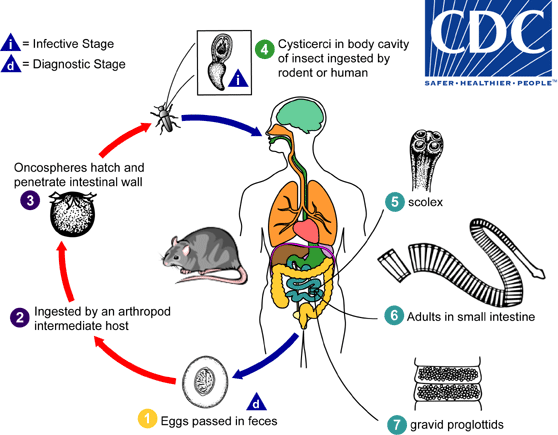
Indirect life cycle (requires intermediate host)
Eggs passed in rat feces
Ingestion by arthropods (grain beetles, fleas, or flour beetles)
Larva develops into cysticercoid inside insect
Rat (or human accidentally) eats infected insect
Larva develops into adult worm in intestine
Life cycle
Usually asymptomatic in humans
Heavy infection (rare):
Abdominal discomfort
Diarrhea
Mild weakness
Pathogenesis
eggs in stool
Diagnostic stage
Stool examination (direct or concentration techniques)
Identification of characteristic eggs
Laboratory Diagnosis
Praziquantel (drug of choice)
Albendazole may also be used
Treatment