Salamander ID Practice
 Call Kai
 Learn
 Practice Test
 Spaced Repetition
 Match
 Flashcards
 Knowt Play
1/68

There's no tags or description
Looks like no tags are added yet.
69 Terms

Body Form: Limbless, eel-like body with distinct ring-like grooves (annuli).
Coloration: Dark greyish-brown to olive above, pale grey underneath.
Key Identifiers: Absence of hind limbs or front limbs; laterally compressed rear body ending in a fin-like fold along the back; small eyes under skin; pair of small sensory tentacles near nostrils on snout.
Typhlonectes natans

Non-native / Exotic. Established locally in the Tamiami Canal drainage system in Miami-Dade County (South Florida) via the pet trade.
Typhlonectes natans
General features: Stocky bodies, broad heads, prominent costal grooves, smooth skin.
Ambystomatidae

Coloration: Dark grey to black base with a fine, net-like (reticulated) pattern of silver-grey lichen-like markings.
Key Identifiers: Reticulate pattern extends down flanks; snout relatively short and pointed; 14-15 costal grooves.
Ambystoma bishopi

Restricted to the western Florida Panhandle (west of the Apalachicola River to the Alabama border, e.g., Santa Rosa, Okaloosa, and Walton counties).
Ambystoma bishopi

Coloration: Black base with fine grey-white lines forming crossbands or ring-like markings (frosted pattern).
Key Identifiers: Crossbanded/frosted appearance rather than reticulated grid; slender build for an Ambystoma; 14-15 costal grooves.
Ambystoma cingulatum

Found in the eastern Florida Panhandle and Northern Florida (east of the Apalachicola River east toward the St. Johns River drainage, south to Alachua/Putnam counties).
Ambystoma cingulatum

Coloration: Jet-black body with high-contrast, bright silvery-white (males) or light grey (females) crossbands along the back and tail.
Key Identifiers: Broad head, short stocky body; distinct white/grey crossbars forming ladder-like patterns; venter solid dark grey/black; 11-12 costal grooves.
Ambystoma opacum

Panhandle and Northern Florida; ranges south through northern peninsular counties down to central Florida (Marion/Volusia area). (Typically follows rivers in the panhandle)
Ambystoma opacum

Coloration: Dull grey to brownish-black, often with light bluish-grey flecking.
Key Identifiers: Disproportionately large head, short body, and sturdy legs; flattened snout; 10-11 costal grooves.
Ambystoma talpoideum

Panhandle and a little south of that and Coastal Eastern Northern Florida; extends south into the northern peninsula (down to Levy and Marion counties near Ocala area).
Ambystoma talpoideum

Coloration: Dark brown/black ground color with variable yellowish-olive blotches, spots, or bars.
Key Identifiers: Large body size (up to 33 cm); yellow/olive ventral pattern extending onto chin; 12-13 costal grooves.
Ambystoma tigrinum

Small Area in Panhandle and Northern Florida down the Suwannee River; localized populations in northern counties (south roughly to the Suwannee River basin).
Ambystoma tigrinum
General features: Extremely elongated, eel-like bodies; minute vestigial limbs; single gill slit on each side of head; lidless eyes.
Amphiumidae

Coloration: Dark brown to slaty-black dorsal surface with a lighter greyish-brown venter.
Key Identifiers: Two toes on each tiny, vestigial foot; dark slate coloration on both back and belly (slight contrast).
Amphiuma means

Found throughout the entire Florida peninsula (including southern freshwater systems) and the Panhandle.
Amphiuma means

Coloration: Uniform purplish-brown to dark grey-brown dorsally and ventrally.
Key Identifiers: One toe on each tiny foot; overall smaller adult length (up to ~30 cm vs. up to 100 cm in A. means); cylindrical head and body.
Amphiuma pholeter

Panhandle to North-Central Florida, mostly along the coast or along rivers. Restricted to coastal plain seepage swamps from the western Panhandle down through the Big Bend region into central Florida (just north of Tampa/Citrus County area)
Amphiuma pholeter
General features: Nasolabial groove running from nostril to upper lip; no lungs (cutaneous respiration).
Plethodontidae
General diagnostic: Pale diagonal line running from eye to angle of jaw; enlarged hind legs relative to forelimbs.
Desmognathus
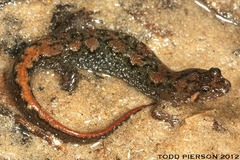
Dark brown/olive dorsum with 5-8 yellowish to reddish wavy dorsal blotches or chevron patterns; tail keeled above; belly pale or mottled grey.
Desmognathus apalachicolae

Panhandle endemic, most geographically restricted to small portion in middle of panhandle. Restricted to ravines along the Apalachicola, Chattahoochee, and Flint River drainages, extending slightly into adjacent Panhandle counties.
Desmognathus apalachicolae

Dark brown to black body; bright white or reddish-orange spots/flecking along lower flanks (above leg level); dark venter with fine white speckling ("salt and pepper").
Desmognathus auriculatus
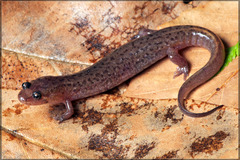
Panhandle and Peninsular Florida south into Central Florida (historically common in dark-water swamps and blackwater streams).
Desmognathus auriculatus

Light brown base with six to eight pairs of golden/reddish dorsal spots that may fuse into a zig-zag stripe; venter pale white or yellow-mottled.
Desmognathus cf. conanti

Panhandle region, most of West panhandle excluding coast (primarily west of the Suwannee River drainage).
Desmognathus cf. conanti

Stout body with dark worm-like or reticulated markings on light brown/grey dorsum; tail sharply keeled on top half; venter pale and unspotted.
Desmognathus monticola

Far Western Panhandle VERY SMALL PROBABLY EXTRIPATED IN FL. Highly localized; restricted to slope ravines in Escambia and Santa Rosa counties near the Alabama border.
Desmognathus monticola
General diagnostic: Slender bodies, yellow to orange ground color (mostly), long tails, 13-20 costal grooves.
Eurycea

Yellowish ground color; two dark longitudinal stripes running down back onto tail; males develop downward cirri (fleshy projections) from nostrils during breeding season; 14-16 costal grooves.
Eurycea cirrigera

Panhandle and some isolated populations in east panhandle area (south to the Nature Coast / Citrus County region).
Eurycea cirrigera

Yellow ground color; three distinct dark black stripes (one down spine, two lateral) extending down body and tail; venter mottled black and white
Eurycea guttolineata

Panhandle (south to about Alachua/Putnam counties).
Eurycea guttolineata

Small size(<9 cm); brownish-yellow with dark lateral bands; 4 toes on rear feet (instead of 5); 15-17 costal grooves; yellow/tan venter.
Eurycea quadridigitata

Panhandle and Northern/Central Florida, excluding everglades. Widespread across northern regions extending south into central peninsular Florida.
Eurycea quadridigitata

Extremely small; overall yellow-orange to reddish-brown coloration; 4 toes on rear feet; typically 16 costal grooves; belly brightly tinted orange/yellow.
Eurycea sphagnicola

West Panhandle. Restricted to coastal hillside seepages and sphagnum bogs in the western Panhandle.
Eurycea sphagnicola
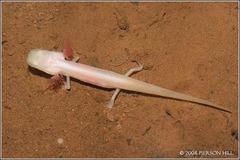
Troglobitic: translucent white/pink skin; reduced, non-functional eyes beneath skin; bright red external gills; slender body and long legs.
Eurycea wallacei

Central Panhandle without extending to coast. Subterranean troglobite restricted to the subterranean waters of the Floridan Aquifer in Jackson and Washington counties (Marianna Karst region).
Eurycea wallacei

4 toes on hind feet; distinct constriction at base of tail (tail shedding site); dorsum reddish-brown; venter pure porcelain-white with bold black spots.
Hemidactylium scutatum

Isolated in bits throughout the panhandle. Highly localized in hardwood floodplains and sphagnum bogs across northern Panhandle counties.
Hemidactylium scutatum
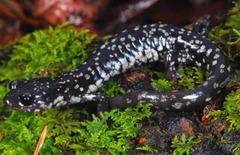
Black base color with abundant metallic white or silvery flecks scattered over dorsum and sides; venter uniform slate grey; produces sticky skin secretions.
Plethodon grobmani

Panhandle and Northern Peninsular Florida (south to about Marion/Volusia counties).
Plethodon grobmani

Red, brown-red, or reddish-orange body with sparse, distinct, round black spots; yellow brown-tinted eyes; short head; venter unspotted reddish-pink.
Pseudotriton montanus

Panhandle and Northern Florida (split) (south to the upper Suwannee River basin).
Pseudotriton montanus

Bright coral-red (juveniles) to purplish-brown (old adults); numerous irregular black spots that fuse/overlap; clear yellow iris; chin often black-flecked.
Pseudotriton ruber

Panhandle and an isolated population in north florida. Restricted primarily to spring-fed streams and ravines in northern Panhandle counties.
Pseudotriton ruber
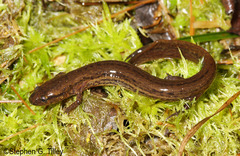
Dull yellow-brown to bronze dorsum with multiple fine dark narrow longitudinal lines along flanks; small head, flattened snout; venter yellow with faint speckling; 17-18 costal grooves.
Stereochilus marginatus

Northeastern Florida. Extremely localized; restricted to swamps along the St. Marys and St. Johns River basins near the Georgia border.
Stereochilus marginatus
General features: Fully aquatic; bushy external gills retained throughout life; 4 toes on front and hind feet.
Proteidae

Coloration: Light brown to dull grey ground color overlaid with dark brown or black spots scattered over back and flanks.
Key Identifiers: Bushy reddish external gills; paddle-like tail; lack of pale dorsolateral stripes (unlike juvenile N. maculosus); dark eye stripe usually present.
Necturus cf. beyeri

Panhandle. Streams and rivers west of the Suwannee River basin (e.g., Escambia, Choctawhatchee, Yellow, and Apalachicola River drainages).
Necturus cf. beyeri
General features: Rough/granular skin in terrestrial phase; costal grooves absent or inconspicuous; no nasolabial grooves.
Salamandridae

Coloration: Olive-green to dull brown ground color with two bright red/orange longitudinal stripes extending down the dorsum.
Key Identifiers: Red dorsal stripes continuous or narrowly broken; bright yellow venter with fine black dots.
Notophthalmus perstriatus

Northern Peninsular Florida and Eastern Panhandle. Endemic sandhill/flatwoods ponds from the Apalachicola National Forest east to the Jacksonville area and south to Orange/Seminole counties.
Notophthalmus perstriatus

Red eft stage

Coloration: Aquatic adults olive-green to yellow-brown; terrestrial eft stage bright orange-red.
Key Identifiers: Red dorsolateral spots encircled by black rings (varies by subspecies); belly bright yellow sprinkled with small black dots; smooth skin in aquatic stage with broad tail fin.
Notophthalmus viridescens

Statewide (except The Keys. Present across the Panhandle and through the peninsula south down to the Okeechobee region (represented by N. v. louisianensis and N. v. piaropicola).
Notophthalmus viridescens
General features: Fully aquatic, eel-like body; external gills present; front limbs present, hind limbs entirely absent.
Sirenidae
General diagnostic: 3 toes on front legs; single pair of gill slits.
Pseudobranchus

Slender body; grey or brown ground color with narrow light tan/yellowish lateral stripes; 34-37 costal grooves; rear fin restricted to tail.
Pseudobranchus axanthus

Peninsular Florida. Endemic range from North-Central Florida (Suwannee basin) down to the Everglades.
Pseudobranchus axanthus

Bold broad broad yellow/tan stripes on dark brown background; 31-36 costal grooves; distinct pale stripe running from head onto body.
Pseudobranchus striatus
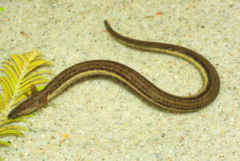
Panhandle and Northeastern Florida. Ranges across northern counties from the western Panhandle east to the Atlantic coast (St. Marys/St. Johns drainages).
Pseudobranchus striatus
General diagnostic: 4 toes on front legs; 3 pairs of gill slits.
Siren
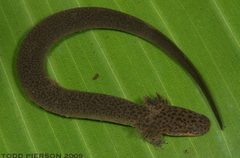
Dark olive, grey, or black dorsum; 31-38 costal grooves; body length up to 68 cm; costal grooves generally 34-36.
Siren intermedia

Panhandle and Northern Florida (extending down the peninsula to about Central Florida).
Siren intermedia

Massive size (up to 97 cm); olive, grey, or dark brown body with lighter grey/yellow chin; 36-40 costal grooves (most commonly 37-39); costal grooves fine and faint.
Siren lacertina complex

Statewide except The Keys. Found in soft-bottom freshwater wetlands across the Panhandle and through the entire peninsula down to southern Florida.
Siren lacertina complex