Human Physiology: An Integrated Approach, 8/e, Chapter 5
 Call Kai
 Learn
 Practice Test
 Spaced Repetition
 Match
 Flashcards
 Knowt Play
1/41

There's no tags or description
Looks like no tags are added yet.
42 Terms
osmotic equilibrium
fluid concentrations are equal on the two sides of the cell membrane; water moves freely across membranes and will move to balance concentrations between ICF and ECF (only factors in the fluid concentration on each side of a membrane vs. solute concentration, not which type of solutes are present)
chemical disequilibrium
some solutes are more concentrated in one of the two body compartments than in the other; your body in a constant state of disequilibrium expends energy to keep specific molecules/ions more concentrated in one fluid compartment vs. the other

homeostasis
does not mean equilibrium; it just means keeping things healthy, safe, and in balance; it has two fluid compartments, intracellular fluid (ICF) and extracellular fluid (ECF)
Body Fluid Compartments
cells (intracellular fluid, ICF) is 2/3 of the total body water volume and extracellular fluid (ECF) is 1/3 of the total body water volume; the extracellular fluid includes the interstitial fluid that lies between the circulatory system and the cells, and the blood plasma (liquid matrix of blood) in the circulatory system; the body fluids are the two compartments of ICF and ECF that are in osmotic equilibrium but have a different chemical composition
osmolarity
compares any two solutions - the relationship is always reciprocal (e.g. if Solution A is hyperosmotic (high in solute) to Solution B, then B must be hyposmotic (low in solute) to A) it doesn't have to be living can be soda, coffee, any liquid
tonicity
a solution relative to a cell, and is only describing the solution (e.g. Solution A is hypotonic to RBC's)
diffusion
the random movement of molecules so that they will eventually become evenly distributed
1. passive process (no energy required)
2. High concentration to low concentration - chemical gradient
3. Net movement until the concentration is equal - equilibrium
4. Rapid over a short distance
5. Directly related to temperature (faster when it's warmer)
6. Inversely related to molecular weight and size (bigger it's slower)
7. In an open system or across a partition -Ions move according to an electrochemical gradient;
temperature (higher temps, faster rate)
concentration gradients (steeper gradients, faster rate)
distance (shorter distance, faster rate)
molecule size (smaller molecules, faster rate)
surface area (larger surface area, faster rate);
as molecules move around, there will be a net movement of molecules from an area where they are more concentrated to an area where they are less concentrated
are NOT a type of mediated transport

active transport (to inside cell)
the movement of materials through a cell membrane using energy; ATP is necessary but not for facilitated diffusion

facilitated diffusion
need protein carriers or protein channels to enter the cell, but the process is still passive

impermeable (membranes can be)
nothing can pass through it
freely permeable (membranes can be)
everything can pass through it
semipermeable (membranes can be)
(selectively permeable) only certain things can pass
concentration gradient
the region where the density of a substance goes from high to low; diffusion down a concentration gradient requires no energy (passive transport, e.g. 02 diffusions across the membrane); image of one side is highly concentrated with one solute and another side with another solute, and then transported across membrane to have a state of equilibrium (dynamic) for example the concentration of calcium inside a cell is 0.3% and the concentration of calcium outside the cell is 0.1% the cell transport even more calcium to the inside by active transport.

aquaporins
channel proteins that facilitate the passage of water (passive transports that are aided by proteins); play a huge role in water balance in your body, e.g. your kidneys cells have many aquaporins to retain water from urine before excretions; if they didn't have aquaporins, you'd excrete around 180L (~48 gallons) of urine every day
ion channels
channel proteins that transport ions
gated channels
open or close in response to a stimulus
osmosis
diffusion of water across any selectively permeable membrane (not just plasma membranes)
primary active transport
Active transport relies directly on the hydrolysis of ATP. (diffusion is passive, doesn't require energy but active transport rely on energy)
vesicle transport
membranous sacs carry particles/molecules through cell and across membranes (e.g. sodium potassium pump Na+K+ pump)
endocytosis
a portion of membrane folds in "engulfing" outside particles, bringing them into the cell packaged in a vesicle; cell takes in molecules by forming new vesicles from plasma membrane (essentially the reverse of exocytosis, except with different proteins involved)
exocytosis
a cell transports large molecules out of the cell;
releasing contents (either product made by the cell or digested wastes) OUT into extracellular fluid, opposite of endocytosis (insulin in the pancreas); vesicles fuse with the plasma membrane and empty their contents outside the cell; vesicles that "bud" off of Golgi membrane travel along microtubules to the membrane; at the membrane, proteins rearrange the lipids of each so they fuse and after the contents spill out, the vesicle becomes part of the membrane; hormones, neurotransmitters, etc. are released in this fashion

phagocytosis (endocytosis)
(phago in greek is to eat) engulfs a food particle to be digested by a lysosyme
pinocytosis (endocytosis)
"drinks" droplets of extracellular fluid into small vesicles, non-specific to the solutes that may be contained within
receptor-mediated endocytosis (endocytosis)
the substance must first bind to protein before its infused into the membrane; often used to take in cholesterol for membrane and steroid synthesis
integral proteins
Integral proteins that span the membrane.
peripheral proteins
The proteins of a membrane that are not embedded in the lipid bilayer; they are appendages loosely bound to the surface of the membrane.
membrane protein functions
structural -cell junctions; maintain cell shape (connect to cytoskeleton); attach to ECM to help anchor cell
enzymes -can be integral or peripheral, can catalyze rxns inside or outside the cell
receptor -binds to ligands (the molecule that "fits" into the receptor) and triggers some cellular response
transport -channel proteins (passive transport); carrier proteins (active transport)

channel proteins
contain a water-filled tunnel or "pore" in the center; can be open; can be gated:
chemically gated - open when a ligand binds or in response to intracellular messenger molecule
voltage-gated - open in response to change in electrical state
mechanically gated - open in response to physical force (pressure applied, increase temperature, etc.)

carrier proteins
hold on to substances and therefore, change shape in a way that shuttles them across:
facilitated diffusion -no energy input, down a concentration gradient
active transport -energy input, against a concentration gradient; three types of carrier proteins

uniport (carrier proteins)
only one specific molecule/ion is transported
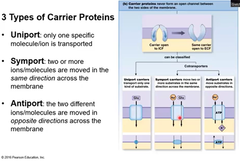
symport (carrier proteins)
two or more ions/molecules are moved in the same direction across the membrane

antiport (carrier proteins)
the two different ions/molecules are moved in opposite directions across the membrane

sodium-potassium pump
a carrier protein that uses ATP to actively transport sodium ions out of a cell and potassium ions into the cell

cell junctions in animal cells
tight junctions, desmosomes, gap junctions (common in epithelial tissue)

tight junction (cell junctions)
plasma membranes of neighboring cells pressed tightly together and bound by proteins, helps prevent things from moving in between cells (like a zipper)

desmosomes (cell junctions)
like button snaps connecting cells together in strong sheets, anchor muscle cells to one another

gap junctions
cytoplasmic channels (similar to plasmodesmata, only not membrane-lined) that facilitate cell-to-cell communication

epithelial transport (transcellular transport)
movement of molecules through the cytoplasm of the epithelial cells; transporting epithelia are polarized: apical membrane which is a side facing the lumen and basal membrane which faces the ECF;
paracellular (between the cells, not through them), transcellular (through the actual cell membrane), secretion (opposite is absorption) which is material moving from ECF into the lumen (name of the space of a hollow organ) (example amino acid and enzymes) , and absorption (opposite direction is secretion) which is material moving from lumen to ECF

permeability
the state or quality of a material or membrane that causes it to allow liquids or gases to pass through it.
absorption
the process by which nutrient molecules pass through the wall of the digestive system into the blood
secretion
a process by which substances are produced and discharged from a cell, gland, or organ for a particular function in the organism or for excretion.
aquaporin
water channel protein in a cell