6. Humanistic Psychology Person Centered Approaches
 Call Kai
 Learn
 Practice Test
 Spaced Repetition
 Match
 Flashcards
 Knowt Play
1/23

There's no tags or description
Looks like no tags are added yet.
24 Terms
What does it mean to live well?
Humanistic Psychology as the “Third Force”
Historical context: the growing influence of humanistic psychology in the 1950s and 1960s
Its relation to two earlier approaches:
Psychoanalysis: Unconscious conflict, early experience, and inner life
Behaviourism: Observe behavior, learning, and environmental influence
Humanistic psychology: Subjective experience, agency, meaning, and growth
Humanistic psychology did not simply reject earlier approaches— it brought different questions to the foreground.
Example: the same low university mark can have different meanings for different students

Maslow’s hierarchy of needs
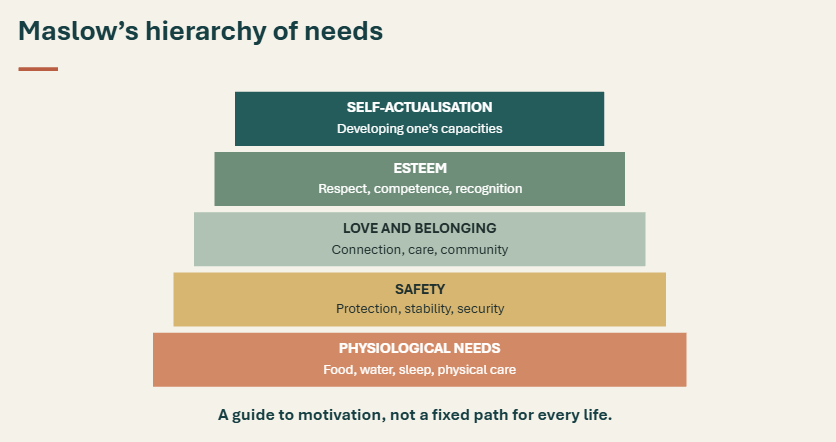
Needs can overlap in real life

Deficiency & Growth needs
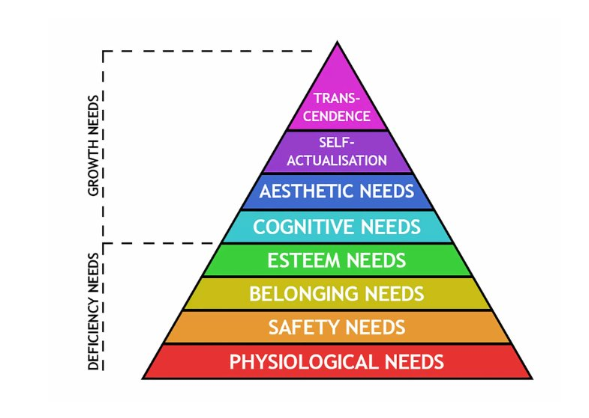
Maslow: Needs, self-actualization, and peak experiences — The hierarchy of needs
Maslow’s five commonly taught levels:
Psychological needs
Safety
Love and belonging
Esteem
Self-actualization
The hierarchy can help us understand what becomes important in a person’s situation
It’s not a rigid sequence that applies to everyone in the same way
Several needs can be present at once: a person facing harship may still experience care, purpose, or creativity
Self-actualization
Developing one’s capacities and living in line with one’s values
It does not mean perfection, fame, or financial success
What growth and fulfilment mean can differ from person to person
Peak Experiences
Brief, intense experiences of meaning, connection or insight
They may occur during creative work, time in nature, learning, or shared activity
They are not required for growth and are not clinical categories
Limits of the model
The hierarchy is a useful guide, but it can oversimplify human motivation
Life circumstances, relationships, and cultural values influence what people find important
Carl Rogers: The main idea and the helper’s role
Roger’s client-centred therapy later became known as the “person-centred approach”
The person’s own experience and understanding are central
The helper creates a relationship that supports exploration and change
Actualising tendency: a basic tendency to maintain life and develop one’s capacities
Rogers and the person-centred approach
Self-concept, ideal self, and conditions of worth:
Self-concept: how a person sses themselves
Ideal self: who a person hopes to becomes
The gap between the two can motivate change or cause distress
Conditions of worth: learned rules about what a person must do to feel acceptable
Example: “I am valuable when I do well,” or “I must not disappoint others.”
Congruence and Incongruence:
Congruence: a closer fit between a person’s experience, awareness, and self-concept.
Incongruence: conflict between an experience and the person’s self-image.
Example: a person feels angry but believes that “good people do not get angry.”
Congruence does not mean expressing or acting on every feeling.
Recognizing feelings can create more room for choice.

Empathy and Unconditional positive regard
Empathy: trying to understand another person’s point of view without confusing their experience with one’s own.
Empathic understanding can be checked and leaves room for correction
Unconditional positive regard: respecting the person even when we disagree with a particular behavior.
Respect for the person can go together with clear limits on behavior
The three relationship conditions together
Congruence: the helper is genuine and self-aware
Empathy: the helper tries to understand the person’s perspective
Unconditional positive regard: the helper respects the person’s dignity
Self-actualization: developing one’s capacities
A person becomes more able to use their abilities and live by their values.

Peak experiences
Brief moments of deep meaning, connection, insight or aliveness.
May happen in art, nature, learning, care, or shared action
Can be powerful even when they are brief
They’re not required for growth and are not a diganosis/clinical categories
Csikszentmihályi Mihály
Mihály Csikszentmihályi was a highly influential Hungarian-American psychologist who is widely recognized as one of the co-founders of positive psychology
Flow is an optimal psychological state in which a person is completely immersed in what they’re doing. The activity itself becomes the reward (intrinsic motivation), while ego-awareness and the sense of time fade into the background. To capture the phenomenon empirically, Csikszentmihályi developed the Experience Sampling Method (ESM)

Self-concept, ideal self, and conditions of worth
A gap between the self-concept and ideal self can motivate change or create distress.
Conditions of worth: “I am accepted when…”
People may learn rules such as:
“I am loved when I get high marks.”
“I must hide my anger to keep people close.”
“I am valuable when I take care of everyone else.”
“I should never disappoint my family.”
The person’s worth starts to feel tied to meeting a narrow set of conditions.

Congruence: acknowledging experience
Experience, awareness, and self-understanding fit more closely.
Congruence supports choice. It does not require acting on every feeling.

Empathy: understand the person’s frame of reference
Listen for feeling and meaning
Check your understanding
Leave room for correction

Unconditional positive regard
Respect for the person does not depend on performance or agreement.
Hold respect for the person while setting clear limits on behavior.

Three conditions in a growth-supportive relationship

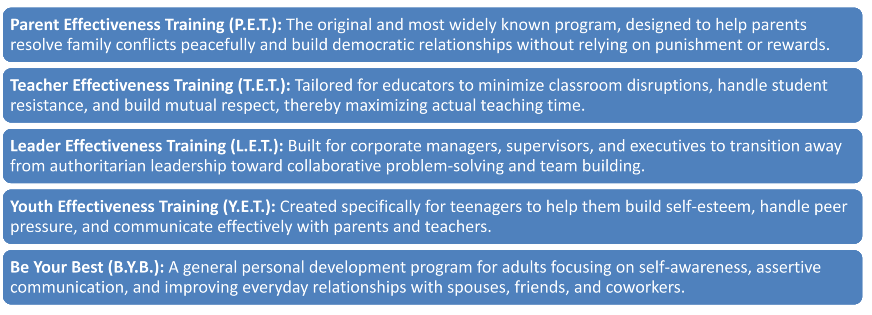
Thomas Gordon
Adapted his core communication model inspired by the Humanistic psychology into several specialized programs to address specific relationships and environments.
Person-centered education: Maria’s first year
Maria speaks very little in class.
The tutor stays curious: “What is it like for you to speak in class?” → then they explore small, realistic ways to take part.
Ask before assuming what silence means.
Helping relationships and community work
Listen — Start with the person’s account of the situation.
Share — Make information and decisions easier to understand.
Respond — Address practical barriers in the setting.
Culture shapes how people describe growth
Growth may include:
Personal aims and self-expression
Care, responsibility, and shared life
Learning how to live with others
Avoid treating any culture as one uniform set of values.
Autonomy can be relational
Relationships can support choice. They can also limit it.

Agency needs real room to act
Access to resources shapes the choices people can make
Discrimination and inaccessible systems restrict participation
Care responsibilities affect time, energy, and opportunity
Supportive relationships matter alongside material change
Support personal choice and address barriers in the environment.
Summary and closing reflection
Humanistic psychology asks us to take people’s experiences and meanings seriously
Maslow’s theory helps us think about needs, growth, and personal development
Rogers emphasizes how empathy, congruence, and acceptance can support exploration
Growth and autonomy can take different forms in different lives
Closing question: How can we support someone’s growth without deciding for them what growth should mean?
