PHAR 116 PBM
 Call Kai
 Learn
 Practice Test
 Spaced Repetition
 Match
 Flashcards
 Knowt Play
1/124

There's no tags or description
Looks like no tags are added yet.
125 Terms
Using the cleavage of a high energy phosphate bond of a molecule to make ATP is a definition of
a. oxidative phosphorylation
b. a kinase reaction
c. substrate level phosphorylation
d. a phosphatase reaction
c. substrate level phosphorylation
Coadministration of azithromycin and colchicine orally can increase the colchicine levels in the blood because
a. colchicine binds better in the CYP3A4 active site than azithromycin
b. colchicine has better binding affinity to p-glycoprotein than azithromycin
c. azithromycin and colchicine bind equally well in the CYP3A4 active site
d. azithromycin has better binding affinity to p-glycoprotein than colchicine
d. azithromycin has better binding affinity to p-glycoprotein than colchicine
True or False: Inhibition of SGLT2 can excrete more glucose in the urine.
a. True
b. False
a. True
Which enzymes in glycolysis demonstrate the first step of the chemical strategy of glycolysis? I am NOT asking for the first enzymatic reaction in glycolysis.
I. hexokinase
II. phosphofructokinase (PFK)
III. phosphoglycerate kinase (PGK)
IV. pyruvate kinase
a. I and II
b. II and III
c. III and IV
d. I and IV
a. I and II
Which enzyme below demonstrates the mechanism of catalysis of close proximity and proper orientation?
a. TIM
b. enolase
c. pyruvate kinase
d. phosphoglucose isomerase (PGI)
c. pyruvate kinase
Which enzyme below uses Mg2+ to bind ATP in the active site?
a. citrate synthase
b. isocitrate dehydrogenase
c. phosphoglycerate mutase (PGM)
d. phosphoglycerate kinase (PGK)
d. phosphoglycerate kinase (PGK)
TIM can establish the GAP and DHAP equilibrium instantaneously because
a. its active site resembles the transition state
b. it has a specificity constant close to 109
c. it binds GAP and DHAP equally well in the active site
d. it uses general acid and base to form the enediol structure
b. it has a specificity constant close to 109
True or False: During glycolysis, Mg2+ can be used by an enzyme to bind ADP or substrate or both in the active site.
a. True
b. False
a. True
To continuously use glycolysis to make ATP during vigorous exercise in skeletal muscle, NAD+ in the cytosol must be regenerated by
a. isocitrate dehydrogenase
b. 3-phosphoglycerol dehydrogenase
c. malate dehydrogenase
d. lactate dehydrogenase (LDH)
d. lactate dehydrogenase (LDH)
Which description below generates the highest amount of ATP per glucose molecule?
a. glycolysis, followed by CAC and OXPHOS in skeletal muscle
b. vigorous exercise in skeletal muscle
c. glycolysis, followed by CAC and OXPHOS in liver
d. glycolysis, followed by CAC and OXPHOS in brain
c. glycolysis, followed by CAC and OXPHOS in liver
When malate-aspartate shuttle is used to regenerate NAD+ in the cytosol, which of the following descriptions are TRUE?
I. OAA is formed in the cytosol by transamination reaction
II. NADH is formed in the matrix by malate dehydrogenase
III. aspartate aminotransferase generates OAA and glutamate in the matrix
IV. OAA is transported across the inner membrane from cytosol to matrix
a. I and II
b. II and III
c. III and IV
d. I and IV
a. I and II
True or False: ATP binds with a higher affinity in the PFK allosteric site and a lower affinity in the PFK active site.
a. True
b. False
b. False
Which of the following descriptions are INVOLVED when lactate is being converted into glucose in the liver?
I. GAPDH converts GAP into 1,3-BPG in the cytosol
II. malate dehydrogenase converts malate into OAA in the cytosol
III. pyruvate carboxylase converts pyruvate into OAA in the matrix
IV. PEPCK forms OAA in the matrix
a. I and II
b. II and III
c. III and IV
d. I and IV
b. II and III
Lineweaver-Burk Plot accuracy for Km and Vmax
Lineweaver-Burk allows accurate determination of Km and Vmax (True).

Characteristics of the most efficient enzyme
Highest specificity constant (kcat/Km) and specificity constant close to k1.
Competitive-like mixed inhibition conditions
α > α' and apparent Vmax < Vmax.
Enzyme inhibitor types indicated by a very high α' (alpha prime)
Uncompetitive inhibitor with high affinity to [ES], or a mixed inhibitor.
Apparent Vmax of noncompetitive inhibitor with α = 2 and α' = 4
Vmax / 4.
Inhibitor classification of TPCK analog covalently binding active-site serine
Suicide inhibitor.
Inhibitor classification of GAPDH inhibitor covalently binding active-site aspartate
Affinity inhibitor.
Characteristics of the most efficient suicide inhibitor
Very low KI and very high kI.
Can initial velocity (vo) mathematically equal Vmax at high [S]?
False (vo approaches Vmax asymptotically but never equals it mathematically).

Clinical effect of adding ritonavir to chronic felodipine therapy
Increased felodipine levels leading to more felodipine side effects.
Primary purpose of a Scatchard Plot
Determining the binding affinity of a ligand to a receptor.
Drugs W-Z are CYP3A4 substrates. The table below shows the parameters obtained with the total concentration of CYP3A4 (which is [E]T) equals to 1 nM. Which drug has the highest binding affinity to CYP3A4? (Which drug binds in the active site the best?)
a. W
b. X
c. Y
d. Z
c. Y

Drugs W-Z are CYP3A4 substrates. The table below shows the parameters obtained with the total concentration of CYP3A4 (which is [E]T) equals to 1 nM. Which drug has the highest Vmax?
a. W
b. X
c. Y
d. Z
d. Z
Drugs W-Z are CYP3A4 substrates. The table below shows the parameters obtained with the total concentration of CYP3A4 (which is [E]T) equals to 1 nM. Which drug binds fastest to the CYP3A4 active site?
a. W
b. X
c. Y
d. Z
a. W
Drugs W-Z are CYP3A4 substrates. The table below shows the parameters obtained with the total concentration of CYP3A4 (which is [E]T) equals to 1 nM. Which drug is the best substrate of CYP3A4?
a. W
b. X
c. Y
d. Z
a. W
Drugs W-Z are CYP3A4 substrates. The table below shows the parameters obtained with the total concentration of CYP3A4 (which is [E]T) equals to 1 nM. Which drug has the Km that reflects closest to its true binding affinity in the CYP3A4 active site?
a. W
b. X
c. Y
d. Z
a. W
Which equation below is false if [ES] is changing?
a. I.
b. II.
c. III
d. IV
d. IV

Given the Michaelis-Menten curve below, what is the slope of the straight line when Km >>>>> [S]?
a. 4
b. 3
c. 2
d. 1
a. 4

Below is a Michealis-Menten graph of an allosteric enzyme. The curve indicated with "no compound added" is the curve generated with no inhibitor, allosteric activator, or allosteric inhibitor. Curves I-IV are generated in the presence of an inhibitor, allosteric activator, or allosteric inhibitor. What is the Km value of this enzyme in the presence of an allosteric activator?
a. 1
b. 2
c. 3
d. 4
a. 1
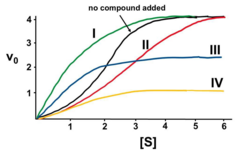
Below is a Michealis-Menten graph of an allosteric enzyme. The curve indicated with "no compound added" is the curve generated with no inhibitor, allosteric activator, or allosteric inhibitor. Curves I-IV are generated in the presence of an inhibitor, allosteric activator, or allosteric inhibitor. Which two curves represent the enzyme in the presence of an uncompetitive inhibitor?
a. I and II
b. II and III
c. III and IV
d. I and IV
c. III and IV
True or False: The Lineweaver-Burk Plot allows us to accurately determine the Km and Vmax values.
a. True
b. False
a. True
The most efficient enzyme should have the following characteristics:
I. the highest specificity constant
II. Km is close to Ks
III. the specificity constant is very close to k1
a. I and II only
b. II and III only
c. I and III only
d. I and II and III
c. I and III only
For competitive-like mixed inhibition, which of the following descriptions must be true?
I. α > α' (alpha > alpha prime)
II. apparent Vmax < Vmax
III. α < α' (alpha < alpha prime)
IV. apparent Vmax = Vmax
a. I and II
b. II and III
c. III and IV
d. I and IV
a. I and II
Which descriptions below can be true when α' (alpha prime) is a very high number?
I. a competitive inhibitor
II. an uncompetitive inhibitor that has a high affinity to [ES]
III. a mixed inhibitor
IV. an uncompetitive inhibitor that has a high KI' (KI prime)
a. I and II
b. II and III
c. III and IV
d. I and IV
b. II and III
What is the apparent Vmax of a noncompetitive inhibitor with α = 2 (alpha = 2) and α' = 4 (alpha prime = 4)?
a. Vmax
b. Vmax / 2
c. Vmax / 4
d. 2 Vmax
c. Vmax / 4
A TPCK analog which forms a covalent bond with the serine residue that initiates the chymotrypsin catalysis is a/an
a. suicide inhibitor
b. affinity inhibitor
c. competitive inhibitor
d. allosteric inhibitor
a. suicide inhibitor
A GAPDH inhibitor forms a covalent bond with an aspartate residue in the GAPDH active site. This inhibitor is a/an
a. competitive inhibitor
b. affinity inhibitor
c. mixed inhibitor
d. suicide inhibitor
b. affinity inhibitor
Which characteristics below represent the most efficient suicide inhibitor?
I. very high KI (big K)
II. very high kdissoc (small k)
III. very low KI (big K)
IV. very high kI (small k)
a. I and II
b. II and III
c. III and IV
d. I and IV
c. III and IV
True or False: Mathematically, it is possible to have vo = Vmax when [S] is very high.
a. True
b. False
b. False
Patient Smith has been taking felodipine chronically to control his high blood pressure with minimal side effects. Felodipine is primarily metabolized by CYP3A4. Recently, he was diagnosed with AIDS and was prescribed with ritonavir. Ritonavir is also a CYP3A4 substrate and has a much higher binding affinity to CYP3A4 than felodipine. Which descriptions below will most likely happen if Smith starts taking ritonavir while taking felodipine as usual?
a. ritonavir is likely not effective to treat his AIDS infection
b. Smith's blood pressure may become high
c. Smith may experience more felodipine side effects
d. Smith may experience more ritonavir side effects
c. Smith may experience more felodipine side effects
Scatchard Plot is useful for determining
a. the true binding affinity of a substrate to an enzyme
b. how fast a ligand dissociates from the ligand binding domain of a receptor
c. how fast a ligand binds in the ligand binding domain of a receptor
d. the binding affinity of a ligand to a receptor
d. the binding affinity of a ligand to a receptor
Which descriptions below are TRUE about PDHC?
I. PDHC converts pyruvate into acetyl-CoA in the cytosol
II. PDHC catalysis demonstrates direct hydride ion transfer from substrate to NAD+
III. PDHC converts pyruvate into acetyl-CoA in the matrix
IV. PDHC catalysis exhibits oxidative decarboxylation
a. I and II
b. II and III
c. III and IV
d. I and IV
c. III and IV
Citrate synthase catalysis is irreversible because
a. close proximity and orientation is involved
b. general acid and base are involved
c. binding of OAA happens first and then acetyl-CoA binds
d. hydrolysis of the citryl-CoA to form citrate
d. hydrolysis of the citryl-CoA to form citrate
True or False: Each round of citric acid cycle generates 3 NADH, 1 FADH2, and 1 GTP.
a. True
b. False
a. True
Which CAC intermediates are transported across the inner membrane from matrix to cytosol when they accumulate?
I. malate
II. OAA
III. succinyl-CoA
IV. citrate
a. I and II
b. II and III
c. III and IV
d. I and IV
d. I and IV
Which description below makes OAA very limiting in the matrix?
a. low acetyl-CoA in the matrix
b. high ADP in the matrix
c. low NADH in the matrix
d. high NADH in the matrix
d. high NADH in the matrix
Which enzyme below does not have direct hydride ion transfer from substrate to NAD+?
a. alpha-ketoglutarate (αKG) dehydrogenase
b. isocitrate dehydrogenase
c. malate dehydrogenase
d. 3-phosphoglycerol dehydrogenase
a. alpha-ketoglutarate (αKG) dehydrogenase
Which enzymes below pass electrons at the inner membrane without the involvement of Complex I?
I. succinate dehydrogenase
II. flavoprotein dehydrogenase
III. acyl-CoA dehydrogenase
a. I and II only
b. II and III only
c. I and III only
d. I and II and III
d. I and II and III
Which CAC enzyme is allosterically regulated by ATP?
a. malate dehydrogenase
b. citrate synthase
c. isocitrate dehydrogenase
d. alpha-ketoglutarate (αKG) dehydrogenase
c. isocitrate dehydrogenase
Which CAC enzymes are regulated by product inhibition?
I. citrate synthase
II. alpha-ketoglutarate (αKG) dehydrogenase
III. succinyl-CoA synthetase
IV. malate dehydrogenase
a. I and II
b. II and III
c. III and IV
d. I and IV
a. I and II
Which descriptions below are the characteristics of brown fat?
I. proton concentration is very high because proton cannot get across the inner membrane
II. more electron transport components than white fat
III. UCP-1 is present at the inner membrane
IV. ATP synthase is very active in forming ATP in the matrix
a. I and II
b. II and III
c. III and IV
d. I and IV
b. II and III
True or False: Reactive oxygen species are formed during rapid oxidation of O2 to form water.
a. True
b. False
b. False
True or False: Formation of one acyl-CoA from free fatty acid consumes two high energy phosphate bonds.
a. True
b. False
a. True
Carnitine assisted transport involves
I. formation of acyl-carnitine in the cytosol
II. carnitine carrier protein to transport carnitine from cytosol into matrix
III. acyl-CoA synthetase to convert free fatty acid into acyl-CoA
IV. CPTII action to form acyl-CoA in the matrix
a. I and II
b. II and III
c. III and IV
d. I and IV
d. I and IV
Which enzyme in fatty acyl-CoA β-oxidation generates the trans delta 2 (Trans Δ2) product?
a. FASN
b. acyl-CoA synthetase
c. acyl-CoA dehydrogenase
d. 3-hydroxyacyl-CoA dehydrogenase
c. acyl-CoA dehydrogenase
True or False: After each round of fatty acyl-CoA β-oxidation, three molecules of acetyl-CoA are released.
a. True
b. False
b. False
What is the maximal amount of FADH2 produced from complete oxidation of a C10 saturated fatty acyl-CoA?
a. 7
b. 8
c. 9
d. 10
c. 9
True or False: After odd-chain fatty acyl-CoA β-oxidation, malate accumulates and then forms OAA to increase the efficiency of CAC.
a. True
b. False
b. False
Which descriptions below are TRUE about fatty acid biosynthesis?
I. acetyl-CoA is used as the building block to add 2 carbon each round
II. same chemical reactions as in acyl-CoA β-oxidation are involved
III. NADPH is required
IV. two reduction reactions and one elimination of water are involved per round
a. I and II
b. II and III
c. III and IV
d. I and IV
c. III and IV
To continuously bring acetyl-CoA from matrix to cytosol for fatty acid biosynthesis, which molecule must be replenished in the matrix?
a. OAA
b. succinate
c. succinyl-CoA
d. alpha-ketoglutarate (αKG)
a. OAA
True or False: Fatty acid synthase can be a drug target for anti-cancer drug development.
a. True
b. False
a. True
True or False: Liver will make ketone bodies when the liver sees primarily glucose to make ATP.
a. True
b. False
b. False
Which event below happens simultaneously in the liver when the liver is making ketone bodies?
a. transporting acetyl-CoA from matrix to cytosol for fatty acid biosynthesis
b. transporting malate from cytosol into matrix for ATP production
c. gluconeogenesis
d. glycolysis
c. gluconeogenesis
Cholesterol biosynthesis involves
I. formation of the activated isoprene unit
II. reactions requiring NADPH
III. reactions requiring ATP
a. I and II only
b. II and III only
c. I and III only
d. I and II and III
d. I and II and III
The explanation of how simvastatin reduces the blood cholesterol level is that
a. simvastatin causes the uptaken of LDL from blood into cells via the increase of LDL receptors on cell surface
b. simvastatin inhibits HMG-CoA reductase in the blood
c. simvastatin causes less cholesterol biosynthesis in the blood
d. simvastatin inhibits the LDL receptors so that less LDL is present in the blood
a. simvastatin causes the uptaken of LDL from blood into cells via the increase of LDL receptors on cell surface
Which description below is TRUE when [ES] is NOT changing in steady-state enzyme kinetics?
a. rate of ES formation = rate of ES dissociation
b. rate of ES formation = rate of product formation
c. rate of ES formation = rate of ES dissociation + rate of product formation
d. rate of product formation = rate of ES formation + rate of ES dissociation
c. rate of ES formation = rate of ES dissociation + rate of product formation
Below shows the parameters of Drugs W-Z of Enzyme X with total Enzyme X concentration ([E]T) of 1 pM. Which drug has the highest Vmax?
a. Drug W
b. Drug X
c. Drug Y
d. Drug Z
d. Drug Z

Below shows the parameters of Drugs W-Z of Enzyme X with total Enzyme X concentration ([E]T) of 1 pM. Which drug is the best substrate of Enzyme X?
a. Drug W
b. Drug X
c. Drug Y
d. Drug Z
d. Drug Z
Below shows the parameters of Drugs W-Z of Enzyme X with total Enzyme X concentration ([E]T) of 1 pM. Which Km reflects the closest to the true binding affinity of substrate in the enzyme active site?
a. Drug W
b. Drug X
c. Drug Y
d. Drug Z
b. Drug X
True or False: When [S] increases, Vmax increases.
a. True
b. False
b. False
If vo doubles when [S] doubles, Km must be
a. much smaller than [S]
b. much larger than [S]
c. very similar to [S]
d. equal to half of Vmax
b. much larger than [S]
True or False: ATP shifts the Michaelis-Menten curve of isocitrate dehydrogenase to right, supporting that ATP is an allosteric inhibitor of isocitrate dehydrogenase.
a. True
b. False
a. True
An inhibitor binds to the ATP binding site of hexokinase is a/an
a. uncompetitive inhibitor of hexokinase
b. competitive inhibitor of hexokinase
c. noncompetitive inhibitor of hexokinase
d. suicide inhibitor of hexokinase
c. noncompetitive inhibitor of hexokinase
What kind of enzyme inhibitor is shown below:
a. affinity inhibitor
b. pure noncompetitive inhibitor
c. competitive inhibitor
d. uncompetitive inhibitor
d. uncompetitive inhibitor
True or False: The rate of product formation always decreases in the presence of an enzyme inhibitor.
a. True
b. False
a. True
The most efficient enzyme should have a specificity constant value close to
a. kcat (small k)
b. k-1 (small k)
c. k1 (small k)
d. Km (big K)
c. k1 (small k)
If the equilibrium below shifts to right in the presence of a reversible enzyme inhibitor, this inhibitor is a/an
a. competitive inhibitor
b. uncompetitive-like mixed inhibitor
c. competitive-like mixed inhibitor
d. pure noncompetitive inhibitor
b. uncompetitive-like mixed inhibitor
An inhibitor competes with OAA for binding in the citrate synthase active site can be a/an
I. competitive inhibitor
II. pure noncompetitive inhibitor
III. uncompetitive inhibitor
IV. suicide inhibitor
a. I and II
b. II and III
c. III and IV
d. I and IV
d. I and IV
Inhibitor X is a mixed inhibitor of Enzyme Y with α > α'. A change of Inhibitor X's structure to form a derivative called Inhibitor X'. This Inhibitor X' forms a permanent covalent bond with Enzyme Y. This Inhibitor X' is a/an
a. affinity inhibitor of Enzyme Y
b. suicide inhibitor of Enzyme Y
c. allosteric activator of Enzyme Y
d. mixed inhibitor of Enzyme Y
a. affinity inhibitor of Enzyme Y
Which parameters below describe the most efficient (the best) suicide inhibitor?
I. lowest KI (big K)
II. highest kdissoc (small k)
III. lowest kinact (small k)
IV. highest kI (small k)
a. I and II
b. II and III
c. III and IV
d. I and IV
d. I and IV
True or False: The lower the kI value (small k of covalent bond formation), the more efficient it is of a suicide inhibitor to kill the enzyme.
a. True
b. False
b. False
Patient X has been taking Zocor® daily to control his high cholesterol well with minimal side effects. Zocor® is primarily metabolized by CYP3A4. Recently, he developed high blood pressure and was prescribed Calan®, which is a potent CYP3A4 inhibitor. What would most likely happen to the patient after he started taking Calan®?
a. experience even higher blood pressure
b. experience very high cholesterol
c. experience Zocor® side effects
d. experience Calan® side effects
c. experience Zocor® side effects
Patient X has been taking felodipine orally every day to control his high blood pressure well with minimal side effects. Felodipine is primarily metabolized by CYP3A4. Recently, he wanted to add grapefruit juice to his diet. What would you predict if he indeed started drinking grapefruit juice every day?
a. may experience felodipine side effects
b. blood pressure may become high
c. no predictable interactions between felodipine and grapefruit juice
d. grapefruit juice may slow down oral absorption of felodipine
a. may experience felodipine side effects
Patient X has been taking colchicine orally every day for his gout treatment. Colchicine is a p-glycoprotein substrate. Recently, he developed an infection and was prescribed Zithromax®, which is a potent p-glycoprotein inhibitor. Which would you predict will happen if he starts taking Zithromax®?
a. no predictable interactions between colchicine and Zithromax®
b. colchicine most likely makes Zithromax® not effective in controlling infection
c. colchicine may become not effective in controlling gout pain
d. may experience more colchicine side effects
d. may experience more colchicine side effects
Below is a Scatchard Plot. Which line represents the ligand with highest affinity to receptor?
a. I
b. II
c. III
d. IV
a. I

Which description below is considered as part of the 3-step Chemical Strategy of glycolysis?
a. isomerization reactions are used during the 10 steps of glycolysis
b. conversion of a phosphorylated intermediate into an intermediate with a high energy phosphate bond
c. usage of oxygen to generate ATP during glycolysis
d. phosphorylation of substrates to form G6P and F6P using inorganic phosphate as the phosphate donor
b. conversion of a phosphorylated intermediate into an intermediate with a high energy phosphate bond
True or False: ATP is consumed in some enzymatic reactions during glycolysis.
a. True
b. False
a. True
True or False: More ATP per glucose can be generated when pyruvate is used to regenerate NAD+ in the cytosol to continue glycolysis.
a. True
b. False
b. False
Which enzymes below use metal ion catalysis to catalyze reactions?
I. citrate synthase
II. GAPDH
III. hexokinase
IV. enolase
a. I and II
b. II and III
c. III and IV
d. I and IV
c. III and IV
Which enzymes below use general acid and base to catalyze reactions?
I. citrate synthase
II. TIM
IV. GAPDH
a. I and II only
b. II and III only
c. I and III only
d. I and II and III
d. I and II and III
Which enzymes below use close proximity and orientation to catalyze reactions?
I. PGI
II. pyruvate kinase
III. citrate synthase
IV. TIM
a. I and II
b. II and III
c. III and IV
d. I and IV
b. II and III
Which enzymes below use preferential TS binding to catalyze reactions?
I. HIV protease
II. TIM
III. succinyl-CoA synthetase
IV. PGK
a. I and II
b. II and III
c. III and IV
d. I and IV
a. I and II
Which molecule below has the highest energy content?
a. pyruvate
b. glucose
c. PEP
d. 3PG
c. PEP
Which enzyme is used to regenerate NAD+ to continue glycolysis when a net total of two ATP molecules is made per molecule of glucose?
a. lactate dehydrogenase
b. malate dehydrogenase
c. 3-phosphoglycerol dehydrogenase
d. isocitrate dehydrogenase
a. lactate dehydrogenase
Which two enzymes are involved in glycerophosphate shuttle?
I. 3-phosphoglycerol dehydrogenase
II. succinate dehydrogenase
III. malate dehydrogenase
IV. flavoprotein dehydrogenase
a. I and II
b. II and III
c. III and IV
d. I and IV
d. I and IV
True or False: Aspartate aminotransferase (AST) is primarily found in the brain.
a. True
b. False
b. False
Which descriptions below are TRUE about malate-aspartate shuttle when this shuttle is used to regenerate NAD+ in the cytosol?
I. OAA is transported out of matrix to cytosol by a protein carrier
II. NADH is formed in the matrix
III. malate is transported from cytosol into matrix
IV. transamination reaction occurs in the matrix but no transamination reaction in cytosol
a. I and II
b. II and III
c. III and IV
d. I and IV
b. II and III