optimize
 Call Kai
 Learn
Learn Practice Test
 Spaced Repetition
 Match
Match Flashcards
 Knowt Play
1/60

There's no tags or description
Looks like no tags are added yet.
Name | Mastery | Learn | Test | Matching | Spaced | Call with Kai | Chat |
|---|
No analytics yet
Send a link to your students to track their progress
61 Terms
define alkyl
alkane with one hydrogen removed to make reactive/bondign with something else(alkane)
amine
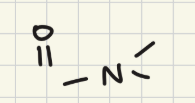
amide

arene

aldehyde

alkane

alkene

alkynes

ester

carbocylic acid

thiol

ketones

dilution equation - rearrange if want to find volume

molarity equation
moles: divide the mass of your sample in grams by the molar mass of that substance
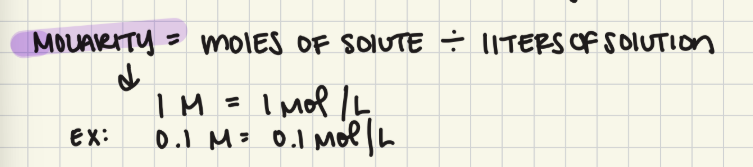
M to mM


how to find grams when creating molar solution - equation


mobile phase defintion
liquid sample put thro column (water, acetonitrile (ACN), methanol, buffers)
increasing organic solvents like ACN or methanol (ch3-oh) = hydrophobic will interact with m. phase more, come off column faster - better at holding hydrophobic molecules
retention time
time @ which compoound comes out of column, more retention = later elution (if compond interacts strongly with s. phase)
reversed phase HPLC
s. phase: nonpolar/hydrophobic
m. phase: polar
*based on hydrophobic interactions
c18
bonded to silica (silanol groups - Si-OH to Si-C18)
hydrophobic (hydrophobic molecules with react stonger, polar molecule will travel with mobile phase)
18 carbon alkyl chain
long nonpolar hydrocarbon
(ch2)17-ch3
how pH affects
pH can change charge of molecules whose protons can change which changes interactions with s. phase
charged molecule = more hydrophilic, polar)
related to conc. of hydrogen ions, H+
more Hions - lower pH - more acidic
less Hions - higher pH - more basic
common hydrophobic molecules
uncharged, nonpolar (alkanes, hydrocarbons)
fundemental mechanism of seperation
*SAMPIE Continuously MOVES btwn MOBILE and STATIONARY PHASES
liquid chromotagraphy
STATIONARY PHASE IS POLAR SOLVENT
MOBIIE : nOnPolAR
hplc and uplc defintion
high preformance liquid chromatography
ultra = higher pressures, smaller particle
smaller silica particles…
can provide better seperation efficiency but creates greater resistance to flow, require higher pressure
detector
common type uv/vis detector
how much uv light molecules absorb as come out of column
Mass spectrometry
used to measure the mass-to-charge ratio (m/z) of ions to identify, quantify, and structure chemical compound
peak position, peak height/area, peak width, seperation btwn peaks
peak position: retention time
peak height/area: amnt of compound detected
peak width: seperation efficiency
seperation btwn peaks: how well diff compounds seperated
silica
highly porous version of silicon dioxide, SiO2
network of pores that increase surface area available for int/ (pore size - angstroms)
has silanol grps sticking off (R-Si-OH)
Silanol can participate in hydrogen bonding, acid base interactions, int with polar or charged
bare silica: polar

bonded stationary phase
when silanol gets chemically modified - remove OH and add C18 )from polar to hydrophobic)
endcapping
cover exposed silanol groups to prevent reactions
chemical treatment to reduce exposed silanol
what molecule will interact most with c18
hydrophobic, nonpolar molecules will interact strongly and come out last
isocratic
mobile phase composition stays consistent
gradient
composition changes during run increasing organix solvent makes easier to elute strongly retained compounds
why would you change the mobile phase or s. phase from typical
some compounds have similar retention times under one set of conditions
changing selectivity of seperation
increasing organic solvent - get retained out of column if hydrophobic molecules wont come off c18
polar defintion
uneven distribution of electrical charge in molecule
electrons = negativley charged
often interact well with water (partial charges can interact and form enegetically favorable interactions)

electronegativy
an atom's tendency to attract shared electrons toward itself when forming a chemical bond
oxygen more electronegative than carbon

commonly polar vs nonpolar
polar functional groups: hydroxyl -oh (alcohols), carbonyl c=o (ketones, aldehyde), amines (nitrogen contribute to polarity, become charged), carboxylic acid -cooh (change state depends on pH)
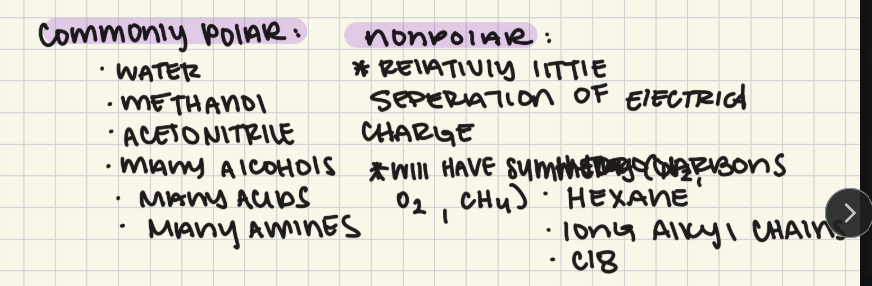
ACN

dipole dipole int/

hydrogen bonding

ion dipole int/

van der waals int/

acid and bases (r-cooh &r-nh2)
neutral form - more hydrophobic - more retention
charged form - more hydriphilic - less retention

pka
how readily an acid gives up its proton
relationship btwn ph and pka helps predict whther mostly uncharged or mostly charged
acids ph<pka : mostly protinated/neutral | ph>pka mostly deprontinated/negatice (less retention) - higher pHs, negative charge not lots of free hydrogens to stay attached

buffers
solutions that help resist changes in pH when small amounts of acid or base are added
phosphate, acetate, amonium acetate/formate
provide resivior of acid/base forms that can absorb change
channeling
large empty space that mobile phase prefers in column, need pack tightly s. phase so the mobile phase has to travel through entire bed
backpressure
more resistance to flow - higher pressure needed
instrument reads this as backpressure
(smaller particles, faster flow rate, longer column, tempature, solvent composition, column diamtere, more viscous liquids = higher pressure needed)
frit
very fine filter
retain s. phase particles (s. phase larger than frit pathways), manage m. phase, support filtration, protect sensitive components, consistent system preform
before column: sample protection
easiest place to precent particulate
in mobile phase
buffer salts, improperly cleaned glassware, microbial contam.
solvent reservior fitlers
guard column
smaller, replaceable *for protection
catch irreversibly retained (permanently bind to column) - guard against premature failure
when m.phase pH is extreme enough = degrade column packing so use g. column with similar phase
pre column filters

types of stationary phase (in gaurd column)

trap columns
for capture
concentrate a dilute analyte
remove salts, buffer components, detergents, or unwanted sample-matrix components
offline sample prep or on line in flow path
unwanted stuff washed away and anlyte is retained
or
unwanted contamiantnt is retained while desired target passes thro
trap columns - sample conc and desalting
retain target - wash away unwanted matrix components (salt or non-volatile buffer compounds) - elude target (concentrating it)
peptide conc and desalting
protien conc and desalting
small molecule conc and desalting
trap columns - detergent removal
trapping approach depends on detergent type and whats being retained
sds removal: protien/peptide passes thro for analysis and sds retained
non-ionic detegernt removal: protien/peptide retained while NID flushed away
trap columns- peptide fractionation and 2d LC trapping
tandem trapping - two diff trapping stages to fractionate peptides, transfer to 2nd trap to conc. abd desalt, then elude
SCX (strong cation exchane) trapping/fractionation - controlled peptide release - peptide concentration and desalting - downstream elution
SCX trap: peptide fractioantion before controlled release to second trap
peptide conc and desalting trap: recieves released peptides for conc. and desalting
HILIC

swept volume
dead volume
interstitial volume
